The Chemical Level of Organization
Every heartbeat, every thought, and every drop of sweat starts as chemistry. Before a cell can divide or a nerve can fire, atoms must join, reactions must run, and water must do its quiet but vital work. This chapter takes you down to the chemical level. It is the base that the rest of this book is built on.
First you will meet the atom and the few elements that make up almost all of you. You will learn the three bonds that hold molecules together. You will watch reactions rearrange matter and see how enzymes speed them up. You will find out why water is perfect for life. You will learn to read pH and meet the buffers that guard your blood. Last, you will meet the four big families of molecules that build your body. Take your time here. Everything else in the body rests on this floor.
By the end of this chapter you can
- Describe the parts of an atom: protons, neutrons, and electrons. Explain how the atomic number tells you which element it is.
- Name the major elements that make up most of the body. Tell them apart from trace elements and isotopes.
- Compare ionic, covalent (polar and nonpolar), and hydrogen bonds. Explain the octet rule, the reason atoms bond.
- Sort chemical reactions into synthesis, decomposition, or exchange. Explain activation energy and how enzymes lower it.
- Explain how water's polarity makes it the body's solvent, heat buffer, and lubricant.
- Read the pH scale and tell acids from bases. Describe how buffers keep blood near 7.4.
- Name the four organic macromolecule families (carbohydrates, lipids, proteins, nucleic acids) plus ATP. Give a job for each.
- Compare dehydration synthesis and hydrolysis, the ways big molecules are built and broken.
Section 1Atoms & the elements
Matter, elements, and the atom
Anything that takes up space and has mass is matter. Your bones, your blood, and the air in your lungs are all matter. All matter is made of elements. An element is a pure substance that normal chemistry can't break into anything simpler. There are 118 known elements. But life uses only a few of them. Only about two dozen show up in the body. Just six of them make up about 99% of your mass. They are oxygen, carbon, hydrogen, nitrogen, calcium, and phosphorus.
The smallest bit of an element that still acts like that element is an atom. If you split an atom apart, you no longer have the element. You just have its raw parts.
| Element | Symbol | ~% of body mass | A job it does |
|---|---|---|---|
| Oxygen | O | 65% | Part of water; takes the electrons at the last step of making energy from food (cell respiration) |
| Carbon | C | 18% | The backbone of every organic molecule |
| Hydrogen | H | 10% | Part of water; as the H⁺ ion, it sets pH |
| Nitrogen | N | 3% | Found in every protein and nucleic acid |
| Calcium | Ca | 1.5% | Bone mineral; helps muscles and nerves send signals |
| Phosphorus | P | 1% | Bone; the energy-rich bonds of ATP; the backbone of DNA |
Inside the atom: three particles
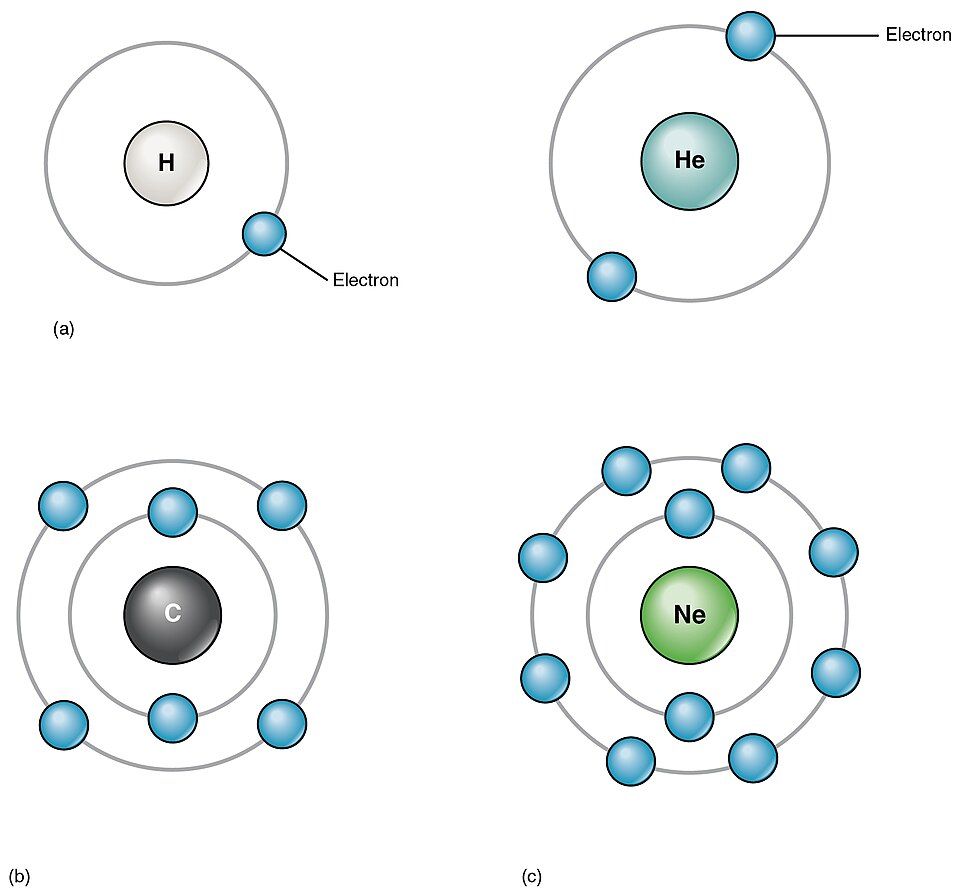
An atom has a packed center called the nucleus. A cloud of moving electrons surrounds it. Only three tiny particles matter for this book. Protons have a positive charge and sit in the nucleus. Neutrons have no charge. They share the nucleus with the protons and add weight but no charge. Electrons have a negative charge and weigh almost nothing. They zip around the nucleus in layers called shells (energy levels).
Protons and electrons have equal but opposite charges. So a neutral atom has just as many electrons as protons. The charges cancel out, and the atom has no overall charge.
| Particle | Charge | Where it is | Relative mass |
|---|---|---|---|
| Proton | +1 | Nucleus | 1 (heavy) |
| Neutron | 0 | Nucleus | 1 (heavy) |
| Electron | −1 | Shells around the nucleus | ~1/1800 (almost nothing) |
Atomic number, isotopes, and the outer shell
One number is like an atom's fingerprint. It is the atomic number, the number of protons in the nucleus. Change it, and you change the element itself. An atom with 1 proton is always hydrogen. One with 6 is always carbon, and one with 8 is always oxygen. The mass number is the protons and neutrons added together.
Atoms of the same element can have different numbers of neutrons. These are called isotopes. Carbon-12 and carbon-14 are both carbon, with 6 protons each. But carbon-14 has two extra neutrons, and it is radioactive. That is why radioactive isotopes are so useful for medical scans and for dating old things.
Still, an atom's chemistry doesn't come from its nucleus. It comes from its outermost electrons, in the valence shell. Atoms are most stable, or "happiest," when that outer shell is full. For most atoms in the body, full means eight electrons. This is the octet rule. An atom with a full outer shell doesn't react. An atom missing a few electrons is reactive and ready to bond.
Pick an element and watch its atom take shape in the interactive below. You will see the nucleus in the center and the electrons filling their shells.
- An atom has a nucleus of positive protons and neutral neutrons. Negative electrons circle it in shells.
- The atomic number (number of protons) tells you the element. A neutral atom has equal protons and electrons.
- Isotopes are the same element with different numbers of neutrons. Some are radioactive and useful in medicine.
- The valence (outer) shell drives chemistry. Atoms bond to get a stable, full shell (the octet rule).
Section 2Chemical bonds
Why atoms bond at all
Atoms bond for one reason: to get a stable, full outer shell. An atom with a half-empty outer shell will do almost anything to fill it. It may give electrons away, take them, or share them. Each of these ways makes a different kind of bond. The noble gases, like helium, neon, and argon, already have full shells. So they drift around and don't react. Every other atom is looking for a partner. There are three main bonds: ionic, covalent, and hydrogen. Once you know them, you can predict how almost every molecule in the body behaves.
Ionic bonds: give and take
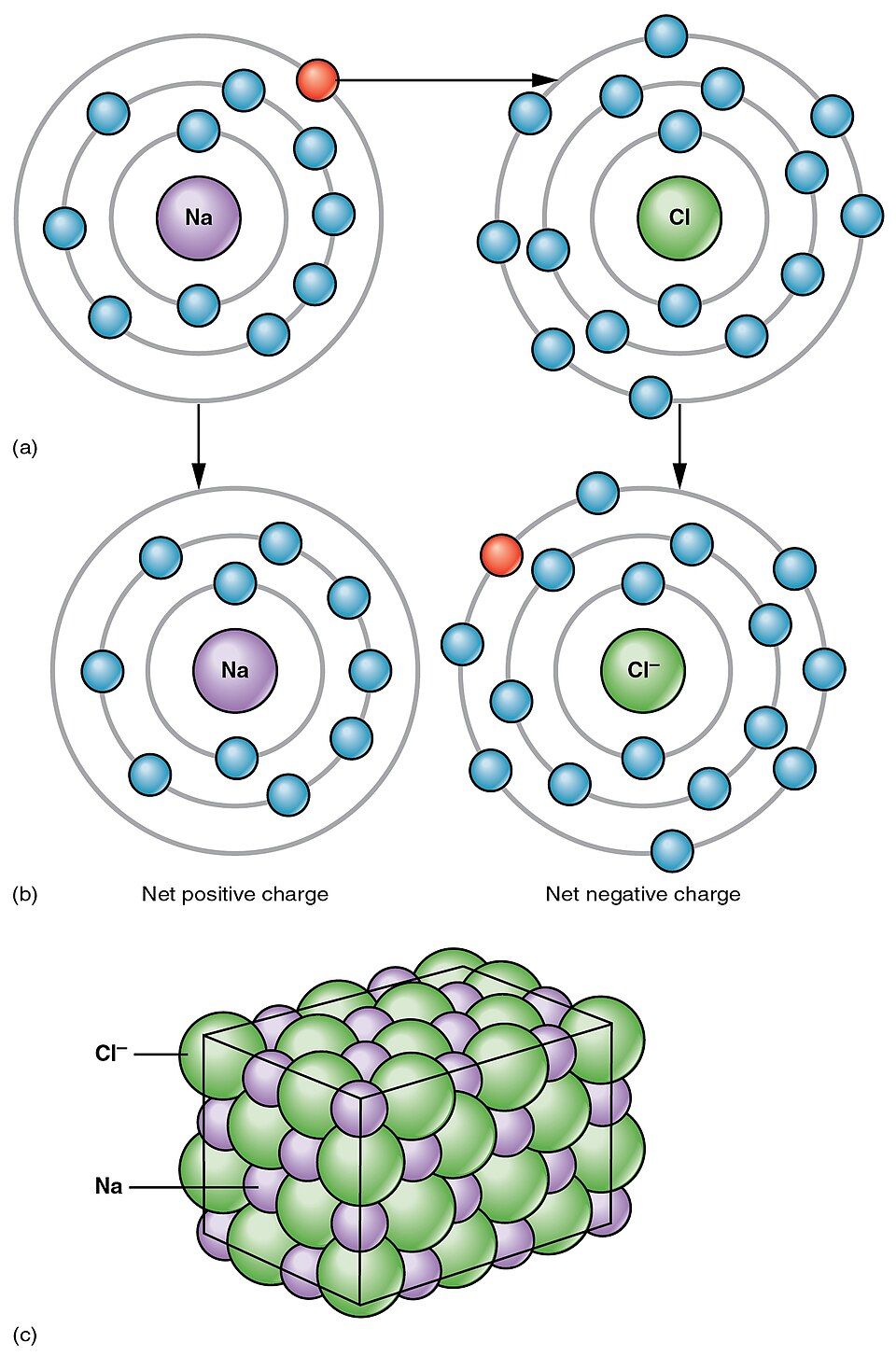
Sometimes the easiest way to fill a shell is to hand an electron over for good. One atom gives an electron, and another takes it. Then both end up with a charge. The giver becomes a positive ion called a cation. The taker becomes a negative ion called an anion. Opposite charges attract, and that pull is the ionic bond.
Table salt is the classic example. Sodium hands its one outer electron to chlorine and becomes Na⁺. Chlorine becomes Cl⁻. The two cling together as NaCl. In water, ionic compounds break apart into separate ions. These charged bits floating in body fluids are your electrolytes, such as Na⁺, K⁺, Ca⁺⁺, and Cl⁻. They run nerve signals, muscle contractions, and fluid balance.
Covalent bonds: sharing, polar and nonpolar
More often, two atoms just share a pair of electrons. Both atoms count the pair toward a full shell. This is a covalent bond. It is the strongest and most common bond in the body. Carbon builds all of life with covalent bonds.
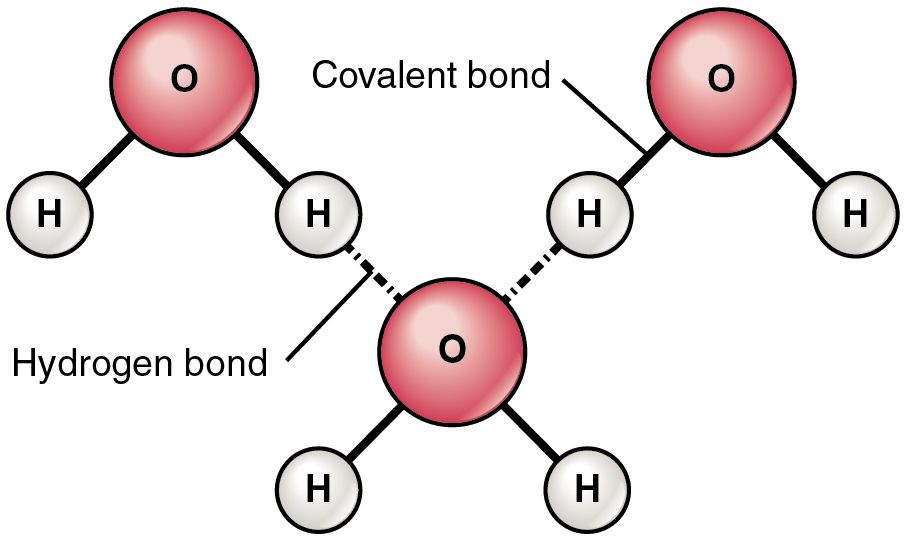
But sharing is not always fair. When both atoms pull the same amount, the shared electrons sit in the middle. The bond is nonpolar, as in O₂ or the carbon–hydrogen bonds of fats. When one atom pulls harder, it hogs the electrons. The bond becomes polar. One end is slightly negative, and the other end is slightly positive. Water is the great polar molecule. Its oxygen pulls the shared electrons away from its two hydrogens. So the oxygen has a partial negative charge, and the hydrogens have a partial positive charge. As you will see, this lopsided charge makes life possible.
Hydrogen bonds: weak but mighty
A hydrogen bond is not a bond inside a molecule. It is a gentle pull between molecules, or between far-apart parts of one big molecule. It forms when the slightly positive hydrogen of one polar molecule is drawn to the slightly negative oxygen or nitrogen of another.
One hydrogen bond on its own is weak, only a small part of the strength of a covalent bond. But millions of them together are mighty. Hydrogen bonds hold liquid water together. They zip the two strands of DNA into a double helix, like the teeth of a zipper. They also fold proteins into their working shapes. They are strong enough to give shape, but weak enough to break and form again. That is just what living molecules need.
| Bond | How it forms | Strength | Example |
|---|---|---|---|
| Ionic | One atom gives an electron to another; the opposite charges attract | Strong (weak once it dissolves in water) | Na⁺Cl⁻ (table salt) |
| Covalent (nonpolar) | Electrons are shared equally | Strong (covalent bonds are the strongest in the body) | O₂; C–H bonds in fats |
| Covalent (polar) | Electrons are shared unequally, so each end gets a partial charge | Strong (covalent bonds are the strongest in the body) | Water (H₂O) |
| Hydrogen | A pull between partial + and partial − charges on polar molecules | Weak (strong in large numbers) | Between water molecules; between DNA strands |
Flip between ionic, covalent, and hydrogen bonds and watch how each one forms in the interactive.
- Atoms bond to fill their valence shell. A full shell is stable and does not react.
- Ionic bonds pass electrons from one atom to another. This makes charged ions (electrolytes) that split apart in water.
- Covalent bonds share electrons, either equally (nonpolar) or unequally (polar). They are the body's strongest bonds.
- Hydrogen bonds are weak pulls between polar molecules. Added up, they hold water, DNA, and proteins together.
Section 3Chemical reactions & enzymes
Reactants, products, and three ways to rearrange atoms
A chemical reaction is just the making or breaking of bonds. Atoms let go of old partners and grab new ones. The starting materials are the reactants. What you end up with are the products. No atoms are made or destroyed. They are only moved around.
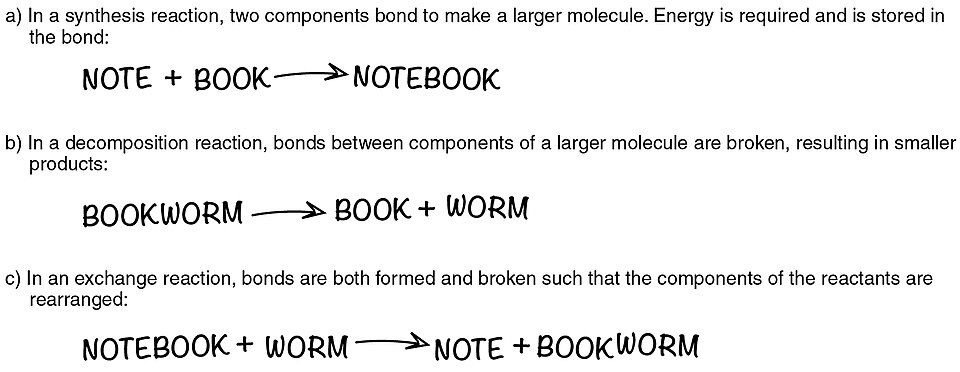
Almost every reaction in the body fits one of three patterns. Synthesis reactions join small parts into a bigger molecule (A + B → AB). These are the building, or anabolic, reactions. Decomposition reactions break a big molecule into smaller pieces (AB → A + B). These are the breaking-down, or catabolic, reactions, like digesting a meal. Exchange reactions do both at once and swap partners (AB + CD → AC + BD). Many reactions are also reversible. They can run either way, depending on conditions.
| Type | Pattern | What it does | Body example |
|---|---|---|---|
| Synthesis (anabolic) | A + B → AB | Builds bigger molecules | Amino acids joined into a protein |
| Decomposition (catabolic) | AB → A + B | Breaks molecules apart | Digesting starch into glucose |
| Exchange | AB + CD → AC + BD | Swaps partners | Buffers trading H⁺ in the blood |
Energy: the hill every reaction must climb
Chemical bonds store energy, so moving them around always changes energy. Reactions that give off energy, often as heat, are exergonic. These power the body, like breaking down glucose. Reactions that take in energy are endergonic. Building big molecules costs energy.
But here is the catch. Even a reaction that gives off energy must first get over a small hump. This hump is the activation energy, the energy needed to get a reaction started. Picture a boulder resting in a small dip near the top of a hill. It will roll down and release lots of energy. But first, something has to lift it over the lip of the dip. That lip is the activation energy. At body temperature, most reactions would sit stuck behind it for hours or even years.
Enzymes: shrinking the hill
The body can't wait hours. It can't just turn up the heat, either. So it uses enzymes. An enzyme is a catalyst, a helper that speeds up a reaction. Enzymes are almost always proteins. They lower the activation energy. This lets reactions run thousands or millions of times faster at a safe 37 °C. And an enzyme is not used up. It does its job and is free to do it again.
Each enzyme is very specific. It has an active site shaped to fit one certain molecule, its substrate. Think of a key in a lock. A better picture is a glove that shapes itself around a hand. Since enzymes are proteins, anything that unfolds a protein can harm them. A high fever or the wrong pH can do this. That is one reason your body guards its temperature and pH so closely.
Watch a reaction climb over its energy hill in the interactive below. Then switch on an enzyme and see the hill shrink.
- Reactions move atoms around to turn reactants into products. The three types are synthesis, decomposition, and exchange.
- Exergonic reactions give off energy. Endergonic reactions take it in. Every reaction must first get over its activation energy.
- Enzymes are protein helpers that lower activation energy. They can be used again, and each one is very specific to its substrate.
- Enzymes depend on their shape. So very high heat or the wrong pH can stop them from working.
Section 4Water, the solvent of life
Polarity: the source of all water's tricks
You are about 60% water, and that is no accident. Almost everything special about water comes from one fact: it is polar. Recall from Section 2 that oxygen hogs the shared electrons in each O–H bond. So a water molecule (H₂O) is slightly negative at the oxygen end. It is slightly positive at the two hydrogen ends. Opposite charges attract. So each water molecule clings to the ones around it by hydrogen bonds. This shifting web of hydrogen bonds is the hidden reason water can be a solvent, a heat buffer, and a lubricant.
The universal solvent
Water is called the universal solvent. Its charged ends surround other charged or polar substances and pull them apart. They spread out evenly to form a solution. The liquid that does the dissolving is the solvent. The substance that gets dissolved is the solute.
Molecules that mix into water, like salts, sugars, and amino acids, are hydrophilic ("water-loving"). Nonpolar molecules, like fats, are hydrophobic ("water-fearing"). They won't dissolve in water. This split does real work in the body. It is why cell membranes, made of hydrophobic lipids, can form watertight walls in your watery body. So much of the body's chemistry happens in water. Nutrients travel in it, wastes dissolve in it, and reactions happen in it. Blood plasma is really just water carrying dissolved cargo.
Heat, cushioning, and chemistry
Water's hydrogen bonds also give it a very high heat capacity. It takes a lot of energy to warm water up. So your water-filled body resists sudden changes in temperature and stays near 37 °C. And when water evaporates, it carries away a lot of heat. That is why sweating cools you so well on a hot day.
Water molecules also stick to each other. This lets water form slippery films that protect and cushion. The fluid in serous membranes, the fluid in your joints (synovial fluid), and the mucus lining your airways all depend on it. Last, water doesn't just sit by during chemistry. It takes part. The body builds big molecules by taking water out (dehydration synthesis). It breaks them down by adding water in (hydrolysis). You will see these two reactions again in Section 6.
| Property | Why (from polarity) | What it does for you |
|---|---|---|
| Solvent | Its charged ends pull solutes apart | Carries nutrients, wastes, and ions in the blood |
| High heat capacity | Hydrogen bonds soak up heat | Keeps body temperature steady near 37 °C |
| Evaporative cooling | Breaking hydrogen bonds carries heat away | Sweating cools the body |
| Cohesion / lubrication | Water molecules stick to each other | Slippery films in joints, membranes, and airways |
| Reactant | Can be added or taken out in reactions | Builds and breaks big molecules |
Explore what water's lopsided charge does for you in the interactive. See how it dissolves things, sticks together, and soaks up heat.
- Water is polar, so its molecules form hydrogen bonds with each other. This is the source of all its special traits.
- As the universal solvent, water dissolves hydrophilic solutes but not hydrophobic ones. This split shapes cell membranes.
- A high heat capacity and cooling by evaporation let water keep body temperature steady and make sweating work.
- Water is a reactant. It is taken out in dehydration synthesis and added in hydrolysis.
Section 5pH, acids, bases & buffers
What pH actually measures
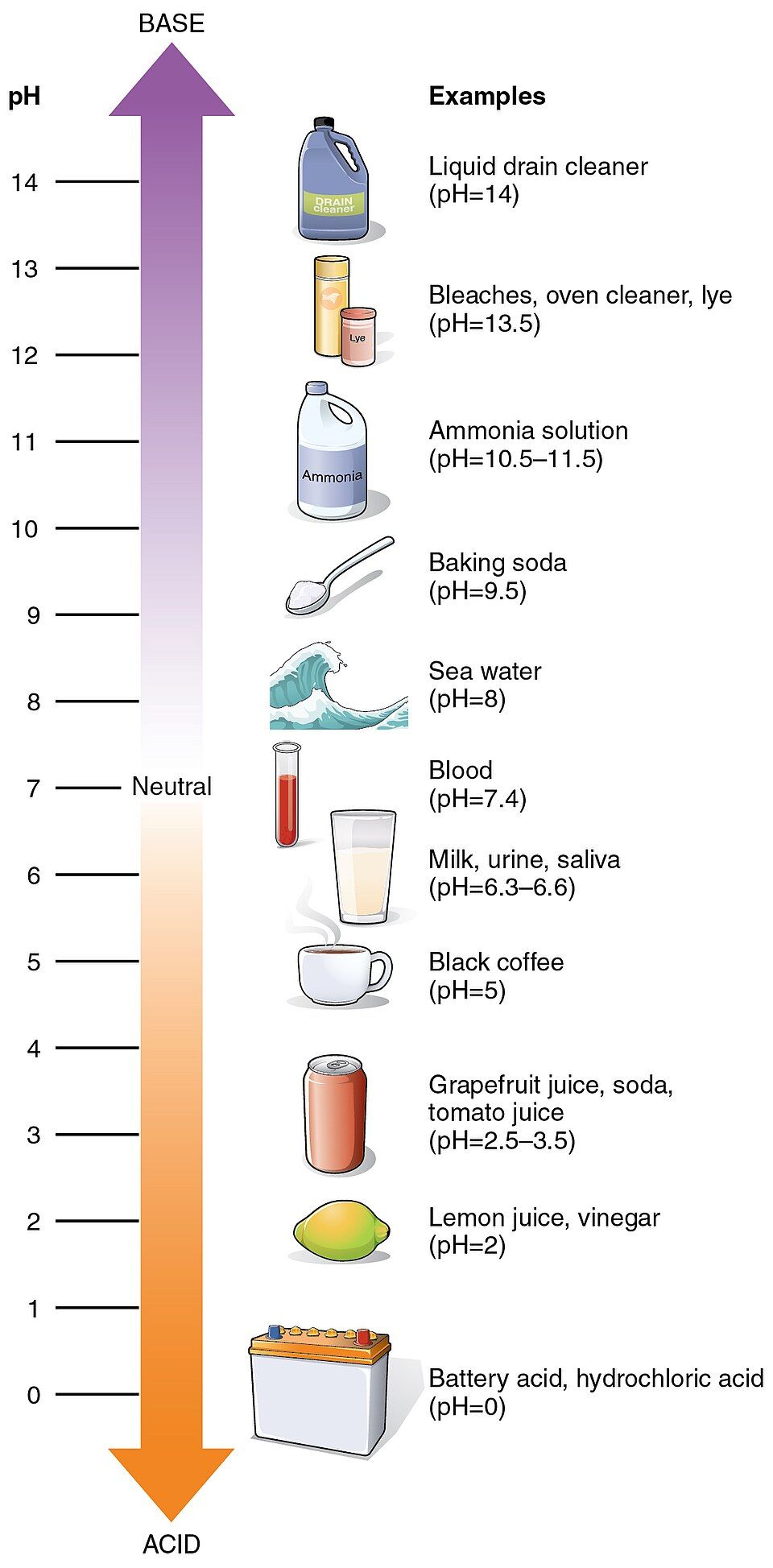
pH measures how many free hydrogen ions (H⁺) are floating loose in a fluid. The more H⁺ there is, the more acidic the fluid. The less there is, the more basic (alkaline) it is. The scale runs from 0 to 14. 7 is neutral, like pure water. Below 7 is acidic, and above 7 is basic.
There is one twist you must keep in mind. The scale is logarithmic. That means each whole step is a tenfold change in H⁺. A fluid at pH 4 is not just a bit more acidic than one at pH 5. It holds ten times more hydrogen ions. That is why a shift of even a few tenths of a pH unit in the blood is a real emergency.
Acids, bases, and the number that matters most
An acid is a substance that gives off H⁺ into a fluid. This pushes the pH down. Stomach acid is near pH 2. A base takes up H⁺ (or gives off OH⁻). This pushes the pH up. Household bleach and the juices from the pancreas are basic.
The most important pH in the body is the pH of blood. It must stay in the very narrow range of 7.35 to 7.45, or about 7.4. If it drops below 7.35, that is acidosis. If it rises above 7.45, that is alkalosis. If it goes past about 6.8 or 7.8, proteins lose their shape and enzymes fail. Then life is in danger. The pH of the world outside swings a lot. But the body keeps its blood almost perfectly steady.
| Fluid | About what pH | Acidic / basic |
|---|---|---|
| Stomach acid | ~2 | Strongly acidic |
| Urine | ~6 | Slightly acidic |
| Pure water | 7 | Neutral |
| Blood | 7.35–7.45 | Slightly basic |
| Pancreatic juice | ~8 | Basic |
Buffers: holding the line at 7.4
Acids pour into the blood from every meal and every working muscle. So how does blood keep its pH so steady? The answer is buffers. A buffer is a team of chemicals that soaks up extra H⁺ when a fluid gets too acidic. It gives off H⁺ when the fluid gets too basic.
The body's first line of defense is the bicarbonate system. It is made of carbonic acid (H₂CO₃) and the bicarbonate ion (HCO₃⁻). The two trade hydrogen ions back and forth to soften any swing. Buffers don't make acid go away. They soften the blow and buy time. Then the lungs and kidneys fix the real balance. The lungs breathe out CO₂, and the kidneys get rid of H⁺ in urine. This is homeostasis at the level of molecules. It is also a sneak peek at the acid–base chapters later in the book.
Push the pH up and down in the interactive and watch buffers fight to pull it back toward neutral.
- pH measures free H⁺. Below 7 is acidic, and above 7 is basic. The scale is logarithmic, so each unit is a 10× change.
- Acids give off H⁺, and bases take it up. Blood must stay in the narrow range of 7.35–7.45.
- Going out of range causes acidosis (too low) or alkalosis (too high). Both are dangerous.
- Buffers, mainly the bicarbonate system, soak up or give off H⁺ to keep pH steady.
Section 6The molecules of life
Organic molecules and the carbon backbone
Now let's move from small inorganic molecules, like water, salts, and gases, to the big organic ones. These are the true building blocks of the body. Organic molecules are built on a frame of carbon. Carbon is the perfect building atom. It can form four covalent bonds at once. This lets it link into long chains, branch out, and close into rings.
The biggest of these molecules are called macromolecules. Most are polymers, long chains snapped together from small repeating units called monomers. Think of beads on a string. The body builds a polymer by dehydration synthesis. It takes out a water molecule to join two monomers. It breaks a polymer apart by hydrolysis. It adds water to split the bond. Almost everything you are made of belongs to just four families. There is also one special molecule that powers it all.
The four families
Carbohydrates are sugars and chains of sugars. Their monomers are called monosaccharides, such as glucose. These link up into polysaccharides, such as glycogen and starch. Carbohydrates are the body's quick, favorite fuel.
Lipids are the oily molecules that don't mix with water. Triglycerides store energy and keep you warm. Phospholipids build every cell membrane. Steroids, like cholesterol, are used to make hormones. Lipids avoid water, and that is exactly what makes membranes work.
Proteins are the body's workhorses. They are built from twenty kinds of amino acids linked in a chain. The chain then folds into an exact 3-D shape. A protein's shape decides its job. So if a protein unfolds (denatures) from heat or the wrong pH, it stops working. Think of egg white turning solid in a hot pan. Proteins act as enzymes, building fibers, carriers, and messengers.
Nucleic acids, DNA and RNA, are chains of nucleotides. They store and carry the genetic instructions for building every protein in your body.
| Family | Monomer / unit | Example | Main job |
|---|---|---|---|
| Carbohydrate | Monosaccharide (glucose) | Glycogen, starch | Quick energy; short-term fuel storage |
| Lipid | Fatty acids + glycerol | Triglyceride, phospholipid, cholesterol | Energy storage, keeping warm, membranes, hormones |
| Protein | Amino acid (20 kinds) | Enzymes, keratin, hemoglobin | Structure, speeding up reactions, carrying things, sending signals |
| Nucleic acid | Nucleotide | DNA, RNA | Store and use genetic information |
ATP: the cell's energy currency
One small molecule gets its own spotlight. It is adenosine triphosphate, or ATP. ATP is the energy "money" that every cell spends. It has a tail of three phosphate groups. The bond to the last phosphate is like a loaded spring.
When a cell needs power, it snaps off that last phosphate (ATP → ADP + phosphate). The energy that comes out does the work. This might be making a muscle contract, pumping an ion, or building a molecule. Then the cell uses energy from food to turn ADP back into ATP. In a real sense, you remake about your own body weight in ATP every day. Your body spends and rebuilds it billions of times a second.
Pick a molecule family in the interactive below and watch it snap together from its monomers.
- Organic molecules are built on carbon, which forms four bonds. Big ones are polymers made of repeating monomers.
- Polymers are built by dehydration synthesis (taking out water). They are broken by hydrolysis (adding water).
- The four families are carbohydrates (fuel), lipids (membranes, storage, hormones), proteins (workhorses whose shape sets their job), and nucleic acids (genetic information).
- ATP is the cell's energy currency. It gives off energy when its last phosphate is removed.
The chapter in one breath
- All matter is made of elements. The smallest unit of an element is the atom. It has a nucleus of protons and neutrons, with electrons around it. The atomic number (number of protons) tells you the element.
- Six elements, O, C, H, N, Ca, P, make up about 99% of the body. Atoms bond to fill their outer shell (the octet rule).
- Three bonds hold molecules together. Ionic bonds pass electrons and make ions. Covalent bonds share electrons and can be polar or nonpolar. Hydrogen bonds are weak.
- Reactions move atoms around by synthesis, decomposition, or exchange. Each must get over an activation energy hill, and enzymes lower that hill.
- Water is polar. This makes it the body's solvent, heat buffer, and lubricant. It also takes part in building and breaking molecules.
- pH tracks free H⁺ on a logarithmic scale. Buffers such as bicarbonate keep blood at 7.35–7.45.
- Life is built from four organic families: carbohydrates, lipids, proteins, nucleic acids. ATP powers the work. These molecules are built by dehydration synthesis and broken by hydrolysis.
ReferenceWords worth knowing
Here is a quick list of the terms in this chapter. Skim it now, or come back any time a word trips you up.
- Acid
- A substance that gives off hydrogen ions (H⁺) into a fluid. It lowers the pH below 7.
- Activation energy
- The first energy hump a reaction must get over before it can go. Enzymes lower it.
- Atom
- The smallest unit of an element that still acts like that element. It has a nucleus of protons and neutrons, with electrons around it.
- Atomic number
- The number of protons in an atom's nucleus. It tells you which element the atom is.
- ATP (adenosine triphosphate)
- The cell's energy currency. It gives off usable energy when its last phosphate is removed, which turns it into ADP.
- Base
- A substance that takes up hydrogen ions (or gives off OH⁻). It raises the pH above 7.
- Buffer
- A set of chemicals that keeps pH from changing by soaking up or giving off H⁺. The bicarbonate buffer in blood is one example.
- Carbohydrate
- A family of organic molecules made of sugars and chains of sugars, like glucose and glycogen. They are used mainly for quick energy.
- Covalent bond
- A bond in which atoms share electrons. Equal sharing is nonpolar. Unequal sharing is polar.
- Dehydration synthesis
- Building a polymer by taking out a water molecule to join two monomers.
- Electron
- A tiny, almost weightless particle with a negative charge. It moves around the nucleus in shells and drives chemical bonding.
- Element
- A pure substance that can't be broken down by chemistry. The body is built mostly from six of them.
- Enzyme
- A helper molecule, usually a protein, that speeds up a reaction by lowering its activation energy. It is not used up.
- Hydrogen bond
- A weak pull between the slightly positive hydrogen of one polar molecule and a slightly negative atom of another.
- Hydrolysis
- Breaking a polymer apart by adding a water molecule across a bond.
- Ionic bond
- A bond that forms when one atom gives an electron to another. This makes two ions with opposite charges that attract.
- Isotope
- An atom of an element with the usual number of protons but a different number of neutrons.
- Lipid
- A family of organic molecules that avoid water (hydrophobic). It includes triglycerides, phospholipids, and steroids. They are used for energy storage, membranes, and hormones.
- Nucleic acid
- A chain of nucleotides, either DNA or RNA. It stores and uses genetic information.
- pH
- A logarithmic measure of how many free hydrogen ions are in a fluid. 7 is neutral, lower is acidic, and higher is basic.
- Polar molecule
- A molecule with an uneven charge, such as water. One end is slightly negative, and the other end is slightly positive.
- Protein
- A chain of amino acids folded into an exact shape. Its shape sets its job, such as an enzyme, a building block, a carrier, or a messenger.