The Endocrine System
Your nervous system is the body's fast messenger. It uses electric signals that are over in a split second. The endocrine system is its patient partner. It is a set of glands that send chemical messengers, called hormones, into your blood. The blood carries them everywhere at once. Their signals start slowly and fade slowly. But they reach every part of your body, and they can last for hours, days, or even a lifetime. This system decides how fast you burn fuel and how tall you grow. It shapes how you handle a stressful morning. It also sets how much sugar is in your blood after breakfast. In this chapter you will meet the main glands. You will learn the two very different ways a hormone can give its message to a cell. You will also trace the neat feedback loops that keep the whole system in balance.
By the end of this chapter you can
- Tell the endocrine system apart from the nervous system and from exocrine glands. Find the main endocrine glands in the body.
- Define a hormone. Explain why it changes only certain target cells, even though it reaches the whole body.
- Compare lipid-soluble and water-soluble hormones. Say where their receptors sit and how fast they work.
- Describe how the hypothalamus–pituitary team works. Name the hormones of the front and back parts of the pituitary.
- Explain how insulin and glucagon work as an opposing pair to control blood sugar.
- Draw the thyroid axis as a negative feedback loop. Predict the signs of a thyroid that works too little or too much.
- Name the layers of the adrenal gland and match each one to the hormones it makes.
- See how negative feedback controls almost every hormone in the body.
Section 1The endocrine glands
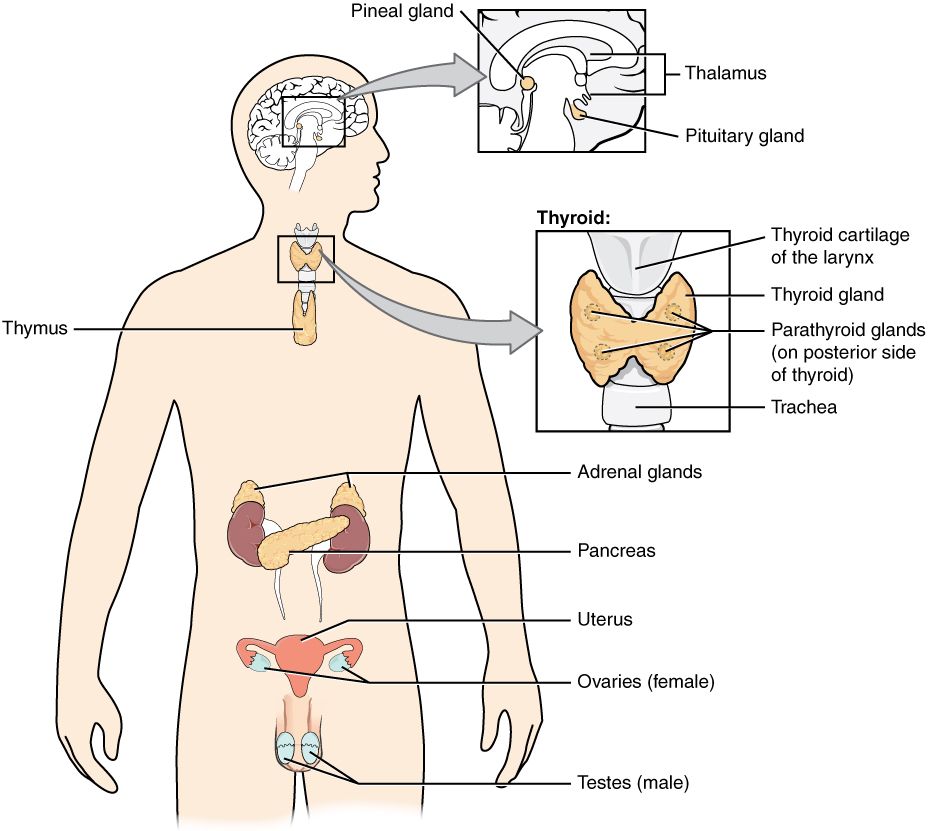
Two systems that share the job of control
Your body needs two ways to send messages. They work side by side. The nervous system sends fast electric signals along wires called neurons. Each message goes to an exact spot. It arrives in a split second and stops as soon as the signal stops.
The endocrine system works the other way. It has no wires. Its glands release chemical messengers called hormones right into the blood. The blood then carries them all over the body. So you trade speed for reach and staying power. A hormone may take seconds to minutes to act. But its effect can be wide and can last a long time. Think of the nervous system as a phone call to one person. The endocrine system is more like a message sent out to everyone. Only the people it is meant for will act on it.
Endocrine versus exocrine
The word endocrine means "to release within." Endocrine glands are ductless, which means they have no tubes. They release their hormones straight into the fluid around them and into the blood. Exocrine glands are different. They send their products through a duct, a small tube, onto a surface. Sweat glands, spit (salivary) glands, and tear glands are all exocrine.
A few organs do both jobs. The pancreas is the classic example. Its exocrine part drips digestive enzymes into a duct that empties into the gut. At the same time, small islands of endocrine tissue release insulin and glucagon into the blood.
The cast of glands
Some glands have making hormones as their main job. These full-time endocrine glands are the pituitary, pineal, thyroid, parathyroid, and adrenal glands. The hypothalamus, a small part of the brain, sits at the top of the chain of command.
Other organs make hormones as a side job. These include the pancreas, the gonads (ovaries and testes), and the thymus. Even the heart, kidneys, stomach, and body fat release hormones. Learn the main glands first. The part-time players will come up in their own chapters.
| Gland | Main hormone(s) | Main job |
|---|---|---|
| Hypothalamus | Releasing & inhibiting hormones | Gives orders to the pituitary; links the brain to the endocrine system |
| Pituitary | GH, TSH, ACTH, FSH, LH, ADH, oxytocin | Passes orders on to many other glands |
| Thyroid | Thyroid hormone (T₃/T₄), calcitonin | Sets how fast you burn fuel; lowers blood calcium |
| Parathyroid | Parathyroid hormone (PTH) | Raises blood calcium |
| Adrenal | Cortisol, aldosterone, epinephrine | Stress response; salt and water balance |
| Pancreas (islets) | Insulin, glucagon | Controls blood sugar (glucose) |
| Pineal | Melatonin | Sets the sleep–wake rhythm |
| Gonads | Estrogen/progesterone; testosterone | Making babies and sex traits |
Tap each gland in the interactive to see where it sits and what it makes.
- The endocrine system controls the body with hormones carried in the blood. Its signals are slower than nerve signals, but they reach more places and last longer.
- Endocrine glands have no ducts and release into the blood. Exocrine glands release through ducts onto a surface.
- The main glands are the hypothalamus, pituitary, thyroid, parathyroid, adrenal, pancreas, pineal, and gonads.
- A hormone acts only on its target cells. These are the cells that have the matching receptor.
Section 2How hormones act
Chemistry decides the delivery
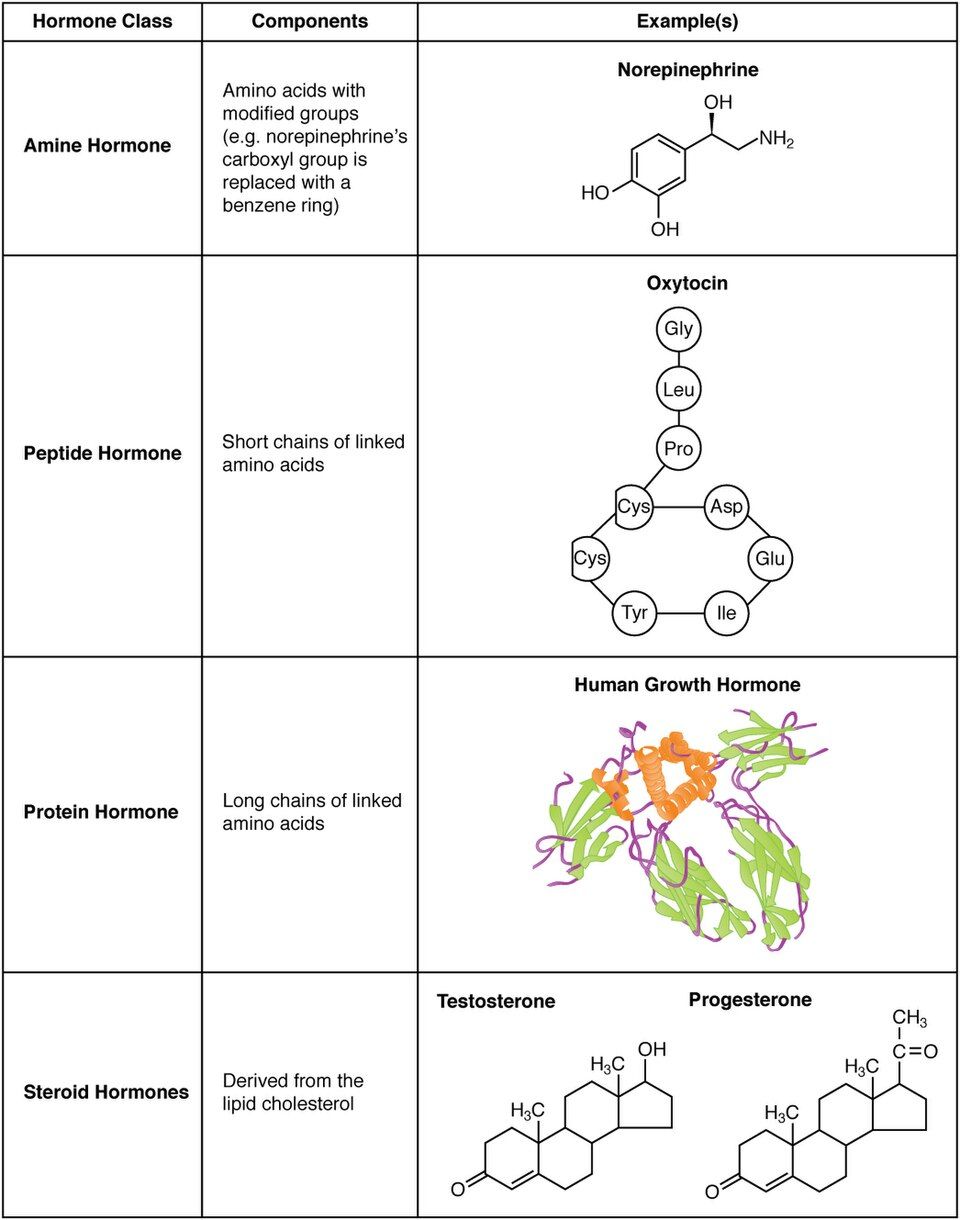
Hormones come in two main chemical families. This is not a small detail. It decides exactly how a hormone talks to a cell.
Most hormones are amino-acid based, which means they are built from the building blocks of protein. Some are peptides and proteins, such as insulin and growth hormone. Others are amines, such as the adrenal catecholamines. These hormones are water-soluble, so they mix well with water. They are also lipid-insoluble, so they do not mix with fat. That means they cannot cross the fatty cell membrane.
The second family is the steroid hormones. These include cortisol, aldosterone, and the sex hormones. They are built from cholesterol. They are lipid-soluble, so they slip right through the fatty membrane. That one question splits hormone action into two clear stories. Can the hormone cross the membrane or not?
Lipid-soluble hormones: walk right in
A lipid-soluble hormone can pass through the membrane. So it does not need to knock from outside. It moves into the cell and binds to an intracellular receptor, a receptor inside the cell. This is usually in the nucleus. The hormone and receptor then work directly on the DNA. They switch certain genes on or off.
The cell responds by making new proteins. These are often new enzymes that change how the cell behaves. Building proteins takes time, so these hormones are slow to start. But the new proteins stick around, so the effects are long-lasting. Steroid hormones such as cortisol work this way.
Water-soluble hormones: knock from outside
A water-soluble hormone cannot get into the cell. So it binds to a receptor on the cell surface instead. This does not reach the DNA. Instead, it starts a relay inside the cell. The relay uses a second messenger. The best-known one is cyclic AMP (cAMP).
The hormone is the "first messenger," and it stays outside. The second messenger carries the signal on. It turns on a chain of enzymes that are already waiting in the cell's fluid. These enzymes are ready-made and just need to be switched on. So the response is fast. But it also fades fast once the hormone is gone. Peptide hormones like insulin and glucagon use this surface route. So does the amine epinephrine.
| Feature | Lipid-soluble (steroid) | Water-soluble (peptide/amine) |
|---|---|---|
| Crosses the membrane? | Yes, it enters the cell | No, it stays outside |
| Where the receptor is | Inside the cell (often the nucleus) | On the cell surface |
| How it works | Turns genes on/off → new proteins | Second messenger (cAMP) → chain of enzymes |
| How fast it starts | Slow (hours) | Fast (seconds to minutes) |
| How long it lasts | Long | Short |
| Examples | Cortisol, aldosterone, estrogen, testosterone | Insulin, glucagon, growth hormone, epinephrine |
Switch between a lipid-soluble and a water-soluble hormone in the interactive. Then step through each path.
- Hormones are either amino-acid based (water-soluble) or steroid (lipid-soluble). Whether they dissolve in fat decides how they work.
- Lipid-soluble hormones enter the cell and bind intracellular receptors. They change gene expression, which genes are turned on. They are slow but lasting.
- Water-soluble hormones bind surface receptors and use a second messenger (cAMP). They are fast but brief.
- Thyroid hormone is the exception. It is an amine that dissolves in fat and acts like a steroid.
Section 3The hypothalamus & pituitary axis
The real chain of command
The pituitary gland is about the size of a pea. It hangs just below the brain. It is often called the "master gland" because it directs so many other glands. But the pituitary has a boss of its own. That boss is the hypothalamus, a small part of the brain just above it.
The hypothalamus is where the nervous and endocrine systems meet. It takes in signals from the brain. Then it turns them into hormone orders for the pituitary. So the true master is the hypothalamus. The pituitary is its strong second-in-command. The pituitary has two lobes, or parts. They are wired in very different ways.
The posterior pituitary: a storage terminal
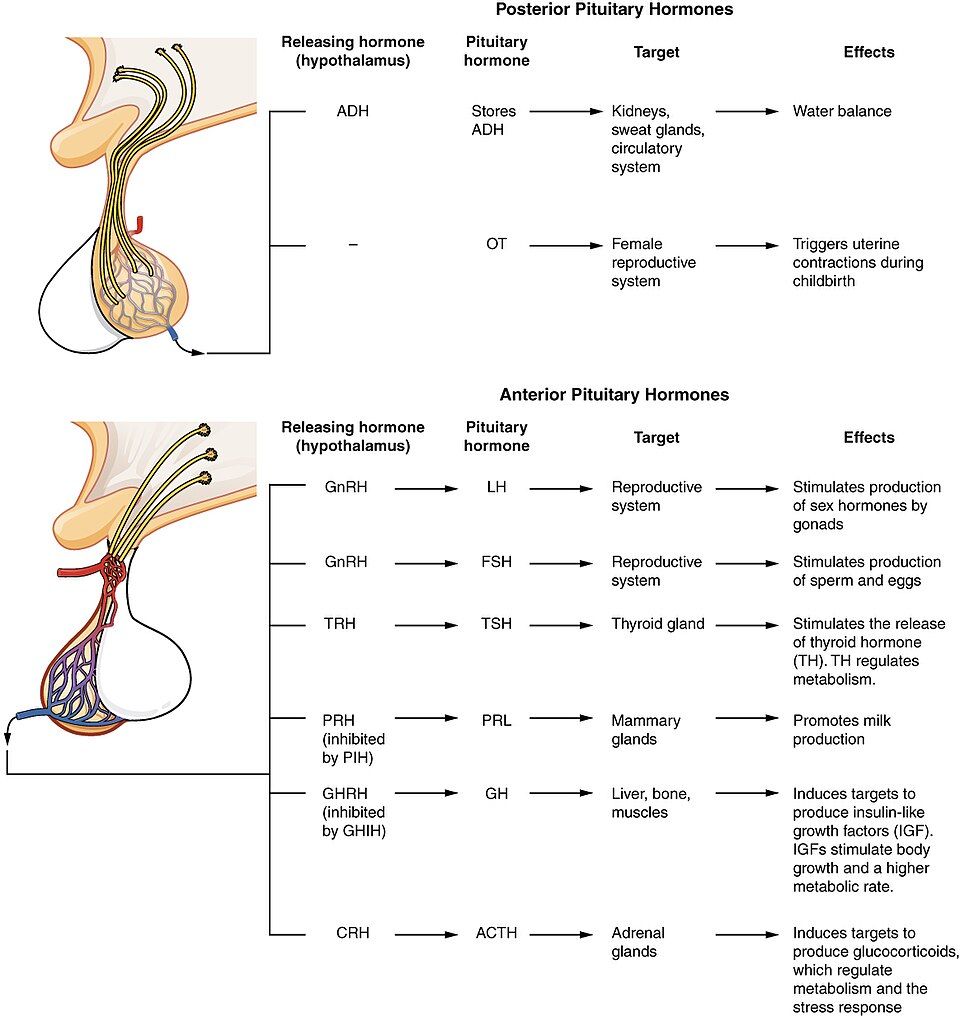
The posterior pituitary is the back lobe. It makes no hormones of its own. It is really nerve tissue that grows down from the hypothalamus. Two hormones are stored here. They are antidiuretic hormone (ADH) and oxytocin. Both are made by nerve cells in the hypothalamus. They travel down the long arms (axons) of those cells. Then they are stored in the posterior pituitary until needed.
ADH tells the kidneys to save water. This makes the urine more concentrated. Oxytocin makes the uterus squeeze during childbirth. It also makes milk flow (let-down) during nursing. So the back lobe is a release station, not a factory.
The anterior pituitary: a true factory under remote control
The anterior pituitary is the front lobe. It is gland tissue that makes and releases its own hormones. But it does this only when the hypothalamus tells it to. The hypothalamus sends tiny releasing and inhibiting hormones. They start or stop the front lobe's work. They travel through a private set of blood vessels called the hypophyseal portal system. These vessels carry them the short trip to the front lobe.
Several front-lobe hormones are tropic hormones. Their job is to give orders to other glands. TSH drives the thyroid. ACTH drives the outer layer of the adrenal gland (the adrenal cortex). FSH and LH drive the gonads. Other front-lobe hormones act on body tissues directly. Growth hormone (GH) acts on almost everything. Prolactin (PRL) acts on the breast.
| Hormone | Lobe | Target & effect |
|---|---|---|
| Growth hormone (GH) | Anterior | Body tissues: growth and fuel use |
| Thyroid-stimulating (TSH) | Anterior | Thyroid: make thyroid hormone |
| Adrenocorticotropic (ACTH) | Anterior | Adrenal cortex: make cortisol |
| Follicle-stimulating (FSH) | Anterior | Gonads: help eggs and sperm mature |
| Luteinizing (LH) | Anterior | Gonads: release of an egg (ovulation), sex hormones |
| Prolactin (PRL) | Anterior | Breast: make milk |
| Antidiuretic (ADH) | Posterior | Kidney: save water |
| Oxytocin | Posterior | Uterus & breast: squeezing, milk let-down |
Tap a pituitary hormone in the interactive. Trace its path from the brain to its target organ.
- The hypothalamus is the true master. It controls the pituitary, which controls many other glands.
- The posterior pituitary only stores and releases ADH and oxytocin. Both are made in the hypothalamus.
- The anterior pituitary makes six hormones when the hypothalamus says so. Four are tropic (TSH, ACTH, FSH, LH).
- Remember them with FLAT PIG.
Section 4Blood glucose regulation
Two hormones from one gland, pulling opposite ways
Blood glucose, or blood sugar, is one of the most closely guarded values in your body. The pancreas guards it with two hormones that work against each other. They are an antagonistic pair. Small clusters of hormone-making cells are spread through the pancreas. They are called the pancreatic islets (islets of Langerhans).
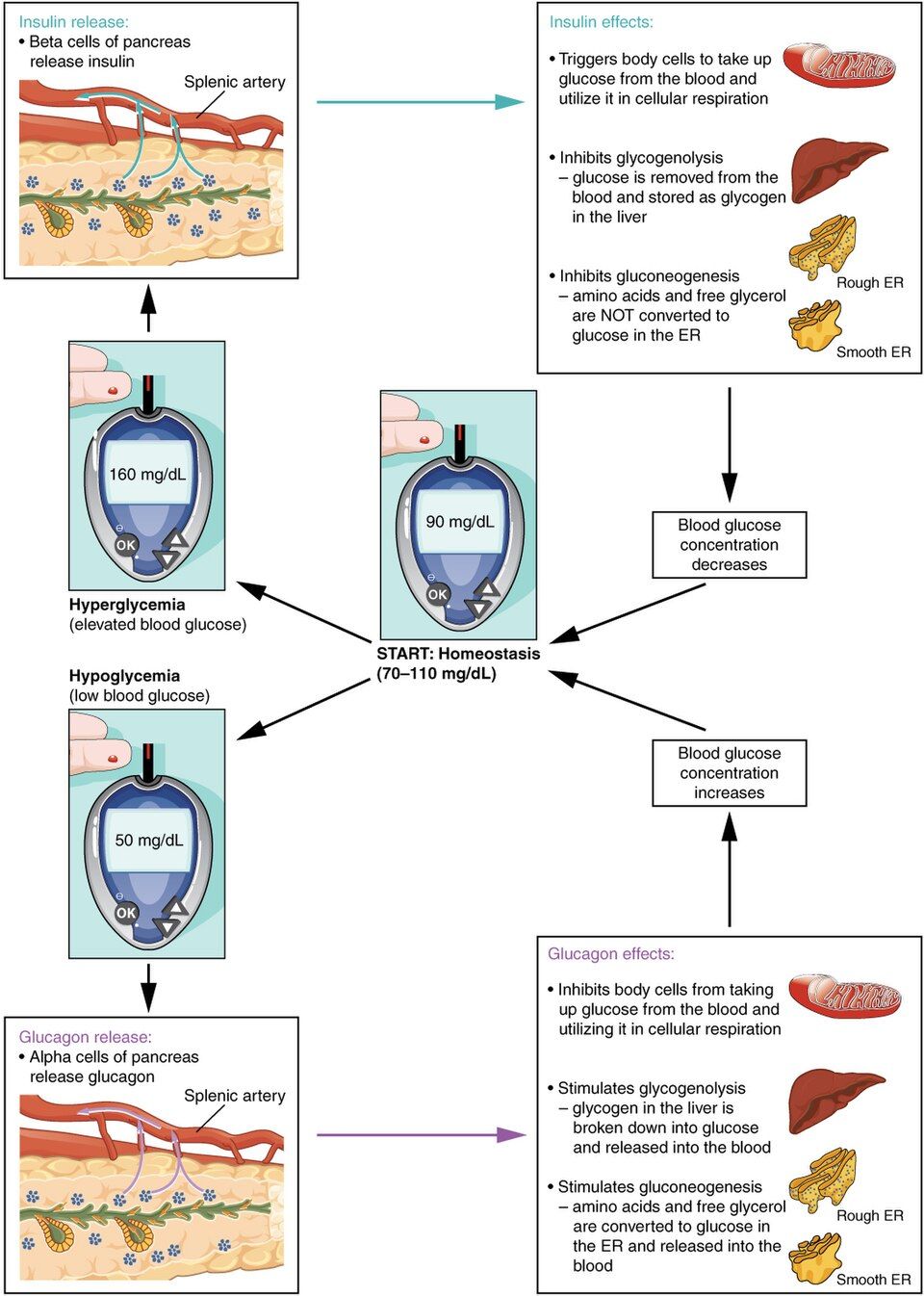
The beta cells in the islets make insulin. The alpha cells make glucagon. One hormone lowers blood sugar and the other raises it. So the pancreas can nudge sugar either way as needed. It is a great example of negative feedback, with a gas pedal and a brake.
Insulin: the "fed-state" hormone that lowers glucose
After a meal, your blood sugar goes up. The beta cells sense the rise and release insulin. Its whole job is to lower blood glucose. Insulin tells body cells to open up and take in sugar. Muscle and fat cells do this most. Insulin also tells the liver to store the extra sugar as glycogen, a stored form of sugar.
As cells soak up the sugar, blood sugar drops back to normal. Then less insulin is released. Here is a handy way to remember it. Insulin is the hormone of the fed state. It moves fuel out of the blood and into storage.
Glucagon: the "fasting" hormone that raises glucose
Between meals, blood sugar slowly drops. Now the alpha cells release glucagon. It does the opposite of insulin. It raises blood glucose. Glucagon tells the liver to break glycogen back down into sugar. This is called glycogenolysis, which means "glycogen splitting." It also tells the liver to make new sugar from other molecules. This is called gluconeogenesis, which means "making new sugar."
The liver releases this sugar into the blood. Blood sugar climbs back to its normal set point, and glucagon release slows. Glucagon is the hormone of the fasting state. It pulls fuel out of storage and back into the blood.
| Feature | Insulin | Glucagon |
|---|---|---|
| Made by | Beta cells | Alpha cells |
| Released when | Blood sugar is high (after eating) | Blood sugar is low (fasting) |
| Effect on blood sugar | Lowers it | Raises it |
| What it tells the liver | Store sugar as glycogen | Break down glycogen; make new sugar |
| Overall role | Fed state: storing fuel | Fasting state: releasing fuel |
Pick a meal or a fast in the interactive. Watch insulin or glucagon pull blood sugar back to normal.
- The pancreatic islets control blood sugar with two hormones that work against each other.
- Insulin comes from beta cells. It lowers blood sugar after a meal. It gets cells to take in sugar and the liver to store it as glycogen.
- Glucagon comes from alpha cells. It raises blood sugar when you fast. It breaks down glycogen and makes new sugar.
- Insulin is the only hormone that lowers blood glucose. Losing it, or cells ignoring it, causes diabetes.
Section 5The thyroid axis
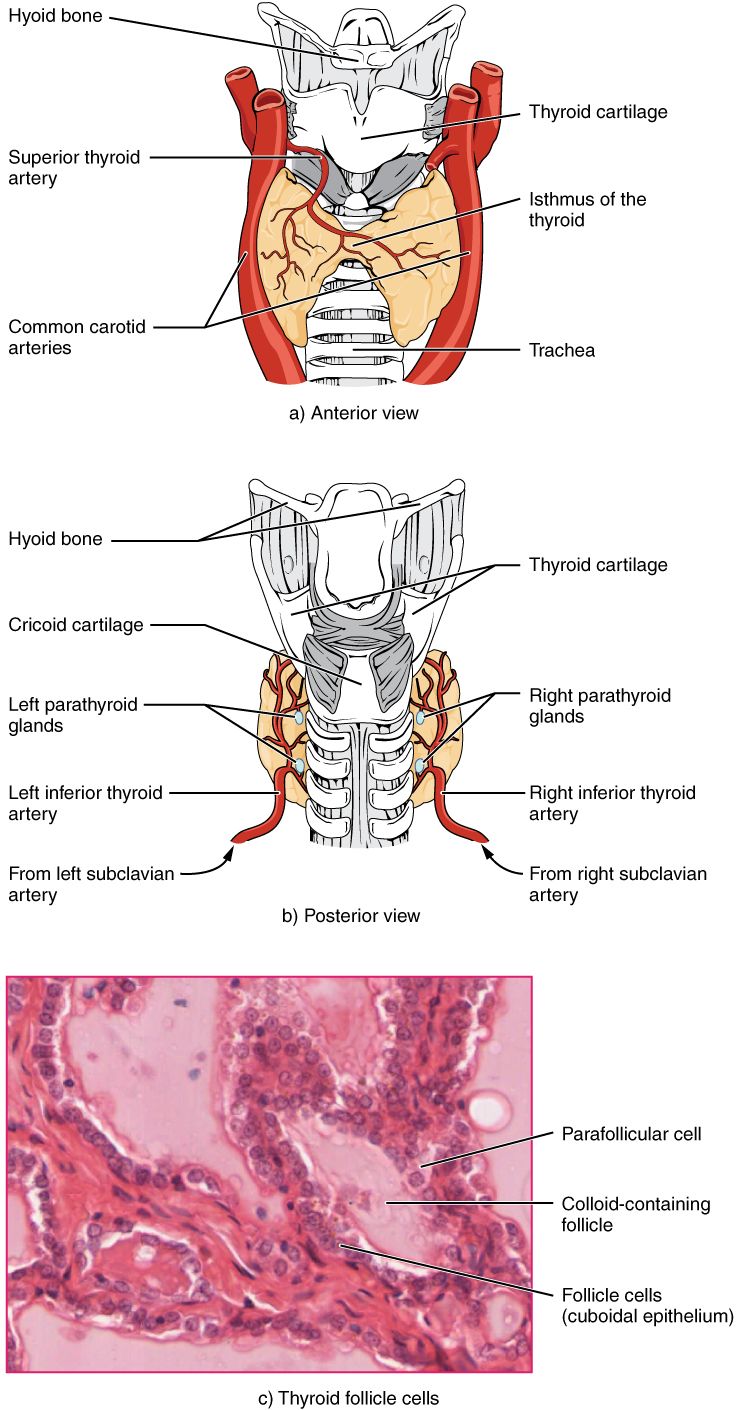
The gland that sets your idle speed
The thyroid gland is shaped like a butterfly. It wraps around the front of your windpipe. It makes thyroid hormone, which comes in two forms, T₃ and T₄. The numbers tell you how many iodine atoms each one has. That is why you need iodine in your diet to make them.
Thyroid hormone sets your basal metabolic rate. This is the speed at which almost every cell burns fuel and makes heat. Turn it up and the whole body runs faster and hotter. Turn it down and everything slows. It is like the idle speed of a car engine.
The feedback loop that keeps it steady
Thyroid hormone is controlled by a three-step chain. It is called the hypothalamus–pituitary–thyroid (HPT) axis. It is a classic negative feedback loop. First, the hypothalamus releases TRH (thyrotropin-releasing hormone). TRH tells the front lobe of the pituitary to release TSH (thyroid-stimulating hormone). TSH then tells the thyroid to release T₃ and T₄.
Here is the clever part. The thyroid hormones loop back and block both the hypothalamus and the pituitary. This turns down TRH and TSH. It works like a brake. When there is plenty of thyroid hormone, the brake keeps it from rising more. When thyroid hormone falls, the brake lets go. TSH rises and pushes the thyroid to work harder.
When the thyroid does too little or too much
Thyroid hormone sets the body's pace. So its problems look like the two ends of a dial. In hypothyroidism, there is too little hormone, and everything slows. You may see weight gain, tiredness, feeling cold, dry skin, and a slow heart rate. In hyperthyroidism, there is too much, and everything speeds up. You may see weight loss even with a big appetite. People feel hot and anxious, and the heart races. Both problems can make the gland swell into a lump you can see, called a goiter.
The feedback loop also helps doctors find the problem. Take primary hypothyroidism, where the thyroid itself is failing. It makes little hormone, so the brake lifts and TSH rises. That is why a high TSH points to an underactive thyroid.
| Sign | Hypothyroidism (too little) | Hyperthyroidism (too much) |
|---|---|---|
| Metabolic rate | Slower | Faster |
| Body weight | Gain | Loss |
| Temperature | Can't stand cold | Can't stand heat |
| Heart rate | Slow | Fast |
| Energy & mood | Tired, sluggish | Anxious, restless |
| TSH level (primary) | High | Low |
Run the interactive to see the normal loop. Then make the thyroid do too little or too much.
- Thyroid hormone (T₃/T₄, made with iodine) sets the body's basal metabolic rate, its idle speed.
- The HPT axis runs TRH → TSH → T₃/T₄. It is a negative feedback loop. Thyroid hormone blocks TRH and TSH.
- Hypothyroidism slows the body (weight gain, feeling cold, tiredness). Hyperthyroidism speeds it up (weight loss, feeling hot, racing heart).
- When the thyroid itself is the problem, TSH moves opposite to thyroid output. A high TSH signals an underactive gland.
Section 6The adrenal gland
Two glands stacked into one
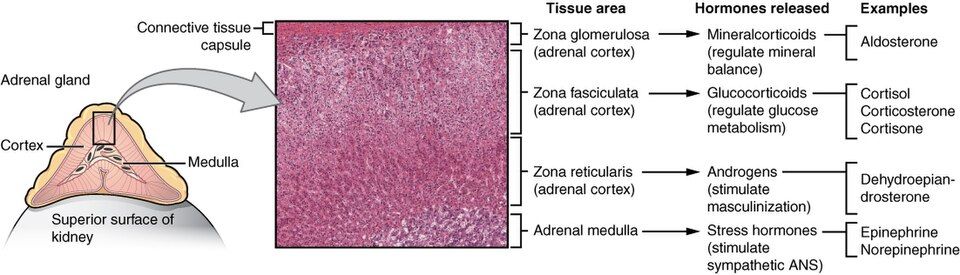
The adrenal gland sits like a cap on top of each kidney. It is really two different glands joined together. The outer part is the adrenal cortex. It makes steroid hormones, and you cannot live without it. The inner part is the adrenal medulla. It makes the catecholamines epinephrine and norepinephrine. The medulla is a direct part of the sympathetic nervous system, the "fight-or-flight" side of your nerves.
The two parts work on very different time scales. The medulla responds in seconds. The cortex takes minutes to hours. But both are key to how your body handles stress.
The cortex: three layers, three kinds of hormone
The cortex has three zones, or layers. Each one makes a different kind of steroid. This is a rare case where you can read the job straight off the layout, from the outside in.
The outer layer is the zona glomerulosa. It makes mineralocorticoids, which control salts. The main one is aldosterone. It tells the kidney to hold on to sodium (Na⁺) and water and to get rid of potassium (K⁺). This raises blood volume and blood pressure.
The wide middle layer is the zona fasciculata. It makes glucocorticoids, which affect sugar. The main one is cortisol, the body's main stress hormone. It raises blood sugar, frees up fuel, and calms swelling (inflammation). The inner layer is the zona reticularis. It makes small amounts of androgens. These are sex hormones such as DHEA.
The medulla: instant adrenaline
The medulla is at the very center. It is wired straight into the sympathetic nervous system. So it fires the moment a threat appears. It floods the blood with epinephrine (adrenaline) and norepinephrine. This causes the well-known fight-or-flight rush. Your heart pounds and your airways open wide. Sugar is released for fuel. Blood is sent to your muscles.
This is the fast, short part of the stress response. It is a jolt that fades within minutes. Cortisol, from the cortex, is the slow, steady part. It carries the body through long or repeated stress.
| Layer (outside → in) | Hormone type | Main hormone & effect |
|---|---|---|
| Zona glomerulosa | Mineralocorticoids | Aldosterone: keep Na⁺ & water, raise blood pressure |
| Zona fasciculata | Glucocorticoids | Cortisol: raise blood sugar, handle stress, reduce swelling |
| Zona reticularis | Androgens | DHEA: building blocks for sex hormones |
| Medulla | Catecholamines | Epinephrine: fast fight-or-flight rush |
Tap each layer of the gland in the interactive. Go from the outer cortex to the inner medulla.
- The adrenal gland is two glands in one. It has an outer cortex (steroids) and an inner medulla (catecholamines).
- Cortex zones, from outside in: glomerulosa → aldosterone (salt), fasciculata → cortisol (sugar and stress), reticularis → androgens (sex).
- The medulla is part of the sympathetic nervous system. It releases epinephrine for the fast fight-or-flight rush.
- Cortisol is the slow, steady stress hormone. Epinephrine is the fast one.
The chapter in one breath
- The endocrine system controls the body with hormones in the blood. It is slower than the nervous system, but it reaches more places and lasts longer. Its glands are ductless.
- A hormone reaches every cell. But it acts only on its target cells, which have the matching receptor.
- Lipid-soluble (steroid) hormones enter the cell and change genes. They are slow and lasting. Water-soluble (peptide/amine) hormones use surface receptors and a second messenger. They are fast and brief.
- The hypothalamus gives orders to the pituitary. The back lobe stores ADH and oxytocin. The front lobe makes six hormones, and four of them are tropic (FLAT PIG).
- The pancreatic islets balance blood sugar with an opposing pair. Insulin lowers it and glucagon raises it. Insulin is the only hormone that lowers it.
- The thyroid sets how fast you burn fuel through the HPT feedback axis. Too little hormone slows the body, and too much speeds it up. TSH moves opposite to thyroid output.
- The adrenal gland has a cortex wrapped around a medulla. The cortex makes aldosterone, cortisol, and androgens (salt, sugar, sex). The medulla makes epinephrine for the fast fight-or-flight rush.
ReferenceWords worth knowing
Here is a quick list of the terms in this chapter. Skim it now, or come back whenever a word trips you up.
- ACTH (adrenocorticotropic hormone)
- A tropic hormone from the front lobe of the pituitary. It tells the adrenal cortex to make cortisol.
- Adrenal cortex
- The outer part of the adrenal gland. Its three layers make steroid hormones: aldosterone, cortisol, and androgens.
- Adrenal medulla
- The inner core of the adrenal gland. It is part of the sympathetic nervous system and releases epinephrine and norepinephrine.
- Aldosterone
- A mineralocorticoid from the zona glomerulosa. It makes the kidney keep sodium and water, which raises blood pressure.
- Anterior pituitary
- The front lobe of the pituitary, made of gland tissue. It makes six hormones (GH, TSH, ACTH, FSH, LH, PRL) when the hypothalamus says so.
- Cortisol
- The main glucocorticoid, made in the zona fasciculata. It is the main long-acting stress hormone. It raises blood sugar and reduces swelling.
- Endocrine gland
- A gland with no duct that releases hormones straight into the blood. An exocrine gland, by contrast, uses a duct.
- Glucagon
- A hormone from the alpha cells of the pancreas. It raises blood sugar during fasting by breaking down glycogen and making new sugar.
- Glucocorticoid
- A type of adrenal steroid, mainly cortisol. It helps control blood sugar and the stress response.
- Hormone
- A chemical messenger that an endocrine gland releases into the blood. It acts on target cells far away.
- Hypothalamus
- The part of the brain that links the nervous and endocrine systems. It controls the pituitary gland.
- Insulin
- A hormone from the beta cells of the pancreas. It lowers blood sugar after a meal by helping cells take in sugar and store it as glycogen.
- Lipid-soluble hormone
- A hormone that dissolves in fat, such as a steroid or thyroid hormone. It crosses the cell membrane, binds receptors inside the cell, and changes which genes are active.
- Negative feedback
- A control loop where a hormone's output blocks its own making. This holds the value near a set point.
- Pancreatic islets
- Clusters of hormone-making cells in the pancreas. Beta cells make insulin, and alpha cells make glucagon.
- Posterior pituitary
- The back lobe of the pituitary, made of nerve tissue. It stores and releases ADH and oxytocin, which are made in the hypothalamus.
- Second messenger
- A relay molecule inside the cell, such as cyclic AMP. It passes on a water-soluble hormone's signal after the hormone binds a surface receptor.
- Steroid hormone
- A fat-soluble hormone built from cholesterol, such as cortisol, aldosterone, or a sex hormone. It acts on genes inside the cell.
- Target cell
- A cell that responds to a certain hormone because it has the matching receptor.
- Thyroid hormone
- The iodine-containing hormones T₃ and T₄. They set the body's basal metabolic rate.
- Tropic hormone
- A hormone whose target is another endocrine gland. Examples are TSH, ACTH, FSH, and LH.
- Water-soluble hormone
- A hormone that cannot enter the cell, such as a peptide, protein, or catecholamine. It works through a surface receptor and a second messenger.