Deontology and the Ethics of Duty
Chapter 3 left us with a nagging problem: if only outcomes matter, then a good enough outcome can license almost anything — a framed defendant, a harvested patient, a lie told for someone’s own good. Deontology is the family of theories that answers, flatly, no. Some acts are wrong in themselves, whatever they produce, because of what they do to the person on the receiving end. This chapter works through that claim carefully, mostly through Immanuel Kant, who gave it its most demanding form, and through the twentieth–century philosophers who repaired and reshaped it: W.D. Ross on conflicting duties, Judith Jarvis Thomson and Philippa Foot on the trolley cases, Christine Korsgaard on lying to murderers. You will meet the Nuremberg Code, the Tuskegee syphilis study, and the daily deontology of a signed consent form. By the end you should be able to run a moral problem through duty–based machinery and see exactly where it grips and where it slips.
By the end of this chapter you can
- Define deontology and explain how it differs from consequentialism in the structure of its reasoning, not just its verdicts.
- Distinguish a hypothetical imperative from a categorical imperative, and explain why Kant thought only the latter yields moral obligation.
- Apply the Formula of Universal Law and the Formula of Humanity to a concrete case and state what each one detects.
- Explain Kant’s notions of the good will, autonomy, and dignity, and why he denies that heteronomous motives have moral worth.
- Distinguish perfect from imperfect duties, and duties to others from duties to self.
- Use W.D. Ross’s prima facie duties to analyze a genuine conflict of obligations and identify the duty proper.
- Evaluate standard objections to deontology — rigorism, the murderer at the door, conflicting duties, empty formalism, moral luck — and state the strongest available reply.
- Explain threshold deontology, the doctrine of double effect, and the acts/omissions distinction, and say what each is doing argumentative work for.
- Trace how duty–based ethics shaped informed consent, the Nuremberg Code, and modern research regulation.
Section 1Why Outcomes Are Not the Whole Story
The complaint against consequences
Start with a case that has haunted moral philosophy since H.J. McCloskey posed a version of it in 1957. A town is on the edge of a riot; the mob will kill five innocent people unless someone is punished for a crime. The sheriff knows the real culprit has fled. He can frame an innocent man, hang him, and save five lives. A strict act utilitarian, counting only welfare, seems committed to the frame–up. Most people, including most utilitarians in their unguarded moments, find this monstrous — and not because they doubt the arithmetic. They find it monstrous because of what it does to the man in the cell. He is used. His life is spent as a means of crowd control, and nobody asked him.
That reaction is the seed of deontology, from the Greek deon, meaning duty or what is binding. Deontological theories hold that the rightness of an action is not determined solely by its consequences. Certain kinds of act — killing the innocent, lying, breaking a promise, using a person as a mere instrument — carry a moral character of their own. The term itself was coined by Jeremy Bentham, of all people, in manuscripts published after his death as Deontology (1834), though he meant something different by it; C.D. Broad gave it its modern sense in Five Types of Ethical Theory (1930).
Be careful about a common misreading. Deontologists are not indifferent to consequences. A surgeon who ignored outcomes would be a menace, not a Kantian. The claim is narrower and sharper: consequences are not the only thing that determines rightness, and some constraints hold even when violating them would produce more good. Philosophers call these agent–relative constraints. They are addressed to you, about what you may do, and they do not dissolve just because your violating them would prevent two other people from violating them. That last feature is what makes deontology genuinely strange to a consequentialist eye.
The paradox of deontology
Samuel Scheffler put the puzzle sharply in The Rejection of Consequentialism (1982). If killing an innocent person is a terrible thing, and what makes it terrible is something about the killing itself, why is it not better that there be fewer such killings in the world? Suppose you can prevent five murders only by committing one. A constraint against killing tells you not to. But then the theory seems to care more about keeping your own hands clean than about the value it claims to protect. Critics call this moral self–indulgence, a charge Bernard Williams examined and rejected in a 1976 essay of that name, later reprinted in his collection Moral Luck (1981).
The standard reply, developed by Frances Kamm and by Thomas Nagel, is that constraints are not about minimizing a quantity of badness in the world. They express a relation between you and the particular person in front of you. Nagel writes that when you aim at someone’s harm, you must, in the act, treat their resistance as an obstacle — you are pointed at them, and that is a distinct moral posture from failing to rescue. The value protected is not “fewer deaths” in the aggregate; it is the standing of each person not to be commandeered. Whether that reply fully works is one of the live fault lines in contemporary moral theory.
What a deontologist is committed to
Most deontological views combine three elements: a set of constraints (things you may not do), a set of duties (things you must do), and a set of options or prerogatives (space to pursue your own projects rather than maximizing good for everyone). That third element matters more than students expect. Utilitarianism is famously demanding — every spare dollar and hour is claimed by whoever needs it most. Deontology typically leaves you a life. You must not defraud your patients; you are not thereby obliged to work every waking hour.
| Question | Consequentialist answer | Deontological answer |
|---|---|---|
| What makes an act right? | It produces the best available outcome. | It conforms to a valid duty or constraint. |
| Where does moral value start? | In states of affairs — welfare, preference, wellbeing. | In persons and in acts — rational agents and what is done to them. |
| Can a good end justify a bad means? | In principle yes, if the sums come out right. | Not for acts falling under an absolute constraint. |
| May I do wrong to prevent more wrong? | Yes; that is simply minimizing. | Usually no; constraints are agent–relative. |
| How demanding is it? | Very — you must always maximize. | Moderate — duties bind, but leave personal room. |
| Typical failure mode | Justifying atrocities by arithmetic. | Rigid rule–following in the face of catastrophe. |
Deontology is the claim that some acts are right or wrong in virtue of what they are and whom they are done to, not solely in virtue of the outcomes they produce.
Section 2Kant: The Good Will and the Categorical Imperative
Nothing good without qualification except a good will
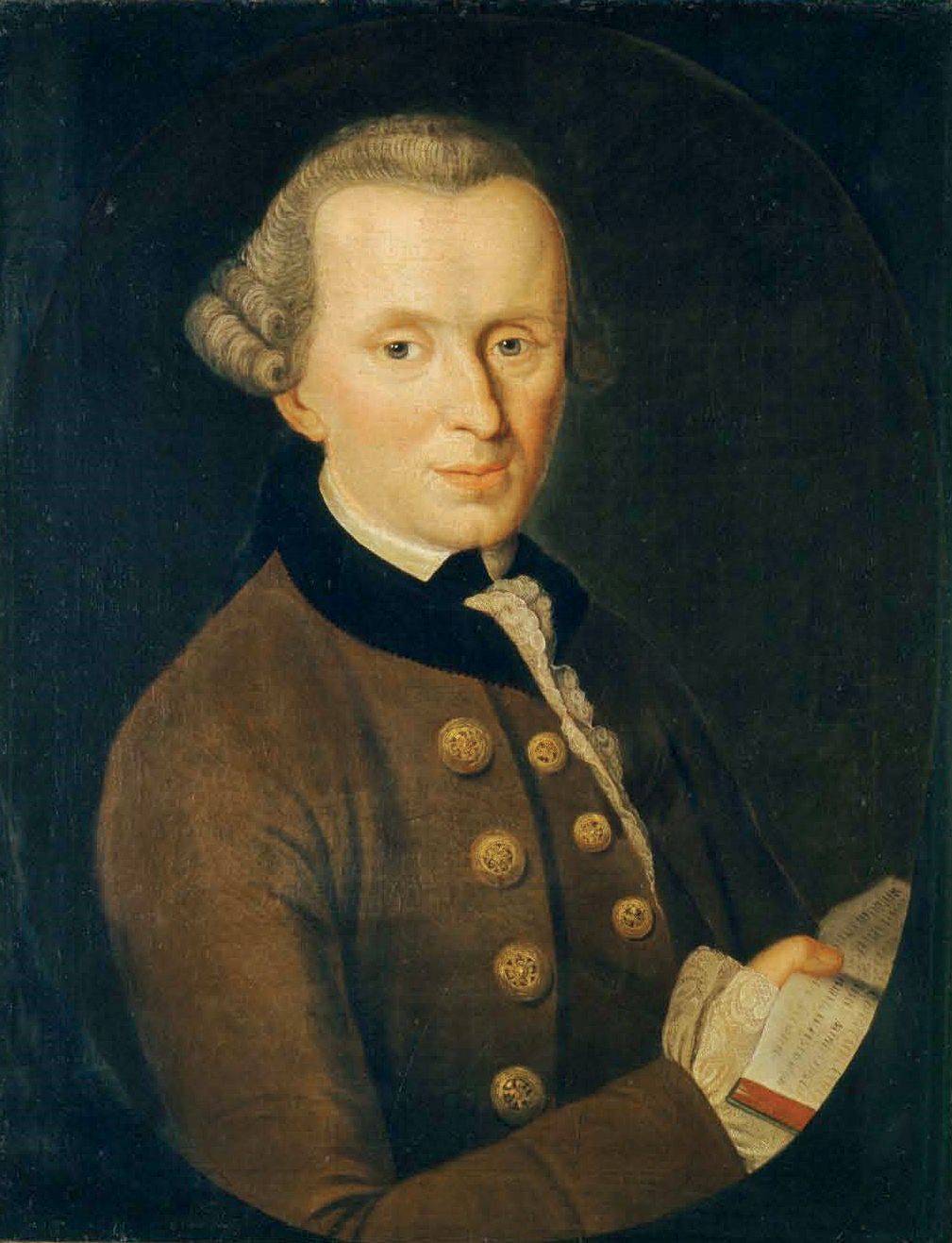
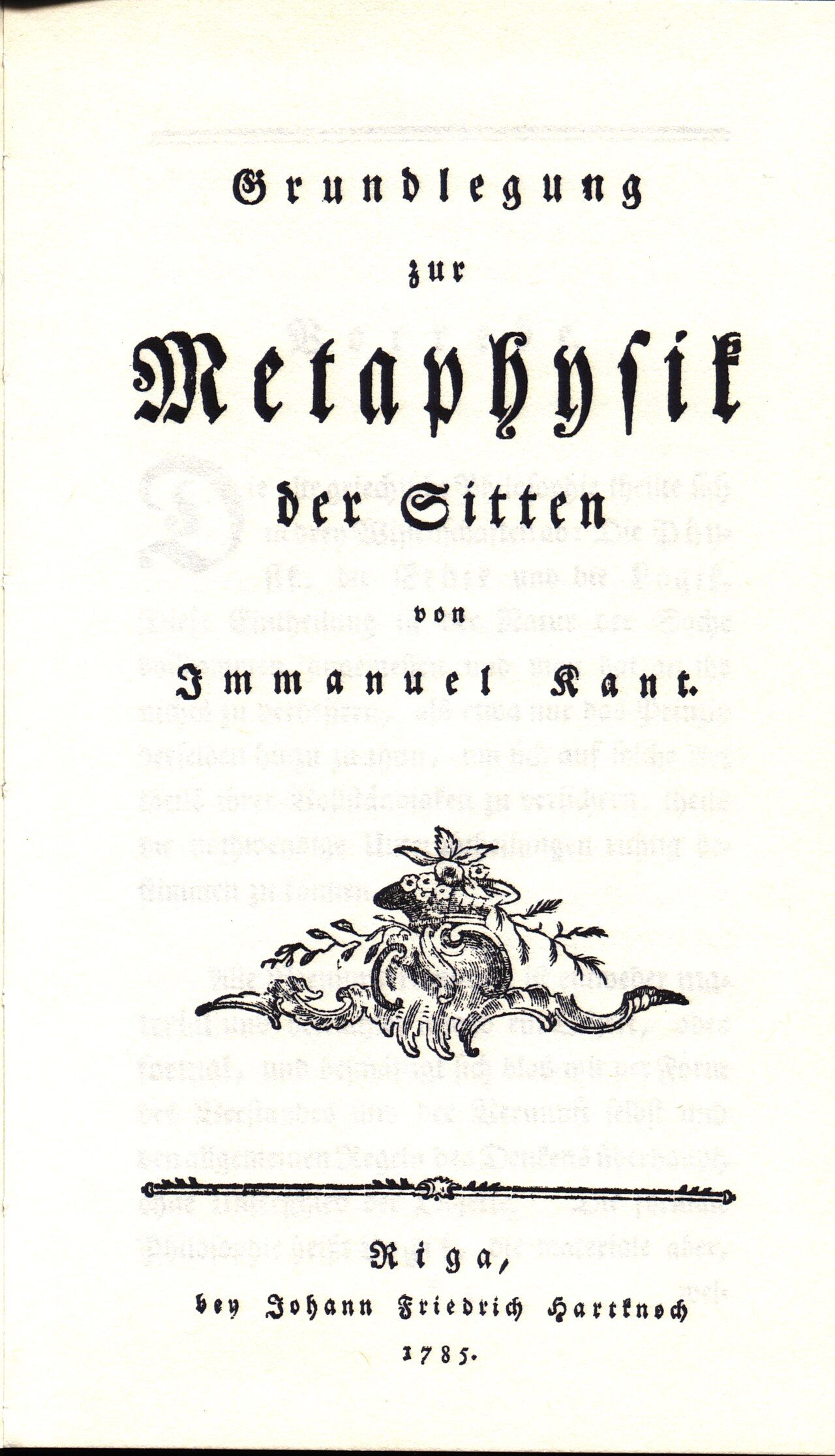
Immanuel Kant (1724–1804) spent his whole life in and around Königsberg, then the capital of East Prussia, and produced in 1785 a short book, the Groundwork of the Metaphysics of Morals, that reorganized moral philosophy around a single idea. It opens with one of the most quoted sentences in the discipline: nothing can be conceived in the world, or out of it, that can be called good without qualification except a good will. Intelligence, courage, wealth, even happiness can all be put to vicious use. A courageous villain is worse than a cowardly one. Only the will that acts from duty carries value that cannot be corrupted.
Kant then draws a distinction that trips people up on first reading. An act done in conformity with duty is not the same as an act done from duty. His example is a shopkeeper who charges honest prices — but only because cheating would ruin his reputation. He does the right thing; he does not act morally, because his motive is self–interest. Kant calls motives that come from outside reason — inclination, fear, desire, social pressure — heteronomous. Only when the will legislates the moral law to itself does it act autonomously, and only then does the action have moral worth.
This is a hard doctrine and it has been criticized since Friedrich Schiller mocked it in an epigram of 1796: must I despise my friends in order to help them from duty alone? Modern Kantians such as Barbara Herman and Marcia Baron read Kant more charitably. Duty need not be the felt motive on every occasion; it must be the limiting condition — the thing that would stop you if inclination pointed the wrong way. The kind nurse who genuinely likes her patients is not disqualified. She is disqualified only if her kindness would evaporate the moment she stopped liking someone.
Hypothetical and categorical imperatives
Kant observed that most practical advice takes a conditional form. “If you want to pass pharmacology, study the drug classes.” “If you want to avoid a lawsuit, document carefully.” These are hypothetical imperatives: they bind you only insofar as you hold the relevant end. Drop the end and the command dissolves. If you no longer care about passing, the advice has no grip.
Moral requirements do not work that way. “Do not falsify the chart” does not lapse if you stop caring about your license. It commands unconditionally. Kant calls such a command a categorical imperative, and he argues there is fundamentally only one, expressible in several formulations. The first, the Formula of Universal Law, runs: act only according to that maxim by which you can at the same time will that it should become a universal law.
The machinery is precise. A maxim is your subjective principle of action — roughly, what you are doing and why, stated as a policy. Not “I will borrow ten dollars,” but “whenever I need money, I will borrow it on a promise I know I cannot keep.” You then imagine that maxim as a law of nature that everyone follows, and ask whether it survives. Kant identifies two ways it can fail. A contradiction in conception occurs when universalizing the maxim destroys the very practice it depends on: if everyone made lying promises, promising would collapse and no one would accept your promise, so the maxim is self–defeating. A contradiction in the will occurs when you could coherently imagine the universalized world but could not rationally will it: a world where no one ever helps anyone is conceivable, but as a finite being who will sometimes need help, you cannot consistently will it.
The Formula of Humanity
The second major formulation is the one clinicians and lawyers reach for most: act so that you use humanity, whether in your own person or in that of another, always at the same time as an end, never merely as a means. This is the Formula of Humanity.
Note the word merely. Kant is not banning the use of other people; that would make ordinary life impossible. You use the pharmacist as a means to a prescription, the driver as a means to a destination. What you may not do is treat someone solely as an instrument — bypassing their rational agency, acting on them in a way to which they could not possibly consent. Deception and coercion are the paradigm violations. When you lie to someone, you cannot share your real maxim with them, because disclosing it would defeat it. Kant calls this the test of whether they could “contain in themselves the end of the action.”
From this Kant derives dignity. Things have a price and can be exchanged for an equivalent; persons have dignity, which admits of no equivalent. This is the philosophical taproot of every modern claim that a human being is not a commodity, and it flows directly into Article 1 of the German Basic Law of 1949 (“Human dignity shall be inviolable”) and the preamble to the 1948 Universal Declaration of Human Rights.
A third formulation, the Formula of the Kingdom of Ends, asks you to act as a legislating member of a community in which everyone is both author and subject of the law. Kant claims the formulations are equivalent; most scholars think they are at least not obviously so, and that the Formula of Humanity does the most practical work.
| Formulation | Test it applies | Catches | Worked example |
|---|---|---|---|
| Universal Law | Can the maxim be willed as a universal law without contradiction? | Free–riding, exceptions made for oneself | Falsifying one time sheet relies on everyone else’s being honest. |
| Humanity | Is anyone being used merely as a means? | Deception, coercion, bypassing consent | Enrolling a patient in a trial without telling them it is a trial. |
| Autonomy / Kingdom of Ends | Could I will this as law for a community of free rational beings? | Rules that only work if hidden | A billing practice you would never explain to the patient. |
For Kant, moral worth lies in a will that binds itself to a law it can universalize, and the deepest expression of that law is the requirement never to treat a rational being merely as an instrument.
Section 3Duties, Conflicts and W.D. Ross

Perfect and imperfect duties
Kant sorts duties along two axes, producing four boxes. The first axis is perfect versus imperfect. A perfect duty admits no exceptions and specifies exactly what you must not do: do not make lying promises, do not kill the innocent, do not commit suicide (Kant’s own contested example). An imperfect duty specifies an end you must adopt but leaves latitude in how and when: develop your talents, help others in need. You are not obliged to help every person on every occasion, but a policy of never helping anyone is forbidden. The second axis is duties to others versus duties to oneself — a category most contemporary ethicists find strange, but which Kant took seriously, because for him the moral law protects rational nature wherever it appears, including in you.
| Perfect duty (strict, no latitude) | Imperfect duty (meritorious, latitude) | |
|---|---|---|
| To self | Do not destroy yourself; do not degrade your rational agency | Cultivate your talents; do not let capacities rot |
| To others | Do not lie; do not make false promises; do not coerce | Beneficence — contribute to the ends of others |
The practical payoff is real. In a clinical setting, the duty not to deceive a patient is perfect: there is no latitude, no “I was busy.” The duty to advocate for patients beyond your assigned shift is imperfect: it is genuine, but you exercise judgment about when and how much. Confusing the two produces either burnout or misconduct, depending on which way you err.
Ross and prima facie duties
Kant’s system has an obvious weak spot. What happens when two perfect duties collide? Kant tended to deny it could really happen. Sir William David Ross (1877–1971), an Oxford philosopher best known outside ethics for translating Aristotle, thought this was plainly false to experience, and in The Right and the Good (1930) he built an alternative.
Ross proposed a plurality of prima facie duties — obligations that are real and that hold “other things being equal,” but that can be outweighed by a stronger duty in a given case. The name is unfortunate, and Ross apologized for it in the book itself: “prima facie” suggests mere appearance, whereas he meant something genuinely binding. Some writers prefer pro tanto duty. When duties conflict, one of them becomes your duty proper — the thing you actually ought to do, all things considered. The defeated duty does not vanish; Ross noted that it leaves what philosophers now call moral residue. You owe an explanation, an apology, sometimes compensation.
Crucially, Ross denied there is any master rule for ranking them. Weighing is a matter of judgment in the particular case — a position called moral intuitionism. Critics say this is an admission of defeat, a theory that tells you what matters and then shrugs. Defenders, including Robert Audi in more recent work, argue that this is simply honest: moral life does not come with an algorithm, and any theory that claims one is bluffing.
| Ross’s prima facie duty | What it requires | Everyday case |
|---|---|---|
| Fidelity | Keep promises; tell the truth | You said you would cover the shift |
| Reparation | Make good on harm you caused | You misplaced a colleague’s equipment |
| Gratitude | Return the good others have done you | A mentor who trained you now needs a reference |
| Justice | Distribute benefits and burdens fairly | Assigning the hardest patients to one nurse every night |
| Beneficence | Improve others’ condition | Sitting with a frightened patient past the end of a task |
| Self–improvement | Better your own virtue and knowledge | Keeping current with practice standards |
| Non–maleficence | Do not injure others | Refusing to give a drug you believe is wrongly dosed |
Working a conflict
Take a real–shaped case. A patient tells you, in confidence, that he intends to stop taking his anticoagulant and has not told the prescriber. Fidelity says keep his confidence. Non–maleficence and beneficence say the prescriber needs to know. A rigid Kantian reading gives you little traction, because the perfect duty here is not to lie, and staying silent is not lying. Ross gives you a vocabulary: confidentiality is a genuine duty; it is here outweighed by a serious and specific risk of harm; and the residue is real — you owe the patient an honest conversation about why you are breaking his confidence rather than doing it behind him. That last step is what separates a considered judgment from a rationalization.
Ross keeps deontology’s insight that duties are real and plural while conceding what Kant resisted — that duties genuinely conflict and must be weighed by judgment rather than by formula.
Section 4The Hard Cases: Lying, Trolleys and Thresholds

The murderer at the door
In 1797 Kant published a short, notorious essay, On a Supposed Right to Lie from Philanthropy, responding to the Swiss–French writer Benjamin Constant. Constant had argued that no one owes the truth to a would–be murderer asking where his intended victim is hiding. Kant disagreed. Truthfulness, he wrote, is an unconditional duty; lie to the murderer and you become responsible for whatever follows, including the possibility that your victim slipped out the back and the lie sends the murderer straight to him.
Almost no one finds this persuasive as stated, and it is the single most damaging exhibit against Kantian ethics. But the essay is more interesting than its reputation. Kant is partly making a legal point about liability under civil law rather than a purely moral one, and the 1797 essay is a polemic written by a man of seventy–three, not a considered part of the Groundwork. Christine Korsgaard argued in a well–known 1986 paper that Kant’s own Formula of Humanity gives a better answer than his Formula of Universal Law did: the murderer, by his own conduct, has placed himself outside the relation of mutual respect that grounds the duty of candor. Deception of someone who is already coercing you does not use them as a mere means in the objectionable way, because you are not undermining a rational agency they are currently exercising in good faith. Korsgaard concedes this is a repair, not an exegesis.
There is a further move worth knowing. Kant distinguishes a lie from a mere failure to disclose. You are rarely obliged to volunteer information. “I will not tell you” is not a lie, and in many real situations — a stalker calling a clinic, a family member fishing for a diagnosis — it is both honest and protective. Students who think Kantian ethics forces them to blurt everything have confused the duty not to deceive with a duty to disclose.
Trolleys, double effect and the acts/omissions line
Philippa Foot introduced the case in a 1967 paper on abortion and the doctrine of double effect, where the agent is the driver of a runaway tram who can steer onto a side track; Judith Jarvis Thomson developed it, named the trolley problem, and added the bystander–at–the–switch and footbridge variants in papers of 1976 and 1985. Take the version most people are shown. A runaway trolley will kill five workers. You, a bystander, can pull a lever diverting it to a side track where it kills one. Most people say pull. Now the footbridge variant: the only way to stop the trolley is to push a large man off a bridge into its path. Most people say do not push, even though the numbers are identical. Something other than arithmetic is doing the work.
Deontologists explain the gap with two tools. The doctrine of double effect, whose lineage runs back to Thomas Aquinas in the Summa Theologiae, distinguishes harm intended as a means or end from harm merely foreseen as a side effect. Divert the trolley and the one worker’s death is a foreseen side effect; if he miraculously stepped clear, you would be relieved and your plan would still work. Push the man and his body is the plan; if he bounced off harmlessly you would have failed. Thomson herself doubted that double effect explained the gap and kept looking for an account in terms of rights; but the feature she fastened on — that the footbridge case uses a person’s body as a physical instrument — is the Formula of Humanity violation in its purest form.
The acts/omissions distinction is the second tool: killing is generally held to be worse than letting die, other things equal. James Rachels attacked this directly in a famous 1975 New England Journal of Medicine paper, with a pair of cases — Smith drowns his young cousin in the bath; Jones intends to but finds the child already drowning and merely watches. Our judgments of the two men are identical, Rachels argues, so the bare act/omission difference cannot carry moral weight. Defenders reply that Rachels has held motive fixed at “murderous” and thereby smuggled the difference out of view; in ordinary cases, motive, effort, and the number of people who could have acted all differ.
| Condition of double effect | What it demands | Clinical illustration |
|---|---|---|
| The act itself is not wrong | Independently permissible or neutral | Giving morphine for pain is a legitimate act |
| Good effect is intended | Bad effect is foreseen, not aimed at | Relief of pain is the goal, not death |
| Bad effect is not the means | Good does not come through the harm | Comfort does not arrive by way of respiratory depression |
| Proportionality | Grave enough reason for the risk | Refractory pain at the end of life, not mild discomfort |
Thresholds and absolutes
Suppose a constraint against torture. Now suppose a device that will kill a million people, and one man who knows the code. Absolutists say the constraint holds regardless. Elizabeth Anscombe held that line fiercely: better known as a founder of modern virtue ethics, she also insisted on absolute prohibitions, and she protested Oxford’s 1956 decision to give Harry Truman an honorary degree on the grounds that he had ordered the deliberate killing of civilians. Threshold deontology, associated with Michael Moore and discussed by Nozick as “catastrophic moral horror,” says constraints hold up to some very high threshold and then give way.
Threshold views are practically attractive and theoretically awkward. Where exactly is the line? If a thousand deaths are not enough and a million are, what happens at 999,999? Any answer looks arbitrary, and once the constraint can be outweighed, it starts to look like a very heavy consequentialist weight rather than a constraint at all. The argument is unfinished. Being able to state the cost of each position is worth more than picking one and defending it reflexively.
The hard cases show that deontology’s power comes from distinctions — intending versus foreseeing, doing versus allowing, using versus harming — and that each of those distinctions is defensible but contested.
Section 5Duty in Practice: Consent, Rights and Professional Life
From Nuremberg to the consent form
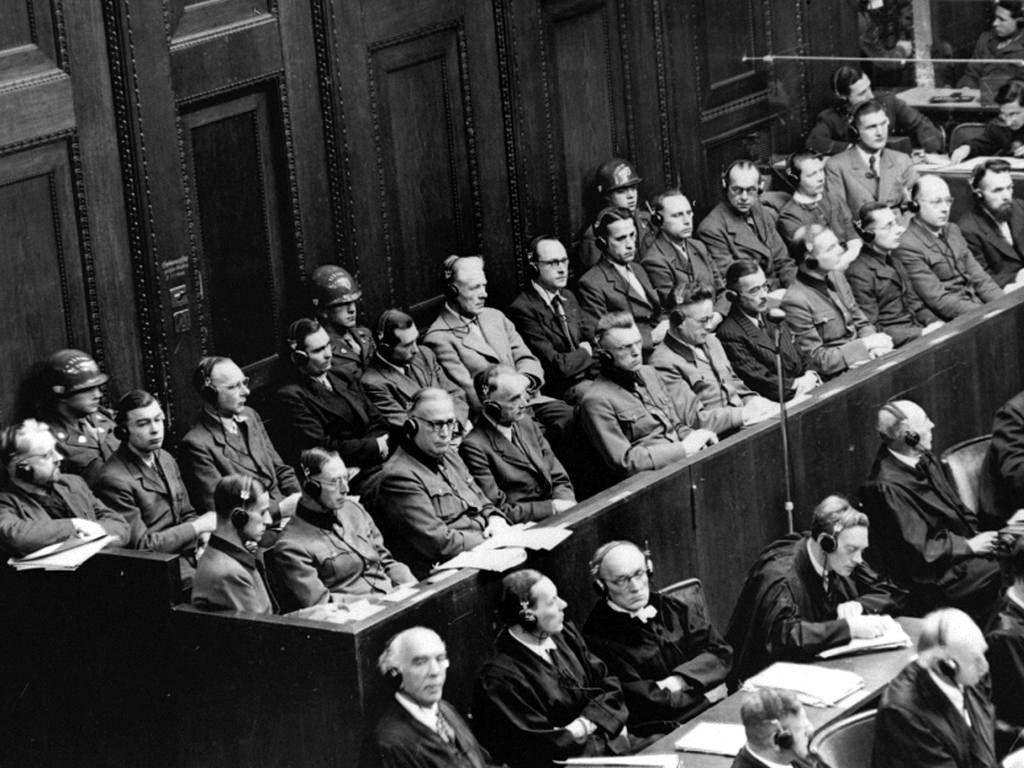
The most consequential deontological document of the twentieth century was written by judges, not philosophers. At the Doctors’ Trial in Nuremberg, twenty–three German physicians and administrators were tried for experiments on concentration camp prisoners — freezing, high–altitude, seawater and infection studies conducted without consent and frequently to the point of death. Sixteen were convicted; seven were hanged in June 1948. In their August 1947 judgment the tribunal set out ten principles now called the Nuremberg Code. Its first sentence is uncompromising: the voluntary consent of the human subject is absolutely essential.
Read that as philosophy and it is pure Formula of Humanity. Note what the Code does not say. It does not say that experiments must produce enough scientific benefit to outweigh the suffering. It refuses the trade at the outset, because the subject is a person and not a resource. That refusal is the deontological move in its clearest institutional form.
It took the United States decades to absorb the lesson. The Tuskegee Study of Untreated Syphilis in the Negro Male ran from 1932 to 1972 under the U.S. Public Health Service, enrolling roughly 600 Black men in Macon County, Alabama, about 400 with latent syphilis. They were told they were being treated for “bad blood.” They were not treated. When penicillin became the standard cure in the late 1940s, it was withheld, and investigators actively worked to keep subjects from getting it elsewhere. The study ended only after Peter Buxtun, a PHS venereal disease investigator whose internal complaints had gone nowhere, passed the story to the press, and Jean Heller’s account appeared in July 1972. The resulting National Research Act of 1974 put institutional review boards on a statutory footing and created the commission that produced the Belmont Report in 1979 — respect for persons, beneficence, justice. Chapter 8 takes up those principles in detail; what matters here is the lineage. The consent form on a clipboard is a piece of applied Kantianism with a body count behind it.
Rights as the political face of duty
Deontology and rights talk are close kin. If I have a duty not to deceive you, you have a corresponding claim against me. Wesley Hohfeld’s analysis, published in the Yale Law Journal in 1913 and 1917, disentangled the vocabulary that lawyers and ethicists still use: a claim right correlates with someone’s duty; a liberty is merely the absence of a duty not to; a power changes legal relations; an immunity protects you from someone else’s power.
Robert Nozick, in Anarchy, State, and Utopia (1974), made the connection explicit with his phrase side constraints: rights are not goals to be maximized but boundaries on what may be done to individuals, and he traced the idea straight to Kant. John Rawls, though he built a very different theory in A Theory of Justice (1971), also placed himself in the Kantian tradition, arguing that principles of justice are what free and equal persons would choose behind a veil of ignorance. Chapter 6 develops these. The point here is that when a nurse says “the patient has a right to refuse,” she is speaking the descendant language of duty–based ethics, and the sentence means the refusal is not up for cost–benefit review.
What duty ethics gets right, and where it strains
The strengths are considerable. Deontology explains the moral weight of promises and consent better than any rival. It gives a principled account of why the vulnerable may not be sacrificed to majorities — the single most important safeguard in research and clinical ethics. It builds in equality: every rational being has the same dignity, and no one’s interests get extra weight for being clever or popular or rich. And it is honest about the limits of calculation, which matters in a profession where you rarely have the data a utilitarian calculation would need.
The strains are equally real. Duties conflict and the theory struggles to adjudicate. Rigid application produces monstrous results in extreme cases. Anscombe’s 1958 essay “Modern Moral Philosophy” pressed a deeper worry: talk of moral “obligation” and “law” may be a leftover from a religious framework, and without a lawgiver the notion of a law nobody legislated is incoherent. Kantians reply that reason itself is the legislator; whether that reply succeeds is a genuine open question. And there is moral luck, pressed by Bernard Williams and Thomas Nagel in a 1976 symposium: Kant insists the good will shines “like a jewel” regardless of results, yet we plainly do judge the drunk driver who kills differently from the drunk driver who gets home. Either our practice is confused or the theory is incomplete.
Most working ethicists are not card–carrying anythings. They use deontology to fix the boundaries — consent, honesty, non–exploitation — and then reason consequentially within them about how to do the most good. That is not intellectual cowardice; it is close to what Ross described, and it is how the four–principles framework in Chapter 8 actually functions in a hospital.
Informed consent, human rights and professional codes are duty–based ethics made institutional — they exist precisely to take certain harms off the negotiating table.
The chapter in one breath
Deontology begins from a refusal: the good end does not sanctify every means, because persons are not resources. Kant gave the refusal a rigorous form. Moral worth lies in the good will, in acting from duty rather than inclination; moral requirements are categorical rather than conditional on what you happen to want; and the supreme principle can be stated either as universalizability — act only on maxims you could will as law — or as the requirement never to treat humanity merely as a means. From these he derived perfect and imperfect duties, autonomy, and the dignity that has no price. Ross then repaired the system’s worst weakness by admitting that plural duties genuinely conflict and must be weighed by judgment, leaving moral residue when one loses. The hard cases — the murderer at the door, the footbridge, the ticking bomb — test the distinctions deontology depends on: intending versus foreseeing, doing versus allowing, absolute constraint versus threshold. None of those disputes is closed. What is settled is the institutional legacy: Nuremberg, the Belmont Report, informed consent, and the ordinary, unglamorous rule that a patient’s refusal is not subject to anyone else’s cost–benefit analysis.
Words worth knowing
| Term | What it means |
|---|---|
| Deontology | The family of theories holding that rightness depends on duties and constraints, not solely on consequences. |
| Good will | Kant’s term for a will that acts from duty; the only thing good without qualification. |
| Maxim | The subjective principle of an action — what you are doing and why, stated as a policy. |
| Hypothetical imperative | A command binding only if you hold a particular end (“if you want X, do Y”). |
| Categorical imperative | A command binding unconditionally on any rational agent, regardless of desires. |
| Formula of Universal Law | Act only on a maxim you can will to become a universal law without contradiction. |
| Formula of Humanity | Treat humanity always as an end, never merely as a means. |
| Autonomy / heteronomy | Self–legislation by reason, versus being governed by inclination or external pressure. |
| Dignity | The value of a rational being, which admits of no equivalent and cannot be traded for a price. |
| Perfect duty | A strict duty with no latitude, usually a prohibition (do not lie, do not coerce). |
| Imperfect duty | A duty to adopt an end, leaving latitude in how and when to act on it (beneficence, self–improvement). |
| Prima facie duty | Ross’s term for a real obligation that can be outweighed by a stronger one in a given case. |
| Duty proper | What you ought to do all things considered, after weighing competing prima facie duties. |
| Moral residue | The obligation that remains — apology, explanation, repair — when a genuine duty is overridden. |
| Agent–relative constraint | A restriction on what you may do, which does not dissolve even to prevent more violations by others. |
| Doctrine of double effect | The view that harm intended as means or end is worse than equivalent harm merely foreseen. |
| Acts/omissions distinction | The claim that killing is generally morally worse than allowing to die, other things equal. |
| Threshold deontology | The view that constraints hold absolutely until consequences become catastrophic, then give way. |
| Side constraint | Nozick’s term for a right that bounds permissible action rather than functioning as a goal to maximize. |
| Moral luck | The problem that we judge agents by outcomes beyond their control, which duty ethics says should not matter. |