The Microbial World and Why It Matters
You are outnumbered. For every human cell you carry, you also carry about one bacterial cell. Almost all of them are harmless, and many are helpful. Microbiology is the study of that invisible world. It covers the bacteria, viruses, fungi, and parasites that share your body. A few of them cause disease. This chapter introduces the main groups. It shows the difference between a microbe that lives with you and one that harms you. It tells how we learned that germs cause disease. It also shows how those germs get their names. The rest of the book grows out of these first few ideas.
By the end of this chapter you can
- Define microbiology and name the major groups of microorganisms.
- Tell cellular microbes from acellular ones, and prokaryotic cells from eukaryotic cells.
- Explain the human microbiome, and compare normal flora, opportunistic pathogens, and true pathogens.
- Tell colonization, infection, and disease apart, and say why the difference changes what gets treated.
- Sum up the germ theory of disease and the work of Semmelweis, Pasteur, and Koch.
- State Koch's postulates and say what they are for.
- Write and read a microbe's binomial name, and place organisms in the three-domain system.
Section 1Meet the microbes
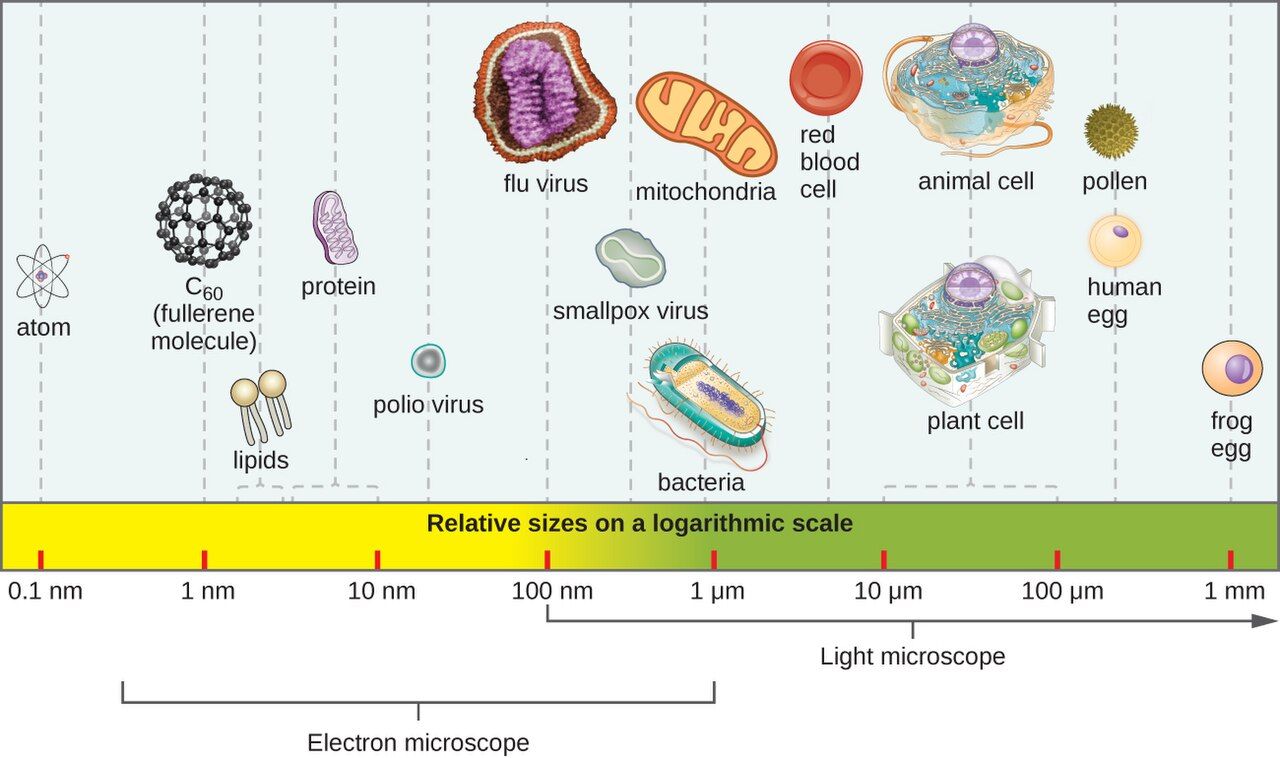
What counts as a microbe
A microorganism, or microbe, is a living thing too small to see with the naked eye. You need a microscope. That one size rule sweeps up a wildly mixed crowd. The organisms in it are not close relatives. So microbiology starts by sorting the crowd into a handful of families. The family a microbe belongs to tells you most of what matters in the clinic. It tells you how the microbe is built and how it grows. It tells you what disease it causes. Best of all, it tells you which drugs can kill it.
The main groups
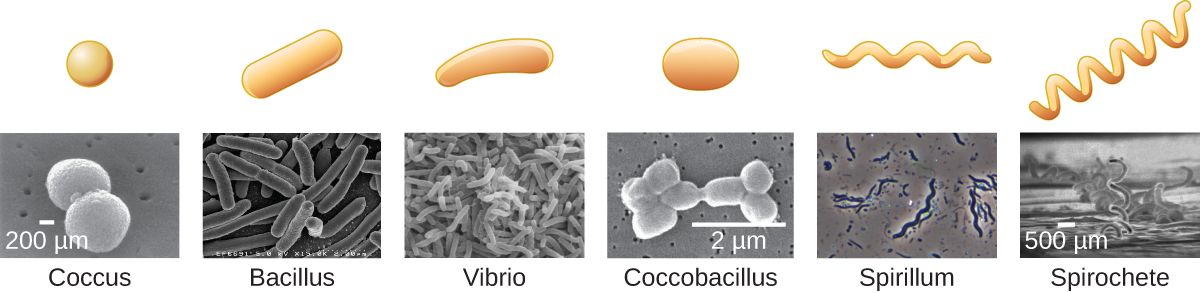
Microbes split first into two camps. Cellular organisms are made of one or more true cells. Acellular agents are not cells at all. Among the cellular microbes, the deepest split is next. A prokaryote is a small, simple cell with no nucleus. A eukaryote is a bigger cell that keeps its DNA inside a nucleus. A nucleus is a pouch made of membrane. Your own cells are eukaryotes, so they have one.
| Group | Cell type | Key features | Example disease |
|---|---|---|---|
| Bacteria | Prokaryote | Single-celled, no nucleus; huge variety; many are our normal flora | Strep throat, UTIs, TB |
| Archaea | Prokaryote | Prokaryotes of extreme places; none are known to cause human disease | — |
| Fungi | Eukaryote | Yeasts (single cells) and molds (long threads called hyphae) | Thrush (Candida), ringworm |
| Protozoa | Eukaryote | Single-celled eukaryotic microorganisms (protists); often able to swim; many are parasites | Malaria, giardiasis |
| Helminths | Eukaryote (animal) | Parasitic worms. The adults are not micro, but their eggs and larvae are, so they are studied here | Pinworm, tapeworm |
| Viruses | Acellular | Genetic material in a protein coat; must take over a host cell to copy itself | Influenza, COVID-19, HIV |
Hold the prokaryote and eukaryote line firmly in mind. It is the reason many drugs are safe to give. An antibiotic is a drug that attacks bacteria. Many antibiotics hit a part that only a bacterial cell has. The cell wall is one such part. The bacterial ribosome is another. A ribosome is the tiny machine a cell uses to build proteins, and the bacterial model is put together differently from yours. So the drug can clear the infection and leave human cells alone. That idea has a name. It is called selective toxicity, and it is the whole reason drug therapy for infection works at all.
Tap through the six groups of microbes below.
- A microbe is any organism too small to see unaided.
- Cellular microbes are bacteria, archaea, fungi, and protozoa. Helminths join the list by tradition. Viruses are acellular.
- Prokaryotes (bacteria, archaea) have no nucleus. Eukaryotes (fungi, protozoa) have one.
- Selective toxicity means hitting a target only the microbe has. It is why these drugs can cure without poisoning the person.
Section 2Microbes on and in us
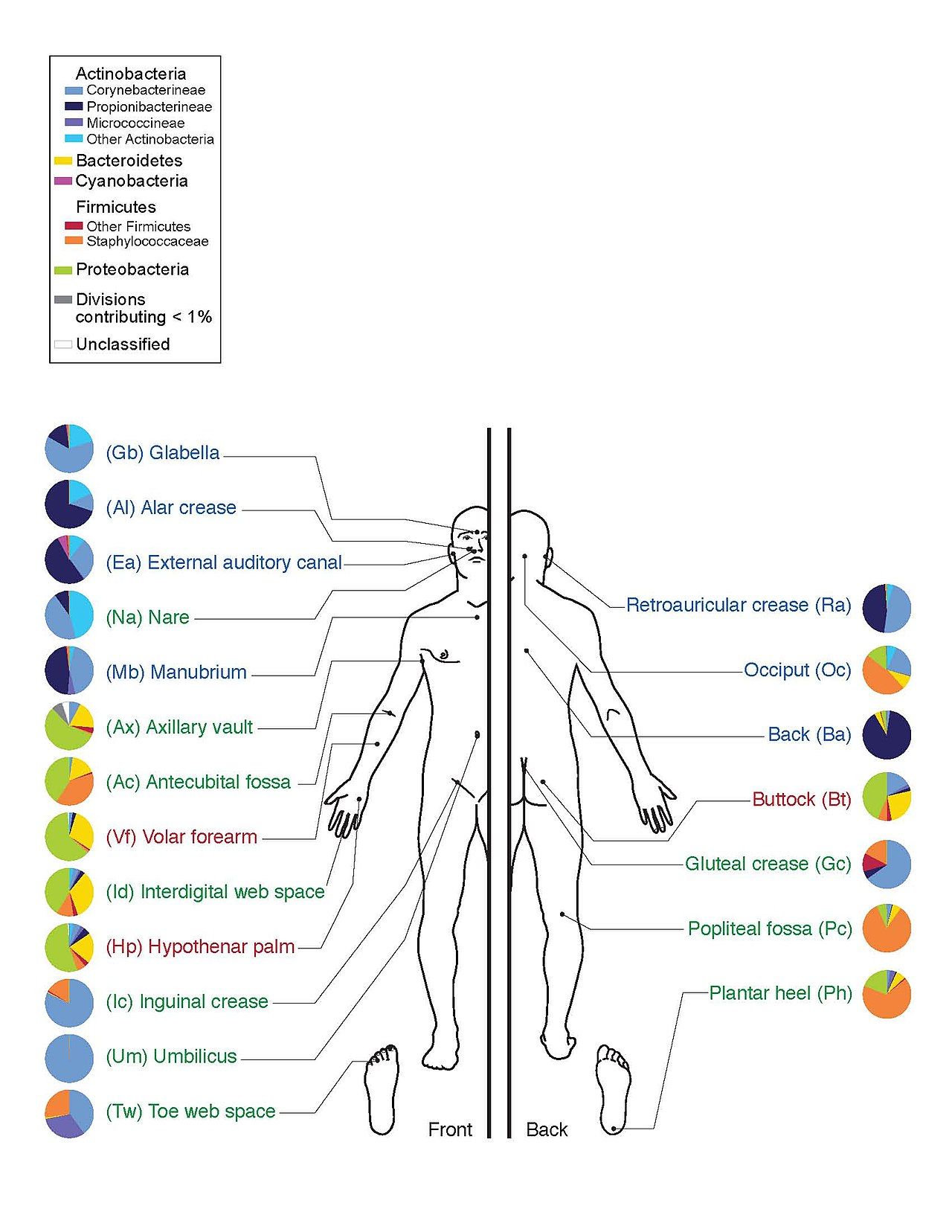
The microbiome: your resident microbes
You are not sterile, and you were never meant to be. Trillions of microbes live on your skin and in your mouth, gut, and other surfaces. The microbes themselves are the microbiota. The microbiota plus all of their genes is the microbiome. They move in from the day you are born. These normal flora are not freeloaders. They earn their keep. Gut bacteria make vitamin K and some B vitamins. They crowd out invaders by filling the space and eating the food first. That crowding has a name, competitive exclusion. They also help train a young immune system to tell friend from foe.
Flora come in two flavors. Resident flora live with you for the long run, and they move back in if something disturbs them. Transient flora are only passing through. You pick them up from a doorknob or a bedrail. This is the group that hand hygiene is built to remove. Washing lifts them off before they reach the next person.
When a good microbe goes bad
Many infections that start in a care setting are not exotic invaders at all. They come from the person's own normal flora. The microbe has not changed. Its chance has. An opportunistic pathogen causes no trouble in its usual home. It causes disease once it moves somewhere new, once the normal flora are wiped out, or once the body's defenses drop. Escherichia coli is harmless in the colon, yet it causes a urinary tract infection if it reaches the bladder. Candida is a yeast that overgrows into thrush when antibiotics clear away its bacterial rivals. Clostridioides difficile blooms into a severe colitis, which is an inflamed colon, after antibiotics flatten the gut community.
| What normal flora do | Why it matters |
|---|---|
| Make vitamin K & some B vitamins | Nutrition; vitamin K is needed for clotting |
| Competitive exclusion of pathogens | They crowd out invaders by space and by chemistry |
| Train the immune system | Early contact sets up balanced immune responses |
| Keep a low pH or a harsh niche | Vaginal lactobacilli hold the pH low, which blocks pathogens |
Explore where your normal flora live.
- The microbiome is the community of microbes that normally live on and in the body.
- Normal flora are mostly helpful. They supply nutrients, crowd out invaders, and train the immune system.
- Opportunistic pathogens are normal flora that cause disease once they are moved, left unopposed, or facing a weakened host.
- Removing transient flora is the entire point of hand hygiene.
Section 3When microbes cause disease
Colonization, infection, disease
Everyday speech uses these three words loosely. In the clinic they mean three different things. Mixing them up leads to over-treatment. Colonization means a microbe is present and multiplying on a body surface. It does no harm, and there are no symptoms. Infection means a microbe has invaded tissue and the body has begun to answer it. Disease is one step further. The infection now shows clear signs and symptoms, and it gets in the way of normal function.
The difference is intensely practical. Picture a wound swab that grows bacteria. If there is no redness, no warmth, and no fever, that is usually colonization. Antibiotics for that do harm with no benefit. A pathogen is any microbe able to cause disease. Pathogenicity is that ability. Virulence is the degree, so it is how much harm the microbe can do. Chapter 10 opens up the machinery behind virulence.
| State | Microbe present? | Host responding? | Symptoms? |
|---|---|---|---|
| Colonization | Yes (multiplying) | No | No |
| Infection | Yes (invading) | Yes | Not necessarily |
| Disease | Yes | Yes | Yes — signs & symptoms |
Why this matters in health care
Infection is one of the most common threats to someone in a hospital. It is also one of the most preventable. A healthcare-associated infection (HAI) is an infection picked up while receiving care. The common ones are catheter-associated urinary tract infections, central-line bloodstream infections, surgical-site infections, and ventilator-associated pneumonia. On any given day, about one in every thirty-one hospital patients has at least one HAI. Most of that spread travels on hands. So small, repeated habits decide the outcome. Every hand wash counts. So does every sterile field, and every catheter taken out a day sooner.
Step through the three clinical states below.
- Colonization (present, no harm) is not infection (invading, host responding), and neither is disease (symptoms and lost function).
- A pathogen can cause disease. Virulence is how much harm it does.
- HAIs are common and largely preventable, and hand hygiene is the front line.
Section 4How we found out microbes cause disease
From bad air to germ theory
For most of history, people blamed disease on miasma, which simply means bad air. Others believed in spontaneous generation. That is the idea that life springs out of non-living matter on its own. The germ theory of disease says something very different. Specific microbes cause specific diseases. That idea is only about 150 years old. It is the base under every infection control rule in use today.
Three people worth knowing
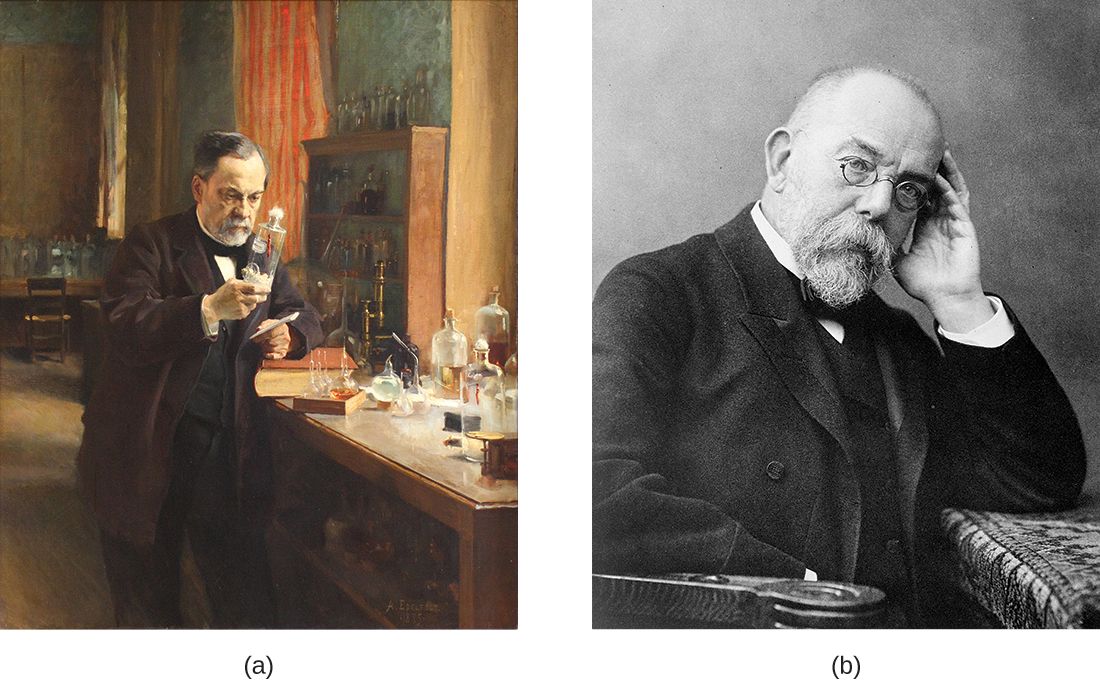
Ignaz Semmelweis was a Hungarian doctor working in Vienna in the 1840s. He delivered babies, and he counted deaths. Mothers died of childbed fever far more often on the ward staffed by doctors. Those doctors came straight from autopsies. The ward staffed by midwives was much safer. Semmelweis ordered handwashing in a chlorine solution, and the death rate dropped sharply. He could not explain why it worked, since germ theory did not exist yet. His colleagues ridiculed him and threw out his advice. Today he is remembered as the father of hand hygiene.
Louis Pasteur put an end to spontaneous generation. He used flasks with long, curved swan necks. Broth inside stayed clear until microbes from the air could reach it. He gave us pasteurization, a gentle heating that kills spoilage microbes. He also showed that microbes drive fermentation and spoilage. Robert Koch then supplied the rigor. He worked out an orderly way to prove that one microbe causes one disease. Those steps are now called Koch's postulates.
| Koch's postulate | In plain words |
|---|---|
| 1 | The microbe is found in every case of the disease, and absent in healthy hosts |
| 2 | It can be isolated from a sick host and grown in pure culture |
| 3 | The cultured microbe causes the same disease when introduced into a healthy host |
| 4 | The same microbe can be re-isolated from that newly diseased host |
Walk through Koch's four-step proof below.
- Germ theory says specific microbes cause specific diseases. It is the basis of all infection control.
- Semmelweis gave us hand hygiene. Pasteur disproved spontaneous generation and gave us pasteurization. Koch gave us the postulates that link a microbe to a disease.
- Koch's postulates are the logical test for proving that a given microbe causes a given disease.
Section 5Naming and classifying microbes
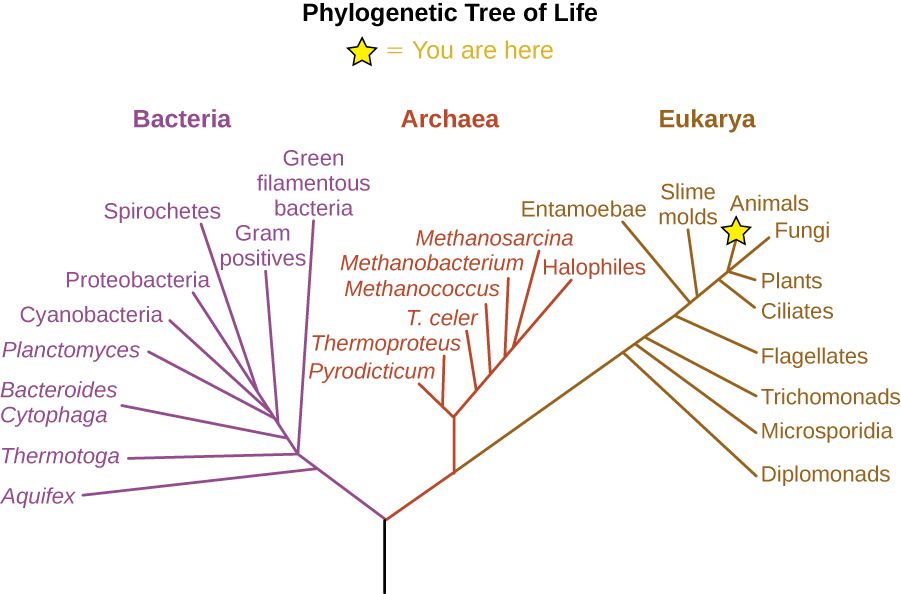
The three domains
Every living organism belongs to one of three great domains. Carl Woese worked the scheme out by comparing ribosomal RNA, the RNA found inside ribosomes. Two of the domains hold prokaryotes. They are Bacteria and Archaea. The third is Eukarya, and it holds everything with a nucleus. That means protozoa, fungi, plants, animals, and you. Notice where the microbes land. Bacteria get a whole domain to themselves. Archaea get a second one. The microbial eukaryotes, the fungi and protozoa, sit beside us in the third. Viruses are not cells, so they get no spot on this tree of life at all.
Place real organisms on the tree of life below.
Binomial names, and how to read them
Every organism gets a two-part Latin name. The system is called binomial nomenclature, and it comes from Carl Linnaeus. The first word is the genus, and it is capitalized. The second word is the species, and it stays lowercase. The whole name is written in italics: Staphylococcus aureus, Escherichia coli, Clostridioides difficile. Once the full name has appeared, shorten the genus to its first letter. So you get S. aureus, E. coli, and C. difficile, which many people say as C. diff. Charts, culture reports, and handoff notes all assume you can read these names without slowing down.
| Domain | Cell type | Members | Human disease? |
|---|---|---|---|
| Bacteria | Prokaryote | True bacteria | Yes — most bacterial pathogens |
| Archaea | Prokaryote | Extremophiles & others | No known pathogens |
| Eukarya | Eukaryote | Protozoa, fungi, plants, animals | Yes — fungi, protozoa, helminths |
Decode a few real microbe names below.
- All life falls into three domains: Bacteria, Archaea (both prokaryotic), and Eukarya.
- Viruses are acellular, so they are not on the tree of life.
- Binomial names are Genus species, written in italics, and shortened to G. species after the first use.
The chapter in one breath
- Microbes are organisms too small to see: bacteria, archaea, fungi, protozoa, helminths, and the acellular viruses.
- The prokaryote and eukaryote divide is what makes selective toxicity possible. That is why these drugs can cure without harming the host, and why antibiotics do nothing to viruses.
- The microbiome of normal flora is mostly helpful. Opportunistic pathogens are normal flora that harm once they are displaced or left unopposed.
- Colonization is not infection, and infection is not disease. A pathogen can cause disease, and virulence is how much harm it does.
- HAIs are common and preventable, and hand hygiene is the most powerful infection control tool there is.
- Germ theory came from Semmelweis, Pasteur, and Koch, and it grounds all infection control. Koch's postulates prove that a microbe causes a disease.
- Life sorts into three domains. Microbes carry italic binomial names that get shortened after the first use.
ReferenceWords worth knowing
Here is a quick reference for the terms in this chapter. Skim it now, or circle back whenever a word trips you up.
- Acellular
- Not made of cells. It describes viruses, viroids, and prions.
- Archaea
- A domain of prokaryotes separate from bacteria. None are known to cause human disease.
- Bacteria
- A domain of single-celled prokaryotes. They are the source of most bacterial infections and much of our normal flora.
- Binomial nomenclature
- The two-part naming system, italic Genus species, used for every organism.
- Colonization
- A microbe present and multiplying on a body surface, with no harm and no symptoms.
- Domain
- The top level of classification: Bacteria, Archaea, or Eukarya.
- Disease
- An infection that shows clear signs and symptoms and gets in the way of normal function.
- Eukaryote
- A cell, or an organism, that keeps its DNA inside a membrane-bound nucleus. Fungi and protozoa are included.
- Germ theory of disease
- The principle that specific microorganisms cause specific diseases.
- Healthcare-associated infection (HAI)
- An infection picked up while receiving care, such as a CAUTI, a CLABSI, or a surgical-site infection.
- Infection
- A microbe invading body tissue, plus the host's response to it.
- Koch's postulates
- Four tests used to show that one particular microbe causes one particular disease.
- Microbiome
- The community of microbes that normally live on and in the body, together with their genes.
- Microorganism (microbe)
- Any living organism too small to see without a microscope.
- Normal flora (microbiota)
- The resident microbes of a healthy body. Most of them are helpful.
- Opportunistic pathogen
- A normally harmless microbe that causes disease once it is displaced, left unopposed, or facing a weakened host.
- Pathogen
- A microbe able to cause disease. That ability is called pathogenicity.
- Prokaryote
- A cell, or an organism, with no membrane-bound nucleus. Bacteria and archaea are prokaryotes.
- Selective toxicity
- Harming a microbe while sparing the host, by aiming at a structure the microbe has and the host lacks.
- Virulence
- The degree of harm a microbe can cause. Pathogenicity is the ability; virulence is how much.