Delivery and Managing Speech Anxiety
Everything you have built so far — the thesis, the research, the outline, the language written for the ear — reaches the audience through one narrow channel: a human body standing in a room, breathing, gesturing, and making sound. Delivery is that channel, and it is learnable in the same way a clinical skill is learnable: by rehearsing specific, observable behaviors until they stop costing you attention. Speech anxiety is part of the same skill set, not a separate personal failing. Your racing heart is ordinary sympathetic arousal, it peaks earlier than you expect, and it responds to preparation, graded exposure, and a few sentences you can practice saying to yourself. This chapter gives you the drills, the scripts, the markup, the rubric, and the recovery moves — the version you can practice tonight in a kitchen, not just the version you can define on an exam.
By the end of this chapter you can
- Distinguish impromptu, manuscript, memorized, and extemporaneous delivery, and choose the right mode for a given occasion.
- Convert a full-sentence outline into a usable key-word outline with bracketed delivery cues.
- Mark a passage for rate, rhetorical pause, and stress, then deliver it with measurable vocal variety.
- Diagnose and correct five common vocal problems: rushing, monotone, weak projection, dense vocalized pauses, and mushy articulation.
- Replace adaptors with purposeful illustrators, hold a stable home position, and sustain one-thought eye contact.
- Adapt delivery for a microphone and for a camera without losing presence.
- Explain communication apprehension, the anticipation–confrontation–adaptation pattern, and the illusion of transparency, and apply at least three evidence-supported anxiety techniques.
- Rewrite catastrophic self-talk using cognitive restructuring and anxiety reappraisal.
- Execute a six-pass rehearsal protocol and recover on your feet from a lost place, a tech failure, or a hostile question.
Section 1Modes of Delivery and the Notes That Hold Them Up
Four modes, and what each one costs you
Delivery mode is a decision, not a personality trait. Impromptu delivery is speaking with little or no preparation: the charge nurse turns to you in huddle, the manager asks what you think, the family asks a question you did not anticipate. Manuscript delivery is reading a text word for word, which is the right choice when exact wording carries legal, regulatory, or clinical consequence. Memorized delivery is reciting a text from memory without notes, useful for a sixty-second toast and dangerous for anything longer. Extemporaneous delivery is fully prepared and rehearsed but not scripted: you know your structure cold and you build the sentences live, from brief notes. It is the default mode in this course, and the default in almost every professional setting, because it is the only mode that keeps your eyes on the audience and your language responsive to the room.
The costs are predictable. Impromptu costs you structure — without a frame you will circle. Manuscript costs you eye contact and vocal life; a page pulls the chin down, flattens pitch, and turns a person into a reader. Memorization costs you resilience: when one phrase drops out, the retrieval chain drops with it, and the recovery is far uglier than a glance at a card. Extemporaneous costs you preparation time, and it costs you the illusion that a speech can be finished the night before.
Impromptu is worth drilling because you will use it weekly. Use a four-move frame: Point, Reason, Example, Point restated. Compare a real answer to the question “What do you think about moving shift report to the bedside?” A weak answer wanders: “Um, I mean, I guess it depends, because some people like it and some people don’t, and there are pros and cons, and honestly I have only done it a few times, so…” A framed answer takes about twenty seconds and lands: “I’m for it, with one condition. Bedside report catches errors the hallway hides — last month I caught a wrong pump rate only because the patient spoke up. My condition is that we script the privacy language first. So: yes, after we agree on what we say in front of the patient.”
| Mode | Choose it when | What it costs you | A concrete occasion |
|---|---|---|---|
| Impromptu | You are asked to respond now and stakes are moderate | Structure; you circle back and trail off | Staff huddle, a question after someone else’s talk, a wedding toast you were volunteered for |
| Manuscript | Exact wording matters legally, clinically, or diplomatically | Eye contact and vocal variety, unless you format and rehearse the page | Reading a policy change, a press statement, an apology, an award citation |
| Memorized | The piece is short and ceremonial, or heavily drilled through many repetitions | Resilience — one dropped phrase can strand you | A sixty-second toast, an elevator pitch, a competitive oratory round |
| Extemporaneous | Nearly always, including class, clinicals, and work presentations | Rehearsal time, spread across days | An eight-minute in-service on falls prevention, a capstone presentation, a community talk |
Building notes you can actually use
Most delivery failures in a beginning course are note failures. Students bring the full-sentence preparation outline to the lectern, cannot find anything on it under pressure, and start reading — and now they are giving a manuscript speech they never rehearsed as a manuscript. The fix is mechanical. Build a separate key-word outline: one card or one page section per main idea, key words only, plus bracketed delivery cues telling you what to do, not what to say.
Rules that survive contact with a real lectern: number every card in the top corner and use one side only; write large enough to read from arm’s length, standing; put transitions in a different color, because transitions are where people get lost; write out in full only three things — your opening line, your closing line, and any statistic or quotation you must get exactly right; and leave white space, because a dense card is unreadable at a glance. Never write a card you have not rehearsed from, and never rehearse from a different set of notes than the ones you will hold.
| Before — a card you will end up reading | After — a card you can glance at |
|---|---|
| “Sepsis is a life-threatening organ dysfunction caused by a dysregulated host response to infection, and early recognition is the single most important modifiable determinant of survival, which is why our unit adopted a triage screening tool in March of last year.” | 2 · WHY SCREENING sepsis = dysregulated response, not just infection early recognition → survival [pause after this] our unit, March → triage tool [hold up the card — look at Row 3] |
| “In conclusion, I would like to summarize the three main points that I have discussed with you today, which were recognition, escalation, and documentation.” | 7 · CLOSE 3 fingers: recognize / escalate / document [slow down] callback: Mr. R. in Bed 4 LAST LINE (say it exactly): “The hour you save is not yours. It is his.” |
Rehearse the moves, not the wording
Extemporaneous speaking works because you rehearse the sequence until it is automatic and let the sentences stay fresh. A useful drill: take one main point and say it aloud three times in three different ways, without looking at anything. If all three versions are coherent, you own the idea. If you can only produce it one way, you have memorized a sentence, and that sentence will desert you.
Manuscript work deserves its own rehearsal, because reading well is a skill. Format the page for the eye: sixteen-point type or larger, one phrase per line, double spacing, wide margins, no sentence split across a page break, and a slash mark where you intend to breathe. Then use the read-ahead technique — your eyes take in a whole phrase while your mouth is still finishing the previous one, so you can lift your head and deliver that phrase to a person rather than to the paper. Aim to be looking up for roughly half the time. Practice the page turns; a rustle at the wrong moment is louder than you think.
Choose the delivery mode on purpose, then build notes for that mode — brief, numbered, cue-marked key words for extemporaneous speaking, and a rehearsed, eye-formatted page for manuscript.
Section 2The Voice: Rate, Pause, Pitch, and Precision
Rate and the pause you are not taking
Rate is how fast you speak. Under arousal almost everyone speeds up, and the speaker is the last person in the room to notice. Commonly cited comfortable rates for public speaking fall somewhere around 120 to 160 words per minute, with broadcast reading a bit faster; sources differ, and the number matters far less than the variation. A speech delivered at a metronomic 140 is still exhausting. What listeners actually need is contrast: faster through familiar material and narrative, slower through numbers, definitions, and anything you want them to carry out of the room.
Test yourself honestly. Take any 150-word paragraph of your own script, stand up, and read it at performance volume while timing yourself. Sixty seconds means you are near 150 words per minute. Forty seconds means 225, and your audience is drowning. Then do the harder version: deliver the same content from key words and time it again. Most speakers add material live — an aside, a restatement, an extra example — and run ten to twenty percent long, so build a marked “cut block” — one clearly bracketed example you can drop without damage — rather than trying to talk faster to fit.
The rhetorical pause is the most under-used tool available to you, and it is free. Pause before a key sentence to create anticipation. Pause after a number so it can land. Pause at every transition, because silence is how an audience hears a paragraph break. Pause after a question so people actually think. A two-second silence feels like an eternity from inside your own head and reads as confidence from row four. Mark your pauses on the page: a single slash for a short breath, a double slash for a full stop-and-hold.
Volume, pitch, and vocal variety
Projection is not shouting. It is supported sound: breath from the diaphragm, an open throat, and the intention to reach the back row. If you shout from the throat you will be hoarse in four minutes and strident throughout. The reliable drill is to place a person or an object at the far wall, speak one sentence at them, and notice that your volume rose because your target moved — not because you pushed. Ask “can everyone hear me?” once, at the start, and then trust the answer; repeating it mid-speech signals doubt.
Pitch variation carries meaning. A falling terminal pitch marks a statement as settled and confident; a rising terminal pitch marks a question or an unfinished thought. Vocal variety is the combined movement of pitch, rate, and volume, and it is among the strongest predictors of whether an audience rates a delivery as engaging. Two honest caveats. First, listeners do react to features like rising terminals on statements (“uptalk”) and creaky voice (“vocal fry”), but the research on how much these hurt is inconsistent, and the judgments are demonstrably gendered — the same feature is penalized more harshly in women’s voices. Second, the practical advice does not require you to change your voice: end declarative sentences with a falling pitch when you want them to read as conclusions. That is a choice about meaning, not an instruction to sound like someone else.
Articulation, pronunciation, and fillers
Articulation is the crispness with which you form sounds; pronunciation is whether you produce the accepted sounds and stress pattern of a word. They fail differently. Sloppy articulation gives you “gonna,” “prolly,” “wanna,” and dropped final consonants. Faulty pronunciation gives you a word the audience has to decode. In health fields the cost is not merely cosmetic: hypertension and hypotension, dysphagia and dysphasia, prostate and prostrate, oral and aural differ by a single sound or syllable and change the meaning completely. If a term is central to your speech, look up the pronunciation in a medical or standard dictionary and say it aloud ten times before you say it once in public.
Vocalized pauses — um, uh, like, you know, so — deserve a more honest treatment than they usually get. They are a normal feature of spontaneous speech in every language studied, and some researchers argue they help listeners by signaling that something complex is coming. Audiences penalize them mainly when they are dense, when they cluster at the start of every sentence, or when they replace silence entirely. So the goal is not zero. The goal is to stop using them as mortar. And the fix is counterintuitive: do not try to stop saying “um.” Instead, start each sentence a beat later. Fillers appear when the mouth outruns the plan; a deliberate half-second of silence before you begin a sentence gives the plan time to arrive.
| Problem | What the audience experiences | Before | After (marked for delivery) | Drill |
|---|---|---|---|---|
| Rushing | Words blur; numbers do not register | “So basically sepsis kills about one in five people who get it and that’s why we screen everybody in triage now which is a change from last year.” | “One in five. // One in five patients with sepsis will die. / That is why — starting last March — we screen every patient in triage. //” | Read 150 words at performance volume against a stopwatch; repeat until you land near 60 seconds |
| Monotone | Attention drifts; the content sounds unimportant to you | Every sentence at the same pitch, volume, and speed | Underline one stressed word per sentence; drop pitch on the final word of each main point | Say one sentence three ways: excited, confidential, resolved. Keep the best. |
| Weak projection | Rows four and back tune out and stop trying | Volume set for the front row and the lectern | Pick a target on the back wall; deliver every fourth sentence to it | Sustained “hah” from the belly, hand on the abdomen to feel the push |
| Dense fillers | Nervousness reads louder than content | “Um, so, like, the second thing is, um, documentation, you know?” | “[half-beat of silence] Second: documentation. //” | Record three minutes; count fillers; re-record aiming to convert half of them into silence |
| Mushy articulation | Technical terms arrive unrecognizable | “We’re gonna talk about hy-pah-tension an’ how it’s diff’rent.” | “We will talk about hyper·ten·sion — and how it differs from hypo·tension.” | Over-articulate final consonants through one full read; exaggerate, then dial back twenty percent |
Vocal delivery improves through contrast — varying rate, pitch, and volume, and using deliberate silence — far more than through eliminating any single habit.
Section 3The Body: Eyes, Hands, Space, and the Camera
Eye contact that actually lands
The workable rule is one thought, one person. Choose a listener, deliver a complete idea to that person — roughly three to five seconds — then move to someone else in a different part of the room. What you are avoiding is the windshield-wiper scan, which sweeps continuously and connects with nobody, and the ceiling check, which is what happens when you are retrieving a memorized sentence. If you catch yourself scanning, the repair is simple: stop on one face and finish one sentence there.
In a large room, divide the audience into five zones — front left, front right, center, back left, back right — and rotate through them out of order so the pattern is not predictable. Give the back rows a disproportionate share; they are the ones most likely to disengage, and they can tell whether you are looking at them. The advice to “look at the back wall instead of at people” is a stopgap for a very large hall. In a classroom of thirty it fails, because everyone can see your eyes.
One honest complication: norms for gaze are culturally variable. Sustained direct eye contact reads as attentive and respectful in most mainstream United States academic and clinical settings, and that is the standard your course rubric will use. In other cultural contexts, sustained gaze at an elder, a superior, or a person of another gender can read as intrusive or confrontational. As a speaker, calibrate to the audience in front of you. As a listener or evaluator, do not read reduced gaze as low competence or dishonesty — that inference is not supported and it is a common source of bias in clinical and classroom judgment alike.
Hands, posture, and purposeful movement
Gestures divide usefully into two kinds. Illustrators carry meaning: three fingers for three stages, hands moving apart to show a widening gap, a flat palm laid down to mark a baseline. Adaptors are self-soothing movements that carry no meaning for the audience: turning a ring, clicking a pen, tugging a sleeve, rubbing the back of the neck, hair-touching, rocking. Listeners rarely notice a single adaptor consciously, but the aggregate reads unmistakably as nervousness. The cure is not to freeze your hands; frozen hands generate more adaptors. Give them a job.
Start from a home position: feet about hip-width apart with weight evenly distributed, knees soft, shoulders down, hands resting easily at your sides or lightly at waist height. From home, gesture out into the space between your shoulders and your waist and slightly away from your torso, hold the gesture for the length of the phrase it supports, and return home. Avoid the four defaults — the fig leaf (hands clasped low in front), parade rest (hands locked behind), pockets, and the death-grip on the lectern edge, which transmits your tremor to the whole podium.
Movement should be motivated. Move on transitions, not in the middle of ideas, and plant when you deliver something important. A workable pattern for a three-point speech is a shallow triangle: one position for the introduction and first point, a step to a second position for the second point, a third for the third, and a return to center for the conclusion. Movement then does structural work — the audience feels the outline. Random pacing does the opposite: it burns your nerves in front of people and asks them to track a moving target.
| Element | Before (what evaluators actually write down) | After (specific, rehearsable behavior) |
|---|---|---|
| Eye contact | Eyes on cards; brief sweeps across the room; eye contact with the instructor only | One complete sentence to one person, then move; back rows get one visit per main point; cards are consulted at pauses, not while speaking |
| Hands at rest | Fig leaf; ring turning; pen clicking; hands gripping the lectern | Home position at the sides; pen and phone left on the table; lectern touched, not held |
| Gesture | “There are three stages” delivered with hands clasped | “There are three stages” with three fingers raised at chest height and held until the sentence ends |
| Movement | Continuous side-to-side sway; weight shifting every few seconds | Plant for each point; one deliberate step on each transition; return to center for the close |
| Face | Flat expression throughout, including during a story about a patient | Expression matches content — a real smile on the welcome, gravity on the case, warmth on the thank-you |
| Approach | Talking begins while walking to the front; opens with “Sorry, I’m so nervous” | Walk, plant, breathe, two-beat pause, find one pair of eyes, then the memorized first line |
Microphones and cameras
A microphone changes the physics of your delivery. Hold a handheld about a fist’s width below your chin and keep it there when you turn your head — the mic follows the mouth, not the room. A lavalier belongs roughly a hand-span below the chin, clipped to a firm layer that will not rustle; avoid necklaces and open collars that flap. With a fixed lectern mic, set your distance once and stay there rather than leaning in and out. Amplification means you can stop pushing volume and start using range, including a genuine quiet register. And assume any mic is live from the moment it is on you.
Camera delivery follows different rules than room delivery, and working adults now do more of it than they do the other kind. Your audience’s eyes are the lens, so drag the participant grid to sit directly beneath the camera and look at the lens for your important lines. Raise the camera to eye level; a laptop on a desk shoots up your chin. Light your face from the front, not from a window behind you. Frame yourself from mid-chest up with a little headroom, which means gestures must move closer to your chest to stay in frame. Increase energy slightly, because compression and a small rectangle flatten everything. Slow down for latency, and pause a full beat longer than feels natural before expecting a response.
Physical delivery is a set of specific, rehearsable behaviors — one thought per person, home position, gestures that match meaning, movement on transitions — and it adapts deliberately to a microphone or a camera.
Section 4Speech Anxiety: What It Is and What Actually Helps
What the fear is made of
Communication apprehension is the term researchers use for fear or anxiety associated with real or anticipated communication with others. It is usefully split in two. Trait anxiety is dispositional — a general tendency to feel apprehensive across many communication situations. State anxiety is situational — the surge you feel about this speech, in this room, in front of these people. Public speaking anxiety is the most common situational form, and the two are only loosely coupled: plenty of confident conversationalists get shaky at a lectern, and plenty of quiet people present well.
Physiologically, what you feel is ordinary sympathetic arousal. Catecholamine release raises heart rate and cardiac output, respiration becomes fast and shallow, peripheral vasoconstriction makes hands cold and sometimes trembly, salivary flow drops so the mouth goes dry, and gut motility changes in ways nobody enjoys. If you are in a health program, name it accurately: this is the same response that lets you move fast in a code. It is not a signal that something is wrong with you. It is a signal that your body has classified this as important.
The time course matters more than most students realize. Research on anxiety patterns in public speaking describes a fairly consistent sequence: anticipation (arousal climbing through the minutes before you begin), confrontation (the peak, in roughly the first thirty to sixty seconds of speaking), adaptation (a steady decline as the speech proceeds), and release afterward. So the worst moment is not somewhere in the middle waiting to ambush you — it is at the front, and it is brief. You do not have to eliminate it. You have to outlast about a minute of it, which is precisely why a memorized opening is worth the effort.
What the evidence supports — and what it does not
Four families of intervention have been studied for decades, and reviews and meta-analyses generally find that all four help, with combinations tending to outperform any single approach. Systematic desensitization pairs relaxation training with graded exposure to increasingly speech-like situations. Cognitive restructuring targets the beliefs and predictions that generate the fear. Skills training — the outlining, rehearsal, and delivery work in this book — reduces anxiety by reducing genuine uncertainty about what you are going to do. And plain exposure, meaning repeated performance experience, produces habituation over a term. Two honest caveats: effect sizes vary substantially across studies, and much of this literature uses undergraduate volunteers in course settings, so how well it generalizes to a high-stakes job talk is less certain than textbooks usually imply.
Anxiety reappraisal is the most useful recent idea. Instead of trying to calm down — which asks your body to make a large physiological change — you relabel the same arousal as excitement, which asks only for a change in interpretation. Saying “I am excited” out loud before performing improved performance in a well-known set of experiments. Be appropriately careful here: replication attempts have produced mixed results and the effects are probably modest. It costs nothing and it aligns with a physiological truth, so use it, but do not expect a switch.
Breathing works best when you make the exhale longer than the inhale — in through the nose for four counts, out through pursed lips for six, for sixty to ninety seconds. The physiological rationale (vagal influence on heart rate) is sound and the direct evidence for performance is modest, but the intervention is free and can be done in a hallway. Add a short physical warm-up: a brisk two-minute walk, which discharges motor tension and gives the arousal somewhere to go, shoulder rolls, a slack jaw, a few tongue twisters, and a hum sliding up and down your range to wake the voice.
Some popular advice deserves retirement. Picturing the audience in their underwear has no evidence behind it and adds a distracting task at the exact moment you need attention. Alcohol degrades exactly the working memory and articulation you need. Memorizing the whole speech raises, not lowers, the risk of a catastrophic blank. Avoiding eye contact reliably increases the sense of isolation. And if you are the person whose anxiety is causing you to drop courses, decline shifts, or avoid clinical presentations, that is worth a conversation with a campus counselor; structured therapy is effective, and for a narrow class of performance situations some people are prescribed medication — a decision that belongs to you and a licensed clinician, never to a textbook.
Rewriting the sentences in your head
Cognitive restructuring is a concrete procedure, not a pep talk. You catch the automatic thought, name the thinking error, test it against actual evidence, and write a replacement sentence you can say to yourself in the hallway. Write the replacements down and rehearse them the way you rehearse your opening line; a reframe you have never said aloud will not show up when your pulse is at 110.
Do the evidence-testing seriously. Watch your own recording from two weeks ago and count how visible your nervousness actually was. Ask a classmate what they noticed. Look at the rubric your instructor will actually use and notice that the word “flawless” does not appear anywhere on it. Anxiety is maintained by predictions that never get checked; checking them is the intervention.
| The automatic thought | What kind of error it is | The evidence check | A replacement line you can actually say |
|---|---|---|---|
| “Everyone can see my hands shaking.” | Mind reading; illusion of transparency | Watch your last recording with the sound off; ask one classmate what they noticed | “This is loud inside me and quiet outside me. They see a person holding notes.” |
| “If I lose my place, I’m finished.” | Catastrophizing | You have lost your place before — in rehearsal, in class — and you found it again | “If I get lost, I pause, look at card three, and restate the last idea. That is the whole plan.” |
| “It has to be perfect.” | All-or-nothing thinking | Read the actual rubric; competence is defined observably, not as perfection | “My job is to be clear and useful for eight minutes, not flawless.” |
| “They all know more than I do.” | Discounting your own preparation | You read six sources on this narrow question; most of the room read none | “For the next eight minutes, I am the person in this room who did the reading.” |
| “My heart is pounding — I’m failing already.” | Misreading arousal as evidence of failure | The same arousal shows up before things you do well, including at work | “I am excited. My body is getting ready. This is fuel, and it drops after the first minute.” |
| “That one long pause ruined it.” | Mental filtering; one detail stands in for the whole | Time the pause on the recording — it is usually two seconds, not ten | “One pause is not the speech. Name it, log it, and move to the next rehearsal.” |
Speech anxiety is common, physiologically ordinary, front-loaded in time, and responsive to a stackable set of tools — preparation, graded exposure, slow exhalation, reappraisal, and rehearsed cognitive reframes.
Section 5Rehearsal, Game Day, and Recovery
A rehearsal protocol that fits a working life
Silent reading is not rehearsal. Neither is muttering through the outline in a car. Rehearsal means standing up and producing sound at performance volume, because that is the only version that trains your breath, your rate, and your recall under something like real conditions. The good news for anyone working full time: spacing beats cramming. Six twenty-minute rehearsals spread across four days will outperform three hours the night before, and it is a schedule you can actually keep between shifts.
Run six distinct passes, each with a different job. Pass one, sense: read the whole thing aloud, seated, and fix every sentence your mouth trips over — that is your ear catching what your eye missed in Chapter 10. Pass two, no-stop: stand, use your real notes, full voice, and forbid yourself to restart; if you fumble, recover live, because recovering is the skill. Pass three, timed: visible clock, and write on your notes where you should be at the halfway mark. Pass four, recorded: phone at eye level on a shelf, then watch it twice — once with the sound off to judge the body, once with the screen off to judge the voice. Pass five, hostile room: rehearse where you will present, test the clicker, the cable, the microphone, and the slide advance, and speak one line at full volume from your actual spot. Pass six, dress: one live human, no stopping, followed by a ninety-second question drill.
Time honestly and cut early. Most speakers run ten to twenty percent longer live than in rehearsal because they add asides; a minority speed up and finish short. Either way, the fix is structural, not vocal. Mark one bracketed cut block — a full example you can drop cleanly — and one bracketed expand block you can add if you are short. Then you adjust content rather than sprinting, and the ending stays intact. Going over time is not a small sin; it is the thing panels and instructors penalize most consistently, because it takes minutes from someone else.
The last hour and the first minute
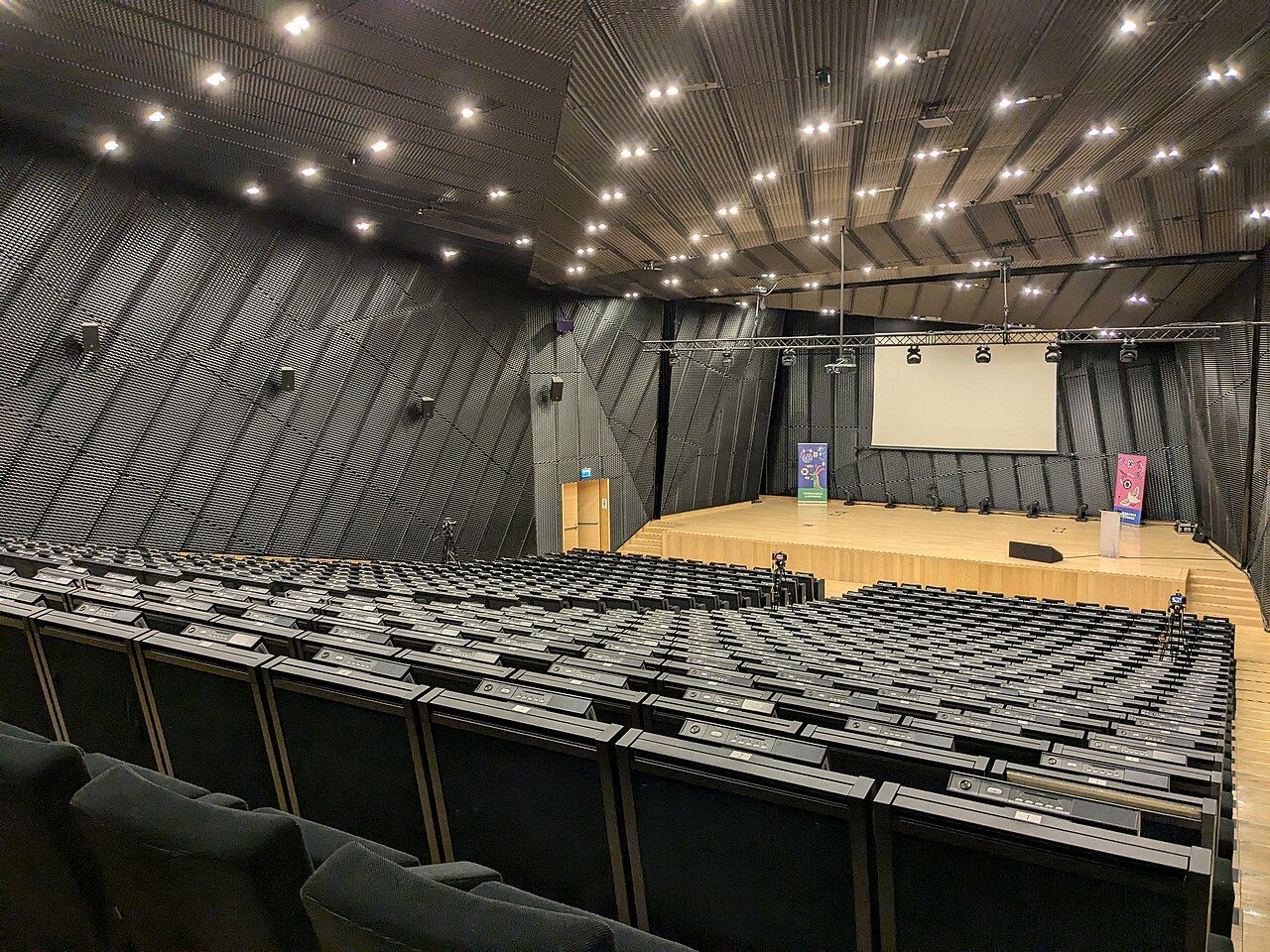
Arrive early enough to walk the room. Stand where you will stand, look at the seats, and say one sentence out loud at performance volume — this single act does more to reduce first-minute arousal than any amount of visualization from home. Set out your materials in order. Confirm that the file opens on the room’s machine. Put your phone away entirely. Drink room-temperature water; skip the extra coffee, which adds tachycardia and tremor you did not need. Two minutes of brisk walking followed by sixty seconds of long-exhale breathing is a better warm-up than reading your notes one more time.
Script your first thirty seconds down to the physical actions, because that is the window in which arousal peaks. Walk to your spot. Plant your feet. Set your notes down or hold them at waist level. Breathe out. Pause two full beats and let the room settle. Find one pair of eyes. Then deliver the opening you memorized. Do not talk while walking, do not fuss with the lectern, and above all do not open by apologizing — an apology tells the audience to start looking for the flaw.
| Opening — before | Opening — after | Why it works |
|---|---|---|
| “Um, hi, sorry, I’m really nervous, so bear with me — I’m gonna talk about, like, sepsis screening, I guess?” | [Plant. Two-beat pause. One person.] “At 2:40 in the morning, Mr. Reyes told his nurse he just felt strange. His temperature was normal. He was septic.” | Removes the apology, opens on a concrete image, and gives the shaky first fifteen seconds a memorized script to run on |
| “So yeah, that’s pretty much everything I had. Any questions? No? Okay, thanks.” | “Recognize. Escalate. Document. // Mr. Reyes went home on a Thursday. The hour you save is not yours — it is his. Thank you.” [Hold still two beats before moving.] | Signals the ending with a callback and a rehearsed final line, so the speech lands rather than evaporating |
When something goes wrong
Assume something will, and pre-decide the response. If you lose your place: stop, close your mouth, look at your notes, restate the last complete idea in different words, and continue. A five-second silence feels like thirty from inside and reads as a considered pause from row four. If a word will not come, describe it — “the test where they thread a scope down to look at the stomach” is a perfectly good save. If you misspeak a number, correct it once, plainly, and move on. If you cough, pause, drink, say “excuse me” once, and resume; a second apology is worse than the cough.
Technology fails often enough that you should be able to give roughly eighty percent of your talk with no slides at all. If the projector dies, say “let me just describe this one” and keep going. If the wrong slide appears, name it in four words and advance. If the mic cuts out, step forward and project. What audiences remember is not the failure — it is whether the speaker stayed composed. Composure is a rehearsable behavior: practice one deliberate fumble in pass two so that recovering has been done before.
Question periods reward a small routine. Listen to the entire question without composing your answer over it. Repeat or paraphrase it so the room hears it and so you confirm you understood. Answer the question asked, briefly, then bridge to one of your main points. If you do not know, say so in the strongest available form: “I don’t know — here is how I would find out, and I will send it to you.” That answer builds more credibility than a guess and costs nothing. For a hostile or off-topic question, acknowledge the concern in one sentence, answer the answerable part, and offer to continue afterward.
| Criterion | Developing | Competent | Strong |
|---|---|---|---|
| Eye contact | Reads from notes; brief sweeps; connects mainly with the instructor | Looks up most of the time; reaches most areas of the room | One complete thought per listener; reaches back rows; consults notes only during pauses |
| Voice | Rushed or monotone; back rows strain; frequent dense fillers | Audible and generally varied; fillers present but not distracting | Deliberate contrast in rate, pitch, and volume; pauses used for emphasis and transition |
| Language precision | Key terms mispronounced or mumbled | Terms pronounced correctly; endings mostly crisp | Technical vocabulary clean and confident; final consonants land |
| Body | Sway, adaptors, hands locked or gripping the lectern | Stable stance; some meaningful gesture | Home position with illustrators that match content; movement motivated by transitions |
| Use of notes | Full-sentence pages read nearly verbatim | Key-word notes used, with occasional reading | Notes glanced at only; speech is spoken, not read |
| Time | More than one minute over or under | Within about thirty seconds of target | On target with a visibly intact conclusion |
| Poise and recovery | Visible distress after an error; apologizes repeatedly | Recovers within a few seconds | Recovers almost invisibly; handles questions calmly, including “I don’t know” |
Distributed, standing, recorded rehearsal — plus a scripted first thirty seconds and pre-decided recovery moves — converts the parts of speaking you cannot control into parts you have already practiced.
The chapter in one breath
Delivery is the last mile between a good idea and an audience, and it is trainable. Start by choosing a mode: extemporaneous for nearly everything, manuscript when exact wording carries consequence, memorized only for short ceremonial pieces, impromptu with a four-move frame so you do not circle. Build key-word notes with bracketed delivery cues and rehearse from the exact cards you will hold. Work the voice through contrast — vary rate, pitch, and volume, and use silence as punctuation rather than filling every gap with “um.” Work the body through specifics: one complete thought per listener, a stable home position, gestures that carry meaning and stop when the phrase does, movement that marks transitions, and deliberate adjustments for a microphone or a camera. Treat anxiety as ordinary sympathetic arousal that climbs before you start, peaks in the first minute of speaking, then declines. Prepare hard, expose yourself gradually, breathe out longer than you breathe in, reappraise the arousal as readiness, and rehearse the reframes the way you rehearse the opening line. Then rehearse standing, recorded, on a clock, in the room — including one deliberate mistake, so the recovery is not the only thing you have never practiced.
Words worth knowing
| Term | What it means |
|---|---|
| Extemporaneous delivery | Fully prepared and rehearsed speaking delivered from brief notes, with the wording composed live; the default professional mode. |
| Impromptu delivery | Speaking with little or no advance preparation, best handled with a quick frame such as point, reason, example, point. |
| Manuscript delivery | Reading a text word for word; appropriate when exact wording matters legally, clinically, or diplomatically. |
| Memorized delivery | Reciting a text from memory without notes; suitable for short ceremonial pieces, risky for anything longer. |
| Key-word outline | Speaking notes reduced to trigger words and phrases rather than full sentences, so the eyes stay up. |
| Rate | Speaking speed, commonly cited around 120 to 160 words per minute for public speaking; variation matters more than the number. |
| Projection | Producing supported, breath-driven sound that carries to the back of the room without shouting from the throat. |
| Vocal variety | Purposeful movement in pitch, rate, and volume across a speech; among the strongest contributors to being heard as engaging. |
| Rhetorical pause | Deliberate silence used to create anticipation, let a number land, mark a transition, or invite thought. |
| Vocalized pause | A filled hesitation such as um, uh, or like; normal in small amounts, costly when dense or used in place of silence. |
| Articulation | The crispness with which sounds are formed, especially consonants at the ends of words. |
| Pronunciation | Producing the accepted sounds and stress pattern of a word — critical for technical vocabulary that differs by a single sound or syllable. |
| Illustrator | A gesture that carries meaning, such as showing three fingers for three stages or hands widening to show a growing gap. |
| Adaptor | A self-soothing movement with no communicative meaning — ring turning, pen clicking, sleeve tugging — that reads in aggregate as nervousness. |
| Home position | A neutral, stable stance with feet about hip-width apart and hands resting easily, from which gestures depart and return. |
| Communication apprehension | Fear or anxiety associated with real or anticipated communication with another person or audience. |
| State and trait anxiety | Trait anxiety is a general disposition across situations; state anxiety is the surge tied to one specific situation, such as this speech. |
| Illusion of transparency | The tendency to overestimate how visible your internal nervousness is to observers; learning about it tends to reduce anxiety. |
| Anxiety reappraisal | Relabeling physiological arousal as excitement or readiness rather than fear; low-cost, with promising but mixed replication evidence. |
| Systematic desensitization | A structured technique pairing relaxation training with graded exposure to increasingly speech-like situations. |