Stress, Health & Coping
A deadline, a diagnosis, a difficult conversation — the events we call "stressful" are wildly different, yet your body answers nearly all of them with the same ancient alarm. This chapter is about that alarm: what trips it, the hormones it releases, and what it does to your heart and immune system when it never shuts off. It is also about the good news — that how you read a situation and how you respond to it change everything, and that the skills of coping, connection, and resilience can be learned. Stress is not simply something that happens to you; it is a transaction between a demand and the resources you bring to meet it.
By the end of this chapter you can
- Define stress and distinguish a stressor from the stress response.
- Explain Lazarus's appraisal model, including primary and secondary appraisal.
- Describe the fight-or-flight response and the role of the sympathetic nervous system and adrenaline.
- Outline Selye's general adaptation syndrome and trace the HPA axis to cortisol.
- Explain how chronic stress damages the cardiovascular and immune systems.
- Distinguish problem-focused from emotion-focused coping and match each to the situation.
- Describe how social support buffers stress and why relationships protect health.
- Summarize positive psychology's account of happiness and the ingredients of resilience.
Section 1What stress is
Stressor, response, and the appraisal in between
In everyday speech "stress" means whatever is bothering us, but psychologists split the idea in two. A stressor is the demand or threat itself — the exam, the traffic, the argument. The stress response is what happens inside you when you meet it — the racing heart, the flood of hormones, the churning thoughts. Stress, then, is best defined as the process by which we perceive and respond to events we judge as threatening or challenging. That word judge is the whole story: the same event can flatten one person and energize another, because a stressor only becomes stressful once the brain has appraised it.
Not all stress is bad. Hans Selye coined the term eustress for the good stress of a challenge you feel able to meet — a first date, a big game, a promotion — as opposed to distress, the draining, harmful kind. The difference between the two often lies not in the event but in whether you see it as a threat to be survived or a challenge to be risen to.
Kinds of stressors
Stressors come in several sizes. Cataclysmic events are sudden, large-scale disasters — earthquakes, war, a pandemic — that strike many people at once. Significant life changes are personal upheavals such as a death, a divorce, or a move; Thomas Holmes and Richard Rahe built the classic Social Readjustment Rating Scale to score how much readjustment such events demand, finding that a pile-up of changes predicts later illness. Then there are the daily hassles — the lost keys, the rude email, the endless small frictions — which seem trivial one at a time but, taken together, may erode health as surely as the dramatic events. A special case is ambient stressors such as noise, crowding, or a long commute: chronic, low-grade, and largely outside our control.
| Kind of stressor | What it is | Example |
|---|---|---|
| Cataclysmic | Sudden, large-scale, affects many at once | Natural disaster, war, pandemic |
| Significant life change | Major personal transition requiring readjustment | Bereavement, divorce, job loss, new baby |
| Daily hassle | Minor irritation; harmful mainly by accumulation | Traffic, lost keys, a difficult coworker |
| Ambient | Chronic background condition, low-grade but constant | Noise, crowding, air pollution, long commute |
| Acute vs. chronic | Brief and passing vs. prolonged and unrelenting | A near-miss in traffic vs. caregiving for years |
Appraisal: the mind's first move
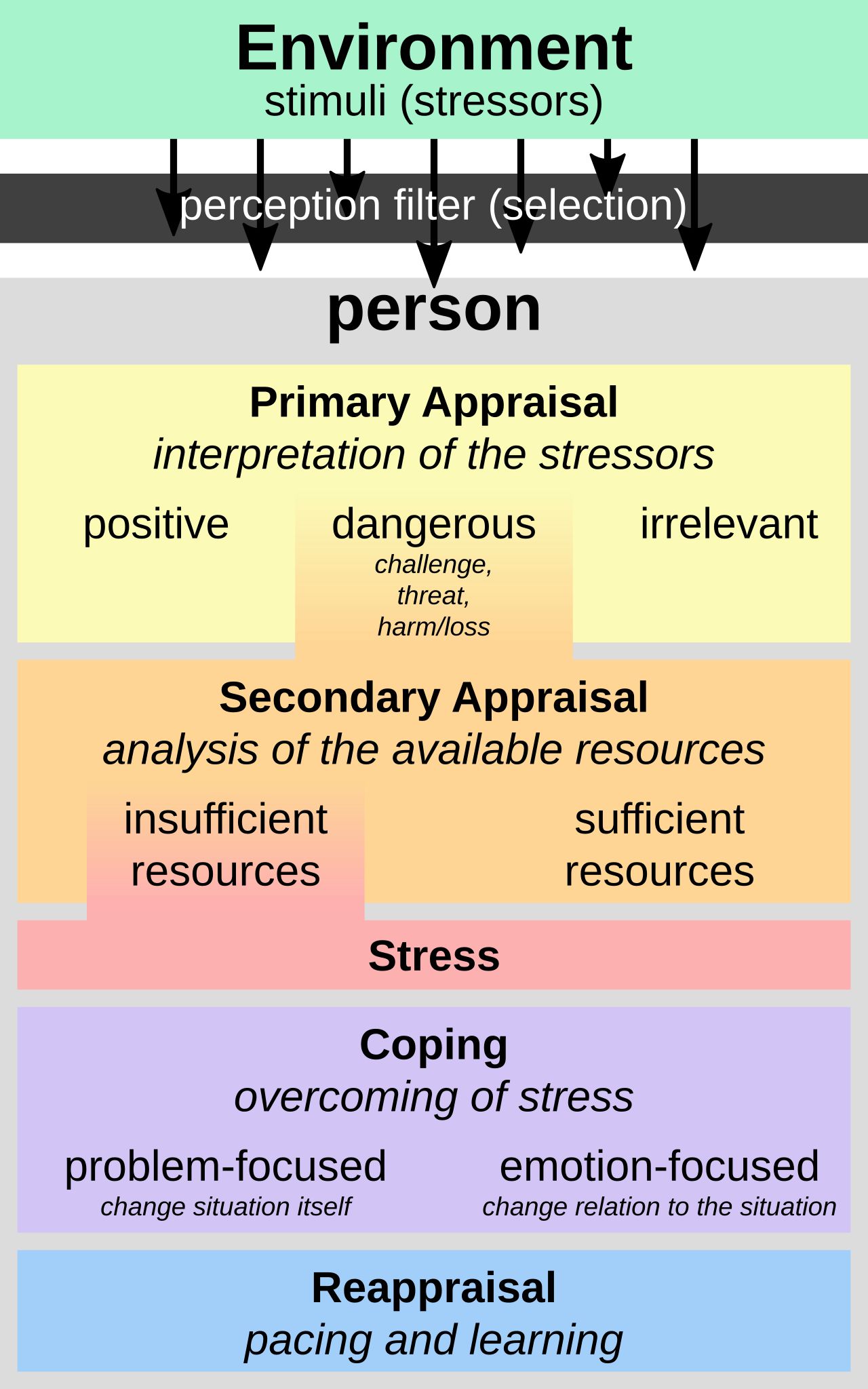
Richard Lazarus argued that stress is a transaction between person and situation, mediated by two quick judgments. In primary appraisal you ask, in effect, "Is this a problem — and is it a threat, a challenge, or nothing to worry about?" In secondary appraisal you ask, "Can I handle it? What are my resources?" Stress flares when the demand looks large and your resources look small; the same demand feels like a manageable challenge when you judge yourself equal to it. This is why two students facing the identical exam can have opposite experiences, and why building skills, support, and confidence reduces stress even when the stressors stay the same.
The fight-or-flight response
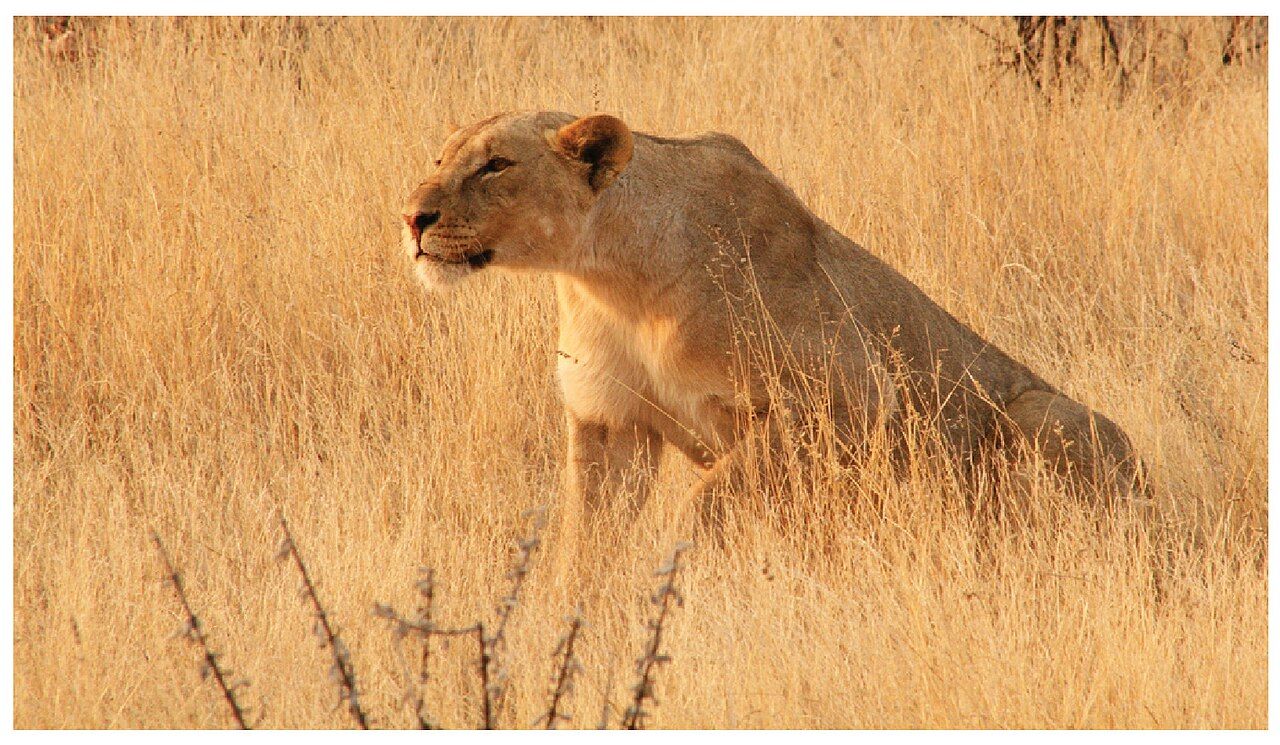
When the appraisal comes back "threat," the body acts before you have finished thinking. The physiologist Walter Cannon named this the fight-or-flight response: the sympathetic nervous system fires, the adrenal glands dump adrenaline (epinephrine) into the blood, and within seconds the heart pounds, breathing quickens, pupils widen, the muscles tense, and digestion halts. Blood and fuel are rushed to the muscles and brain so you can either confront the danger or flee it. It is a superb system for escaping a predator, which is what it evolved to do. Its flaw is that a traffic jam or an unanswered text can trip the very same switch — and unlike the zebra that sprints from the lion and then grazes in peace, humans can keep the alarm ringing for hours, days, or years.
- A stressor is the demand; the stress response is your reaction; stress is the whole appraised process.
- Stressors range from cataclysmic events to daily hassles; small hassles harm by accumulating.
- Lazarus: stress depends on primary appraisal (Is it a threat?) and secondary appraisal (Can I cope?).
- The fight-or-flight response (Cannon) is a fast sympathetic surge driven by adrenaline, built for brief emergencies.
Section 2The stress response
Selye's general adaptation syndrome
Hans Selye, often called the father of stress research, noticed something strange in the 1930s: no matter what he did to his laboratory rats — heat, cold, toxins, injury — their bodies showed the same three-part pattern of response. He called it the general adaptation syndrome (GAS), "general" because the body reacts the same way to almost any prolonged stressor. It unfolds in three stages. In the alarm reaction, resources mobilize and the fight-or-flight surge takes over. In the resistance stage, the body settles into a state of high alert, drawing on hormones to cope while the stressor persists — you feel like you are managing, but at a cost. If the stressor never lets up, the body reaches exhaustion: reserves are depleted, defenses fail, and vulnerability to illness, burnout, and breakdown rises sharply.
| GAS stage | What is happening | How it feels / costs |
|---|---|---|
| Alarm | Fight-or-flight surge; resources mobilized | Racing heart, high arousal, "shock" then countershock |
| Resistance | Sustained high alert; hormones keep the body coping | Coping but depleting; irritability, fatigue build |
| Exhaustion | Reserves run out; defenses weaken | Illness, burnout, collapse of function |
Two roads out of the brain: the SAM and HPA axes
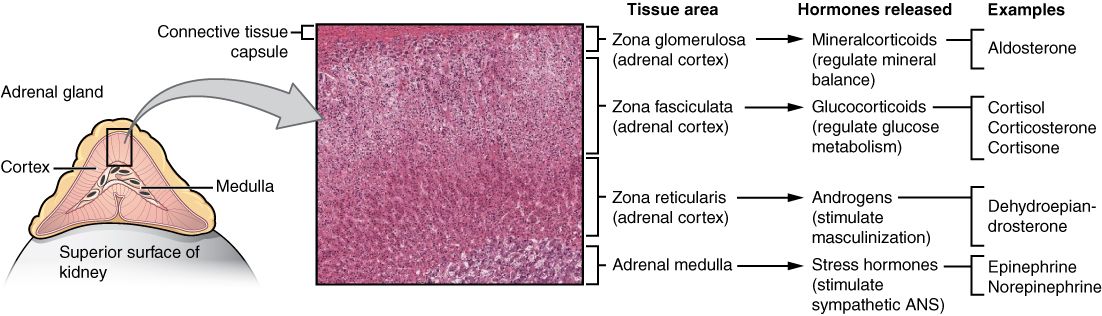
The stress response actually travels two paths at two speeds. The fast path is the SAM axis (sympathetic-adrenal-medullary): the sympathetic nerves signal the adrenal medulla to release adrenaline in seconds — this is the fight-or-flight jolt of Section 1. The slower, longer-lasting path is the HPA axis, and it is the star of the chronic-stress story. The hypothalamus releases CRH, which prompts the pituitary gland to release ACTH, which travels in the blood to the adrenal cortex, which pours out cortisol — the body's main stress hormone. Cortisol keeps glucose flowing to the muscles and brain, sharpens attention, and dampens processes (like immunity and digestion) that can wait until the emergency passes.
In short bursts, cortisol is a life-saver. The problem is that the HPA axis was designed to switch off once the threat clears. When appraisal keeps signaling "threat" — a stressful job, an unhappy relationship, financial fear — cortisol stays elevated for weeks or months, and a hormone that is protective in the short run becomes corrosive in the long run.
Allostatic load: the price of staying switched on
The body maintains stability through change — a process called allostasis. Every time the stress system activates and recovers, it does its job. But repeated or unrelenting activation exacts a cumulative toll on the organs that carry the load; researchers call this accumulated wear-and-tear the allostatic load. It is the biological bridge between "I feel stressed all the time" and the diseases that stress promotes — the subject of the next section. The neuroscientist Robert Sapolsky captured the whole idea in the title of his book: zebras do not get ulcers, because their stressors end when the chase does. Ours often do not.
- Selye's GAS has three stages: alarm, resistance, and exhaustion.
- The fast SAM axis releases adrenaline; the slower HPA axis runs hypothalamus → pituitary → adrenal cortex → cortisol.
- Cortisol is protective in short bursts but harmful when chronically elevated.
- Allostatic load is the cumulative bodily wear from a stress system that never switches off.
Section 3Stress and health
Stress and the heart
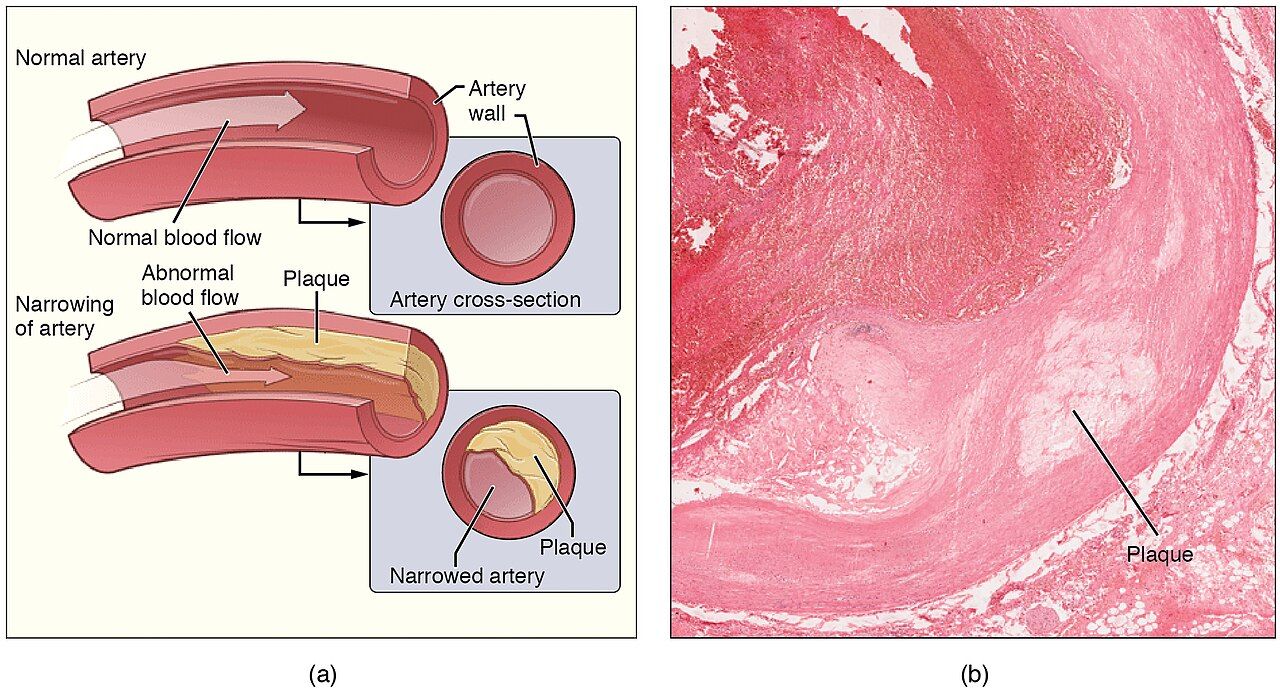
The clearest evidence that stress harms the body comes from the cardiovascular system. Chronic stress raises blood pressure, promotes the inflammation and plaque buildup of atherosclerosis, and is now recognized as a risk factor for coronary heart disease. The link was first sharpened by cardiologists Meyer Friedman and Ray Rosenman, who described the Type A personality — competitive, impatient, time-driven, and easily angered — in contrast to the more relaxed Type B. In their Western Collaborative Group Study, Type A men developed coronary heart disease at roughly twice the rate of Type B men, independently of the standard risk factors — though smoking, blood pressure, and cholesterol remained powerful predictors in that same cohort in their own right. Later research forced a sharper revision: several large prospective studies failed to reproduce the global Type A effect at all, and when the pattern was broken into its parts, the ingredient that reliably predicted cardiac risk was not ambition or busyness but hostility — chronic anger, cynicism, and mistrust. The hard-charging executive who enjoys the work may be fine; the one who seethes at every red light is not.
Stress and immunity
The field of psychoneuroimmunology studies how the mind, nervous system, and immune system talk to one another — and they talk constantly. Cortisol, so useful in the moment, suppresses the immune system when it stays high, which is why chronically stressed people get sick more easily and heal more slowly. In an elegant demonstration, Janice Kiecolt-Glaser found that the small wounds of people under chronic stress (caregivers for relatives with dementia) healed markedly more slowly than those of matched controls. And Sheldon Cohen exposed healthy volunteers to a cold virus and found that the more chronic stress they reported, the more likely they were to actually develop a cold — direct evidence that stress does not just make you feel worse, it lowers your defenses.
| System | Short-term stress | Chronic stress cost |
|---|---|---|
| Heart & vessels | Faster rate, higher output to fuel action | Hypertension, inflammation, atherosclerosis, heart disease |
| Immune | Brief mobilization of defenses | Suppressed immunity, slower healing, more infection |
| Brain | Sharper focus and memory encoding | Impaired memory and mood; hippocampal wear |
| Metabolism | Glucose released for quick energy | Abdominal fat, insulin resistance, higher diabetes risk |
- Chronic stress raises blood pressure and drives the inflammation and atherosclerosis behind heart disease.
- Friedman & Rosenman's Type A pattern was tied to about double the rate of heart disease in their own cohort, but the global effect failed to replicate; the component that holds up is hostility, not busyness.
- Psychoneuroimmunology shows cortisol suppresses immunity when chronically high.
- Kiecolt-Glaser (slow wound healing) and Cohen (common-cold susceptibility) link stress to real illness.
Section 4Coping
Two ways to cope
Once a stressor is appraised, we do something about it — that is coping. Richard Lazarus and Susan Folkman drew the field's central distinction. Problem-focused coping attacks the stressor itself: you make a plan, gather information, ask for an extension, fix the leaking pipe, have the hard conversation. Emotion-focused coping manages your reaction instead: you reframe the situation, seek comfort, exercise, meditate, or simply let yourself grieve. Neither is superior in the abstract — the trick is matching the strategy to the situation.
| Feature | Problem-focused coping | Emotion-focused coping |
|---|---|---|
| Target | The stressor itself | Your emotional response to it |
| Best when | The situation is controllable | The situation is uncontrollable |
| Examples | Make a plan, study, negotiate, seek advice | Reappraise, exercise, meditate, confide, accept |
| Risk if overused | Wasted effort on what cannot be changed | Avoidance; the problem festers |
Matching coping to control — and what goes wrong
The rule of thumb: when you can change the situation, lead with problem-focused coping; when you cannot — a terminal diagnosis, a loss, a past you cannot undo — emotion-focused coping is not weakness but wisdom. Trouble comes when the two are mismatched, and especially when coping slides into avoidance. Denying a problem, numbing it with alcohol, or ruminating endlessly all feel like coping in the moment but leave the stressor intact and often make it worse. Avoidant coping is one of the strongest predictors of stress becoming chronic.
Social support
Of all the buffers against stress, none is better documented than other people. Social support — the comfort, help, and belonging we receive from our relationships — predicts better health and longer life across hundreds of studies; some analyses put its effect on mortality on par with quitting smoking. It works in several ways at once, captured by the buffering hypothesis: support cushions the impact of stressors, both by offering practical help and by changing how threatening an event feels in the first place. Psychologists distinguish emotional support (a listening ear), informational support (advice and guidance), and instrumental support (tangible help — a ride, a meal, money). Even the mere belief that support is available lowers the stress response.
- Problem-focused coping targets the stressor; emotion-focused coping targets your reaction (Lazarus & Folkman).
- Use problem-focused coping for controllable stressors, emotion-focused for uncontrollable ones.
- Avoidance (denial, substances, rumination) is maladaptive and predicts chronic stress.
- Social support buffers stress and strongly predicts health and longevity.
Section 5Health and well-being
Positive psychology
For most of its history, psychology studied what goes wrong. At the turn of this century, Martin Seligman and colleagues launched positive psychology — the scientific study of what makes life worth living: strengths, meaning, flourishing, and the conditions under which people thrive rather than merely cope. Seligman, whose earlier work on learned helplessness had illuminated depression, turned to its opposite, learned optimism, and later proposed PERMA as the ingredients of flourishing: Positive emotion, Engagement, Relationships, Meaning, and Accomplishment. The point is not to paint on a smile but to broaden the field's questions from "How do we fix illness?" to "How do people flourish?"
Happiness: what actually moves it
Happiness researchers such as Ed Diener study subjective well-being — a person's own evaluation of life satisfaction and balance of positive to negative emotion. One of the field's most humbling findings is hedonic adaptation, the hedonic treadmill: we quickly get used to good fortune and bad, so lottery winners and, over time, even accident survivors drift back toward their earlier baseline. That baseline, or set point, is partly heritable: twin studies put the heritability of subjective well-being at roughly 30–40%. Sonja Lyubomirsky and colleagues once popularized a breakdown that assigned fixed percentage shares to genes, to life circumstances, and to intentional activity, the things we deliberately do. That partition has since been formally disavowed by its own authors as invalid — it misapplied a population statistic to individual lives and understated how much circumstances matter — so no percentage split should be quoted. What holds up is the qualitative message: well-being has a real heritable component, we adapt to changes in circumstance faster than we expect, and what we do is the part we can act on.
| Influence on happiness | What the evidence supports | What it means |
|---|---|---|
| Genetic set point | Real and substantial; twin heritability of well-being about 30–40% | A heritable baseline we tend to return to |
| Life circumstances | Matters more than the old pie chart implied, but we adapt | Income, looks, where you live — the effect fades as it becomes the new normal |
| Intentional activity | Small but repeatable gains in trials of deliberate practices | Gratitude, connection, exercise, purpose — the part we can act on |
Barbara Fredrickson's broaden-and-build theory explains why cultivating positive emotion is worth the effort: where negative emotions narrow attention for emergencies, positive emotions broaden our thinking and build lasting resources — relationships, skills, resilience — that pay off long after the good mood fades. Evidence-based practices that reliably nudge well-being are unglamorous but real: expressing gratitude, exercising, sleeping enough, savoring good moments, performing acts of kindness, and investing in relationships.
Building resilience
Resilience is the capacity to adapt and recover in the face of adversity — and it is far more common than we assume. Studying children who thrived despite hardship, Ann Masten famously called resilience "ordinary magic": it arises not from rare gifts but from ordinary human resources — a supportive relationship, a sense of competence, the ability to regulate emotion. Suzanne Kobasa identified a resilient stance she called hardiness, built on three C's: commitment (engaging with life rather than withdrawing), control (believing you can influence outcomes), and challenge (viewing change as opportunity rather than threat). Many survivors of serious adversity even report post-traumatic growth — deeper relationships, new priorities, a greater sense of strength. Resilience is not the absence of stress; it is what lets people meet stress and come through it whole.
- Positive psychology (Seligman) studies flourishing; PERMA names its ingredients.
- Hedonic adaptation pulls us back to a partly heritable set point; circumstances matter less than expected.
- Intentional activity — gratitude, connection, exercise, purpose — is the part of happiness we can act on.
- Resilience is common and buildable; Kobasa's hardiness rests on commitment, control, and challenge.
The chapter in one breath
- Stress is a process: a stressor (the demand), your appraisal of it, and the stress response it triggers.
- Lazarus showed stress hinges on primary (Is it a threat?) and secondary (Can I cope?) appraisal — the same event can be threat or challenge.
- The fight-or-flight response (Cannon) fires the sympathetic system and adrenaline; Selye's GAS runs alarm → resistance → exhaustion.
- The slow HPA axis releases cortisol, which is protective briefly but drives allostatic load when chronic.
- Chronic stress harms the heart (hostility, atherosclerosis, heart disease) and immune system (Kiecolt-Glaser, Cohen).
- Problem-focused coping suits controllable stressors; emotion-focused coping suits uncontrollable ones; avoidance backfires.
- Social support powerfully buffers stress, and positive psychology shows happiness and resilience can be deliberately built.
ReferenceWords worth knowing
A quick reference for the terms in this chapter — skim it now, or circle back whenever a word trips you up.
- Allostatic load
- The cumulative wear-and-tear on the body from repeated or chronic activation of the stress response.
- Appraisal
- The mental evaluation of a situation that determines whether — and how much — it is experienced as stressful.
- Coping
- The efforts, mental and behavioral, we use to manage a stressor and the emotions it produces.
- Cortisol
- The main stress hormone, released by the adrenal cortex via the HPA axis; protective in bursts, harmful when chronically elevated.
- Emotion-focused coping
- Coping that manages one's emotional reaction to a stressor; best suited to uncontrollable situations.
- Eustress
- Positive, motivating stress arising from a challenge one feels able to meet.
- Fight-or-flight response
- Walter Cannon's term for the fast sympathetic-nervous-system surge that prepares the body to confront or flee a threat.
- General adaptation syndrome (GAS)
- Selye's three-stage model of the body's response to prolonged stress: alarm, resistance, exhaustion.
- Hardiness
- Kobasa's resilient stance built on commitment, control, and challenge.
- Hedonic adaptation
- The tendency to return to a baseline level of happiness after good or bad events; the "hedonic treadmill."
- HPA axis
- The hypothalamic-pituitary-adrenal pathway that releases cortisol; the slow, sustained arm of the stress response.
- Positive psychology
- The scientific study of strengths, well-being, and the conditions under which people flourish.
- Primary appraisal
- The first judgment of a situation: Is it a threat, a challenge, or irrelevant?
- Problem-focused coping
- Coping that acts on the stressor itself; best suited to controllable situations.
- Psychoneuroimmunology
- The study of how psychological states, the nervous system, and the immune system interact.
- Resilience
- The capacity to adapt and recover in the face of adversity.
- Secondary appraisal
- The judgment of whether one has the resources to cope with a stressor.
- Social support
- The comfort, guidance, and tangible help provided by one's relationships, which buffers stress.
- Stress
- The process by which we perceive and respond to events appraised as threatening or challenging.
- Stressor
- An event or demand that has the potential to trigger a stress response.
- Type A
- Friedman and Rosenman's competitive, impatient, hostile pattern, originally linked to heart disease; the global pattern did not replicate, and hostility is the component that does predict cardiac risk.