Culture
Take a fish out of water and it finally notices the water. Culture is like that: the ocean of shared meaning you swim in every day and almost never see, because you have never known anything else. It is the language you think in, the food that tastes like home, the gestures you make without deciding to, and the values you defend as simply “right.” Sociologists study culture precisely because it feels so natural and stays so invisible — and because nearly everything else in social life is built on top of it. This chapter pulls the water into view: what culture is made of, the rules and symbols that hold it together, why human cultures differ so wildly, how the major theories explain it, and how it changes.
By the end of this chapter you can
- Define culture and distinguish material from nonmaterial culture with examples.
- Explain how values, norms, and symbols organize everyday behavior.
- Classify norms as folkways, mores, taboos, and laws by the sanction each carries.
- State the Sapir–Whorf hypothesis and explain how language can shape thought.
- Contrast subcultures with countercultures, and ethnocentrism with cultural relativism.
- Apply the functionalist, conflict, and symbolic–interactionist paradigms to culture.
- Explain cultural change through innovation, diffusion, and cultural lag.
Section 1What culture is

A working definition
In everyday speech, “culture” means opera, museums, and knowing which fork to use. Sociologists mean something far broader. Culture is the entire way of life of a group of people — the beliefs, values, behaviors, language, and material objects they share and pass on to the next generation. By this definition everyone has culture, and no way of life is more “cultured” than another. A tailgate party, a hip-hop lyric, and a wedding ritual are all culture in exactly the same sense that a symphony is.
Two features make culture sociologically important. First, it is shared: it lives in the group, not in any one person, which is why you can be born into a culture you never chose. Second, it is learned, not inherited in your genes — a newborn adopted across the world grows up speaking the language and holding the values of wherever it is raised. Because culture is learned and shared, it can be studied, compared, and changed, and that is the whole project of this chapter.
Material and nonmaterial culture
Sociologists split culture into two halves. Material culture is the physical stuff a society makes and uses — smartphones, chopsticks, wedding rings, skyscrapers, currency, weapons, and food. Nonmaterial culture is everything you cannot touch — the ideas, beliefs, values, norms, gestures, and language that give the objects meaning. The two are welded together: a wedding ring (material) is a worthless band of metal until a shared belief about marriage (nonmaterial) makes it mean lifelong commitment. Hand someone a smartphone and the glass rectangle is material; the etiquette about when it is rude to check it is nonmaterial.
| Feature | Material culture | Nonmaterial culture |
|---|---|---|
| Made of | Physical objects you can touch | Ideas and meanings you cannot touch |
| Examples | Tools, buildings, clothing, money, food, technology | Values, beliefs, norms, language, symbols, gestures |
| How it is studied | Examining artifacts, architecture, technology | Observing behavior and interpreting meaning |
| How fast it changes | Often fast — a new device can spread in a year | Often slow — beliefs and habits lag behind |
That last row is not a throwaway. The fact that material culture usually races ahead while nonmaterial culture drags behind is the seed of a whole theory of social change — cultural lag — that we return to in Section 5. Keep it in the back of your mind.
- Culture is a group’s whole learned, shared way of life — and everyone has it.
- Material culture is physical objects; nonmaterial culture is ideas, values, norms, and language.
- Culture is learned and shared, never inherited biologically, which is why it can be studied and changed.
- Material culture tends to change faster than nonmaterial culture — the setup for cultural lag.
Section 2Values, norms & symbols
Values: what a culture calls good
Values are a culture’s deeply held standards of what is good, desirable, and worth striving for. They are broad and abstract — freedom, family, wealth, equality, honor, faith — and they rarely tell you what to do in a specific moment. The sociologist Robin Williams famously catalogued core U.S. values such as achievement, individualism, and progress; other societies rank collective harmony or deference to elders far higher. Values are the why behind behavior, which is why two cultures can look at the identical act and reach opposite verdicts.
Values also come in an idealized and a realistic version. Ideal culture is what a group says it believes; real culture is what its members actually do. A society can prize honesty as an ideal value while tolerating everyday dishonesty — the gap between the two is itself a favorite object of sociological study.
Norms: the rules that put values into action
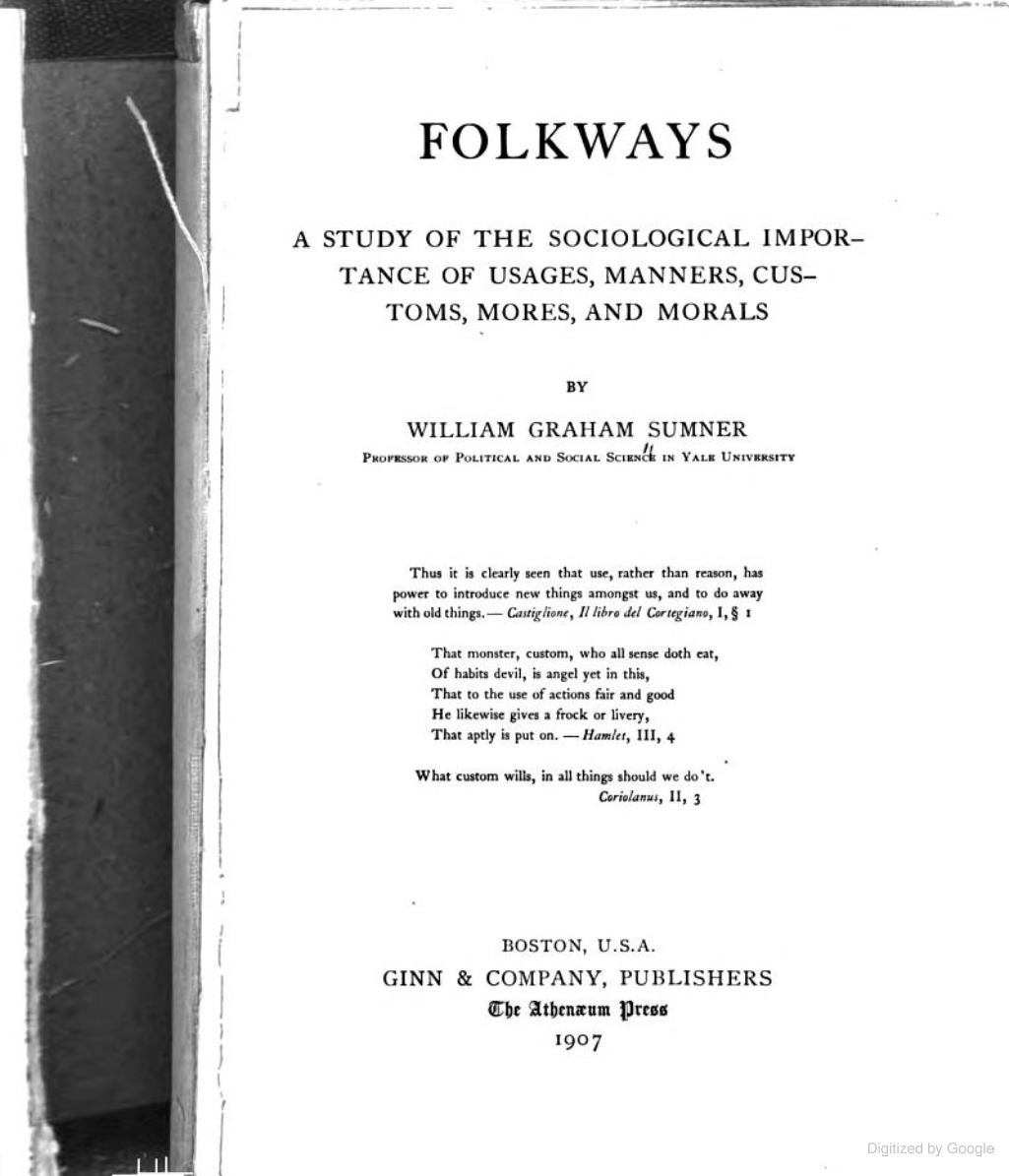
If values are abstract goals, norms are the concrete rules and expectations that translate them into behavior — the do’s and don’ts of daily life. Norms are enforced by sanctions, the rewards for conformity and punishments for violation, which can be as small as an approving nod or as large as a prison term. In 1906 William Graham Sumner sorted norms by how strongly a society reacts when they are broken, and his scheme is still used today.
Folkways are everyday customs and manners — facing forward in an elevator, saying “bless you,” not standing too close in line. Break one and you get a strange look, not a lawsuit. Mores (say “MOR-ays”) carry real moral weight; violating them — cheating, plagiarism, theft — brings shame, ostracism, or punishment. Taboos are the strongest norms of all, prohibitions so deep that the mere thought of violation provokes disgust, such as incest or cannibalism. When a society decides a norm matters enough to write down and enforce through the state, it becomes a law.
| Type of norm | What it governs | Reaction to violation | Example |
|---|---|---|---|
| Folkway | Everyday custom & manners | Mild — a look, light disapproval | Chewing with your mouth closed; queue etiquette |
| More | Morally significant behavior | Strong — shame, ostracism, punishment | Cheating, plagiarism, adultery |
| Taboo | The nearly unthinkable | Revulsion, exile | Incest, cannibalism |
| Law | Norms formalized by the state | Official — fines, imprisonment | Traffic codes, criminal statutes |
Symbols and language
A symbol is anything — a word, a gesture, an object, a color — that carries a meaning recognized by people who share a culture. A red octagon means “stop,” a raised middle finger means insult, a white dress can mean a wedding in one place and a funeral in another. Symbols have no natural meaning; the culture assigns it, which is exactly why the same gesture can be a compliment in one country and an obscenity in the next.
Language is the most powerful symbol system of all — an organized set of symbols that lets people not only communicate but store and transmit an entire culture across generations. The Sapir–Whorf hypothesis (also called linguistic relativity) pushes the point further: the language you speak does not just express your thoughts, it partly shapes them. Speakers whose language has many words for a concept may perceive finer distinctions in it; a language that marks gender on every noun may nudge attention toward gender. The strong version — that language traps thought — is now considered overstated, but the softer version, that language influences habitual perception, has real support.
- Values are broad standards of good; norms are the specific rules that enact them, enforced by sanctions.
- Sumner ranked norms by reaction: folkways (mild) → mores (moral) → taboos (unthinkable); laws are formalized norms.
- Symbols carry culturally assigned meaning; language is the master symbol system that transmits culture.
- The Sapir–Whorf hypothesis holds that language shapes, not merely reflects, how we perceive and think.
Section 3Cultural diversity
Variety within: subcultures and countercultures
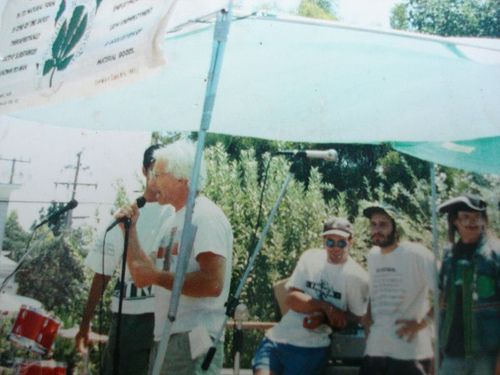
No large society is a single seamless culture. Inside it are countless subcultures — groups that share the wider culture but also maintain their own distinct patterns of language, dress, and values. Surfers, gamers, bikers, jazz musicians, competitive weightlifters, and physicians all form subcultures with their own slang, heroes, and unwritten rules. A subculture is a variation on the mainstream, not a rebellion against it; you can belong to several at once.
A counterculture goes further: its values actively reject and oppose those of the dominant culture. The 1960s hippie movement, certain radical political or religious communes, and some youth movements set themselves consciously against the mainstream way of life. Countercultures are worth studying because their opposition often becomes tomorrow’s norm — ideas that once seemed subversive, from environmentalism to organic food, frequently migrate into the center over time.
Judging others: ethnocentrism and cultural relativism
When people meet an unfamiliar culture, the reflex is to measure it against their own — and their own always wins. Ethnocentrism, another term coined by Sumner, is the practice of judging another culture by the standards of your own and assuming yours is superior. It is why an outsider might call an unfamiliar dish “disgusting” rather than “different,” and it shades easily into prejudice. A mild dose builds group loyalty; a heavy dose fuels contempt, discrimination, and worse.
The sociological antidote is cultural relativism: the practice of understanding a culture on its own terms, in its own context, before judging it. Relativism does not demand that you approve of everything — it is a research stance, not a surrender of ethics — but it insists you first ask why a practice makes sense to the people who live it. A related idea, culture shock, names the disorientation travelers feel when the taken-for-granted rules suddenly stop applying.
| Concept | Core idea | Example | Watch out for |
|---|---|---|---|
| Subculture | Distinct group within the mainstream | Gamers, surfers, a profession | Not opposed — simply different |
| Counterculture | Values that reject the mainstream | 1960s hippies, radical communes | Often drives later social change |
| Ethnocentrism | Judging others by your own yardstick | “Their customs are backward” | Breeds prejudice; blocks understanding |
| Cultural relativism | Understanding a culture on its own terms | Studying a ritual in its context | A research stance, not “anything goes” |
- Subcultures differ from the mainstream but coexist with it; countercultures actively oppose it.
- Ethnocentrism judges other cultures by one’s own standards and assumes superiority.
- Cultural relativism seeks to understand a culture in its own context before judging — a stance, not moral blankness.
- Countercultural ideas often move, over time, from the margin to the mainstream.
Section 4Theoretical views of culture

Three lenses on the same thing
Sociology looks at culture through three major paradigms — broad theoretical frameworks that each ask a different question. None is the whole truth; each is a lens that brings some features into focus and blurs others. Learning to switch between them lets sociologists see an object from several angles at once. This many-sided habit of mind is a close cousin to what C. Wright Mills called the sociological imagination — the capacity to connect personal experience to the larger social and historical forces that shape it.
Structural functionalism asks what culture does to keep society running. In this view, worked out by Auguste Comte and Émile Durkheim and refined by Talcott Parsons and Robert Merton, shared values are the glue that binds strangers into a society — Durkheim’s collective conscience. A holiday, a flag, a wedding: each reinforces common values and social solidarity. Merton added that customs have manifest functions (obvious, intended) and latent functions (hidden, unintended) — a football game manifestly entertains, but latently teaches teamwork and sells a city’s identity back to itself.
Conflict theory asks whose interests a culture serves. Following Karl Marx, this lens sees culture not as neutral glue but as a resource the powerful use to protect their advantage. The “ruling ideas” of an era, Marx argued, tend to be the ideas of the ruling class — values that make an unequal arrangement feel natural and fair to those on the bottom. Later thinkers extended this to popular culture, arguing that what looks like harmless entertainment can quietly reproduce inequalities of class, race, and gender.
Symbolic interactionism asks how culture is built and rebuilt in everyday life. Drawing on George Herbert Mead, Charles Horton Cooley, and Erving Goffman — and on Max Weber’s call to grasp the meaning (verstehen) behind action — this lens zooms in on face-to-face interaction. Culture, from here, is not a thing handed down whole but a living web of shared symbols that people negotiate, perform, and revise every time they talk, greet, or disagree.
| Paradigm | Key thinkers | What culture is | The question it asks |
|---|---|---|---|
| Structural functionalism | Comte, Durkheim, Parsons, Merton | Shared values that hold society together (social glue) | How does this custom keep society stable? |
| Conflict theory | Marx, and critics after him | A resource the powerful use to protect privilege | Whose interests does this culture serve? |
| Symbolic interactionism | Mead, Cooley, Goffman (Weber’s verstehen) | Meaning built and re-built in everyday interaction | How do people create and share this meaning? |
- Functionalism (Durkheim, Merton): culture is shared value that produces solidarity and stability; it has manifest and latent functions.
- Conflict theory (Marx): culture reflects and reproduces inequality, serving the interests of the powerful.
- Symbolic interactionism (Mead, Cooley, Goffman): culture is meaning created and maintained through everyday interaction.
- The paradigms are complementary lenses, not rivals for a single right answer.
Section 5Cultural change
Innovation: new from within
No culture stands still, and change enters through three doors. The first is innovation — the appearance of something new — which itself comes in two forms. Discovery is recognizing or understanding something that already existed but was not yet grasped, such as realizing the Earth orbits the Sun, or that unseen germs cause disease. Invention is combining existing elements into something genuinely new: the wheel, the printing press, the vaccine, the smartphone. Every discovery and invention ripples outward, changing other parts of the culture in ways no one intended — the automobile did not just move people faster; it reshaped courtship, cities, and the family vacation.
Diffusion: borrowed from beyond
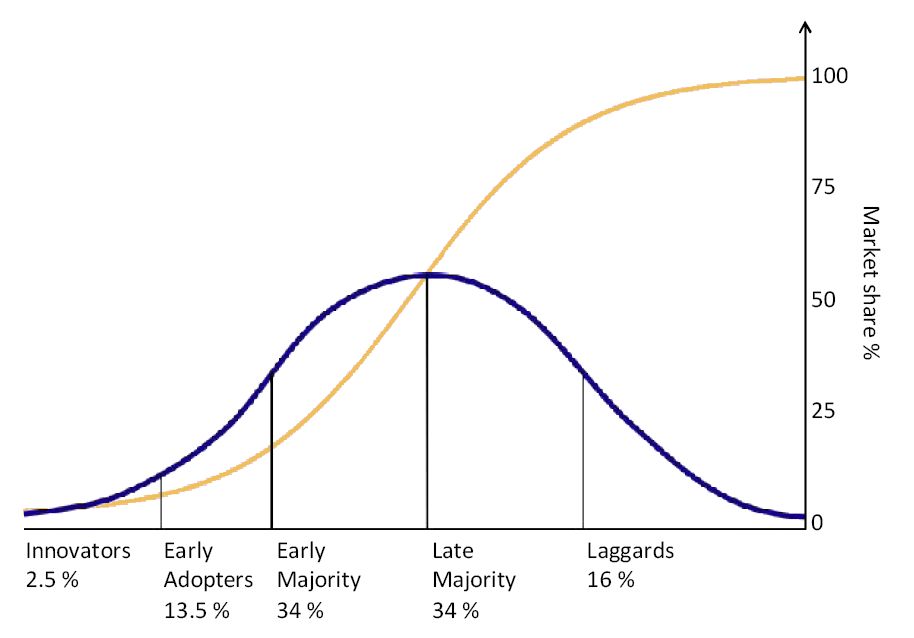
The second door is diffusion — the spread of cultural traits from one group or society to another. Most of what any culture contains was not invented there; the anthropologist Ralph Linton estimated that the overwhelming majority of any culture is borrowed. Your morning likely runs on coffee (Ethiopia), tea (China), an alphabet adapted from the Phoenicians, and numerals from India by way of the Arab world. Diffusion follows a recognizable path — the S-shaped curve in the figure — as a new trait moves from a handful of early adopters to the majority and finally to the last holdouts. In the age of the internet, that curve has grown steeper: a dance, a slang word, or a protest tactic can circle the planet in days.
Cultural lag: when the rulebook falls behind
The third door is really a side effect of the first two. The sociologist William F. Ogburn observed that the two halves of culture do not change at the same speed: material culture tends to race ahead while nonmaterial culture — laws, ethics, customs, beliefs — lumbers behind. He named the gap cultural lag, the uncomfortable stretch of time during which a society has a powerful new technology but has not yet worked out the rules for using it. We are living in several such gaps right now: gene editing, social media, surveillance tools, and self-driving cars have all arrived faster than our ethics and statutes can decide what to do with them.
| Engine of change | What it means | Example |
|---|---|---|
| Innovation — discovery | Recognizing something that already existed | The Earth orbits the Sun; germs cause disease |
| Innovation — invention | Combining existing things into something new | The wheel, printing press, the internet |
| Diffusion | Traits spreading from one culture to another | Coffee, yoga, pizza, Arabic numerals, K-pop |
| Cultural lag | Nonmaterial culture trailing material culture | Law and ethics scrambling to catch up with gene editing |
- Innovation introduces the new through discovery (grasping what exists) and invention (combining into something new).
- Diffusion spreads traits between cultures; most of any culture is borrowed, and the internet accelerates it.
- Cultural lag (Ogburn): nonmaterial culture trails material culture, leaving a gap where the rules have not caught up.
- The same change often has unintended ripple effects far beyond its original purpose.
The chapter in one breath
- Culture is a group’s whole learned, shared way of life; it splits into material (objects) and nonmaterial (ideas, values, norms, language).
- Values define what is good; norms are the rules that enact them, enforced by sanctions.
- Sumner ranked norms as folkways (mild), mores (moral), and taboos (unthinkable); laws are norms formalized by the state.
- Symbols carry culturally assigned meaning, and language — per the Sapir–Whorf hypothesis — can shape thought itself.
- Subcultures vary from the mainstream while countercultures oppose it; ethnocentrism judges others by one’s own standards, and cultural relativism resists that pull.
- The three paradigms read culture differently: functionalism as social glue, conflict theory as a tool of power, symbolic interactionism as meaning built in interaction.
- Cultures change through innovation (discovery and invention), diffusion (borrowing), and the cultural lag between fast technology and slow custom.
ReferenceWords worth knowing
A quick reference for the terms in this chapter — skim it now, or circle back whenever a word trips you up.
- Counterculture
- A group whose values and norms actively reject and oppose those of the dominant culture.
- Cultural lag
- Ogburn’s idea that nonmaterial culture (laws, customs, ethics) changes more slowly than material culture, leaving a gap.
- Cultural relativism
- The practice of understanding a culture on its own terms and in its own context before judging it.
- Cultural universal
- A pattern or trait — such as marriage, cooking, or funerals — found in every known human culture.
- Culture
- The learned, shared beliefs, values, behaviors, language, and material objects of a group, passed to the next generation.
- Diffusion
- The spread of cultural traits, ideas, or objects from one group or society to another.
- Ethnocentrism
- Judging another culture by the standards of one’s own and assuming one’s own is superior.
- Folkways
- Everyday customs and manners whose violation brings only mild disapproval.
- Innovation
- The introduction of something new to a culture, through discovery or invention.
- Invention
- Combining existing cultural elements into something genuinely new, such as the printing press.
- Language
- An organized system of symbols that lets people communicate and transmit culture across generations.
- Material culture
- The physical objects a society creates and uses — tools, buildings, clothing, technology.
- Mores
- Norms with strong moral significance whose violation brings serious social sanctions.
- Nonmaterial culture
- The intangible parts of culture: ideas, beliefs, values, norms, symbols, and language.
- Norm
- A rule or expectation that guides behavior within a culture, enforced by sanctions.
- Sanction
- A reward for conforming to a norm or a punishment for violating it.
- Sapir–Whorf hypothesis
- The idea (linguistic relativity) that the language one speaks shapes how one perceives and thinks.
- Subculture
- A group that shares the wider culture but maintains its own distinct values, norms, and style.
- Symbol
- Anything — word, gesture, object, image — that carries a meaning recognized by those who share a culture.
- Taboo
- A norm so strong that violating it is nearly unthinkable and provokes revulsion.
- Values
- A culture’s broad standards of what is good, desirable, and worth pursuing.