Global Inequality
A child born today in Norway can expect more than eighty years of life, near-universal schooling, and clean water from a tap. A child born the same day in Niger faces a one-in-ten chance of dying before age five and may never see the inside of a classroom. Neither child chose where to be born, yet that single accident will shape their lives more powerfully than talent, effort, or ambition ever could. This chapter is about the largest and most consequential form of inequality on earth — the gulf between nations — how sociologists measure it, how they explain it, what it does to human bodies and lives, why it falls hardest on women, and how a globalizing world is reshuffling the whole arrangement.
By the end of this chapter you can
- Define global stratification and distinguish high-, middle-, and low-income nations.
- Explain the common measures of national wealth and poverty — GNI per capita, the Gini coefficient, and the Human Development Index.
- Compare and contrast modernization theory and dependency theory, and locate each in the functionalist and conflict paradigms.
- Distinguish absolute from relative poverty and describe the lived reality of extreme poverty.
- Explain the feminization of poverty and the mechanisms that concentrate hardship among women.
- Analyze how globalization has changed inequality both between and within nations.
- Apply the three sociological paradigms — structural functionalism, conflict theory, and symbolic interactionism — to global inequality.
Section 1Global stratification — high-, middle-, and low-income nations
What global stratification means
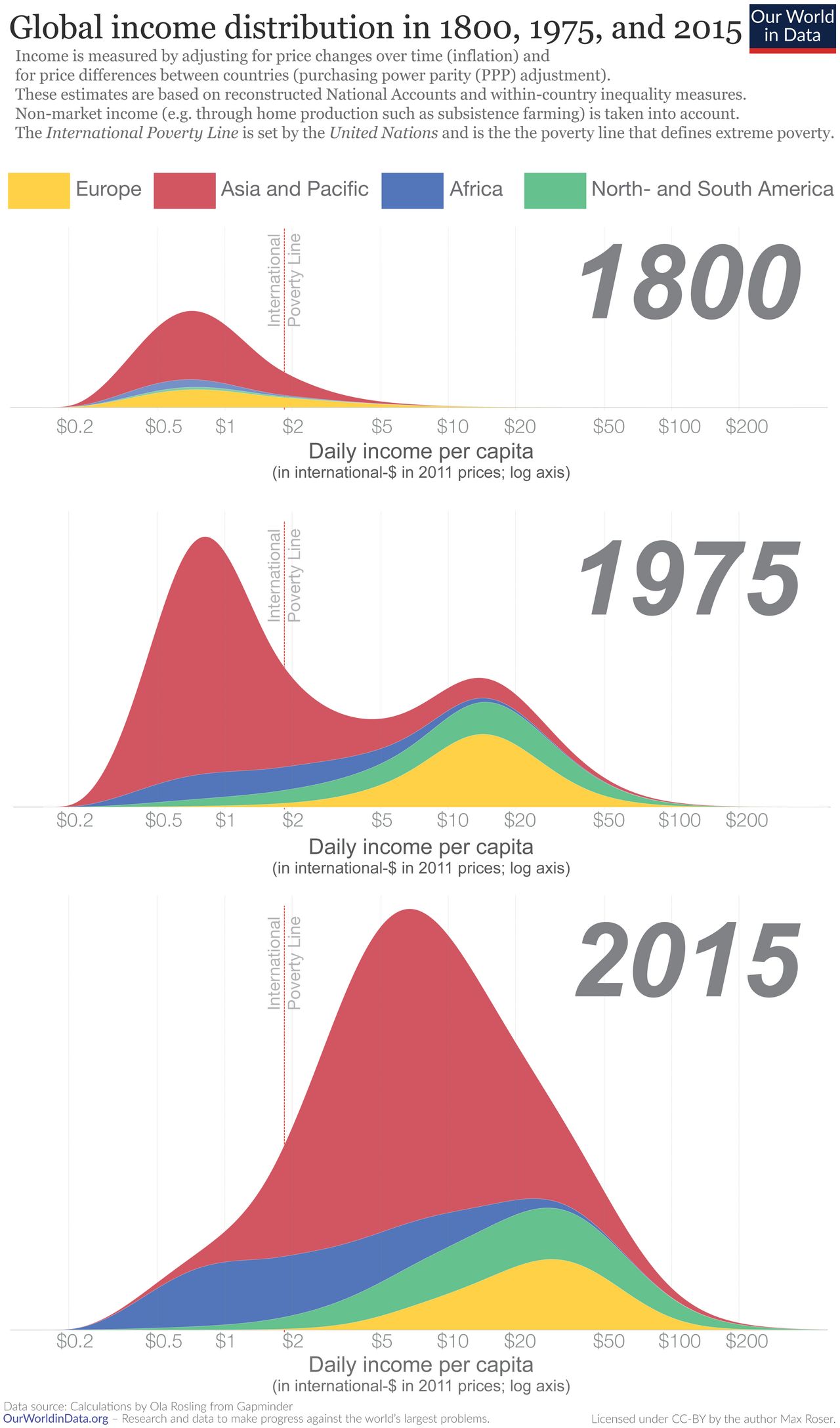
Within any single country, sociologists study social stratification — the way a society ranks its members into layers of wealth, power, and prestige. Global stratification lifts that same lens to the level of the planet: it is the ranking of entire nations into layers, so that whole populations are advantaged or disadvantaged by the country they happen to inhabit. The scale of this ranking dwarfs anything inside a single society. The richest fifth of the world's people consume roughly three-quarters of the world's output, while the poorest fifth consume a tiny sliver. For most of human history the gap between the richest and poorest societies was modest — a peasant in 1700 lived much like a peasant anywhere. Industrialization changed that. Over two centuries the nations that industrialized first pulled dramatically ahead, opening a chasm that defines the modern world.
The income ladder
The most widely used map of global stratification is the World Bank's income classification, which sorts economies by gross national income (GNI) per capita — the total income of a country divided by its population. It marks four rungs. High-income nations are the industrialized and post-industrial economies — the United States, Germany, Japan, Norway — that hold the great majority of global wealth. Upper-middle-income nations, such as China, Brazil, and Mexico, are industrializing rapidly and growing a large middle class. Lower-middle-income nations, including India, Nigeria, and Bangladesh, have mixed economies with large agrarian sectors and swelling cities. Low-income nations — concentrated in sub-Saharan Africa and including Niger, the Democratic Republic of the Congo, and Somalia — remain largely agrarian, with high child mortality and short life expectancy. Older labels you will still hear — "First, Second, and Third World," or "developed and developing" — are fading, partly because they were coined during the Cold War and partly because they implied that poor nations were simply immature versions of rich ones.
| Income tier | GNI per person (approx.) | Examples | Typical profile |
|---|---|---|---|
| High-income | Above ~$14,000 | United States, Germany, Japan, Norway, Qatar | Industrial/post-industrial; life expectancy ~80; holds most global wealth |
| Upper-middle-income | ~$4,500–14,000 | China, Brazil, Mexico, South Africa | Rapidly industrializing; growing urban middle class |
| Lower-middle-income | ~$1,150–4,500 | India, Nigeria, Kenya, Bangladesh | Mixed economies; large agrarian sector; fast-growing cities |
| Low-income | Below ~$1,150 | Niger, DR Congo, Somalia, Mali | Largely agrarian; high child mortality; life expectancy ~55–62 |
Measuring the gap
GNI per capita is a blunt instrument — it is an average, and an average can hide a nation where a few billionaires sit atop widespread misery. Sociologists therefore reach for other tools. The Gini coefficient captures how evenly income is spread within a country, running from 0 (everyone equal) to 1 (one person holds everything). The Human Development Index (HDI), developed for the United Nations, blends income with life expectancy and education, on the reasoning that development means more than money — it means a long, healthy, informed life. Together these measures reveal a stubborn truth: national wealth and human well-being usually rise together, but not always, and the exceptions are where the most interesting sociology lives.
Where you are born outweighs almost anything you will ever do. The economist Branko Milanovic calls it the "birthplace lottery": roughly half of a person's income can be predicted from their country of citizenship alone, before we know a single thing about their effort, schooling, or intelligence. In a world that prizes merit, that is a sobering finding — global stratification hands out most of the prizes at birth.
- Global stratification ranks whole nations into layers of wealth and life chances.
- The World Bank sorts nations by GNI per capita into high-, upper-middle-, lower-middle-, and low-income tiers.
- The Gini coefficient measures inequality within a nation; the HDI blends income with health and education.
- Country of birth — the "birthplace lottery" — predicts life chances more powerfully than individual merit.
Section 2Explaining global inequality — modernization vs. dependency
Modernization theory: poverty from within
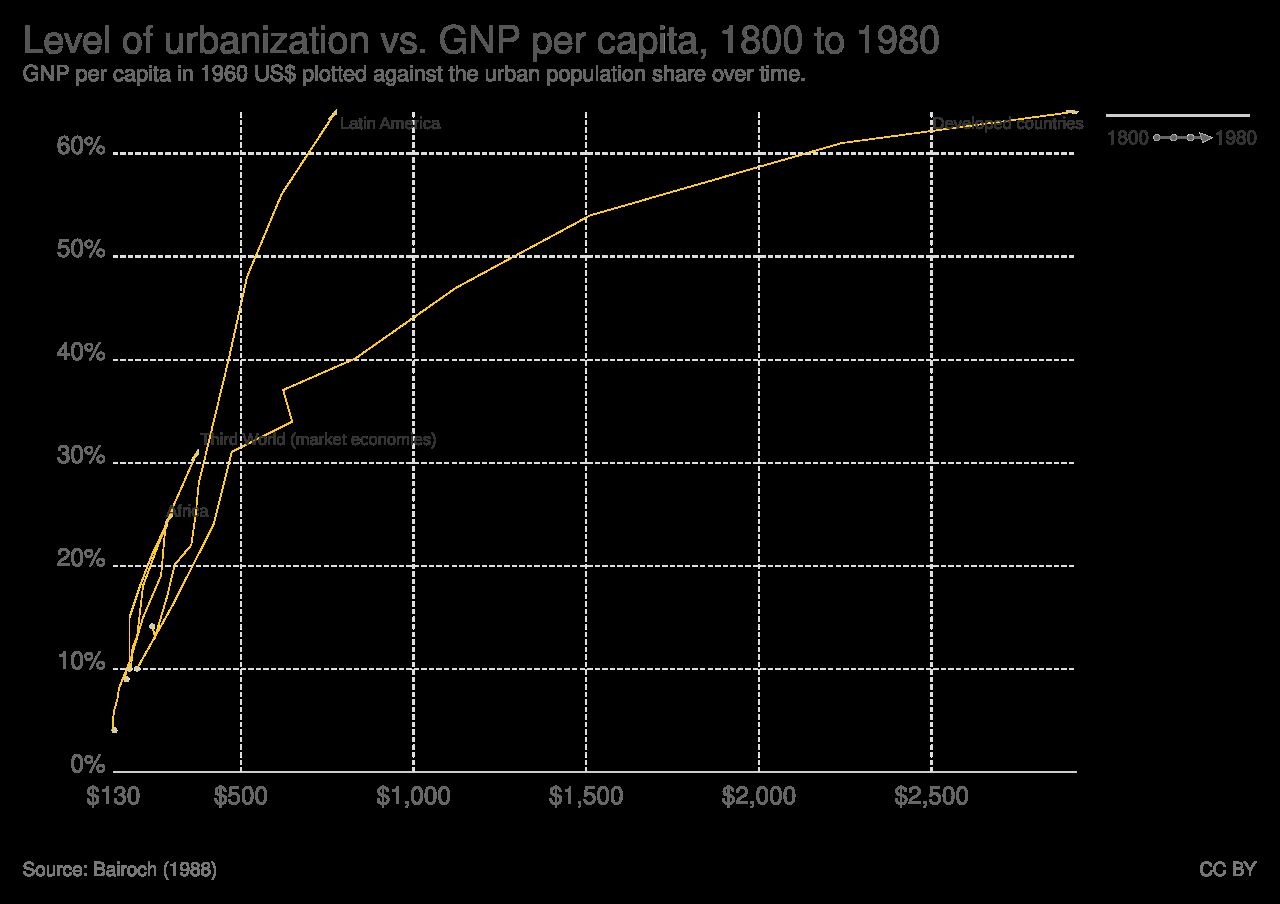
Why are some nations rich and others poor? The first major answer, modernization theory, grows out of the structural-functionalist tradition of Emile Durkheim and Talcott Parsons. It locates the cause of poverty inside poor nations themselves: in traditional values, weak technology, and a shortage of the cultural habits — saving, investing, valuing science — that let a society take off economically. Its most famous statement is W. W. Rostow's stages of economic growth (1960), which imagines every nation climbing the same ladder: (1) traditional society, (2) preconditions for take-off, (3) take-off, (4) the drive to maturity, and (5) the age of high mass consumption. On this view, rich nations simply climbed first, and poor nations can follow by adopting modern values, welcoming investment, and opening to trade. The policy that follows is optimistic: foreign aid, technology transfer, and education will pull the poor up the ladder.
Dependency theory: poverty from without
Critics found modernization theory not just wrong but insulting — it seemed to blame the poor for their own poverty while ignoring five centuries of history. Dependency theory, rooted in the conflict tradition of Karl Marx, flips the explanation outward. Poverty, it argues, is not an original condition that poor nations have failed to escape; it is a condition that was created by the rich. Through colonialism, powerful nations extracted the gold, rubber, sugar, and labor of the lands they conquered, wiring the global economy so that raw materials flow cheaply out of poor countries and finished goods flow expensively back in. The Latin American economist Raúl Prebisch showed how these terms of trade keep poor nations running to stand still, and Andre Gunder Frank coined the phrase "the development of underdevelopment" to capture the idea that some nations were made poor by the same process that made others rich. Immanuel Wallerstein's world-systems theory extends the argument, describing a single capitalist world-economy divided into a wealthy core, an exploited periphery, and a semi-periphery in between.
Weighing the two
Neither theory is a clean winner. Modernization theory struggles to explain why decades of aid have not lifted many nations, and why some resource-rich countries stay poor — but it rightly notes that internal factors like governance, corruption, and education genuinely matter, and that a few nations (South Korea, Taiwan) really did climb the ladder. Dependency theory brilliantly exposes the scars of colonialism — but it can underplay internal factors and struggles to explain the spectacular, home-grown growth of China and India. A careful sociologist holds both: history and exploitation set the starting positions, and internal choices shape what a nation does from there.
| Feature | Modernization theory | Dependency theory | World-systems theory |
|---|---|---|---|
| Root paradigm | Structural functionalism | Conflict (Marxist) | Conflict, on a global scale |
| Cause of poverty | Internal — traditional culture, weak technology | External — colonial extraction, unequal trade | A nation's position in one capitalist world-economy |
| Key thinkers | W. W. Rostow, Talcott Parsons | Andre Gunder Frank, Raúl Prebisch | Immanuel Wallerstein |
| Way out of poverty | Adopt modern values, invest, trade openly | Break dependency; fairer terms of trade | Very hard — the system resists escape |
| Main critique | Blames the poor; ignores colonialism | Underplays internal factors & real growth | Broad and hard to test |
Much of the world's poverty was manufactured, not inherited. When Belgium ruled the Congo, it built railways — not to move Congolese people, but to move Congolese rubber and copper to the coast. Colonial economies were engineered for extraction, and many of those channels still run in the same direction. Dependency theory's core insight is that you cannot understand a poor nation's present without reading its extracted past.
- Modernization theory (functionalist; Rostow, Parsons) blames poverty on internal traditional culture and prescribes modern values, aid, and trade.
- Dependency theory (conflict; Frank, Prebisch) blames poverty on external exploitation — colonialism and unequal trade.
- World-systems theory (Wallerstein) sees one capitalist economy split into core, periphery, and semi-periphery.
- The strongest account combines both: history sets starting positions, and internal choices shape the path from there.
Section 3The human cost — the lived reality of global poverty
Two kinds of poverty
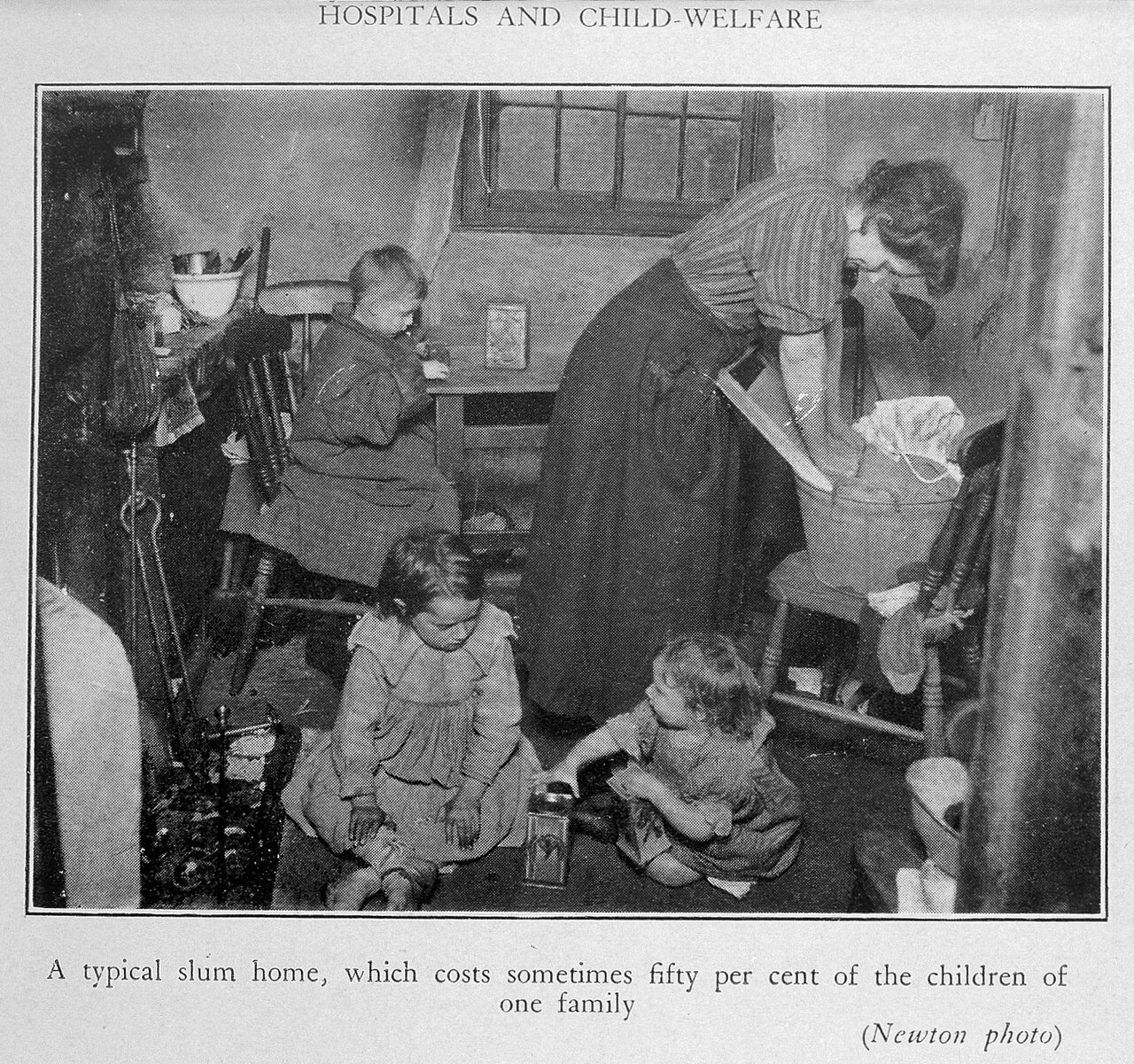
Sociologists draw a sharp line between two poverties. Relative poverty means falling well below the standard of living of one's own society — a family in a wealthy nation that cannot afford what neighbors take for granted. Absolute poverty is the deprivation of the basics needed to survive: food, clean water, shelter, sanitation. The World Bank marks the line of extreme poverty at roughly $3.00 a day (in 2021 purchasing-power terms — the older $2.15 line, in 2017 prices, has been retired), and more than 800 million people — roughly one in ten human beings — live below it. This is not the poverty of doing without a smartphone; it is the poverty of doing without dinner.
What poverty does to a life
Absolute poverty is not merely uncomfortable — it is lethal, and it is lethal disproportionately to the young. A child in the poorest nations is many times more likely to die before age five than a child in the richest, felled by diseases — diarrhea, pneumonia, malaria — that are cheap to prevent and treat where money exists. Roughly one in eleven people worldwide is undernourished, and hunger in the first years of life stunts both bodies and brains permanently. Billions still lack safely managed drinking water and sanitation, so the simple act of fetching water — a task that falls mostly to women and girls — can consume hours that might have gone to school or paid work. Poverty, in short, is a thief of time, health, and futures long before it is anything else.
The persistence of bondage
The harshest edge of global poverty is that human beings are still bought and sold. Modern estimates count on the order of 50 million people in some form of modern slavery — forced labor, forced marriage, and debt bondage, in which a loan that can never be repaid chains a worker (and sometimes their children) to an employer. Tens of millions of children work instead of attending school, many in hazardous conditions. These are not relics of a distant century; they are features of the same global economy that fills store shelves in wealthy nations, and they thrive precisely where poverty leaves people with no other option.
| Indicator | What it measures | Roughly, in the world today |
|---|---|---|
| Extreme poverty | Living below ~$3.00 a day (2021 PPP) | More than 800 million people (~1 in 10) |
| Undernourishment | Chronic lack of adequate food | Hundreds of millions; ~1 in 11 hungry |
| Under-5 mortality | Deaths before the fifth birthday | Many times higher in low- than high-income nations |
| Safe water & sanitation | Access to clean water and toilets | Billions still lack safely managed services |
| Modern slavery | Forced labor, forced marriage, debt bondage | On the order of 50 million people |
Absolute poverty kills; relative poverty still wounds. It is tempting to say only extreme poverty "counts," but relative poverty in a rich nation is real deprivation too — the child who cannot afford the school trip, the family one paycheck from the street. The distinction matters not to rank suffering but to aim policy: absolute poverty demands food, medicine, and water now, while relative poverty demands a fairer share of a society that already has enough.
- Absolute poverty lacks the basics for survival; relative poverty falls below a society's own standard.
- The extreme poverty line is about $3.00/day (2021 PPP); more than 800 million people live below it.
- Poverty's cruelest toll falls on children through hunger, preventable disease, and lost schooling.
- Modern slavery and debt bondage still trap tens of millions inside the global economy.
Section 4Gender & global poverty — the feminization of poverty
Poverty has a gender
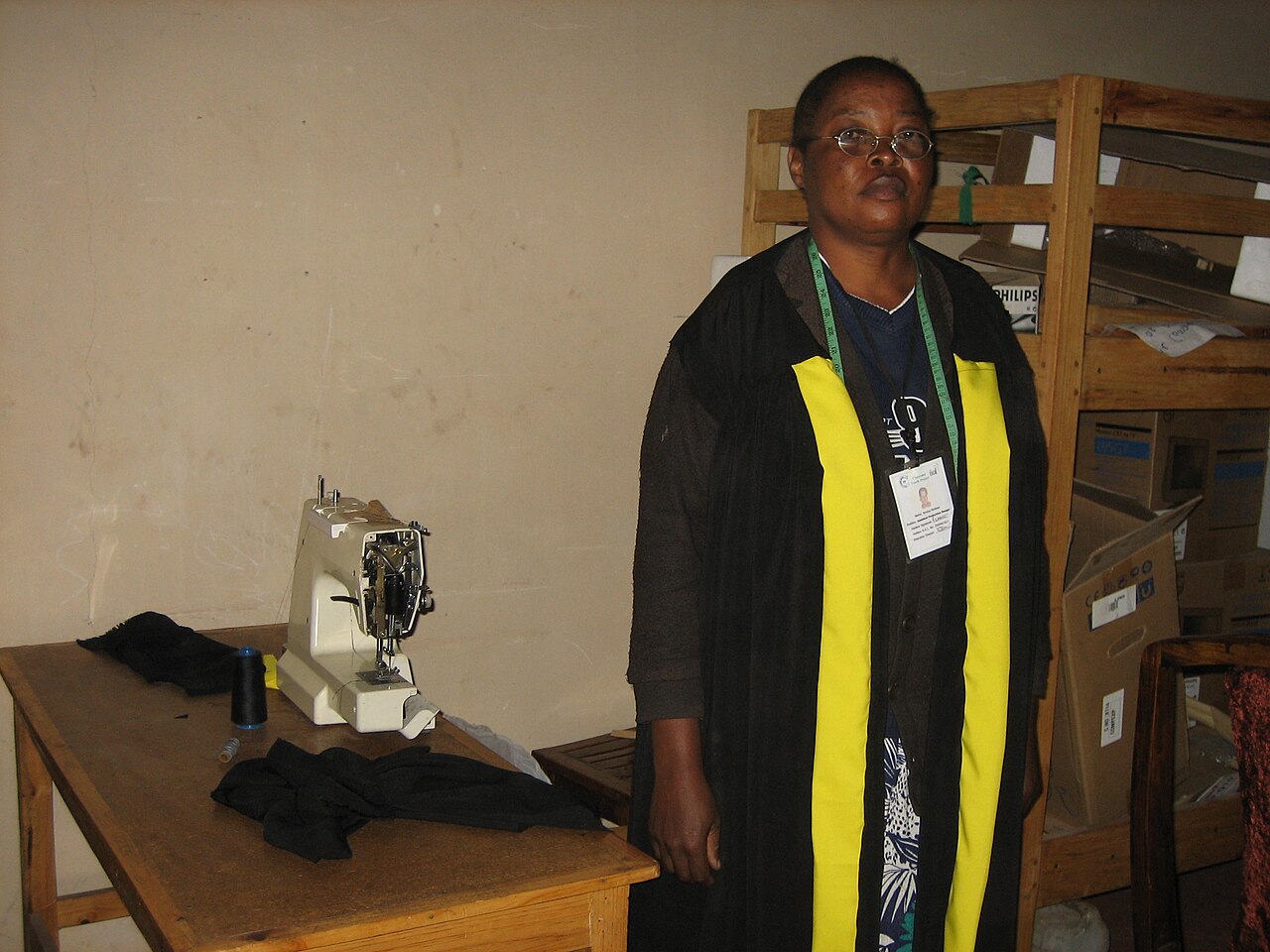
Poverty is not distributed evenly between the sexes. The sociologist Diana Pearce named the pattern in 1978: the feminization of poverty, the tendency for women and children to make up a growing and disproportionate share of the world's poor. Women perform a large majority of the world's unpaid labor and much of its most precarious paid labor, yet own only a small fraction of the world's property and earn far less than their share of its income. When a household is poor, the woman in it is usually poorer still, eating last and least, working longest, and holding the fewest assets to fall back on.
Why the burden falls on women
Several mechanisms lock the pattern in place. First is unpaid care work: cooking, cleaning, hauling water, and raising children fall overwhelmingly to women, invisible to the economy and uncounted in any wage. Arlie Hochschild called the paid job stacked on top of this unpaid one the "second shift." Second is the wage gap and the crowding of women into the low-paid informal sector — street vending, piecework, domestic service — with no contract and no protection. Third is unequal access to property and credit: in many nations women cannot easily own land or borrow money, so they cannot build the assets that lift a family out of poverty. Fourth is education: when a poor family can school only some of its children, it is usually the daughters who are kept home. Each mechanism reinforces the others across a lifetime.
Why investing in women pays
The pattern has a hopeful mirror image. Decades of development research find that resources placed in women's hands do more good: mothers tend to spend added income on their children's food, health, and schooling. Educating girls lowers child mortality and birth rates and raises earnings across a whole society. This insight drove the microcredit movement — Muhammad Yunus's Grameen Bank in Bangladesh lent tiny sums, mostly to women, to start small enterprises, and won a Nobel Peace Prize for it. Microcredit is no cure-all, and critics note that debt can trap as easily as it can free, but the underlying lesson stands: because poverty is feminized, the fastest route out of it usually runs through women.
| Domain | The gendered pattern | Consequence for women |
|---|---|---|
| Paid work | Crowded into informal, low-wage jobs | Little pay, no protection or pension |
| Unpaid work | Care and housework — the "second shift" | Long hours, invisible to the economy |
| Property & credit | Barred or limited from owning land or borrowing | No assets to build wealth or buffer shocks |
| Education | Girls pulled from school first when money is short | Fewer skills, lower lifetime earnings |
| Health | High maternal mortality where care is scarce | Death and disability in childbirth |
Give a dollar to the mother, not the household. Development economists learned this the hard way: aid handed to "families" often never reaches the women and children who need it most, while aid placed directly in women's hands reliably improves child nutrition and schooling. The feminization of poverty is a problem, but it is also a lever — because women are the world's poorest, lifting them lifts the most.
- The feminization of poverty (named by Diana Pearce, 1978) is women's growing, disproportionate share of the poor.
- Its engines are unpaid care work (Hochschild's "second shift"), the wage gap, the informal sector, and denied access to land, credit, and schooling.
- Resources placed in women's hands yield outsized gains in child health and education.
- Microcredit (Yunus, Grameen Bank) targets women, though debt can trap as well as free.
Section 5A changing world — globalization and its effects on inequality
What globalization is
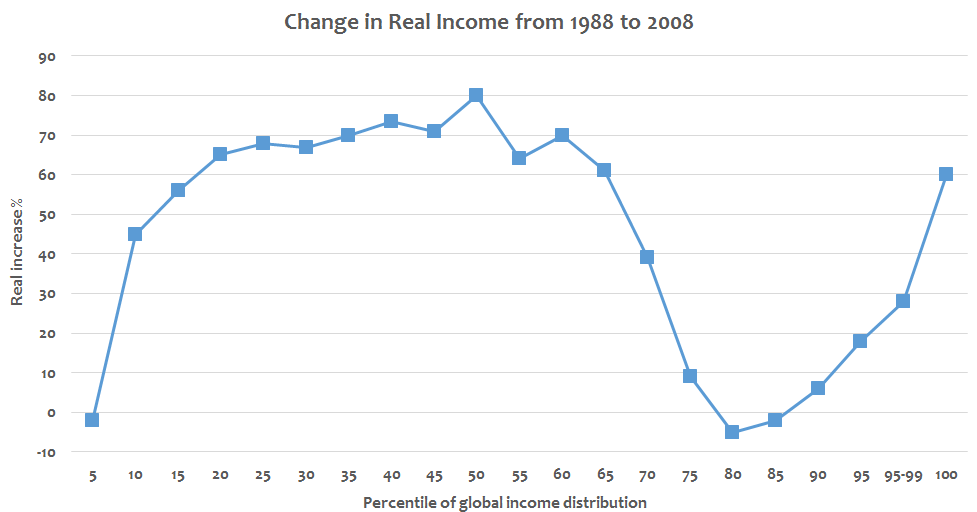
Globalization is the growing integration of the world's economies, cultures, and populations — the flow of goods, money, people, and ideas across borders at a scale and speed without precedent. Its economic engine is the transnational corporation, which designs a product in one country, manufactures it in a second, and sells it in a third, chasing the lowest costs across the planet. Supporters see globalization spreading prosperity; critics see it spreading exploitation. Both are partly right, and the truth is legible in a single, oddly shaped curve.
Winners, losers, and the elephant
Over the past generation something remarkable happened: extreme poverty fell faster than at any time in history, as China and India pulled hundreds of millions of people up. The gap between the average citizen of rich and poor nations narrowed. Yet within nations, inequality often widened at the same time. The economists Christoph Lakner and Branko Milanovic captured this in the famous "elephant curve": the emerging middle classes of Asia gained enormously (the elephant's rising back), and the global super-rich gained most of all (the raised trunk), while the working and middle classes of wealthy nations saw their incomes stagnate (the dip before the trunk). Globalization, in other words, did not simply raise or lower inequality — it rearranged it, creating new winners and new losers on every continent.
How the paradigms read the change
The three sociological paradigms interpret this rearrangement differently, and each catches something real. Structural functionalists, heirs to modernization theory, see globalization spreading technology and modern institutions, integrating poor nations into a productive whole. Conflict theorists, heirs to dependency theory, see a new engine of extraction: sweatshops, tax havens, and a "race to the bottom" in which corporations pit workers in different nations against one another. Symbolic interactionists zoom in on lived meaning — how a factory job reshapes a village woman's identity, how global brands rewrite what people in poor nations desire, how the very labels "developed" and "backward" frame whole populations. Add to this the digital divide — the gap between those with access to the internet and its opportunities and those without — and it is clear that globalization is not one thing happening to everyone but many things happening unevenly.
| Paradigm | How it sees global inequality | Reads globalization as |
|---|---|---|
| Structural functionalism | Nations at different stages of one shared climb | Modernization spreading — mostly a rising tide |
| Conflict theory | Exploitation of the powerless by powerful nations and firms | A new engine of extraction that widens gaps |
| Symbolic interactionism | Poverty and wealth as lived meanings and labels | A remaking of identities, desires, and consumption |
Globalization is neither savior nor villain — it is a choice about distribution. The technology that moved a factory to Bangladesh could have shared its gains with laid-off workers in Ohio, or with the women stitching shirts for a dollar a day; whether it did was a political decision, not an economic law. The elephant curve is not fate. It is the sum of choices about taxes, wages, trade rules, and rights — which means it could have been drawn, and could still be redrawn, differently.
- Globalization integrates the world's economies through trade, migration, technology, and transnational corporations.
- It narrowed inequality between nations (China, India) while often widening it within them — the "elephant curve."
- Functionalist, conflict, and interactionist paradigms each read globalization differently and each capture part of the truth.
- The digital divide is a new axis of global inequality, and distribution of globalization's gains is a political choice.
The chapter in one breath
- Global stratification ranks whole nations into high-, middle-, and low-income tiers, and the "birthplace lottery" makes country of birth the single biggest predictor of life chances.
- National wealth is measured by GNI per capita, inequality within nations by the Gini coefficient, and human well-being by the Human Development Index.
- Modernization theory (functionalist; Rostow) blames internal culture; dependency theory (conflict; Frank, Prebisch) and world-systems theory (Wallerstein) blame external exploitation and colonial history.
- Absolute poverty lacks survival basics — more than 800 million live under ~$3.00/day — and it kills children through hunger and preventable disease; relative poverty harms too.
- The feminization of poverty concentrates hardship among women through unpaid care, the wage gap, and denied land, credit, and schooling — yet investing in women yields the largest gains.
- Globalization narrowed inequality between nations while often widening it within them — the "elephant curve" of winners and losers.
- The three paradigms — functionalism, conflict, and symbolic interactionism — each illuminate a different face of global inequality.
ReferenceWords worth knowing
A quick reference for the terms in this chapter — skim it now, or circle back whenever a word trips you up.
- Absolute poverty
- Deprivation of the basic necessities for survival — food, clean water, shelter, sanitation.
- Colonialism
- The historical domination of one nation by another to extract its land, labor, and resources.
- Core nations
- In world-systems theory, the wealthy, industrialized nations at the center of the global economy.
- Dependency theory
- A conflict-based explanation holding that poor nations were made poor by exploitation from rich ones.
- Extreme poverty
- Living below the international poverty line (about $3.00 a day in 2021 purchasing-power terms; the earlier line was $2.15 in 2017 prices).
- Feminization of poverty
- The growing, disproportionate share of the world's poor made up of women and children.
- Gini coefficient
- A measure of income inequality within a nation, from 0 (perfect equality) to 1 (total concentration).
- Global North / Global South
- A shorthand contrast between wealthier (often northern) and poorer (often southern) nations.
- Global stratification
- The ranking of entire nations into layers of wealth, power, and life chances.
- Globalization
- The growing integration of the world's economies, cultures, and populations across borders.
- Gross national income (GNI) per capita
- A nation's total income divided by its population; the basis of income-tier classification.
- Human Development Index (HDI)
- A composite measure blending income, life expectancy, and education.
- Microcredit
- Small loans, often to women, to start enterprises and escape poverty; pioneered by the Grameen Bank.
- Modernization theory
- A functionalist explanation attributing poverty to internal traditional values and prescribing modern development.
- Neocolonialism
- Continued economic domination of former colonies through trade, debt, and corporations rather than direct rule.
- Peripheral nations
- In world-systems theory, poor nations exploited for cheap labor and raw materials.
- Relative poverty
- Falling well below the ordinary standard of living of one's own society.
- Rostow's stages of growth
- W. W. Rostow's five-stage model of a nation's climb from traditional society to mass consumption.
- Semi-peripheral nations
- In world-systems theory, industrializing nations between the core and the periphery.
- World-systems theory
- Wallerstein's model of a single capitalist world-economy split into core, semi-periphery, and periphery.