Foundations: Mesopotamia and Egypt
Everything that follows in this book — parliaments, cathedrals, laboratories, factories, constitutions — rests on a set of inventions made between roughly 9500 and 500 BCE by people who left no memoirs and never heard the word “Europe.” Farming. Cities. Writing. Bureaucracy. Kingship. Written law. Monumental architecture. Standardized weights, calendars, and interest rates. Two river valleys did most of that work: the Tigris–Euphrates floodplain of southern Iraq and the Nile corridor of Egypt. They were not the same place and did not solve their problems the same way, and the differences between them — unpredictable flood versus reliable flood, open plain versus protected valley, quarreling city-states versus a unified kingdom — shaped two very different political cultures. This chapter asks how and why those things emerged, what they cost the people who lived through them, and how a set of Afro-Asian innovations became the foundation of a story Europeans would later tell about themselves.
By the end of this chapter you can
- Explain the Neolithic Revolution and evaluate the trade-offs farming imposed on human health, labor, and social equality.
- Describe how irrigation agriculture on the alluvial plain of southern Mesopotamia produced surplus, specialization, and the world’s first cities.
- Trace the development of cuneiform from accounting tokens to literature, and explain why writing began as bookkeeping rather than poetry.
- Compare the city-state politics of Sumer with the territorial empires of Akkad, Assyria, and Babylon, and identify what each empire added to the toolkit of rule.
- Analyze the Code of Hammurabi as both a legal document and a piece of royal self-presentation, including its class-graded penalties.
- Explain how the Nile inundation shaped Egyptian agriculture, taxation, religion, and the ideology of ma’at.
- Distinguish the Old, Middle, and New Kingdoms of Egypt and account for the Intermediate Periods between them.
- Assess the causes and consequences of the Late Bronze Age collapse around 1200 BCE, acknowledging where the evidence is contested.
- Evaluate the claim that Mesopotamia and Egypt are the “origins of Western Civilization,” and articulate a more defensible version of that claim.
Section 1Before Cities: Farming, Sedentism & the First Big Buildings
The bargain nobody negotiated
For roughly 95 percent of the time anatomically modern humans have existed, everyone lived by hunting, fishing, and gathering. Then, over a few thousand years beginning around 9500 BCE, populations in a crescent of well-watered hills running from the Levant north through southeastern Anatolia and down the Zagros foothills began to plant, harvest, and herd. Archaeologists call the region the Fertile Crescent, and the change the Neolithic Revolution — a misleading name, since it unfolded over some three thousand years, longer than the span from the founding of Rome to the present.
The Fertile Crescent got there first largely because of what grew there. Wild einkorn and emmer wheat, barley, lentils, chickpeas, peas, bitter vetch, and flax — eight founder crops — all occurred naturally within a few hundred kilometers of one another, and four of the world’s most useful domesticable large mammals (sheep, goat, pig, cattle) lived in the same neighborhood. That is not a statement about the genius of the people involved. It is a statement about a lucky biological inventory. Regions that lacked comparable species domesticated later or not at all.
Farming produced more calories per acre, and more calories meant more people. But it did not produce healthier people. Skeletal evidence from Neolithic sites across the Near East and beyond shows shorter stature than in the foraging populations that preceded them, more dental caries from starchy diets, more enamel hypoplasia signaling childhood nutritional stress, more iron-deficiency anemia, and more degenerative joint disease from repetitive grinding and hauling. Living beside domesticated animals in permanent settlements gave humans a new class of disease: measles, tuberculosis, smallpox, and influenza all have origins in or close relationships to animal pathogens. Sedentism plus livestock plus dense population plus contaminated water is the recipe for the epidemic.
Göbekli Tepe and the order of operations
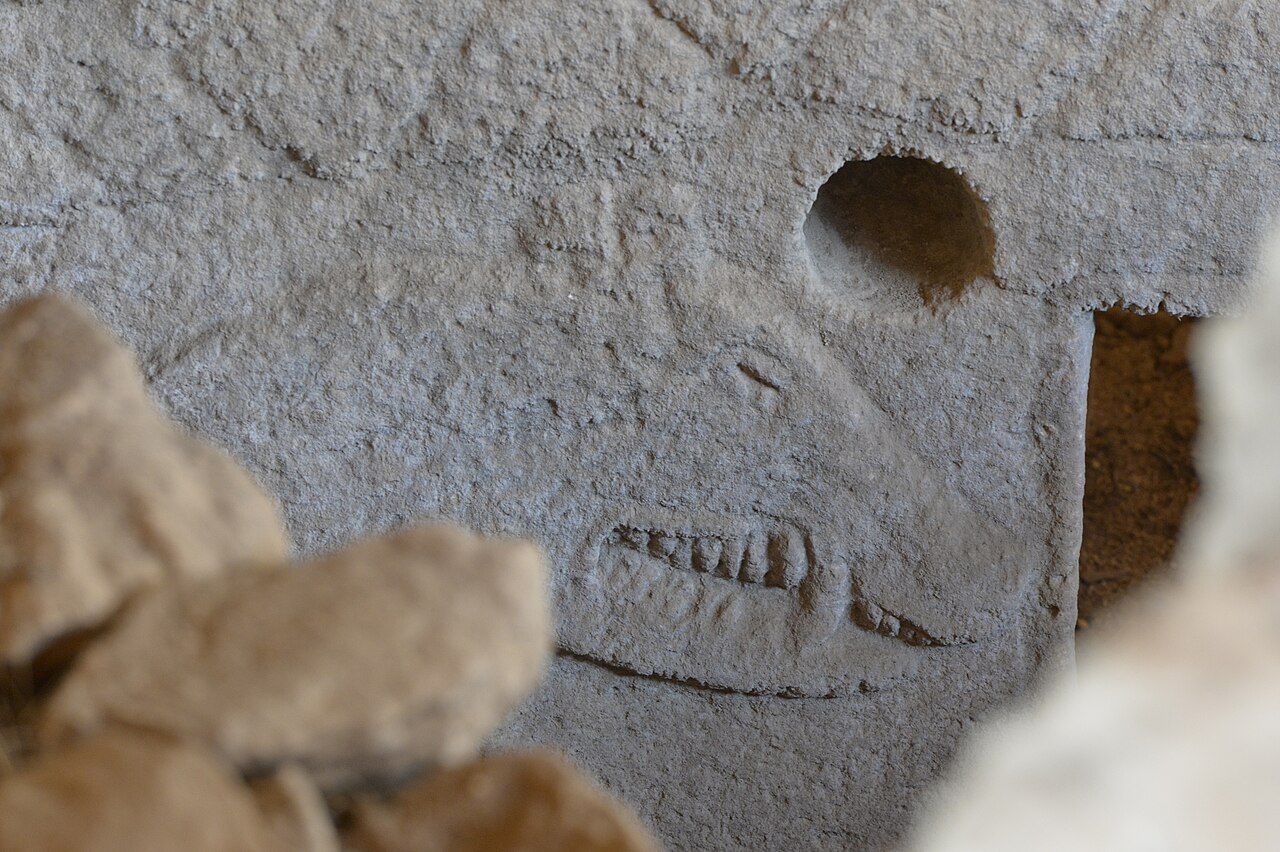
The tidy old textbook sequence ran: farming creates surplus, surplus creates leisure, leisure creates religion and monuments. Then in 1995 Klaus Schmidt began excavating a hilltop in southeastern Turkey called Göbekli Tepe. He found circular enclosures ringed with T-shaped limestone pillars up to 5.5 meters tall and 10 tonnes in weight, carved with foxes, boars, vultures, scorpions, and snakes. The earliest layers date to roughly 9500 BCE — before domesticated crops and livestock are securely attested anywhere.
Schmidt argued that the sequence was backwards: gathering large numbers of people to build and feast at ritual sites created the demand for a reliable food supply, and farming followed. That strong version is contested. More recent excavation has found grinding installations, cisterns, and possible domestic structures at the site, suggesting the builders may have been more sedentary and more dependent on intensively harvested wild cereals than Schmidt first thought. The honest summary is that Göbekli Tepe demolished the simple causal arrow without yet replacing it with a settled alternative. Monumental construction and food production emerged together, entangled, over centuries.
Two other sites fill in the picture. At Jericho in the Jordan Valley, people built a stone wall and a solid stone tower roughly 8.5 meters high around 8000 BCE — the oldest known monumental architecture in a settlement. At Çatalhöyük in central Anatolia, occupied roughly 7100 to 5950 BCE, several thousand people lived in mudbrick houses packed so tightly that there were no streets; residents walked across rooftops and entered through the roof by ladder. They buried their dead under the floors of their own houses, plastered and repainted their walls dozens of times, and left no evidence of a palace, a temple precinct, or a chief. A large settlement, in other words, is not automatically a city, and density does not automatically produce hierarchy.
Agriculture was a slow, regionally lucky, and physically costly transition that fed more people while making the average person shorter, sicker, and busier — and monumental building may have helped drive it rather than merely following from it.
Section 2Sumer: Irrigation, the First Cities & the Invention of Writing
Mud, water, and the surplus problem
Southern Iraq is a hot, nearly rainless alluvial plain built from silt dumped by the Tigris and Euphrates. It has almost no stone, no metal ore, and no useful timber. What it has is deep fertile soil and two rivers — and if you can get the water onto the fields at the right time, the yields are spectacular. Barley returns on the southern floodplain in the third millennium BCE ran extraordinarily high by premodern standards.
Getting the water there was the catch. The Tigris and Euphrates flood in April and May, after the winter grain is already in the ground and too late for the crop that needs it — the opposite of the Nile’s helpful timing. Their flow varies wildly from year to year and their beds shift. Farming this plain therefore required canals, levees, weirs, and basins, and it required maintaining them: silt clogs a canal every season, and a canal serves many fields at once. Someone has to decide who digs, who gets water first, and what happens to the household that breaches a dike. Irrigation does not automatically create states, but it creates disputes that reward whoever can settle them.
Around 3500 BCE, Uruk in southern Sumer became something the world had not seen: a city. By roughly 2900 BCE its walls enclosed some 400 hectares and a population plausibly in the range of 40,000 to 50,000 — larger than any city in Europe would be for more than two thousand years. At its center stood the Eanna precinct, sacred to the goddess Inanna, and a high terrace supporting the whitewashed temple of An. Around it clustered specialists a village cannot support: potters using the fast wheel, metalworkers, weavers, brewers, scribes, priests, and soldiers.
From tokens to cuneiform
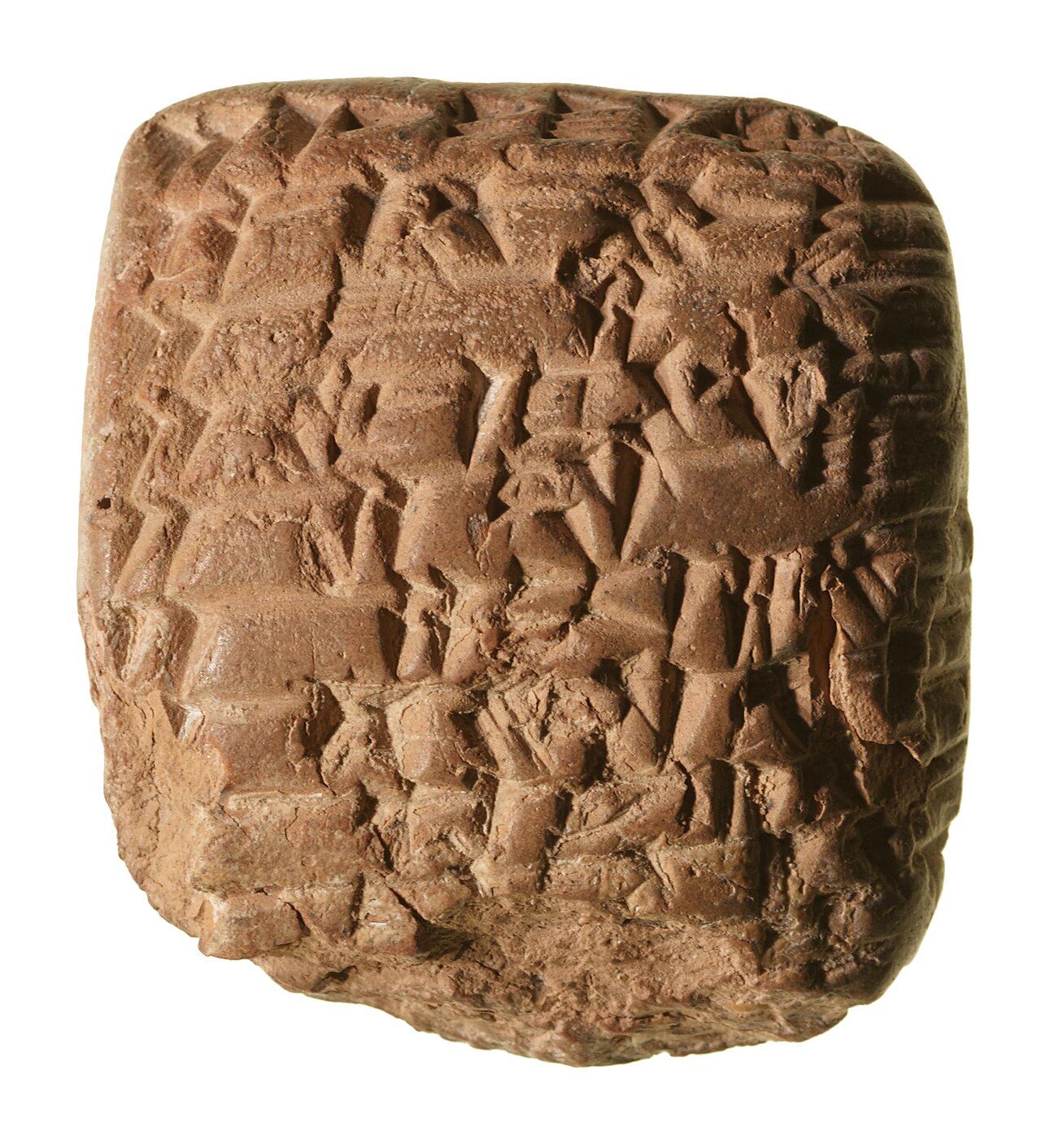
The oldest substantial writing in the world comes from Uruk, around 3300 to 3200 BCE. It is not a hymn or a chronicle. It is a set of clay tablets recording quantities of barley, beer, textiles, livestock, and labor rations. Denise Schmandt-Besserat proposed an influential lineage: for millennia Near Eastern accountants had used small clay tokens of standard shapes to stand for standard commodities, sealing them inside hollow clay envelopes and impressing the envelope’s surface to show what was inside. Eventually someone realized the impressions alone did the job. Specialists debate how much weight that particular story can bear, but the general point holds — writing grew out of accounting.
Early signs were pictographic. Over centuries scribes replaced curved strokes with wedge impressions made by pressing a cut reed stylus into damp clay, producing the script we call cuneiform (from Latin cuneus, wedge). The decisive breakthrough was phonetic: a sign could stand for a sound rather than a thing, which meant scribes could write personal names, verbs, prepositions, and abstractions. Once that happened, cuneiform could record Sumerian — a language isolate with no known relatives — and then be borrowed to write Akkadian, a Semitic language, and later Hittite, Elamite, Hurrian, and Old Persian. A writing system invented for one language became the diplomatic script of the entire Near East for two thousand years.
Literacy stayed narrow. Cuneiform in its mature form used several hundred signs, many with multiple readings, and mastering it took years in a school the Sumerians called the edubba, the “tablet house.” Scribal exercise texts survive that complain about beatings, tardiness, and sloppy handwriting. But out of that training culture came the first literature we can read: the Sumerian temple hymns and the Exaltation of Inanna, attributed to Enheduanna, daughter of Sargon of Akkad and high priestess of the moon god at Ur around 2300 BCE. She is conventionally called the first author in world history known by name, though some Assyriologists argue the attribution reflects later tradition rather than her own pen.
Kings, walls, and the Epic of Gilgamesh
Sumer was never one country. It was a dozen or so rival city-states — Uruk, Ur, Lagash, Umma, Kish, Nippur, Eridu — each with its patron deity, its temple, its walls, and its claim to disputed border canals. The long war between Lagash and Umma over the Gu’edena border strip is documented across generations of inscriptions and is the earliest well-recorded interstate conflict in history. Leadership titles evolved: the en was originally a priestly-civic office, the ensi a city governor, and the lugal — literally “big man” — a war leader whose temporary command hardened into hereditary kingship. War made kings.
All of this shaped the greatest surviving work of Mesopotamian literature. The Epic of Gilgamesh centers on a king of Uruk who may well have been historical, ruling around 2700 BCE. The Standard Babylonian version, arranged on twelve tablets and traditionally credited to the scholar Sin-leqi-unninni around 1200 BCE, follows Gilgamesh from tyrannical youth through friendship with the wild man Enkidu, through Enkidu’s death, and into a desperate, failed search for immortality. He returns to Uruk and, finding nothing else eternal, points to the city walls. It is a poem about accepting death, and it contains a flood narrative — the survivor Utnapishtim, the ark, the birds sent out to find land — that startled Victorian London when George Smith identified it on a tablet from Nineveh in 1872, because of its evident relationship to the flood story in Genesis.
| Period | Approximate dates BCE | What defines it |
|---|---|---|
| Ubaid | 5500–4000 | First permanent villages and temples on the southern plain; irrigation begins |
| Uruk | 4000–3100 | First true city; proto-cuneiform; cylinder seals; mass-produced pottery |
| Early Dynastic | 2900–2334 | Rival Sumerian city-states; Royal Tombs of Ur; kingship consolidates |
| Akkadian | 2334–2154 | Sargon builds the first territorial empire; Akkadian rises as a written language |
| Ur III | 2112–2004 | Sumerian revival; extreme bureaucratic record-keeping; Code of Ur-Nammu |
| Old Babylonian | 2004–1595 | Hammurabi unifies the south; law stele; mathematics and divination flourish |
| Neo-Assyrian | 911–609 | Iron-age military empire; deportation policy; Ashurbanipal’s library |
| Neo-Babylonian | 626–539 | Nebuchadnezzar II; destruction of Jerusalem; falls to Cyrus of Persia |
Dates follow the widely used “middle chronology.” Specialists disagree by roughly a century in either direction for the third and second millennia; treat early dates as approximate.
Sumer shows the whole package arriving together: irrigation created surplus, surplus supported specialists and temples, managing both required records, and records became writing — while competition among city-states turned war leaders into kings.
Section 3Empire & Law: Sargon, Hammurabi, Assyria
Sargon and the invention of empire
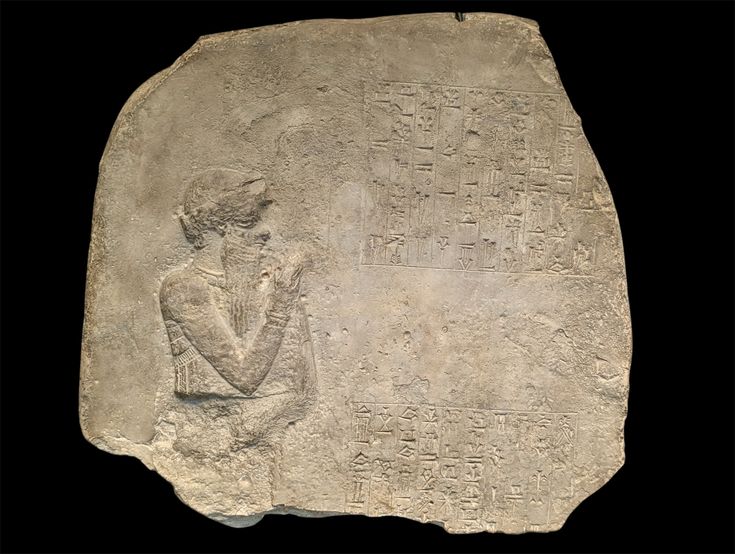
Around 2334 BCE a cupbearer at the court of Kish overthrew his king, defeated Lugalzagesi of Uruk, and made himself master of Sumer; a much later legend supplied him with a birth in secret, a reed basket set adrift on the river, and a childhood as a gardener’s foundling. Sargon of Akkad conquered city after city, tore down their walls, and installed his own governors and garrisons. He appointed Akkadian-speaking officials over Sumerian cities, standardized weights and measures across his territory, and put his daughter Enheduanna in the most prestigious religious office in the south — a shrewd fusion of family, religion, and administration.
What made this an empire rather than a large kingdom was that it ruled culturally distinct populations from a single center, extracted tribute, and moved goods and soldiers over long distances. It did not last. His grandson Naram-Sin took the extraordinary step of writing his name with the divine determinative and calling himself “god of Akkad,” and within a century the empire fell apart. Later Mesopotamian tradition blamed Naram-Sin’s impiety in a text called The Curse of Akkad. Modern researchers have proposed a severe multi-century drought around 2200 BCE, sometimes called the 4.2 kiloyear event, as a contributing cause; the paleoclimate evidence is real, but how directly it caused the collapse remains debated.
The Third Dynasty of Ur (about 2112–2004 BCE) rebuilt a smaller, tighter state under Ur-Nammu and his son Shulgi, and it produced one of the most obsessively documented bureaucracies of the ancient world — tens of thousands of surviving tablets recording livestock deliveries, dead animals, and labor days down to fractions. The dynasty also left the oldest surviving law collection, conventionally credited to Ur-Nammu though some scholars assign it to Shulgi, which mostly sets silver compensation for injuries rather than physical retaliation.
Hammurabi’s stele and what a law code is for
Hammurabi of Babylon (reigned about 1792–1750 BCE) spent decades as a middling king before a burst of campaigns in his last fifteen years made him master of Mesopotamia. He is remembered for a 2.25-meter pillar of black diorite carved with 282 legal provisions, framed by a prologue and epilogue in which the king declares that the gods called him “to cause justice to prevail in the land, to destroy the wicked and the evil, that the strong might not oppress the weak.” The stele was carried off as war booty to Susa in Iran and dug up there by a French expedition in 1901–02; it stands in the Louvre.
The provisions are casuistic — “if a man does X, then Y” — and famous for retaliation in kind, lex talionis: if a man destroys the eye of another man, his eye shall be destroyed. But that principle applies only between social equals, and the code is explicitly graded by status.
| Offense | If victim is an awīlum (free person of standing) | If victim is a muškēnum (dependent commoner) | If victim is a wardum (slave) |
|---|---|---|---|
| Eye destroyed | Offender’s eye destroyed | 60 shekels of silver | Half the slave’s market value paid to the owner |
| Bone broken | Offender’s bone broken | 60 shekels of silver | Half the slave’s value to the owner |
| Tooth knocked out (equal status) | Offender’s tooth knocked out | 20 shekels of silver | Not separately provided for |
The pattern is unmistakable: injury to a person of rank is answered with mirrored bodily harm; injury to a commoner or a slave is converted into money, and in the slave’s case the money goes to the owner, not the victim.
The code also reveals a society with regulated professions and real liability. A surgeon who successfully opened an abscess with a bronze lancet on a free man earned ten shekels; if the patient died or lost an eye, the surgeon’s hand was cut off. A builder whose house collapsed and killed the owner was put to death; if it killed the owner’s son, the builder’s son was put to death. That last provision — vicarious punishment — is one reason the code strikes modern readers as both recognizably legal and profoundly alien.
Assyria, Babylon, and the machinery of conquest
After 900 BCE the Neo-Assyrian Empire built the most effective military-administrative machine the Near East had yet seen. Iron weapons, siege ramps and battering rams, cavalry, and an integrated road-and-messenger system let Assyrian kings project force from northern Iraq to Egypt. Tiglath-Pileser III (745–727 BCE) reorganized conquered territory into provinces under salaried governors and systematized mass deportation: relocating entire populations hundreds of miles to break local identity and resettle depopulated land. Assyrian palace reliefs advertised the consequences of resistance in graphic detail — flaying, impalement, mounds of severed heads — because terror is cheaper than garrisons.
The same empire produced Ashurbanipal, who assembled a library at Nineveh of more than 30,000 tablets covering omens, medicine, mathematics, lexical lists, and literature. Most of what we know about Mesopotamian intellectual life, including the fullest text of Gilgamesh, comes from that collection. Nineveh fell in 612 BCE to a coalition of Medes and Babylonians; the fire that destroyed the palace baked the clay tablets hard and preserved them.
Babylon then had a brilliant final act. Nebuchadnezzar II (605–562 BCE) rebuilt the city with the glazed-brick Ishtar Gate and the ziggurat Etemenanki, campaigned in the Levant, and in 587/586 BCE destroyed Jerusalem and deported much of Judah’s elite — the Babylonian Exile, a catastrophe that reshaped Israelite religion. Babylonian scholars in these centuries kept systematic astronomical diaries from the seventh century BCE into the first, roughly six hundred years of nightly observation and the longest continuous scientific record known, and developed mathematical methods for predicting lunar and planetary positions that Greek astronomers later inherited. In 539 BCE Cyrus the Great of Persia took the city, and Mesopotamia became a province of somebody else’s empire for the rest of antiquity.
Mesopotamian rulers invented the working parts of empire — provincial governors, standardized measures, written law as royal advertisement, deportation, road systems, and tribute — and every later imperial state in this book borrowed from that toolkit.
Section 4Egypt: The Nile, the Pharaoh & the Order of Ma’at
A river that behaved
Herodotus called Egypt the gift of the Nile, and the phrase has survived because it is close to true. The Nile rises in the Ethiopian highlands and equatorial Africa and flows north through desert. Before the modern dams, monsoon rains in Ethiopia sent a flood down the valley every summer, rising from July, cresting in September, and falling away through October and November, spreading across the floodplain, soaking the soil and depositing a fresh layer of mineral-rich silt. The water receded in time for autumn planting; grain ripened in the mild winter and was harvested in spring.
Compare that to the Tigris and Euphrates and the political consequences follow almost mechanically. The Nile flooded at the useful moment, in a predictable season, along a narrow strip hemmed by cliffs and desert. Egyptian farmers used basin irrigation — earthen banks holding floodwater on a field until the soil was saturated — which is far less labor-intensive and less quarrelsome than maintaining a branching canal network in a hot, silt-choked plain. Egypt also enjoyed something Mesopotamia never had: defensible geography. Deserts east and west, cataracts to the south, sea to the north. The result was a civilization that was unified early, stayed unified for astonishing stretches, and produced an art style so stable that a statue carved in 2500 BCE and one carved in 700 BCE follow visibly the same conventions.
The Nile also ran the wrong way for a river’s convenience and therefore the right way for commerce. It flows north while the prevailing wind blows south, so a boat could drift downstream with the current and sail back upstream with the wind. That single accident of geography made the whole 1,000-kilometer corridor a functioning transport network and helped make political unification practical.
| Feature | Mesopotamia | Egypt |
|---|---|---|
| Flood timing | April–May, too late for winter grain | July–October, ideal for autumn planting |
| Flood reliability | Highly variable, sometimes destructive | Fairly regular; a low Nile meant famine |
| Irrigation | Large canal networks needing constant labor | Basin irrigation, largely local |
| Natural defenses | Open plain, exposed on all sides | Desert, cataracts, and sea |
| Typical political form | Rival city-states, then conquest empires | Unified territorial kingdom under one ruler |
| Building material | Sun-dried mudbrick (little stone) | Abundant limestone, sandstone, granite |
| Outlook in surviving texts | Often anxious; gods capricious, death bleak | Often confident; cosmic order restorable, afterlife desirable |
The state that built the pyramids
Egyptian tradition credited the unification of Upper Egypt (the southern valley) and Lower Egypt (the northern delta) around 3100 BCE to a king called Menes. The archaeological anchor is the Narmer Palette, a carved siltstone slab found at Hierakonpolis in 1898, showing a king wearing the white crown of the south on one face and the red crown of the north on the other. Whether it depicts a single conquest or commemorates a longer process is disputed, but the political idea it announces — one king, Two Lands — governed Egyptian self-understanding for three thousand years.
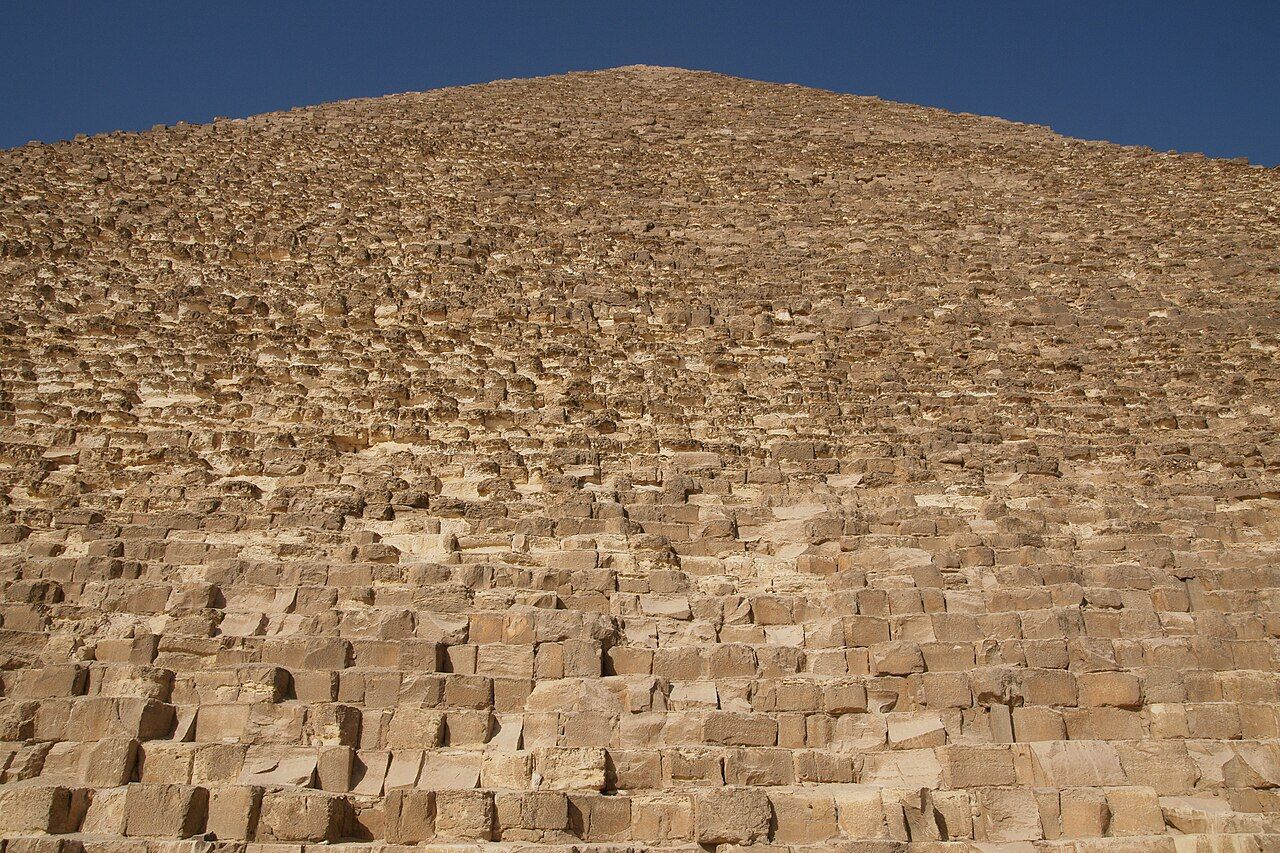
The Old Kingdom (about 2686–2181 BCE) is the pyramid age. Around 2670 BCE the architect Imhotep built Djoser a step pyramid at Saqqara, the earliest colossal building in dressed stone. Sneferu’s engineers, in three enormous attempts at Meidum and Dahshur, worked out the geometry of the true pyramid. His son Khufu built the Great Pyramid at Giza around 2560 BCE: roughly 2.3 million blocks, an original height of about 146.6 meters, sides aligned to true north within a fraction of a degree, and a base level to within a couple of centimeters. It remained the tallest structure on earth for about 3,800 years.
It was not built by slaves. Excavations by Mark Lehner and Zahi Hawass at the Giza workers’ settlement uncovered bakeries, breweries, dormitories, and cemeteries for laborers who were buried with honor near the monuments they raised, and whose skeletons show healed fractures treated with set bones — evidence of medical care. In 2013 archaeologists at Wadi al-Jarf on the Red Sea found the oldest inscribed papyri in the world, including the logbook of an official named Merer recording his crew ferrying fine limestone from the Tura quarries to Giza. It reads like a shipping manifest, which is exactly what makes it convincing. The workforce was conscripted and provisioned Egyptian labor, probably concentrated in the flood season when fields were underwater.
Ma’at, the afterlife, and Egyptian knowledge
The organizing Egyptian concept was ma’at — truth, justice, balance, and cosmic order, personified as a goddess wearing an ostrich feather. Its opposite was isfet: chaos, falsehood, disorder. The king’s essential job was to uphold ma’at, which is why royal art shows pharaoh smiting foreigners in the same stylized pose for millennia. That image is not a war report; it is a statement that chaos is being held at the border.
Ma’at also governed the fate of the individual dead. In the vignette from the Book of Coming Forth by Day (commonly called the Book of the Dead), the deceased’s heart is weighed on a balance against the feather of ma’at while Anubis adjusts the scales, Thoth records the verdict, and the composite monster Ammit waits to devour the heart that fails. Crucially, this judgment was moral and eventually available to non-royals — a democratization of the afterlife that spread after the Old Kingdom collapsed. Elaborate mummification followed from the belief that the person needed a preserved body; embalmers removed the viscera but famously discarded the brain, since the Egyptians located thought and feeling in the heart.
Egyptian practical knowledge was formidable. The Edwin Smith Papyrus, a copy of a much older text, describes 48 trauma cases in a strictly clinical format: title, examination, diagnosis, verdict, treatment — including the earliest known descriptions of the cranial sutures, the meninges, the brain surface, and a connection between head injury and contralateral paralysis. Several cases are honestly labeled “an ailment not to be treated.” The Ebers Papyrus mixes recognizable pharmacy with incantation. The Rhind Mathematical Papyrus, copied around 1550 BCE, works arithmetic, fractions, and area problems. Egypt also gave the world a 365-day civil calendar of twelve 30-day months plus five added days — drifting about a day every four years, but the direct ancestor of the calendar on your phone. Meanwhile Mesopotamian scribes bequeathed base 60: sixty seconds, sixty minutes, and 360 degrees in a circle are Babylonian fossils embedded in modern life.
| Era | Dates BCE | Signature developments |
|---|---|---|
| Early Dynastic | c. 3100–2686 | Unification; Narmer Palette; hieroglyphs; capital at Memphis |
| Old Kingdom | 2686–2181 | Step Pyramid; Giza pyramids; strong centralized bureaucracy |
| First Intermediate | 2181–2055 | Central authority fragments; regional governors rule; famine texts |
| Middle Kingdom | 2055–1650 | Mentuhotep II reunifies; classical literature; Nubian forts; afterlife broadens |
| Second Intermediate | 1650–1550 | Hyksos rule the delta; chariot, composite bow, new bronze technology arrive |
| New Kingdom | 1550–1069 | Empire in Syria and Nubia; Hatshepsut, Thutmose III, Akhenaten, Ramesses II; Valley of the Kings |
| Third Intermediate & Late | 1069–332 | Division, Libyan and Kushite dynasties, Assyrian and Persian conquest |
The New Kingdom deserves a closer look because it is where Egypt becomes an imperial power rather than an inward-facing kingdom. After expelling the Hyksos rulers of the delta around 1550 BCE — and adopting their chariots and composite bows — Egyptian kings campaigned into Syria and deep into Nubia. Hatshepsut (reigned about 1473–1458 BCE) ruled as king in her own right, had herself depicted with a royal beard, and sent a celebrated trading expedition to Punt; her successor Thutmose III won the meticulously recorded Battle of Megiddo around 1457 BCE. Akhenaten (about 1352–1336 BCE) attempted the ancient world’s most radical religious reform, elevating the sun-disk Aten above all other gods, closing temples, and moving the capital to a new city at Amarna; whether this counts as true monotheism or a form of exclusive royal henotheism is genuinely argued among Egyptologists. It collapsed within a generation, and his successors, including the boy king Tutankhamun, restored the old gods. Ramesses II (1279–1213 BCE) fought the Hittites at Kadesh in 1274 BCE, advertised it at home as a triumph despite an ambiguous outcome, and around 1259 BCE concluded with the Hittite king a treaty preserved in both Egyptian hieroglyphs and Akkadian cuneiform — the earliest surviving international peace treaty, complete with mutual defense and extradition clauses.
The Nile’s predictable flood and protective geography produced an early, durable, unified state whose ideology of ma’at made the king the guarantor of cosmic order — and whose surplus, once organized, could be spent on pyramids, empire, and one of the ancient world’s deepest bodies of practical knowledge.
Section 5Collapse, Alphabets & the Question of “Western” Origins
The Late Bronze Age world and its collapse
By 1300 BCE the eastern Mediterranean was an interconnected system. Egypt, the Hittite Empire in Anatolia, Assyria, Babylonia, Mycenaean Greece, Cyprus, and the Syrian port of Ugarit exchanged tin, copper, grain, textiles, glass, and royal daughters. The Amarna letters — nearly four hundred clay tablets from the Egyptian royal archive at Amarna, written mostly in Akkadian — preserve the correspondence of kings who addressed one another as “brother” and haggled over gifts of gold. The shipwreck at Uluburun off Turkey, dated to around 1320 BCE, went down carrying ten tonnes of Cypriot copper, a tonne of tin, Canaanite jars, Baltic amber, African ebony, and ostrich eggshells. Bronze itself required this network: copper from one region, tin from another, often thousands of kilometers apart.
Between roughly 1200 and 1150 BCE most of it broke. The Hittite capital Hattusa burned. Ugarit was destroyed and never reoccupied. Mycenaean palaces collapsed and Greek literacy in Linear B disappeared entirely for four centuries. Egypt survived but shrank, losing its Levantine empire. Ramesses III’s inscriptions at Medinet Habu describe repelling an invasion around 1177 BCE by groups the Egyptians named individually: Peleset, Tjeker, Shekelesh, Denyen, Weshesh. Modern scholarship lumps them together as the Sea Peoples, a nineteenth-century coinage rather than an Egyptian one.
Why it happened is one of the liveliest debates in ancient history. Older accounts blamed the Sea Peoples outright. Paleoclimate work — pollen cores from the Sea of Galilee, isotope records from the Dead Sea and Cyprus — now indicates a serious multi-decade drought across the region in exactly this window. Others emphasize earthquake sequences, or internal revolt against palace redistribution economies, or the fragility of a system in which the loss of any tin supply route could cripple everyone. The synthesis argued by Eric Cline and others is that no single cause suffices: a tightly coupled, specialized network failed the way complex systems fail, with drought, famine, migration, warfare, and trade disruption reinforcing each other. That is a lesson worth carrying forward, because you will meet the pattern again in later chapters.
Twenty-two letters and one god
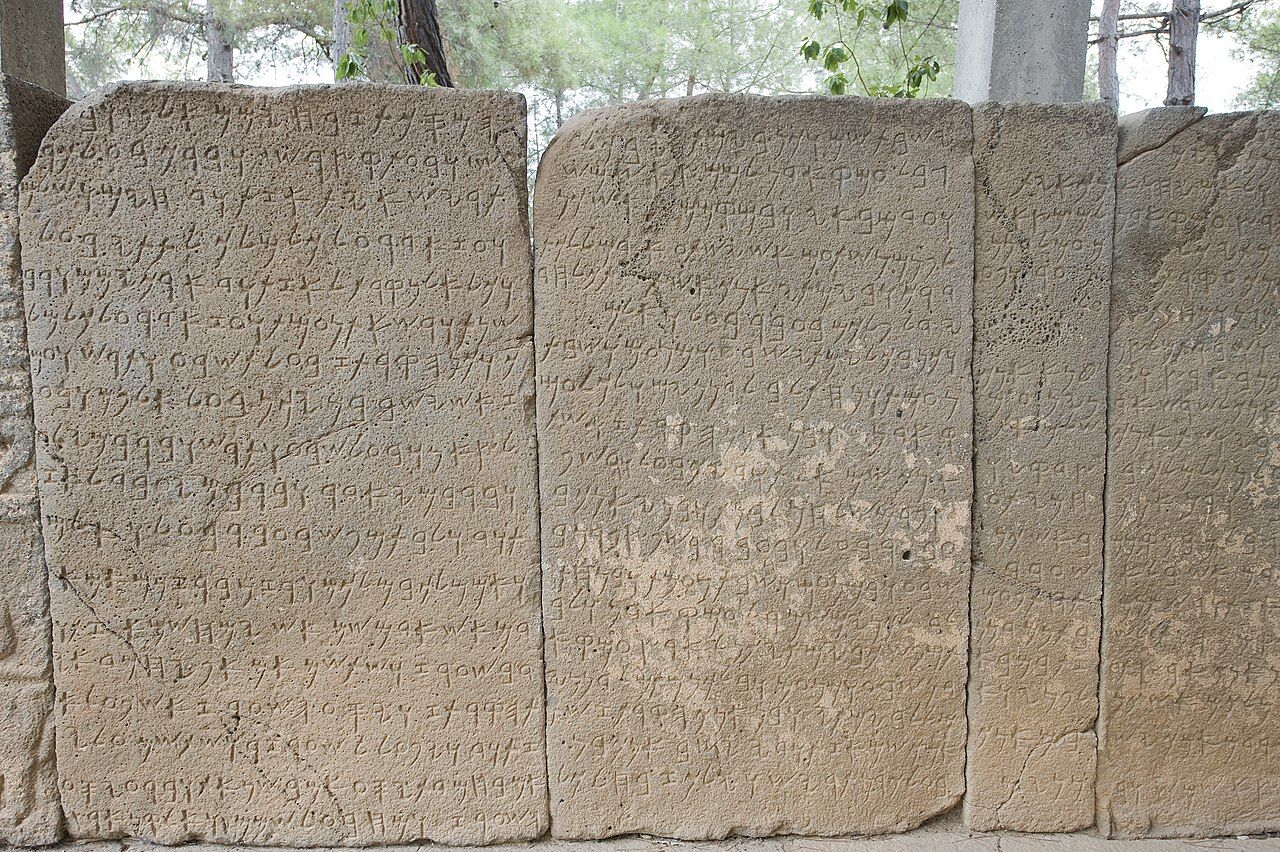
Somewhere around 1900–1700 BCE, Semitic-speaking workers in the Egyptian turquoise mines at Serabit el-Khadim in Sinai did something remarkable: they took Egyptian hieroglyphic signs and used them for the first sound of the Semitic word each picture named. An ox-head sign, ’alp, stood for the sound at the start of “ox.” A house sign, bayt, stood for “b.” This Proto-Sinaitic script collapsed a system of hundreds of signs into a couple of dozen. Its descendant, the Phoenician alphabet of 22 consonantal letters standardized around 1050 BCE, spread with Phoenician merchants across the Mediterranean. Greeks borrowed it, repurposed some unneeded consonant signs as vowels, and produced the first fully alphabetic script; the Etruscans passed a version to Rome; you are reading its descendants now, including the words “alphabet” (alpha, beta) and the letter A, which is still an ox-head turned upside down.
An alphabet lowers the cost of literacy in a way cuneiform and hieroglyphs never could: several hundred signs took years of school to master, while twenty-two letters can be learned in weeks. That did not make ancient societies literate — reading and writing stayed a minority skill for centuries afterward — but it did put writing within reach of merchants, soldiers, and local officials outside a professional scribal class, and scriptural religion and publicly posted law both grew in that soil.
The other durable inheritance from this corner of the world is the religious tradition of ancient Israel. The earliest reference to “Israel” outside the Bible is on the Merneptah Stele, an Egyptian victory inscription of about 1208 BCE, where it names a people rather than a place. How much of the biblical narrative before the monarchy is history is fiercely contested: scholars often described as maximalists argue for substantial historical memory behind the Exodus and the united monarchy of David and Solomon, while minimalists argue those texts are largely later literary constructions serving Judah’s political needs. What is far less disputed is that the Babylonian destruction of Jerusalem in 587/586 BCE and the exile that followed forced a religious reckoning — how could a defeated people’s god still be god? — and that the answer developed in that crisis, an exclusive monotheism in which one universal deity uses even foreign empires as instruments, became one of the most consequential ideas in world history. Later chapters pick it up.
What “the West” actually inherited
It is worth being precise about the claim in this book’s title. Mesopotamia and Egypt are not European. Sumerians did not think of themselves as ancestors of anyone in Paris or Philadelphia, and the category “Western Civilization” is itself modern — it took its familiar course-catalog shape in American universities around and after the First World War, beginning with Columbia’s 1919 “Contemporary Civilization” requirement, partly as a way to explain to students what the war had been fought to defend.
So the honest version is not descent but transmission. Greeks sailed to Egypt and came home with stone architecture, monumental sculpture, and geometry; Herodotus devoted an entire book of his Histories to Egypt. Greek astronomy runs on Babylonian observational data and Babylonian base-60 arithmetic, which is why we still measure angles in degrees and minutes. Roman and later European law worked with an idea already carved on Hammurabi’s stele: that rules should be published, fixed, and applied to cases. Judaism, Christianity, and Islam all grew from soil worked by these civilizations. Writing, the city, the state, the school, the archive, the contract, the calendar, and the interest-bearing loan are all Near Eastern inventions that the West received rather than made.
Keeping that straight does two useful things. It protects you from the bad argument that some inherent European genius produced modernity, and it protects you from the equally bad argument that borrowed ideas are somehow less genuinely yours. Cultures are almost entirely made of things they got from somebody else. What follows in this book is the story of what happened to these inheritances once they moved west and north — into a small, poor, quarrelsome peninsula that would ask an odd question the river valleys had rarely asked out loud: who, exactly, has the right to rule?
The Bronze Age system collapsed but its most portable inventions — the alphabet, iron, written law, monotheism, base-60 mathematics — survived and traveled, which is why “Western Civilization” is best understood as an inheritance from Africa and Asia rather than a European invention.
The chapter in one breath
Between about 9500 and 500 BCE, people in the Fertile Crescent and the Nile Valley assembled the equipment every later society in this book would use. Farming came first, slowly and at real cost to health and equality, and it fed populations that grew faster than the foragers around them. On the silty, rainless plain of southern Iraq, irrigation produced enough surplus to support priests, potters, soldiers, and scribes; Uruk became the first city; and the need to track barley produced cuneiform, which then learned to record names, laws, prayers, and finally Gilgamesh. Competition among Sumerian city-states made war leaders into kings, and Sargon of Akkad turned kingship into empire — a set of techniques Hammurabi, the Assyrians, and the Babylonians refined into provincial administration, published law, deportation, and tribute. Egypt, protected by desert and blessed with a punctual flood, unified early and stayed unified, spending its surplus on pyramids, empire, medicine, and a theology of cosmic order in which the king held chaos at bay. When the interconnected Bronze Age world broke apart after 1200 BCE, the wreckage released cheaper metal, a twenty-two-letter alphabet, and eventually a monotheism forged in exile — the portable inheritance that Greece, Rome, and Europe would build on.
Words worth knowing
| Term | What it means |
|---|---|
| Neolithic Revolution | The multi-millennium shift from foraging to farming and herding, beginning around 9500 BCE in the Fertile Crescent. |
| Fertile Crescent | The arc of well-watered land from the Levant through southeastern Anatolia to the Zagros foothills, home to the eight founder crops. |
| Alluvial | Made of river-deposited silt; describes the fertile, stoneless plain of southern Mesopotamia. |
| City-state | An independent city with its own government, patron deity, and rural territory — the standard political unit of early Sumer. |
| Cuneiform | Wedge-shaped writing pressed into clay with a reed stylus; invented for Sumerian, later used for Akkadian and many other languages. |
| Ziggurat | A stepped temple platform at the center of a Mesopotamian city, marking the god’s residence and the temple estate. |
| Lugal | Sumerian “big man”; a war leader whose emergency command evolved into hereditary kingship. |
| Akkadian | The Semitic language of Sargon’s empire and later of Babylonia and Assyria; the diplomatic language of the Late Bronze Age. |
| Lex talionis | Retaliation in kind (“eye for an eye”); in Hammurabi’s stele it applies only between people of equal status. |
| Stele | An upright inscribed stone slab or pillar used to publish a law, victory, or treaty. |
| Mass deportation | Neo-Assyrian policy of relocating conquered populations to break resistance and repopulate territory. |
| Babylonian Exile | The deportation of Judah’s elite to Babylon after 587/586 BCE, a crisis that reshaped Israelite religion. |
| Ma’at | Egyptian principle of truth, justice, and cosmic order that the pharaoh existed to uphold against chaos (isfet). |
| Pharaoh | The Egyptian king, understood as a divine or semi-divine guarantor of ma’at and the link between gods and people. |
| Hieroglyphs | Egypt’s monumental picture-based script, with cursive hieratic and later demotic used for everyday writing. |
| Papyrus | Writing material made from pressed reed strips; lighter than clay, which is why so much survives only in dry Egypt. |
| Intermediate Period | An era of divided or weakened central authority between Egypt’s Old, Middle, and New Kingdoms. |
| Late Bronze Age collapse | The cascading failure of eastern Mediterranean states and trade networks around 1200–1150 BCE. |
| Phoenician alphabet | A 22-letter consonantal script standardized around 1050 BCE; ancestor of the Greek, Latin, and modern European alphabets. |
| Monotheism | Belief in a single universal god; developed decisively in Israelite religion during and after the Babylonian Exile. |