Rome: Republic to Empire
Rome began as an unremarkable farming town on a muddy bend of the Tiber and ended as the only Mediterranean state that mattered. That is the puzzle this chapter takes apart. How did a community with no natural harbor, no philosophical tradition to speak of, and no obvious advantage over its neighbors absorb the Etruscans, the Samnites, Carthage, Macedon and Egypt within roughly four centuries — and then find that the machinery of conquest had broken the government that built it? The thread running through what follows is the Roman constitution: aristocratic in origin, widened by the Struggle of the Orders, corroded by land, slaves and loyal armies, and finally rebuilt by Augustus into a monarchy that insisted it was a restored republic. Along the way: what Roman law actually did, who counted as a citizen, how the empire governed people who had never seen Rome, and why its collapse in the West took three centuries rather than an afternoon.
By the end of this chapter you can
- Distinguish the legendary founding of Rome from the archaeological and Etruscan evidence, and explain why Romans told the stories they told.
- Describe the institutions of the Roman Republic — consuls, Senate, tribunes of the plebs, the assemblies — and explain how the Struggle of the Orders reshaped them.
- Explain how Rome’s treatment of defeated peoples, especially the graded rights of the Latin League settlement, converted conquest into manpower.
- Analyze the causes and consequences of the three Punic Wars, including the rise of the latifundia and the displacement of small farmers.
- Trace the collapse of the Republic from the Gracchi through Marius, Sulla, Caesar and the Second Triumvirate, identifying the structural causes beneath the personalities.
- Explain how Augustus constructed the Principate and why calling it a restoration was politically necessary.
- Evaluate the Pax Romana using concrete evidence — roads, aqueducts, urbanization, the Constitutio Antoniniana — and its costs.
- Explain the Crisis of the Third Century and assess the reforms of Diocletian and Constantine as responses to it.
- Weigh competing explanations for the fall of the western empire and account for the survival of the eastern half.
Section 1From Village to Republic
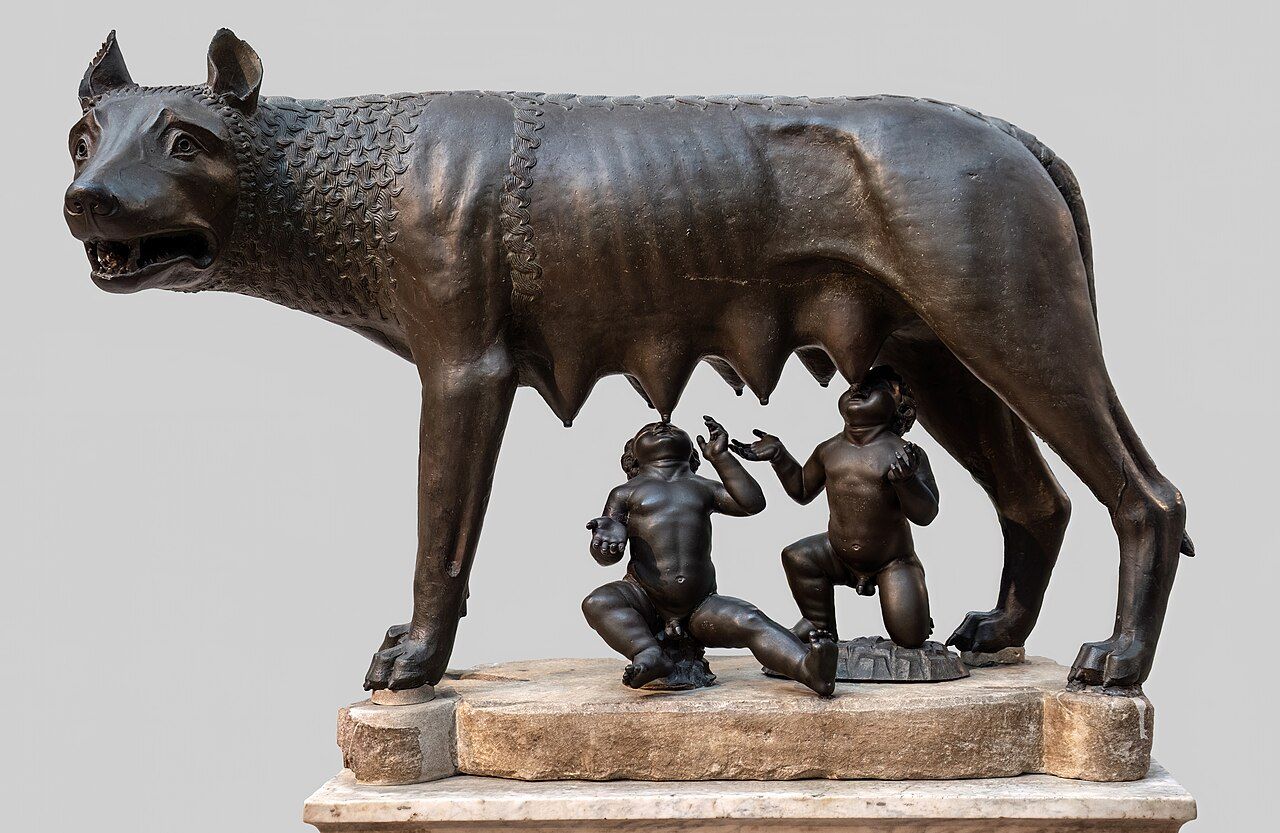
The site and the story
Rome sits about fifteen miles inland on the Tiber, at the lowest point where the river could be forded, on a cluster of hills that were defensible and malarial in roughly equal measure. That geography explains more than any legend. The ford made the site a crossroads between Etruria to the north and Campania to the south; the hills made it survivable; the inland position kept it safe from the pirates who plagued coastal towns. Archaeology shows huts on the Palatine from around the tenth century BCE and a recognizable town by the seventh, when the marshy low ground between the hills was drained and paved to become the Forum.
The Romans themselves told a different kind of story. Romulus and Remus, twin sons of Mars, exposed as infants, suckled by a she-wolf, growing up to found a city in 753 BCE — a date the scholar Varro calculated in the first century BCE and Romans thereafter treated as fact. Romulus kills Remus over the placement of a wall. Virgil, writing under Augustus, spliced this onto an older Greek thread: Aeneas fleeing burning Troy, carrying his father on his back, to found the line that would produce the twins. None of this is history. All of it is evidence — of what Romans thought Rome was. The stories insist on divine parentage, on fratricidal violence at the founding, on refugees and outsiders as ancestors, and on piety toward family and gods as the trait that made Romans win.
Rome’s early kings were real enough as an institution, whatever the individual names. Seven kings are named in the tradition, and the last three — Tarquinius Priscus, Servius Tullius and Tarquinius Superbus — were remembered as Etruscan. This matters. The Etruscans, occupying the region north of the Tiber, had cities, writing, metalwork, engineering and a religion of divination that Rome absorbed wholesale. The toga, the fasces (a bundle of rods around an axe, carried before magistrates as a symbol of power over life and limb), gladiatorial combat at funerals, the practice of reading the will of the gods in the livers of sacrificed animals — all Etruscan or transmitted through Etruria. Rome was, in its formative century, a provincial town in an Etruscan cultural world.
The Republic and its offices
Roman tradition dates the expulsion of the last king, Tarquin the Proud, to 509 BCE. The trigger in the story is the rape of the noblewoman Lucretia by the king’s son and her subsequent suicide — a tale that says a great deal about Roman ideas of honor, the female body as a marker of family status, and the tyrant as a man who takes what he wants. Historians treat the date as approximate and the narrative as later construction, but the outcome is solid: monarchy ended and Rome became a res publica, literally the “public thing.”
What replaced the king was designed with a single obsession: never again should one man hold permanent power. Two consuls shared the king’s executive authority, each able to veto the other, each serving one year only. Below and beside them grew a ladder of offices — the cursus honorum — with minimum ages and a required sequence. Every office was collegial (held by two or more) and annual. The one designed exception proved the rule: in a genuine emergency the Senate could authorize a dictator with sole authority for six months maximum. For three centuries dictators laid down power on schedule, which is why the office was so shocking when Sulla and Caesar abused it.
The Senate was formally only an advisory council of ex-magistrates, holding office for life. In practice it was the state. It controlled finance, foreign policy and the assignment of provinces, and its collective prestige — auctoritas — meant that its advice was rarely refused. Its decrees, senatus consulta, were technically recommendations. Almost nobody treated them that way. Meanwhile the citizen assemblies elected magistrates and passed laws, but they voted in blocs, and the blocs were weighted so that the wealthy voted first and, in the most important assembly, effectively decided outcomes before poorer citizens were called at all.
A common misconception: the Roman Republic was not a democracy in the Athenian sense, and Romans never claimed it was. Citizens voted, but only on proposals put to them by magistrates, in blocs weighted toward wealth, with no right of debate from the floor. Rome was an oligarchy with popular ratification — which is precisely why the office of tribune, discussed next, mattered so much.
The Struggle of the Orders
Early Rome was split between patricians, a closed hereditary aristocracy of some fifty clans, and plebeians, everyone else — a category that included the desperately poor and also wealthy families excluded from the charmed circle. Patricians monopolized the priesthoods, the magistracies and the interpretation of law, which was unwritten and therefore whatever they said it was. The plebeians had the numbers and, critically, they were the infantry.
Their weapon was the secession of the plebs: a collective walkout from the city, leaving the patricians with no army. Tradition records the first around 494 BCE and several more over the next two centuries. Each produced concessions. The plebeians won their own officers, the tribunes of the plebs, whose persons were declared sacrosanct and who could veto any act of any magistrate with a single word — veto, “I forbid.” Around 450 BCE the law was written down and posted in the Forum as the Twelve Tables, so that it could no longer be conjured to order. The Lex Canuleia of 445 legalized patrician–plebeian intermarriage. The Licinio-Sextian laws of 367 opened the consulship to plebeians. Finally the Lex Hortensia of 287 BCE made resolutions of the plebeian assembly binding on the whole citizen body.
On paper, this looks like two centuries of steady democratization. Look closer and the result is subtler. The men who benefited were rich plebeians, who married into patrician families and merged with them into a new governing class — the nobiles, defined not by birth but by having a consul in the family tree. The poor got legal protections and a tribune to appeal to; they did not get land, and they did not get power. Rome had swapped a closed aristocracy of blood for a slightly wider aristocracy of office. That unfinished business would come due in the second century.
Rome replaced monarchy with a system engineered against one-man rule, then spent two centuries widening its ruling class just enough to keep the plebeians fighting for it — without ever resolving the economic grievances underneath.
Section 2Conquering Italy and the Mediterranean
The Italian system
Rome’s conquest of Italy took roughly two hundred years and was neither swift nor inevitable. The Gauls sacked the city itself around 390 BCE, an event that scarred Roman memory permanently. The Samnites, a tough confederation in the central Apennines, fought Rome in three wars between 343 and 290 BCE and inflicted a humiliation at the Caudine Forks in 321 where an entire Roman army surrendered and was made to pass under a yoke of spears. Rome lost battles constantly. What it did not do was quit.
The real innovation came after victory. Most ancient conquerors either destroyed a defeated city or extracted tribute from it. Rome did something stranger: it offered graded membership. After crushing the Latin League in 338 BCE, Rome dissolved it and dealt with each community separately. Some got full Roman citizenship. Some got civitas sine suffragio — citizenship without the vote, meaning full private-law rights and the obligation to serve. Some held the Latin right, a middle tier carrying rights of trade and intermarriage with Romans and a path to full citizenship. Others became socii, allies who kept their own laws and government but surrendered foreign policy and supplied troops. Rome also planted colonies of citizens at strategic points and connected them with roads: the Via Appia, begun in 312 BCE, ran south toward Capua and eventually to Brundisium.
The consequence was arithmetic. Every defeated Italian people became a source of soldiers rather than a garrison requirement. By the time of the war with Hannibal, Rome could draw on a manpower pool that Polybius estimated at over seven hundred thousand infantry across Italy. Rome could lose an army — and it lost several — and field another. No Hellenistic kingdom could do that. This, more than tactics or virtue, is the mechanical explanation for Roman success.
| Status | Vote at Rome? | Military obligation | Local self-government |
|---|---|---|---|
| Roman citizen | Yes | Legionary service | N/A — governed from Rome |
| Citizenship without suffrage | No | Legionary service | Partial local magistrates |
| Latin right | Limited, if resident at Rome | Auxiliary contingents | Yes, with trade and intermarriage rights |
| Italian ally (socius) | No | Contingents under own officers | Yes, own laws and constitution |
| Provincial subject (after 241 BCE) | No | Auxiliary levies | Varied; taxed and governed by a Roman official |
Carthage and the Punic Wars
Carthage, a Phoenician foundation on the North African coast near modern Tunis, was the great commercial power of the western Mediterranean: a maritime empire built on trade, tribute and mercenary armies. Rome and Carthage had signed treaties and had no obvious quarrel until both became interested in Sicily. The First Punic War (264–241 BCE) began over a squalid dispute involving a band of Campanian mercenaries who had seized Messana, and turned into a twenty-three-year naval slog. Rome had essentially no navy. It built one, reportedly copying a wrecked Carthaginian warship, lost fleets to storms with staggering casualties, and built again. Carthage lost Sicily, which became Rome’s first province, and then lost Sardinia and Corsica to a piece of naked opportunism three years later.
The Second Punic War (218–201 BCE) was the closest Rome came to destruction. Hannibal Barca, operating from a Carthaginian power base in Spain, marched an army with war elephants over the Alps and into Italy, and proceeded to annihilate Roman armies at the Trebia, at Lake Trasimene, and above all at Cannae in 216 BCE, where his double envelopment destroyed a Roman force that ancient sources put at fifty thousand or more in a single afternoon. Cannae is still taught in military academies. And it did not win the war. Most of Rome’s Italian allies stayed loyal — the payoff of the graded-citizenship system — and Rome refused to negotiate. Fabius Maximus adopted a strategy of shadowing Hannibal without engaging, earning the nickname Cunctator, the Delayer, and the contempt of Romans who wanted a battle. It worked. Meanwhile Scipio Africanus took the war to Spain, then to Africa, forcing Hannibal’s recall and defeating him at Zama in 202 BCE.
The Third Punic War (149–146 BCE) was not a war in any meaningful sense. Carthage, disarmed and paying indemnities, had recovered commercially, which was intolerable to a faction at Rome led by Cato the Elder, who allegedly ended every speech regardless of topic with the demand that Carthage be destroyed. Rome issued escalating demands until it reached one no city could accept — abandon your site and move inland — and then besieged Carthage for three years. The city was razed and its surviving population enslaved. The story of salt sown in the fields appears in no ancient source and is a modern invention, but the destruction itself was real and deliberate.
Rome did not conquer the Mediterranean according to a plan. Each war generated the conditions for the next: Sicily required a navy, the navy required bases, bases in Spain provoked Hannibal, defeating Hannibal required intervention in Greece against his ally Philip V of Macedon, and intervention in Greece produced permanent commitments there. Historians debate whether Rome was defensively reactive or predatory — the honest answer is that Roman elites gained enormously from war and rarely looked for a reason to avoid one.
East to Greece and Asia
Between 200 and 146 BCE Rome dismantled the Hellenistic kingdoms with disorienting speed. Philip V of Macedon was beaten at Cynoscephalae in 197. The Roman commander Flamininus then stood at the Isthmian Games in 196 and proclaimed the Greek cities free, to wild acclaim — and the Greeks discovered over the following decades what Roman freedom meant in practice. Antiochus III of the Seleucid empire was crushed at Magnesia in 190. Macedon was defeated again at Pydna in 168 and abolished as a kingdom. In 146 BCE, the same year Carthage fell, Rome sacked Corinth as a warning to Greece. In 133 Attalus III of Pergamum simply left his kingdom to Rome in his will, and Rome accepted.
Wealth on this scale changed Rome faster than Rome could absorb it. Direct taxation of Roman citizens in Italy was suspended in 167 BCE because provincial revenue made it unnecessary. Greek art, Greek tutors, Greek philosophy and Greek slaves flooded the city. Cato the Elder railed against the corruption of ancestral custom, the mos maiorum, while the poet Horace later observed that captive Greece had taken its savage conqueror captive. Both were describing the same thing: a farming republic’s culture being rewritten by an empire it had acquired almost absentmindedly.
Rome won the Mediterranean less through tactical genius than through a political system that turned defeated enemies into soldiers and an elite culture that made quitting unthinkable — but victory imported wealth and slaves on a scale that would poison the Republic’s own society.
Section 3The Republic Destroys Itself
Land, slaves and the disappearance of the small farmer
The Republic’s crisis began in the countryside. Rome’s traditional soldier was a smallholder who owned enough property to equip himself and returned to his farm after a campaign. That model worked when wars were fought in the next valley in the summer. It broke when a legionary might spend six years in Spain. Farms went untended. Debt accumulated. And when the soldier came home, he found that his neighbor — a senator with capital and access to hundreds of war captives — had bought up the surrounding plots and merged them into a latifundium, a large estate worked by chained slave gangs producing wine, olive oil and livestock for market.
Slavery on this scale was new. The conquests dumped captives into Italy in numbers historians estimate in the hundreds of thousands; Epirus alone reportedly yielded 150,000 enslaved people in 167 BCE. Slave labor was cheaper than free labor and could not strike, migrate or vote. Dispossessed citizens drifted to Rome, where they swelled a poor, volatile urban population dependent on grain and on the patronage of politicians. Simultaneously, the property qualification for military service meant that as farmers fell below it, the recruitment pool shrank. Rome was, paradoxically, running out of soldiers because it had won too much.
The counter-pressure came from below too. Three large slave revolts erupted between 135 and 71 BCE, the last led by Spartacus, a Thracian gladiator whose following grew into an army of perhaps seventy thousand and beat several Roman forces before Crassus destroyed it. Six thousand survivors were crucified along the Appian Way. The revolts terrified the elite without changing anything structural. Slavery was not questioned; security was tightened.
The Gracchi and the breaking of the rules
Tiberius Gracchus, tribune in 133 BCE, proposed enforcing an old and ignored limit on how much public land any individual could occupy, redistributing the surplus to landless citizens in small allotments. The proposal was legal, moderate and arguably conservative — its goal was to rebuild the smallholder class that filled the legions. It was also an attack on the wealth of the men who ran the Senate.
What made Tiberius revolutionary was not the bill but the method. When a fellow tribune vetoed it, Tiberius had the assembly depose him, an act with no precedent. When the Senate starved the land commission of funds, he claimed the bequest of Pergamum to pay for it, seizing the Senate’s traditional control of finance. When he stood for a second consecutive tribunate to protect himself, a mob of senators led by the chief priest beat him to death with broken furniture on the Capitol and threw his body in the Tiber. His brother Gaius Gracchus, tribune in 123–122, went further — subsidized grain, colonies, courts taken from senators and given to the equestrian order — and died in 121 after the Senate passed its first senatus consultum ultimum, the emergency decree that effectively licensed killing citizens without trial.
The precedent set in 133 BCE was the one that mattered: political disputes at Rome could now be settled with blood. Every subsequent generation escalated. Historians conventionally date the Republic’s terminal crisis from this moment, and the labels optimates (those working through the Senate) and populares (those working through the assemblies and tribunate) come from this period — though it is a mistake to treat them as parties with platforms. They were methods, and ambitious men switched between them.
| Date | Event | Precedent it set |
|---|---|---|
| 133 BCE | Tiberius Gracchus killed by senators | Political murder inside Rome |
| 121 BCE | Death of Gaius Gracchus under emergency decree | Senate may suspend citizen rights |
| 107–100 BCE | Marius recruits the propertyless; repeated consulships | Armies loyal to a general, not the state |
| 88 BCE | Sulla marches his legions on Rome | The city itself is a military target |
| 82–79 BCE | Sulla’s dictatorship and proscriptions | State-sanctioned lists of citizens to be killed |
| 49 BCE | Caesar crosses the Rubicon | A provincial governor may invade Italy |
| 43 BCE | Second Triumvirate’s proscriptions; Cicero killed | Legalized elimination of the political class |
Marius, Sulla and the private army
Gaius Marius, a wealthy man from outside the old nobility, solved the recruitment crisis in the most dangerous way available. Facing war in North Africa and a Germanic invasion, he opened enlistment in 107 BCE to citizens with no property at all, equipping them at state expense. The cohort organization of the legion and the marching load that earned soldiers the nickname “Marius’s mules” are also credited to him, though recent scholarship treats the whole package of “Marian reforms” with caution: the property qualification had been falling for decades and the cohort was already in use, so Marius may have accelerated a trend rather than invented it. Militarily this was excellent; the reformed legions destroyed the Cimbri and Teutones in 102–101 BCE. Politically it was a bomb. A landless soldier had no farm to return to, so his retirement depended entirely on his general obtaining a land grant for him. The Senate was often unwilling. The general therefore became the veteran’s patron, and the army became the general’s clientele.
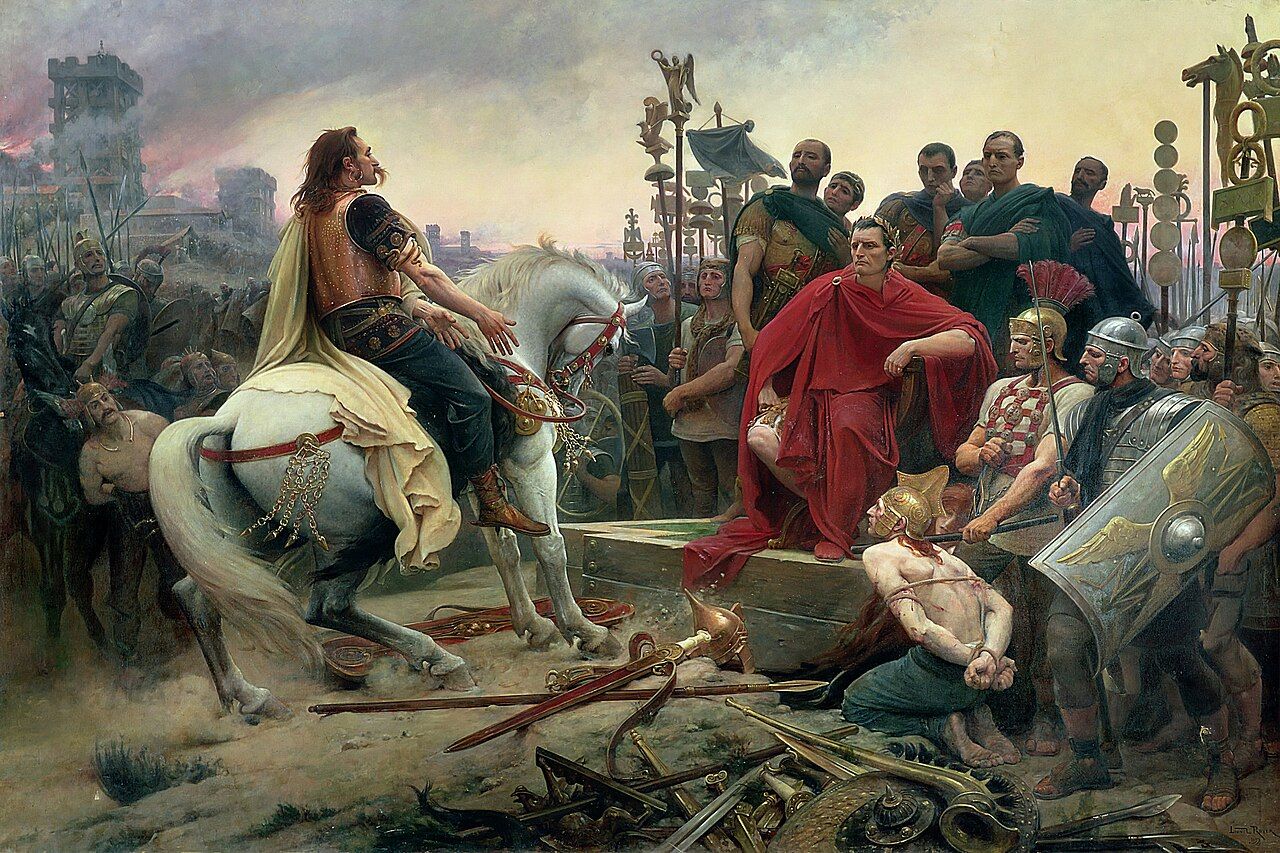
The bomb detonated in 88 BCE. When the assembly transferred a lucrative eastern command from Lucius Cornelius Sulla to Marius, Sulla marched his legions into Rome — something no Roman had done. The revealing detail is who went with him: the rank and file followed without hesitation, while all of his senior officers but one refused and left him. The soldiers now belonged to the general, not to the state. Sulla went east, and returned in 83 to fight a civil war, win it, and have himself made dictator with no time limit. He then published proscriptions: lists of citizens declared outlaws, whose killers were rewarded and whose property was auctioned, with the proceeds enriching his supporters. Ancient figures vary and are probably inflated, but they run to scores of senators and well over a thousand equestrians, with thousands of lesser victims besides. Sulla rewrote the constitution to strengthen the Senate and cripple the tribunate, then astonished everyone by resigning in 79 and dying in his bed. His constitution was dismantled within a decade. His example was not.
Julius Caesar inherited a system in which the rules were fictions. Allied with Pompey the Great and the immensely rich Crassus in the informal arrangement modern historians call the First Triumvirate, he took the consulship in 59, then a long command in Gaul, where between 58 and 50 BCE he conquered territory roughly equal to modern France and Belgium. Plutarch reports a million killed and a million enslaved — figures probably inflated but indicative of the scale. When the Senate, with Pompey’s backing, ordered him to disband his army and face prosecution, Caesar crossed the Rubicon river in January 49 BCE with a single legion. Civil war followed across Italy, Greece, Egypt and Spain. Caesar won, was made dictator for life in early 44, and was stabbed to death on the Ides of March at a meeting of the Senate in Pompey’s theatre complex, by a conspiracy of some sixty men who believed they were killing a tyrant and restoring the Republic.
They had misread the situation entirely. There was no republic left to restore — only competing armies. Caesar’s eighteen-year-old great-nephew and adopted heir Octavian allied with Mark Antony and Lepidus in the Second Triumvirate, which conducted its own proscriptions and killed Cicero, then destroyed the assassins at Philippi in 42 BCE. The alliance decayed into a final civil war fought as a propaganda contest — Octavian portraying Antony as a Roman unmanned by the Egyptian queen Cleopatra VII — and settled at the naval battle of Actium in 31 BCE. Antony and Cleopatra died by suicide the following year. Octavian, at thirty-two, held everything.
The most useful question about the Republic’s fall is not “who was to blame” but “what could a city-state constitution do with a Mediterranean empire?” Annual magistrates cannot run multi-year wars. Amateur governors with no salary and no audit will extort. Landless soldiers will follow whoever pays them. The Republic did not die of moral decline — it died of a mismatch between its institutions and its size.
Empire dissolved the Republic from within: conquest destroyed the smallholders who filled the legions, the fix created armies loyal to generals rather than the state, and once political murder became normal in 133 BCE, each generation escalated until only one man was left standing.
Section 4Augustus and the Roman Peace
The constitutional magic trick
Octavian had watched his adoptive father get murdered for looking like a king. His solution was to hold monarchical power while scrupulously avoiding monarchical forms. In 27 BCE he theatrically returned his extraordinary powers to the Senate and people; the Senate, thoroughly managed, begged him to keep the essentials and voted him the honorific name Augustus, meaning something like “revered” — a religious word, not a political title. He called himself princeps, first citizen, from which historians take the term Principate for this phase of the empire.
What he actually held was an accumulation of ordinary republican powers, permanently. He kept a huge provincial command covering the frontier zones where the legions were, so the army was his. He held tribunicia potestas, tribunician power, giving him the veto and personal sacrosanctity without holding the office. He was pontifex maximus, chief priest, from 12 BCE. He controlled Egypt as personal property, and Egypt was the grain supply. Every element was traditional. The combination was unprecedented. The Senate still met, consuls were still elected, and the outward machinery ground on — which allowed the governing class to keep its dignity while surrendering its power. Tacitus, writing a century later, was scathing about the bargain and about the men who took it.
Augustus ruled for forty-four years after Actium, long enough that almost nobody alive at his death in 14 CE remembered the Republic functioning. He professionalized the army at twenty-eight legions with fixed sixteen- then twenty-year terms and a state pension fund, removing the veteran-settlement problem that had made generals into warlords. He created a permanent bureaucracy staffed partly by equestrians and freedmen loyal to him rather than to senatorial families. He rebuilt Rome physically — his boast that he found it brick and left it marble is roughly accurate — and legislated on marriage and adultery to encourage elite childbearing, with limited success. He also failed: three legions under Varus were annihilated in the Teutoburg Forest in 9 CE, ending expansion into Germany and fixing the frontier at the Rhine.
What the peace actually delivered
The two centuries from Augustus to Marcus Aurelius are conventionally called the Pax Romana. The phrase can be misleading — there was civil war in 68–69 CE, with 69 remembered as the Year of the Four Emperors, brutal frontier campaigns, and the crushing of Jewish revolts in 66–73 and 132–135 CE that destroyed the Second Temple in Jerusalem and depopulated Judaea. But for most of the interior, for most of that time, there was no war, and the effects were transformative.
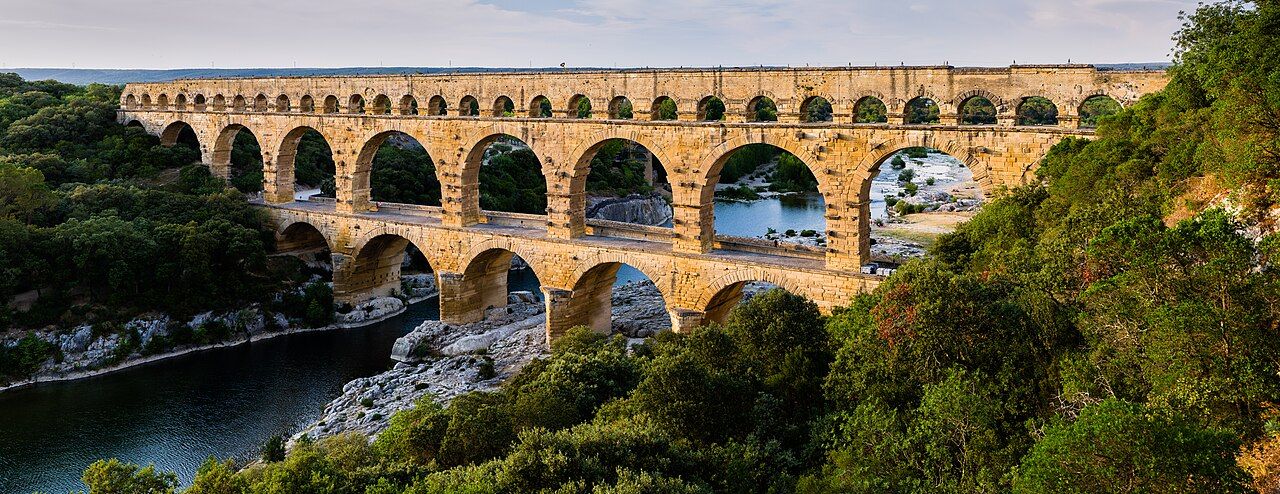
Consider what an integrated Mediterranean made possible. Some 80,000 kilometers of paved roads eventually linked the provinces, primarily for military movement but usable by anyone. Piracy was suppressed, so grain from Egypt and North Africa fed a city of perhaps one million people. A common currency, and after the mid-second century a broadly common legal framework, made long-distance contracts enforceable. Cities were founded or refounded on a Roman template — forum, baths, amphitheater, aqueduct, grid streets — from Bath in Britain to Palmyra in Syria. Aqueducts delivered water at volumes that European cities would not match again until the nineteenth century. Rome had public latrines, sewers, and a fire brigade. It also had lead pipes, tenement collapses, and no germ theory.
The most consequential act of the period came in 212 CE, when the emperor Caracalla issued the Constitutio Antoniniana, granting Roman citizenship to virtually every free inhabitant of the empire. The motive was probably fiscal — citizens paid inheritance tax — and the practical effect was to make the old citizen/provincial distinction obsolete, replacing it with a distinction between honestiores (the respectable, who received lighter punishments) and humiliores (everyone else, who could be flogged, tortured or thrown to beasts). Legal equality arrived just as legal privilege shifted from citizenship to class.
| Emperor | Dates (CE) | Why they matter |
|---|---|---|
| Augustus | 27 BCE–14 CE | Invented the Principate; professionalized the army |
| Claudius | 41–54 | Conquered Britain; expanded the imperial bureaucracy |
| Nero | 54–68 | Great Fire of 64; first persecution of Christians; suicide ends the Julio-Claudians |
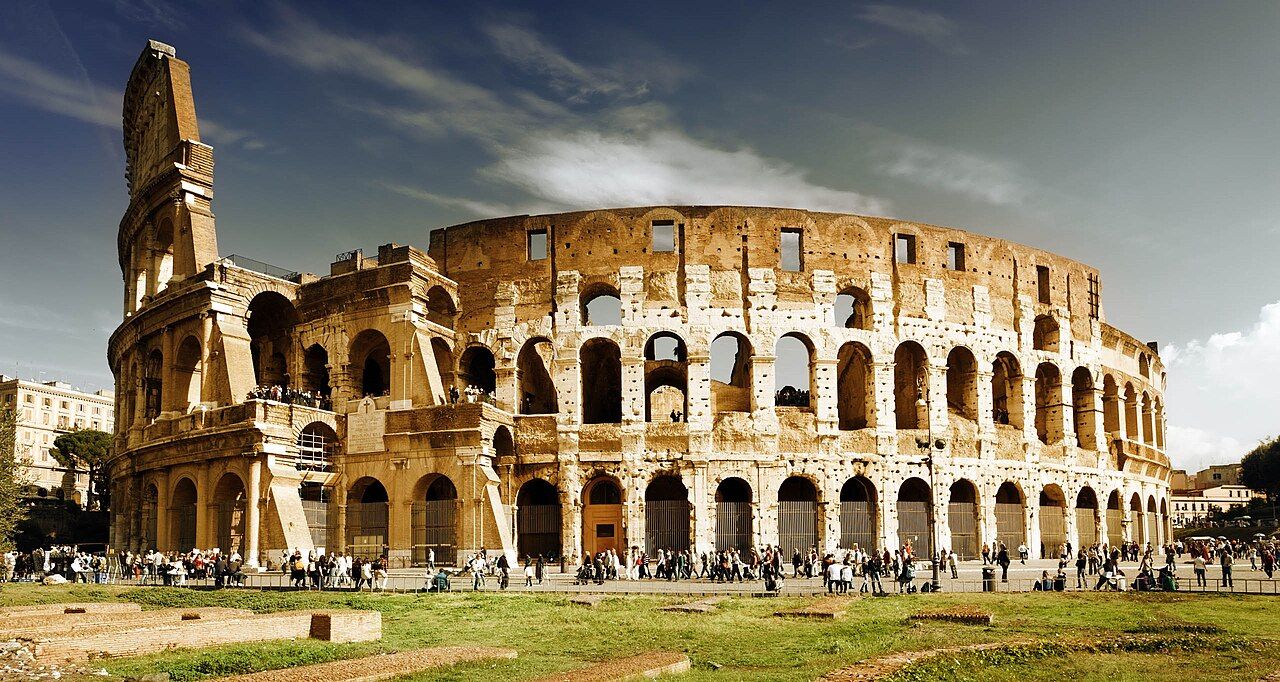
| Vespasian | 69–79 | Won the Year of the Four Emperors; began the Colosseum |
| Trajan | 98–117 | Empire at greatest territorial extent (Dacia, Mesopotamia) |
| Hadrian | 117–138 | Consolidated frontiers; the Wall in Britain; crushed the Bar Kokhba revolt |
| Marcus Aurelius | 161–180 | Stoic Meditations; Antonine Plague; endless Danube wars |
| Caracalla | 198–217 (sole from 211) | Universal citizenship in 212 |
Law, religion and daily life
Rome’s most durable export was law. Roman jurists developed the ius gentium, the “law of nations” — principles thought to be common to all peoples and therefore applicable to disputes between a Roman and a foreigner. Over time this merged with Stoic ideas of natural law and produced concepts still recognizable in modern legal systems: contracts requiring genuine consent, the notion that intent matters in assessing wrongdoing, that a person should not be condemned unheard, that the burden of proof lies with the accuser. Roman law was systematized under Justinian in the sixth century as the Corpus Juris Civilis, and through that text it became the foundation of the civil-law tradition of continental Europe and Latin America.
Roman religion was not a matter of belief in the modern sense but of correct performance. Rites had to be executed precisely; the gods, in exchange, sustained the state. This made Rome extraordinarily tolerant of new deities, which were simply added, and extraordinarily intolerant of refusal to participate, which looked like sabotage. Jews received a formal exemption in recognition of their ancient tradition. Christians, initially indistinguishable from Jews, lost that cover as they separated, and their refusal to sacrifice to the emperor’s genius made them suspects — though persecution before the third century was sporadic and local rather than systematic. Pliny the Younger’s letter to Trajan around 112 CE, asking how to handle Christians, and Trajan’s reply that they should not be sought out but must recant if accused, is our best window into official confusion on the subject.
For most people the empire meant work: farming, above all, since perhaps eighty to ninety percent of the population lived on the land. Roman society was steeply hierarchical and openly so, organized around patronage — the daily morning ritual in which clients called on a patron for favors, money or legal help and returned political support and public deference. Women could own property, run businesses and initiate divorce, and elite women exerted real informal influence, but they could not vote or hold office, and marriage was arranged around family strategy. Slavery was everywhere and legally total, though Roman manumission was unusually common and a freed slave became a citizen — a fluidity that startled Greek observers.
Do not mistake Roman religious tolerance for indifference or for pluralism as we mean it. Rome accepted any god you liked so long as you also honored the gods of Rome. The trouble with Christianity was not its content but its exclusivity — a refusal to participate in civic cult read to Roman officials as disloyalty, roughly the way refusing to acknowledge the state itself would read now.
Augustus made monarchy acceptable by dressing it in republican clothing, and the two centuries of relative peace that followed produced an integrated Mediterranean world — roads, cities, citizenship and law — whose legal and urban legacy long outlasted the state that built it.
Section 5Crisis, Reinvention and the End in the West
The third century nearly ends it
The system Augustus built had one structural flaw he never fixed: no rule of succession. As long as an emperor died with an adult heir the army accepted, things held. When Commodus — Marcus Aurelius’s son, and unfit for the job by every surviving account, all of them hostile — was strangled in 192, five men claimed the throne within a year. Septimius Severus won that contest and his dynasty patched over the gap for another four decades, largely by buying the army’s loyalty. After the murder of Severus Alexander by his own troops in 235, nothing held. Between 235 and 284 CE, the Crisis of the Third Century saw more than twenty men recognized as emperor and many more claimants, most of them elevated by their own troops and most of them murdered. The average reign was under three years.
The crisis was compound, and each element worsened the others. On the frontiers, a newly aggressive Sasanian Persia captured the emperor Valerian alive in 260 — an unprecedented humiliation — while Gothic and Alamannic groups raided deep into the Balkans, Greece and Gaul. To pay troops, emperors debased the silver coinage until the denarius contained almost no silver, and prices spiraled. Trade contracted as roads became unsafe. The Antonine Plague of the 160s and the Plague of Cyprian in the 250s killed populations already strained. The empire physically fragmented for over a decade into three pieces — a Gallic Empire in the west, a Palmyrene state in the east under Zenobia, and a rump center — before Aurelian reassembled it by force in the early 270s.
Diocletian, Constantine and the reinvented state
Diocletian (284–305) responded with radical restructuring. He split the empire administratively into eastern and western halves, each under an Augustus with a junior Caesar designated to succeed — the Tetrarchy, an attempt to engineer succession and put a ruler nearer each threatened frontier. He doubled the number of provinces to make governors less dangerous, separated military from civil commands, expanded the army and bureaucracy enormously, and abandoned the pretense of the Principate: the emperor became dominus, lord, approached with prostration in a court modeled on Persian ceremonial. His Edict on Maximum Prices in 301 tried to legislate inflation away and failed, as such edicts do. He also launched the empire’s most systematic persecution of Christians in 303.
The Tetrarchy survived Diocletian’s retirement to grow cabbages in Dalmatia by barely a year before the succession he had designed broke down into open competition. Constantine emerged from the resulting scramble, winning control of the west at the Milvian Bridge in 312 — a victory he attributed to the Christian God — and of the whole empire by 324. His two decisions of lasting consequence were to legalize and then favor Christianity, and to found a new capital at Byzantium, refounded in 330 as Constantinople, on a superbly defensible peninsula controlling the straits between Europe and Asia. He also summoned the Council of Nicaea in 325 to settle a doctrinal dispute, thereby establishing that the emperor would arbitrate the church — a precedent with a thousand-year afterlife, and the subject of the next chapter.
| Problem in the third century | Diocletian’s or Constantine’s answer | Result |
|---|---|---|
| No succession rule | Tetrarchy of four rulers with designated heirs | Broke down within two years of Diocletian’s retirement |
| Governors rebelling | Provinces doubled; civil and military commands split | Largely effective; usurpation rate fell |
| Debased coinage, inflation | New gold solidus; price edict | Solidus stable for centuries; price edict ignored |
| Tax evasion and labor flight | Occupations and tenancies made hereditary | Revenue secured; social mobility strangled |
| Rome too far from the frontiers | New capitals; Constantinople founded 330 | East strengthened, west relatively weakened |
Why the west fell and the east did not
After 395, when Theodosius I died and left the halves to his two sons, the empire was never again ruled by one man. The western half unraveled over the next eighty years. Pressure from the Huns pushed Gothic and other groups across the Danube; a Gothic force destroyed a Roman army and killed the emperor Valens at Adrianople in 378. Alaric’s Goths sacked Rome in 410, a shock felt across the Mediterranean even though the capital had moved to Ravenna. Vandals took North Africa — and with it the western grain and tax base — by 439. In 476 the general Odoacer deposed the boy emperor Romulus Augustulus and did not bother to replace him, sending the imperial regalia to Constantinople. That date is a convenient marker, not an event contemporaries thought momentous.
Explanations for the fall are genuinely contested. Edward Gibbon in the eighteenth century blamed Christianity for draining civic energy, an argument few historians accept today. Others have emphasized lead poisoning, plague, soil exhaustion, or the demographic effect of epidemics — each contributing but none sufficient. The serious modern debate runs between two poles. One tradition, associated with Peter Heather and Bryan Ward-Perkins, stresses external military pressure and sees a violent collapse with measurable material consequences: pottery quality, building in stone, coin circulation and literacy all drop sharply in the fifth-century west. Another, associated with Walter Goffart and much work on “Late Antiquity,” stresses gradual accommodation and transformation, with barbarian groups settled by treaty inside a Roman system that changed rather than ended.
The comparison with the east is the most useful analytical tool here. The eastern empire faced similar pressures and survived until 1453. Why? It was richer, with denser cities in Egypt, Syria and Anatolia and a larger tax base. Its capital was nearly impregnable behind the Theodosian Walls and could be supplied by sea. Its frontier was shorter and its main enemy, Persia, was a state that could be negotiated with rather than a set of migrating peoples. And it managed, sometimes by paying, to deflect invasions westward. The west, by contrast, lost Africa’s revenue early, could not pay its armies, and increasingly relied on the very Gothic and Frankish forces it needed to control. The empire did not so much die as get replaced piecemeal by successor kingdoms whose kings kept Roman titles, Roman taxes where they could collect them, and eventually Roman religion.
“Rome fell in 476” is a date historians use for convenience and then immediately qualify. Nobody at the time announced the end of the empire; Odoacer ruled Italy as a nominal subordinate of the emperor in Constantinople, the Senate kept meeting, and the eastern empire — which called itself Roman until 1453 — would reconquer much of Italy sixty years later under Justinian.
The third-century crisis nearly destroyed the empire and forced a reinvention — a bigger, more coercive, more Christian state with a new capital in the east — which saved the wealthier eastern half for a further millennium while the west fragmented into successor kingdoms that kept much of Rome inside them.
The chapter in one breath
Rome’s history is a single long argument between the size of its power and the design of its institutions. A city-state constitution built to prevent tyranny — annual, collegial magistrates, a dominant Senate, tribunes with a veto — proved unexpectedly good at absorbing neighbors, because Rome offered defeated Italians graded citizenship rather than subjection and thereby converted enemies into an inexhaustible supply of soldiers. That manpower beat Carthage, absorbed the Hellenistic east, and made Rome rich. It also flooded Italy with slaves and estates, destroyed the smallholding class that had filled the legions, and forced a fix — landless volunteers dependent on their generals — that put private armies in the hands of ambitious men. From the killing of Tiberius Gracchus in 133 BCE, Roman politics ran on violence until Octavian was the last man standing. Augustus solved the mismatch by building a monarchy that spoke republican, and bought two centuries of Mediterranean integration: roads, cities, law, and eventually universal citizenship. But he never solved succession. The third century nearly ended the experiment; Diocletian and Constantine rebuilt the state as something harder and more centralized, with its center of gravity in the wealthier east. The west, poorer and more exposed, dissolved into kingdoms that carried Roman law, language and religion forward under new management.
Words worth knowing
| Term | What it means |
|---|---|
| Res publica | “The public thing” — the Roman state as common property of the citizens, source of our word republic. |
| Consul | One of two annually elected chief magistrates holding executive and military command, each able to veto the other. |
| Senate | Life-tenured council of ex-magistrates; formally advisory, in practice the governing body of the Republic. |
| Tribune of the plebs | Sacrosanct plebeian officer who could veto any magistrate’s act; the plebeians’ institutional weapon. |
| Cursus honorum | The fixed ladder of public offices, with minimum ages and required sequence, that structured a Roman political career. |
| Patrician / plebeian | The closed hereditary aristocracy versus everyone else; the division behind the Struggle of the Orders. |
| Twelve Tables | Rome’s law code written down and publicly posted around 450 BCE, ending patrician monopoly on legal knowledge. |
| Mos maiorum | “The way of the ancestors” — unwritten custom that carried more moral force at Rome than statute. |
| Socii | Italian allies who kept their own laws and government but supplied troops and surrendered foreign policy to Rome. |
| Latifundium | A large slave-worked estate producing for market; its spread displaced Italy’s smallholding soldier-farmers. |
| Proscription | A published list of citizens declared outlaws, whose killers were rewarded and whose property was confiscated. |
| Optimates / populares | Not parties but methods — working through the Senate versus working through the assemblies and tribunate. |
| Princeps | “First citizen,” the modest title Augustus preferred; the root of the term Principate for the early empire. |
| Tribunicia potestas | Tribunician power held without the office, giving an emperor veto authority and personal sacrosanctity. |
| Pax Romana | The roughly two centuries of relative internal peace from Augustus to Marcus Aurelius, and the prosperity it enabled. |
| Constitutio Antoniniana | Caracalla’s edict of 212 CE granting citizenship to nearly all free inhabitants of the empire. |
| Ius gentium | “Law of nations” — principles held to apply to all peoples, a root of later natural-law and international-law thinking. |
| Tetrarchy | Diocletian’s rule of four — two senior and two junior emperors — intended to fix succession and frontier defense. |
| Patronage | The reciprocal patron–client relationship of favors for loyalty that structured Roman social and political life. |
| Late Antiquity | The period roughly 250–750 CE, studied as transformation rather than simple decline of the Roman world. |