Byzantium, Islam and the Early Middle Ages
Between roughly 500 and 1000 the Mediterranean world stopped being one thing and became three. In the east, a Greek-speaking Roman Empire kept its capital, its law courts, its tax rolls and its emperor, and survived a century of catastrophe by shrinking and reorganizing. In Arabia, a new revelation gathered scattered tribes into a single community that within a hundred years governed from the Atlantic to the Indus and built cities where Greek philosophy, Persian administration and Indian mathematics met. In the Latin west, Roman government dissolved into successor kingdoms where bishops, abbots and warlords improvised order from the wreckage of an imperial system nobody could afford anymore. These three worlds argued, traded, raided and copied one another constantly. Understanding the early Middle Ages means understanding that separation — and refusing the old story in which one civilization “declined” while the others were merely background.
By the end of this chapter you can
- Explain what Justinian tried to do in the sixth century and why his reconquest of the west proved unsustainable, using the Corpus Juris Civilis, the Plague of Justinian and the Gothic War as evidence.
- Describe how the Byzantine Empire survived the seventh-century crisis, including the themes, Greek fire and the shift from Latin to Greek administration.
- Summarize the career of Muhammad, the meaning of the Hijra, and the core beliefs and practices of early Islam without reducing them to a list.
- Trace the Arab conquests from Yarmuk (636) to the failed siege of Constantinople (717–718) and identify the political and military reasons they succeeded so fast.
- Contrast the Umayyad and Abbasid caliphates in capital, personnel, religious politics and cultural output, and explain the origins of the Sunni–Shia division.
- Analyze how monasteries, bishops and the Rule of Saint Benedict preserved and reshaped learning in the post-Roman west.
- Evaluate the achievement of Charlemagne and the Carolingian Renaissance, including the coronation of 800 and the significance of Caroline minuscule.
- Explain how Viking, Magyar and Muslim raids after 840 reorganized power in western Europe, and state why historians now dispute the word feudalism.
- Compare the three post-Roman civilizations on a set of common measures — taxation, urbanism, literacy and law — and defend a judgment about what “decline” does and does not describe.
Section 1The Empire That Refused to End
Justinian’s gamble
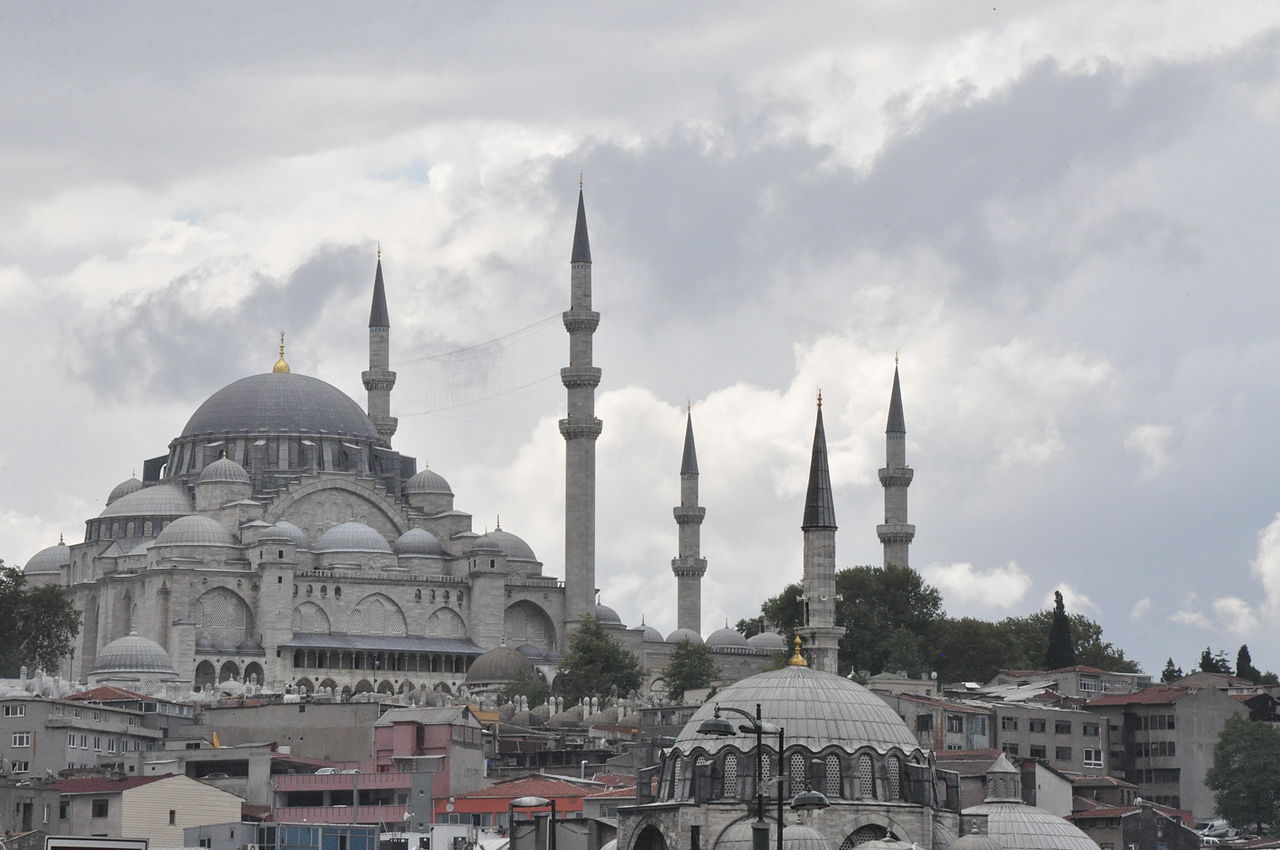
When Justinian I came to the throne in 527 he ruled an empire that had lost its western half but kept the profitable one. Egypt and Syria still fed the treasury. Constantinople, with perhaps 400,000 people, was the largest city in the Mediterranean. Justinian was the nephew of a peasant soldier who had become emperor, he was tireless to the point of insomnia, and he believed something that most of his predecessors had quietly abandoned: that the loss of Italy, Africa and Spain was temporary and reversible.
He nearly lost everything in his fifth year. In January 532 the two great chariot-racing factions of the capital, the Blues and the Greens, briefly united against his tax collectors in what became the Nika riots. Half the city burned, the crowd acclaimed a rival emperor, and Justinian had ships loaded for flight. According to the historian Procopius, the empress Theodora stopped him with a line about purple making a fine burial shroud. Whether she said it or Procopius improved it, Justinian stayed, his generals trapped the crowd in the Hippodrome, and tens of thousands died. Out of the ashes he rebuilt the burned cathedral as Hagia Sophia, finished in under six years by the mathematicians Anthemius of Tralles and Isidore of Miletus — a dome on pendentives that engineers had not attempted at that scale before.
The reconquest followed. In 533 the general Belisarius landed in Africa and broke the Vandal kingdom in barely six months; its last king surrendered in the spring of 534. Italy was the disaster. The Gothic War that began in 535 was supposed to take two years; it took nineteen, and it wrecked the peninsula. Rome changed hands five times. The aqueducts were cut, the Senate never recovered as a working body, and the great senatorial estates that had survived Alaric and Odoacer did not survive Justinian’s liberation. In 554 the Pragmatic Sanction reorganized a province that no longer had much left to organize. Fourteen years later the Lombards walked into most of it.
Law, plague and overreach
Justinian’s most durable act had nothing to do with armies. In 528 he set a commission to reduce a thousand years of Roman legal opinion to something usable, and from 530 the work was directed by the jurist Tribonian. The result, later called the Corpus Juris Civilis, had four parts: the Codex of imperial legislation, the Digest of extracts from classical jurists, the Institutes as a student textbook, and the Novellae, the new laws Justinian kept issuing (mostly in Greek, which tells you where the empire was going). Rediscovered in Bologna in the late eleventh century, this compilation became the seedbed of the civil-law tradition that still governs most of continental Europe, Latin America, Quebec, Louisiana and Japan.
Then came the pandemic. In 541 a disease reached Pelusium in Egypt and spread along the grain routes; by spring 542 it was killing in Constantinople at a rate Procopius put, probably too high, at 10,000 a day. DNA recovered from sixth-century graves in Bavaria and elsewhere has confirmed the pathogen as Yersinia pestis — the same organism as the Black Death. The Plague of Justinian returned in waves for two centuries. Historians disagree sharply about how much it killed: older estimates of a third to a half of the Mediterranean population have been challenged by scholars who point to continuing building, stable coinage and thin archaeological evidence of collapse. What is not disputed is that the empire ended Justinian’s reign with more territory and less money than it began with, and that the bill came due under his successors.
Surviving the seventh century
Between 602 and 628 Rome and Persia fought the last and worst of their wars. The Sasanian king Khosrow II took Syria, Egypt and Jerusalem, carrying off the relic of the True Cross in 614. The emperor Heraclius (r. 610–641), in a campaign that reads like desperation dressed as strategy, melted down church plate, marched around the Persian flank through the Caucasus, and shattered Khosrow’s army near Nineveh in December 627. Both empires had spent everything. Within a decade Arab armies had taken Syria and Egypt from the exhausted victors, and within twenty years the Sasanian state had ceased to exist.
What remained of the empire — Anatolia, the Aegean coast, a strip of the Balkans, Sicily and a few Italian toeholds — reorganized around survival. Provincial armies were settled on the land in districts called themes (themata), where a single commander held both military and civil authority and soldiers held land in return for service. Older textbooks credit Heraclius with inventing the system in one stroke; most specialists now see it emerging piecemeal across the later seventh and eighth centuries as a response to permanent raiding. Latin gave way to Greek in government, and Heraclius replaced the old Latin titles with the Greek basileus in 629. Twice Arab fleets attacked Constantinople — a long blockade traditionally dated 674–678, which some scholars now redate to the 660s, and a full siege in 717–718 — and twice they failed, partly because of the triple Theodosian land walls and partly because of Greek fire, a petroleum-based incendiary sprayed from siphons that burned on water and whose exact recipe was such a close state secret that it is still not certainly known.
The strain produced a religious civil war of its own. From about 726 the emperor Leo III and, far more aggressively, his son Constantine V attacked the veneration of religious images as idolatry. Iconoclasm — literally image-breaking — was made official doctrine by a council in 754, overturned when the Second Council of Nicaea restored the veneration of icons in 787, imposed again from 815, and finally abandoned in 843, an event the Orthodox Church still commemorates as the Triumph of Orthodoxy. The quarrel mattered beyond art: it soured relations with the papacy, which sided firmly with the images, and pushed Rome toward a new protector in the north.
| Pressure | Byzantine response | Result by c. 750 |
|---|---|---|
| Loss of Egypt and Syria (636–642) | Free grain dole already ended in 618; tax Anatolia harder | Revenue down perhaps three-quarters; capital shrinks toward 40,000–70,000 |
| Annual Arab raids into Anatolia | Theme system; fortified hilltop kastra replace open cities | Countryside militarized; classical urban life largely ends in Anatolia |
| Naval assaults on the capital | Theodosian walls, Greek fire, dromon fleet | Two sieges broken (678, 718); Constantinople not taken until 1204 |
| Slavic settlement in the Balkans | Forced transfers of population; missions and baptism | Greece slowly recovered; Bulgaria becomes a rival Christian state after 864 |
| Internal religious division | Iconoclasm, then its reversal in 843 | Doctrinal settlement, but permanent friction with Rome |
By the ninth century the empire was smaller, poorer, more Greek and considerably tougher. Under the Macedonian dynasty founded by Basil I in 867 it went back on the offensive, and under Basil II (r. 976–1025) it annexed Bulgaria outright. Meanwhile its missionaries were doing quieter work: in 863 the brothers Cyril and Methodius went to Moravia and devised the Glagolitic alphabet for Slavic speech, out of which their disciples in Bulgaria developed the Cyrillic script that carries Cyril’s name; Bulgaria accepted baptism from Constantinople in 864, and the Rus’ of Kiev followed under Vladimir around 988. Eastern Christendom acquired a religious and cultural sphere that outlived the empire by a thousand years.
Byzantium survived not by restoring Rome but by abandoning most of it — trading the Mediterranean-wide, city-based empire Justinian tried to rebuild for a compact, militarized, Greek-speaking state that could actually be defended and paid for.
Section 2Revelation and Community: The Rise of Islam
Arabia before 610
Sixth-century Arabia was not empty and it was not isolated. Its northern tribes were clients of the Roman and Persian empires, paid to police desert frontiers. Yemen in the south had dams, irrigated agriculture and a long literate tradition. Between them ran caravan routes carrying incense, leather and slaves. Mecca, controlled by the Quraysh tribe, was a trading town and a pilgrimage site built around the Kaaba, a cube-shaped shrine housing the images of many deities. Jewish and Christian communities were established across the peninsula, and Arabic-speakers were entirely familiar with the idea of one God, scripture and prophecy.
Muhammad was born in Mecca around 570 into a respectable but not wealthy branch of the Quraysh. Orphaned early, he worked in the caravan trade and married his employer, a widow named Khadija. Around 610, according to the tradition, he began receiving revelations in a cave outside the city through the angel Gabriel. The message was uncompromising: there is one God, He will judge every person, wealth carries obligations toward the poor and the orphan, and the idols of the Kaaba are nothing. Recited aloud over twenty-two years and collected after his death, these revelations form the Quran — a text Muslims understand not as Muhammad’s words about God but as God’s own speech in Arabic.
The Hijra and the making of the umma
Mecca’s leadership heard a threat to the shrine economy and to the tribal order, and persecution followed. In 622 Muhammad and his followers accepted an invitation to arbitrate a feud in the oasis town of Yathrib, 340 kilometres north, which became Medina — “the city” of the Prophet. This migration, the Hijra, is the year 1 of the Islamic calendar, and the choice is revealing: the era begins not with the Prophet’s birth or first revelation but with the founding of a community that governed itself.
In Medina the movement became a polity. The document usually called the Constitution of Medina bound emigrants, local converts and several Jewish clans into a single mutual-defense compact. The umma, the community of believers, cut across the tribal blood ties that had organized Arabian life, which is precisely why it was revolutionary and why it was resisted. Eight years of intermittent war with Mecca followed — Badr in 624, Uhud in 625, the siege of Medina in 627 — ending when Muhammad entered Mecca essentially unopposed in 630 and cleared the Kaaba of its idols while keeping the shrine itself as the focus of pilgrimage. When he died in 632, most of the Arabian tribes had accepted his authority.
Succession and the first divisions
Muhammad left no son and, in Sunni understanding, no explicit successor. The community chose Abu Bakr, his close companion, as khalifa — caliph, deputy or successor. A minority held that leadership belonged to the Prophet’s cousin and son-in-law Ali ibn Abi Talib and his descendants. That disagreement, initially political, hardened over generations into the division between Sunni Muslims, who located authority in the consensus of the community and the recorded practice (sunna) of the Prophet, and Shia Muslims, the “party of Ali,” who located it in a designated line of imams.
The first four caliphs are known to Sunnis as the Rashidun, the Rightly Guided. Their record is not tranquil. Umar organized the conquests and was murdered by a Persian slave in 644. Uthman standardized the written text of the Quran — an act of lasting importance — and was killed by mutinous soldiers in 656. Ali’s caliphate was consumed by the first fitna or civil war: the Battle of the Camel against Aisha, the Prophet’s widow, in 656; the indecisive confrontation at Siffin with Muawiya, governor of Syria, in 657; the secession of the Kharijites, who held that a sinful ruler forfeited authority; and Ali’s assassination by a Kharijite in 661. In 680 Ali’s son Husayn and a small band were killed at Karbala in Iraq by Umayyad troops — a defeat that became the emotional centre of Shia devotion and is still commemorated annually.
| Caliph | Dates | What defined the reign |
|---|---|---|
| Abu Bakr | 632–634 | Ridda wars reassert authority over tribes that had seceded after the Prophet’s death |
| Umar ibn al-Khattab | 634–644 | Yarmuk (636) and Qadisiyya take Syria and Iraq; garrison cities founded at Kufa, Basra, Fustat |
| Uthman ibn Affan | 644–656 | Canonical text of the Quran fixed; charges of nepotism trigger revolt |
| Ali ibn Abi Talib | 656–661 | First civil war; capital moves to Kufa; Kharijite secession; assassination |
| Muawiya (first Umayyad) | 661–680 | Capital to Damascus; caliphate becomes hereditary in practice |
Why the conquests moved so fast
Within a decade of Muhammad’s death Arab armies had beaten a Roman force at the Yarmuk river in 636, taken the Sasanian capital of Ctesiphon, and occupied Egypt. Within a century the caliphate ran from Spain to the Indus. Explanations that rest on religious enthusiasm alone are inadequate; the enthusiasm was real but so were four structural advantages. First, both target empires had just exhausted themselves in the war of 602–628 and neither could field a reserve. Second, plague had thinned Mediterranean populations while sparing the interior of Arabia. Third, the conquerors used mobility and desert lines of retreat that heavy imperial armies could not match. Fourth, and most underrated, the terms were often attractive: the Arabs generally did not require conversion, left local administration and existing tax collectors in place for decades, and imposed a poll tax, the jizya, on non-Muslim dhimmi subjects that in Syria and Egypt was frequently lighter than Byzantine or Sasanian exactions, and lighter still for the Miaphysite Christians of Syria and Egypt — long labelled Monophysites by their opponents — whom Constantinople had been persecuting as heretics.
The result was a conquest that was fast militarily and slow religiously. Recent work using tax registers, papyri and the conversion curves reconstructed by Richard Bulliet suggests that Egypt, Syria and Iran did not become majority-Muslim until somewhere between the ninth and eleventh centuries. For a long while the ruling class was a small Arab garrison elite living in new cities, taxing a Christian, Zoroastrian and Jewish countryside.
Islam expanded so quickly because a genuinely new form of community coincided with two burned-out empires and a conquest policy that taxed subject populations rather than forcing their conversion.
Section 3Damascus, Baghdad, Cordoba: The Caliphates and Their Civilization
The Umayyads: an Arab kingdom
Muawiya made Damascus the capital in 661 — the seat of government had already left Medina for Ali’s Kufa — and named his son as heir, converting an elected office into a dynasty. The Umayyad caliphate (661–750) governed a Roman and Persian empire with Roman and Persian officials, and for a generation it looked like a continuation of the old order under new management: Greek-speaking clerks kept the accounts in Syria, Pahlavi clerks kept them in Iraq, and Byzantine-style coins circulated with the crosses filed off.
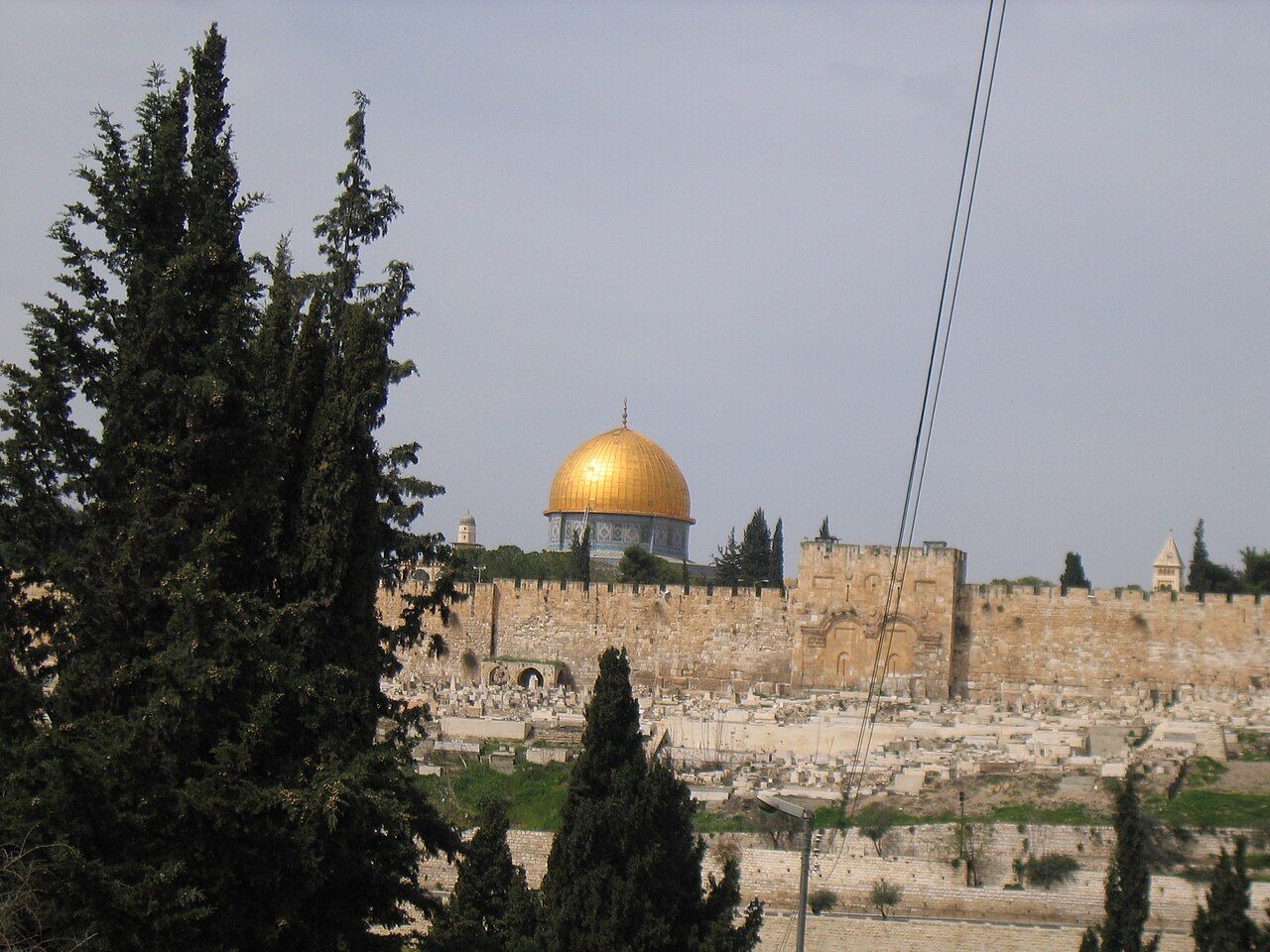
That changed under Abd al-Malik (r. 685–705). He made Arabic the language of administration, minted a purely epigraphic gold dinar with no ruler’s portrait, and in 691–692 built the Dome of the Rock in Jerusalem, whose interior inscriptions include Quranic verses addressed pointedly to Christians about the nature of Jesus. These were acts of statement as much as of governance: the caliphate was announcing that it was not a variant of Rome. Expansion continued to its natural limits — Spain from 711, Central Asia and Sind by 715, a raiding column stopped near Poitiers by Charles Martel in 732 — but the empire was straining. Non-Arab converts, the mawali, resented paying taxes that Arabs did not; Shia and Kharijite movements simmered; and in 750 a revolutionary coalition assembled in Khurasan destroyed the Umayyad army at the river Zab.
The Abbasid century
The Abbasids, who claimed descent from the Prophet’s uncle, hunted the Umayyad family almost to extinction and moved the centre of gravity east. In 762 the caliph al-Mansur founded Baghdad on the Tigris, a planned round city near the ruins of Ctesiphon, at the junction of the routes to Iran, India and the Mediterranean. Within fifty years it may have held several hundred thousand people; some estimates make it, with Chang’an, one of the two largest cities on earth. The Abbasid state was Persian in style: a vizier ran the bureaucracy, the caliph was screened from petitioners by court ritual, and Arab tribal aristocracy lost its monopoly on office to a cosmopolitan service class of Persians, Arabs, Christians and converts.
The famous cultural consequence was the translation movement. From the late eighth to the tenth century, and with lavish official patronage, nearly the whole surviving corpus of Greek science and philosophy was rendered into Arabic — Aristotle, Euclid, Ptolemy, Galen, Hippocrates, Archimedes — usually via Syriac, often by Christian scholars, of whom the greatest was Hunayn ibn Ishaq (d. 873), a Nestorian physician who translated Galen with a critical method that involved collating manuscripts. The Bayt al-Hikma or House of Wisdom in Baghdad is traditionally described as a great research academy; the historian Dimitri Gutas has argued persuasively that it was closer to a palace library and translation office, and that the real engine was broad elite demand for useful knowledge, not a single institution. Either way the transfer was decisive: Greek learning survived to reach medieval Europe largely because it had first been translated into Arabic.
What followed was not preservation but production. Al-Khwarizmi (d. c. 850) wrote a treatise on restoring and balancing equations whose title gave us the word algebra and whose Latinized name gave us algorithm; he also popularized the Indian decimal place-value numerals we still call Arabic. Al-Razi (Rhazes, d. 925) wrote the first clinical account distinguishing smallpox from measles and left case notes that read like modern rounds. Ibn Sina (Avicenna, d. 1037) compiled the Canon of Medicine, a systematization of Galenic medicine so thorough it was still assigned in European medical faculties in the seventeenth century. Ibn al-Haytham (Alhazen, d. c. 1040) demolished the theory that vision works by rays emitted from the eye and did it with controlled experiments in a darkened chamber, which is why he has a fair claim to be called the first experimental physicist. Paper, learned from Central Asia in the eighth century, made all of this cheap enough to circulate; the tradition that the technique was extracted from prisoners after the battle of Talas in 751 is a good story that specialists treat with caution.
Fragmentation, and Spain
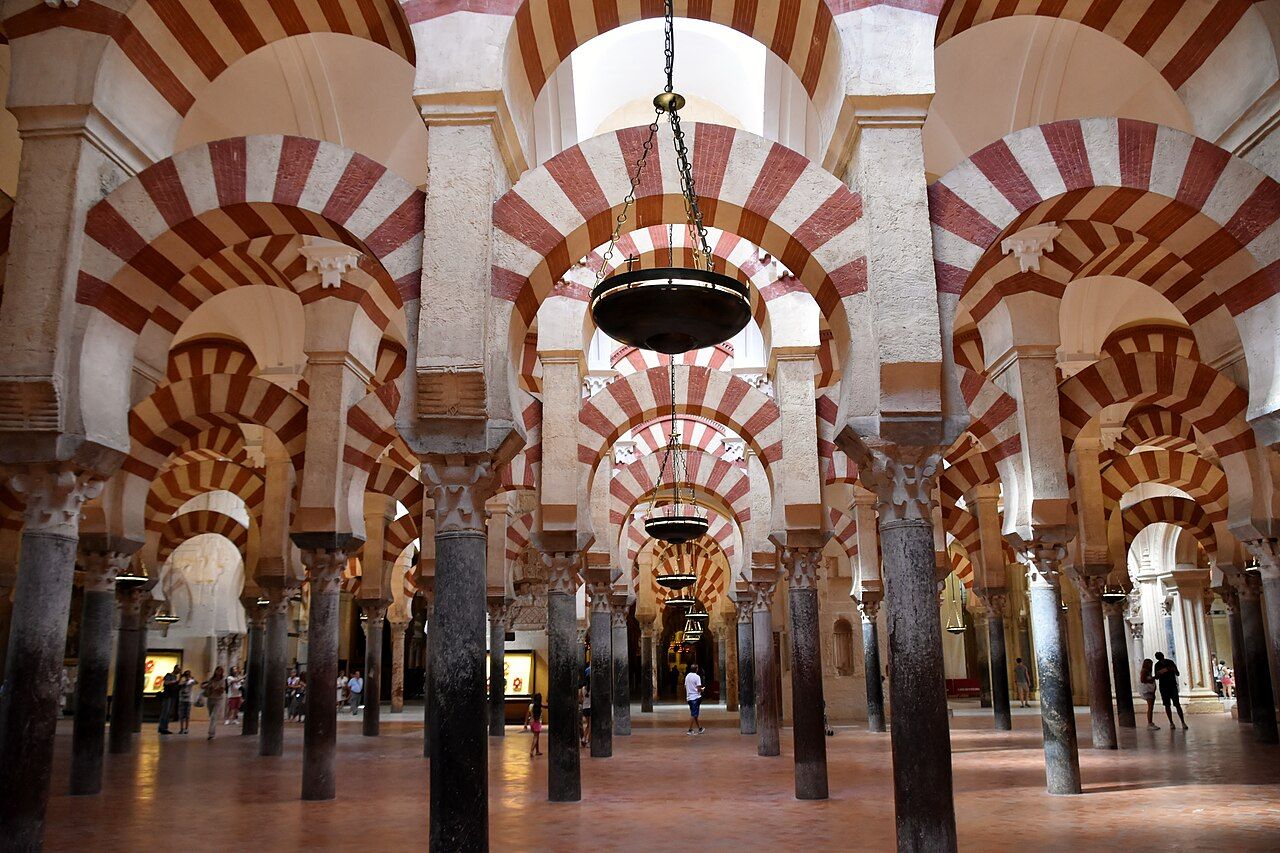
Political unity did not last. A surviving Umayyad prince, Abd al-Rahman I, reached Spain in 755, took Cordoba the following year and founded an independent emirate there; his descendant Abd al-Rahman III declared himself caliph in 929. Tenth-century Cordoba had paved and lamplit streets, a library whose catalogue reportedly ran to forty-four volumes, and a population perhaps approaching 100,000 — larger than any Christian city west of Constantinople. Its scholars included the Jewish statesman Hasdai ibn Shaprut; the physician-philosopher Maimonides was born there in 1138, though the Almohad conquest drove his family out while he was still a boy. This convivencia, the coexistence of Muslims, Christians and Jews, was real but should not be romanticized: it was a legally unequal arrangement, punctuated by persecutions, that nonetheless permitted an intellectual exchange with few parallels in the period.
Elsewhere the caliphate hollowed out. The Shia Fatimids took Egypt in 969, founded Cairo, and endowed al-Azhar, which is still teaching a thousand years later. Turkish military slaves — mamluks — recruited to make the caliph independent of factions ended by dominating him, and after 945 the Abbasid caliph in Baghdad was a religious figurehead under the control of the Shia Buyid dynasty. The Islamic world of the year 1000 was a single civilization with a shared language of learning and three or more rival governments, which is roughly the condition Latin Christendom would reach some centuries later.
| Umayyad (661–750) | Abbasid (750–1258, real power to 945) | |
|---|---|---|
| Capital | Damascus — Mediterranean, Roman-facing | Baghdad — Mesopotamian, Persian-facing |
| Ruling elite | Arab tribal aristocracy; converts second-class | Cosmopolitan service class; convert status equalized |
| Style of rule | Accessible tribal chief with Byzantine machinery | Screened sacral monarch with vizier and Persian court ritual |
| Signature monument | Dome of the Rock; Great Mosque of Damascus | Round City of Baghdad; Samarra |
| Cultural output | Arabization of coinage and administration | Translation movement; algebra, optics, clinical medicine |
| Fatal weakness | Arab-versus-convert resentment; overextension | Provincial secession; dependence on Turkish slave soldiers |
The caliphates turned conquest into civilization by absorbing Greek, Persian and Indian learning into an Arabic-language culture that then surpassed its sources — even as the political unity that had made the exchange possible broke apart.
Section 4The Latin West: Kingdoms, Bishops and the Monastic Solution
What actually ended in the west
The deposition of the last western emperor in 476 changed less at the time than the date suggests. What ended over the following century and a half was more consequential and less dramatic: the imperial tax system, the professional standing army it paid for, long-distance bulk trade in cheap goods, and the mass production of things like pottery and roof tiles. Archaeologists can watch it happen. Standardized African red-slip tableware, shipped to every Mediterranean province in 400, stops reaching most Italian sites by about 600; in Britain, always at the edge of that trade, wheel-thrown pottery of any kind essentially vanishes within a generation of 400. Coin finds thin out. Buildings switch from mortared stone to timber. Chris Wickham has argued that this simplification — a genuine fall in material complexity and in aggregate wealth — is the real content of the phrase “fall of Rome,” and it varied enormously by region: catastrophic in Britain, severe in Gaul, moderate in Italy and Spain, mild in Byzantine Egypt.
The successor kingdoms were not simply invaders squatting in the ruins. Their rulers wanted to be Roman. Theodoric the Ostrogoth (r. 493–526) governed Italy from Ravenna with the Senate intact, employed the Roman aristocrat Cassiodorus as his secretary, restored aqueducts and issued edicts in Latin. The problem was religion. Most of the Germanic peoples had been converted to Arian Christianity, which held that the Son was created by the Father and neither co-eternal nor equal with him, and their Catholic subjects regarded them as heretics. Theodoric’s later years soured accordingly; he executed the philosopher Boethius on suspicion of treason around 524, and Boethius wrote the Consolation of Philosophy in prison awaiting death — a book that would be among the most widely read in medieval Europe.
| Kingdom | Where and when | Outcome |
|---|---|---|
| Vandals | North Africa, 429–534 | Destroyed by Belisarius; Africa Byzantine until the Arab conquest |
| Ostrogoths | Italy, 493–553 | Annihilated in Justinian’s Gothic War; Lombards take the north from 568 |
| Visigoths | Spain and Aquitaine, c. 418–711 | Converted from Arianism at Toledo in 589; conquered by Arab and Berber armies in 711 |
| Burgundians | Rhone valley, c. 443–534 | Absorbed by the Franks |
| Anglo-Saxons | Britain, from the fifth century | Multiple kingdoms; Christianized from 597; Danish invasion from 865 |
| Franks | Gaul, from 481 | Pagan, then Catholic — never Arian; the one kingdom that lasts and expands |
Clovis and the Frankish exception
Clovis (r. 481–511) united the Frankish groups by conquest and murder — Gregory of Tours, our main source, is candid about both — and made one decision that separated his kingdom from all the others. He accepted baptism as a Catholic, not an Arian, probably around 496 or 508. That meant the Gallo-Roman bishops, who were the surviving administrative class, could work with him rather than against him. In 507 he destroyed the Visigothic king Alaric II at Vouillé and pushed Gothic power out of Gaul into Spain. His dynasty, the Merovingians, issued the Salic law code and ruled, with a fondness for partitioning the kingdom among sons that guaranteed recurring civil war, for two and a half centuries.
By the seventh century real power had drifted from Merovingian kings to their chief household officers, the mayors of the palace. The family that held that office in Austrasia produced Pippin II, then Charles Martel, who defeated an Umayyad raiding army between Tours and Poitiers in 732 — a battle whose importance Edward Gibbon inflated into the salvation of Christendom and which recent scholars treat more soberly as the checking of a raid, though it certainly consolidated Charles’s prestige. In 751 his son Pippin III asked Pope Zacharias whether it was right that the man with the power should not have the title. The pope’s answer was convenient for both. Pippin was made king, the last Merovingian was tonsured and sent to a monastery, and in 754 Pope Stephen II crossed the Alps to anoint him with holy oil in the manner of the kings of Israel. In return Pippin took central Italy from the Lombards and gave it to the papacy — the beginning of the Papal States, which endured until 1870.
The monastic engine
Roman schools required cities, endowments and a tax base. As those failed, education migrated to institutions that could feed themselves. Around the 530s or 540s a monk named Benedict of Nursia wrote a rule for his community at Monte Cassino that would organize western monastic life for a thousand years. The Rule of Saint Benedict is a short, moderate, practical document. It divides the day among prayer, manual labour and reading; it makes the abbot an elected authority who must consult the community; it requires stability, so monks stop wandering; and it insists on a level of humane compromise — adequate food, enough sleep, wine allowed — that made it workable for ordinary people rather than only for athletes of asceticism.
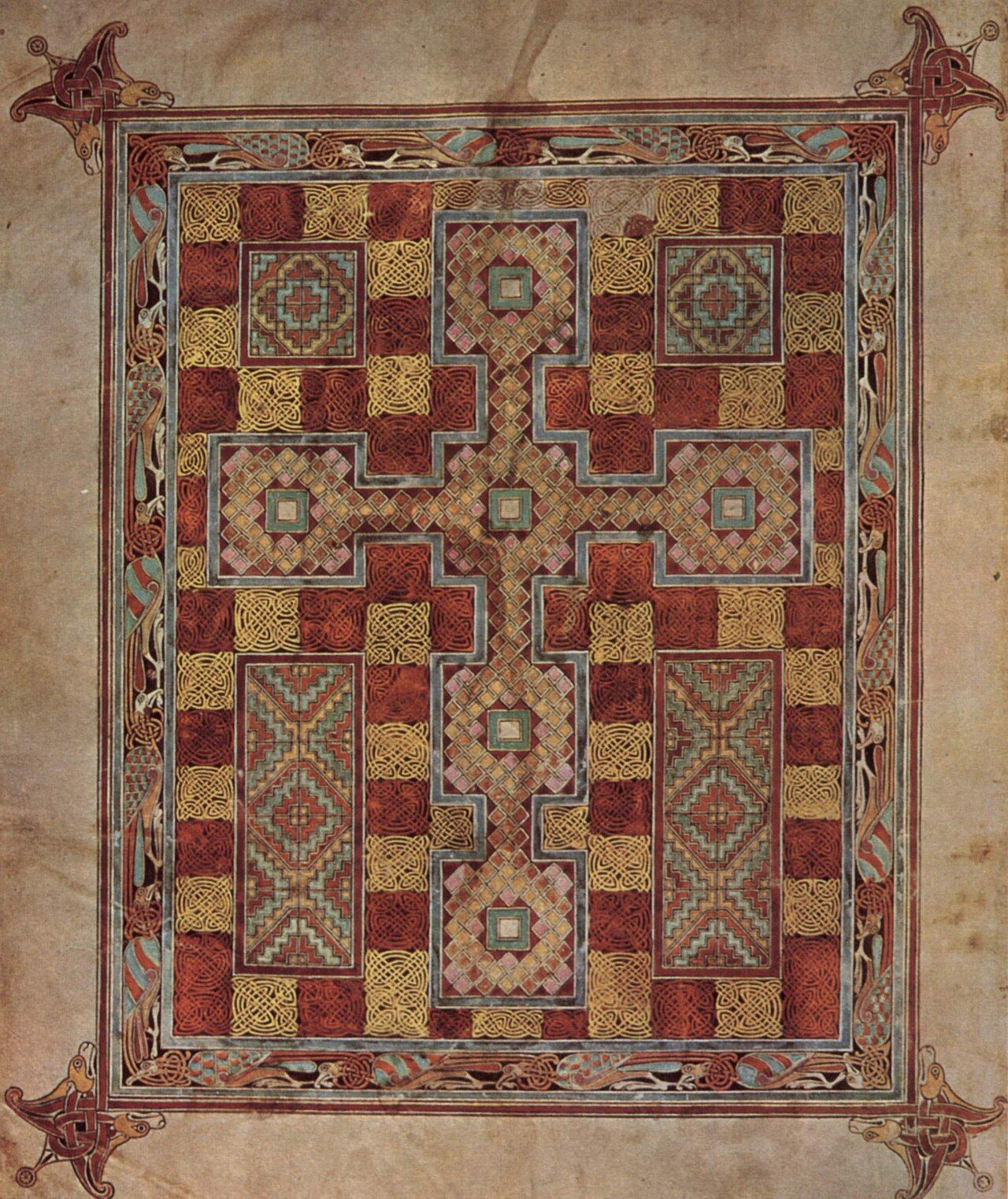
Its side effect was intellectual. Reading was mandatory, so books were needed; books had to be copied, so scriptoria appeared; copying required trained hands and correct Latin, so schools followed. Cassiodorus at Vivarium in Calabria explicitly turned manuscript copying into a spiritual discipline. The Irish, converted in the fifth century and never Roman, developed a monasticism of exile and scholarship: Columba founded Iona in 563, Columbanus carried the movement to Burgundy and northern Italy, and Irish monks maintained Latin learning, along with some Greek, at a level rare on the continent. In 597 Gregory the Great — the pope who fed Rome from papal estates when no imperial official could — sent Augustine to Kent, and the mission met the Irish stream head on. The Synod of Whitby in 664 settled the resulting disputes over the dating of Easter in Rome’s favour, aligning England with the continent. Out of that alignment came Bede (d. 735) at Jarrow, whose Ecclesiastical History of the English People is still the foundation of early English history and who did more than anyone to popularize dating years from the Incarnation — the AD convention.
In the Latin west the Roman state disappeared but the Roman church did not, and the monastery — self-supporting, disciplined and literate — became the institution that carried both learning and organized economic life through the poorest centuries.
Section 5Charlemagne, the Carolingian Order and the Second Wave
An empire assembled on horseback
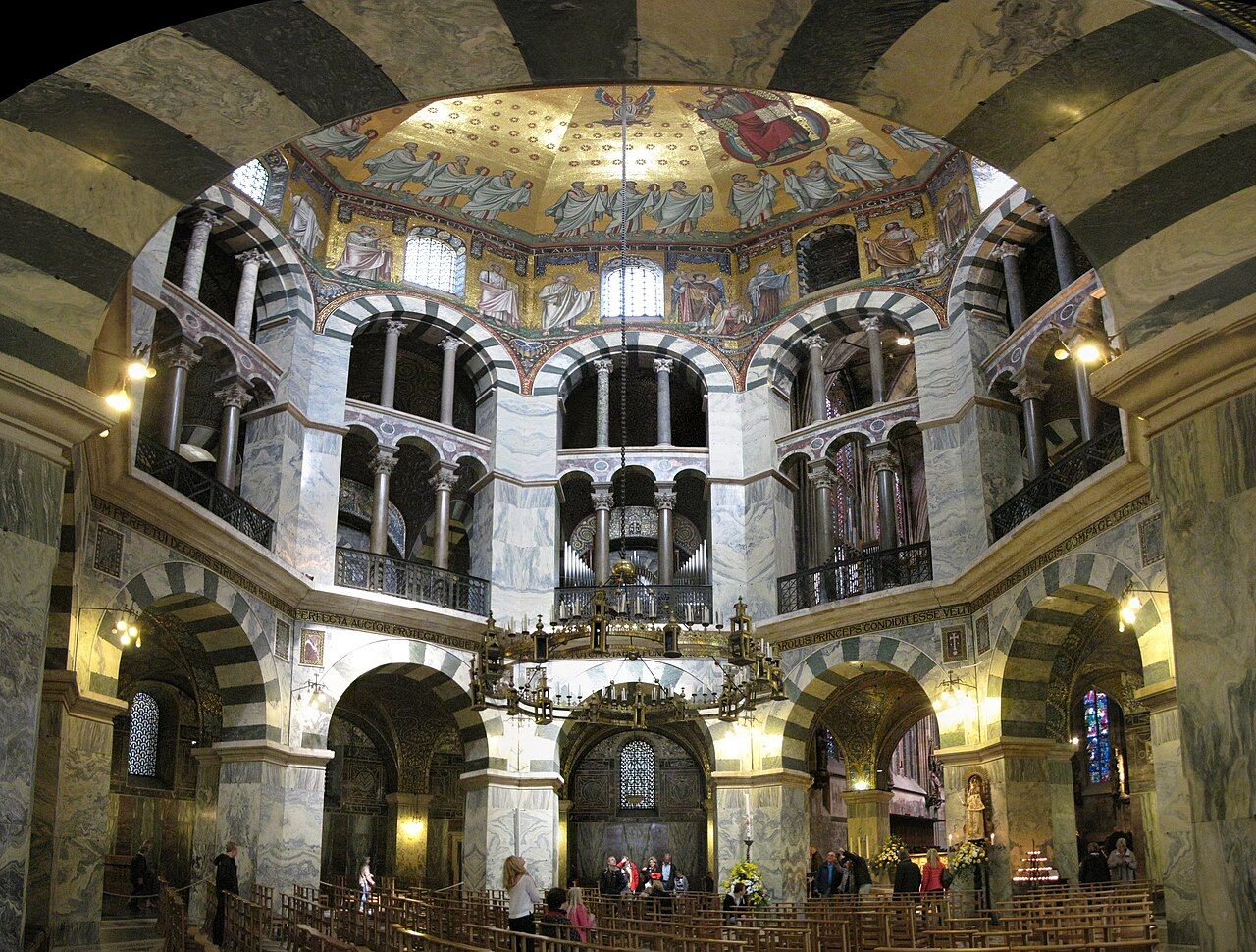
Charlemagne (Charles the Great, r. 768–814) went on campaign in almost every year of his forty-six-year reign. He conquered the Lombard kingdom in 774 and added king of the Lombards to his own titles. He fought the pagan Saxons for thirty-two years in a war of forced conversion whose brutality his own biographer does not conceal; the annals record the execution of 4,500 Saxon captives at Verden in 782, a figure some historians suspect is a scribal corruption but which nobody can soften into gentleness. He destroyed the Avar khaganate in the Carpathian Basin, in what is now Hungary, in the 790s and hauled its treasury back to Francia, an injection of gold that funded a decade of building. He failed in Spain, where a rearguard ambush in the Pyrenees in 778 became, three centuries later, the Song of Roland.
On Christmas Day 800, in Saint Peter’s, Pope Leo III placed a crown on Charlemagne’s head and the congregation acclaimed him emperor. Einhard, his courtier-biographer, claims Charlemagne would not have entered the church had he known what was intended — a statement historians have argued about for two hundred years. It may be false modesty, or genuine irritation at having been crowned by a pope rather than acclaimed by his own people, or an attempt to avoid provoking Constantinople, where there was already a legitimate Roman emperor and where the throne was at that moment occupied by a woman, the empress Irene. What is clear is the consequence: western Europe now had an emperor of its own, crowned by the bishop of Rome, and the question of whether the crown made the emperor or the emperor made the pope would poison European politics for the next five hundred years.
Governing without a bureaucracy, and the Carolingian Renaissance
Charlemagne ruled 1.1 million square kilometres with no salaried civil service, no standing army and almost no cash economy. His instruments were counts who governed districts and held land at royal pleasure, missi dominici — travelling inspectors sent in pairs, one lay and one clerical, to audit the counts — and written instructions called capitularies. He also standardized the silver denarius on a reckoning of 240 pennies to the pound, a system that survived in Britain until 1971.
All of this required literacy, and literacy was in poor repair. Charlemagne imported scholars: Alcuin of York from Northumbria, Theodulf, a Goth from Spain and its Septimanian borderland, Paul the Deacon from Lombard Italy, Peter of Pisa. The Admonitio generalis of 789 ordered that every monastery and cathedral run a school. Scribes developed Caroline minuscule, a clear rounded script with word spaces, lower-case letters and punctuation, replacing a jumble of regional hands that were often barely decipherable. It worked so well that Renaissance humanists, finding classical texts in ninth-century copies, mistook the script for ancient Roman writing and revived it — which is why the letters you are reading now descend directly from a reform of Charlemagne’s court. Of the surviving manuscripts of Latin classical authors, the large majority of the oldest copies are Carolingian. Whether this deserves the name Carolingian Renaissance is debated: it was a narrow, clerical, correctness-driven programme aimed at fixing the liturgy and the Bible text, not a broad cultural flowering. It was also the single most important act of textual rescue in European history.
Division, invasion and the reorganization of power
The empire did not outlive its founder by a generation in working order. Louis the Pious (r. 814–840) faced rebellions by his own sons, and after his death the Treaty of Verdun in 843 divided the realm three ways: a west Frankish kingdom that became France, an east Frankish kingdom that became Germany, and a long unstable middle strip from the North Sea to Rome that Europe would fight over from Lorraine to Alsace for the next eleven centuries. Frankish inheritance custom treated a kingdom as property to be split among heirs, and no theory of an indivisible state existed to prevent it.
Into that division came the second wave of invasions. Scandinavian raiders sacked the monastery of Lindisfarne in 793 and were soon operating in fleets of hundreds of shallow-draught ships that could row up the Seine, the Loire, the Thames and the Volga. Paris was sacked in 845 and besieged in 885–886. In 865 a Danish “Great Heathen Army” came to England to settle rather than raid and destroyed three of the four English kingdoms; only Wessex under Alfred the Great (r. 871–899) survived, and Alfred bought his survival with fortified burhs, a reorganized levy, a fleet, and a programme of translating Latin works into English. In 911 the west Frankish king handed the lower Seine to a Viking leader named Rollo, whose descendants became the Normans. From the east came the Magyars, mounted archers who raided as far as Burgundy until Otto I destroyed them at the Lechfeld in 955, after which they settled and became Christian Hungary. From the south, Muslim fleets took Sicily between 827 and 902 and sacked the basilicas outside the walls of Rome in 846.
Against fast raiders arriving without warning, a king hundreds of kilometres away was useless. What worked was a local strongman with a fortified point and mounted retainers who could respond in hours. So power went local. Landholders commended themselves and their land to stronger neighbours in exchange for protection; free peasants accepted dependent status on manors in exchange for the same; and military service came to be owed in return for the use of land, the fief.
Textbooks have long called this bundle feudalism and drawn it as a neat pyramid of king, lords, knights and serfs. Be careful. Since Elizabeth Brown’s 1974 article and especially Susan Reynolds’s Fiefs and Vassals (1994), many medievalists have argued that the pyramid is a construct assembled by sixteenth-century lawyers and eighteenth-century philosophers from a legal literature written after the fact, and that actual arrangements were local, various, negotiated and frequently non-hierarchical. Some historians defend a modified version of the term as a useful shorthand. The honest summary is this: the decentralization was real and the manorial economy was real, but the tidy diagram is a modern invention, and you should treat the word as a label for a debate rather than a description of a system.
| Raiders | From where, when | Method | How it ended |
|---|---|---|---|
| Vikings | Scandinavia, 793–c. 1050 | Shallow-draught longships up navigable rivers; raid, then settle | Danelaw in England; Normandy granted 911; Scandinavia Christianized |
| Magyars | Steppe via the Danube basin, c. 899–955 | Mounted archery, extreme range, tribute extraction | Crushed at the Lechfeld, 955; kingdom of Hungary founded c. 1000 |
| Muslim fleets | North Africa and Spain, ninth–tenth centuries | Sea raiding; conquest of Sicily; coastal bases such as Garigliano | Bases cleared by 915; Sicily taken by the Normans after 1061 |
Charlemagne briefly recreated a western empire and permanently reformed western literacy, but his realm split among heirs and then fractured under raiders, leaving Europe with localized power, an imperial idea, and a corrected library.
The chapter in one breath
Justinian tried to put the Roman Mediterranean back together and instead spent the money that his successors needed for defence; plague, the ruinous Persian war of 602–628 and then the Arab conquests reduced the eastern empire to Anatolia and the Aegean, where it reinvented itself as a compact Greek-speaking military state defended by the theme system, the Theodosian walls and Greek fire, and exported its faith and alphabet to the Slavs. Meanwhile Muhammad’s revelations produced something the ancient world had not seen: a community organized by belief rather than blood, which after the Hijra of 622 became a state and after 632 an empire that stretched from Spain to the Indus within a century, taxing rather than converting its subjects and absorbing Greek, Persian and Indian learning into an Arabic civilization that surpassed its sources in optics, medicine and mathematics. In the Latin west the tax system, the army and the long-distance economy simply stopped, and order was rebuilt around bishops, Benedictine monasteries and Frankish warlords — culminating in Charlemagne, whose empire fell apart within two generations but whose script, schools and imperial title outlasted him by a millennium. Three civilizations, one inheritance, three answers.
Words worth knowing
| Term | What it means |
|---|---|
| Corpus Juris Civilis | Justinian’s codification of Roman law (529–534); rediscovered in eleventh-century Bologna and the root of the modern civil-law tradition. |
| Theme (thema) | Byzantine military-administrative district where soldiers held land in return for service; the backbone of survival after the Arab conquests. |
| Greek fire | Petroleum-based incendiary sprayed from ship-mounted siphons that burned on water; a Byzantine state secret whose formula is still uncertain. |
| Iconoclasm | The eighth- and ninth-century Byzantine campaign against religious images, reversed in 843; a major irritant in relations with Rome. |
| Hijra | Muhammad’s migration from Mecca to Medina in 622, and year 1 of the Islamic calendar. |
| Umma | The community of believers, defined by faith rather than by tribal descent. |
| Quran | The recited revelations received by Muhammad, understood by Muslims as God’s own speech; textually standardized under Uthman. |
| Caliph | Successor or deputy; the political leader of the Muslim community after the Prophet’s death. |
| Rashidun | The first four caliphs (632–661), called “rightly guided” in Sunni tradition. |
| Sunni and Shia | The two main branches of Islam, divided originally over whether authority lay with the community’s consensus or with Ali’s designated line. |
| Dhimmi / jizya | Protected non-Muslim subjects of an Islamic state, and the poll tax they paid in lieu of military service. |
| Translation movement | The Abbasid-sponsored rendering of Greek science and philosophy into Arabic, largely eighth to tenth centuries. |
| Arianism | The doctrine that the Son was created by the Father and is not co-eternal with him; held by most Germanic kingdoms and a source of friction with Catholic subjects. |
| Rule of Saint Benedict | Sixth-century monastic constitution balancing prayer, labour and reading; the organizing document of western monasticism. |
| Missi dominici | Paired lay and clerical inspectors sent by Charlemagne to audit his counts. |
| Caroline minuscule | Clear, spaced, lower-case script developed under Charlemagne; the ancestor of modern Roman type. |
| Treaty of Verdun | The 843 partition of the Carolingian Empire into west, east and middle kingdoms. |
| Manor | The agricultural estate combining a lord’s demesne with dependent peasant holdings; the basic economic unit of the early medieval countryside. |
| Feudalism | Contested modern label for early medieval arrangements of land held for military service; useful shorthand, but not a system contemporaries would recognize. |