The Endocrine System
The nervous system is the body's fast messenger — electrical, precise, over in milliseconds. The endocrine system is its patient counterpart: a network of glands that pours chemical messengers called hormones into the bloodstream to be carried everywhere at once. Its signals are slower to start and slower to fade, but they reach every corner of the body and can last for hours, days, or a lifetime. This is the system that decides how fast you burn fuel, how tall you grow, how you handle a stressful morning, and how much sugar sits in your blood after breakfast. In this chapter you will meet the major glands, learn the two very different ways a hormone can deliver its message to a cell, and trace the elegant feedback loops that keep the whole system in balance.
By the end of this chapter you can
- Distinguish the endocrine system from the nervous system and from exocrine glands, and locate the major endocrine glands.
- Define a hormone and explain why it affects only certain target cells despite reaching the whole body.
- Contrast lipid-soluble and water-soluble hormones by where their receptors sit and how quickly they act.
- Describe the hypothalamus–pituitary relationship and name the hormones of the anterior and posterior pituitary.
- Explain how insulin and glucagon regulate blood glucose as an antagonistic pair.
- Diagram the thyroid axis as a negative feedback loop and predict the signs of an under- or over-active thyroid.
- Identify the layers of the adrenal gland and match each to the hormones it secretes.
- Recognize how negative feedback underlies the control of nearly every hormone in the body.
Section 1The endocrine glands
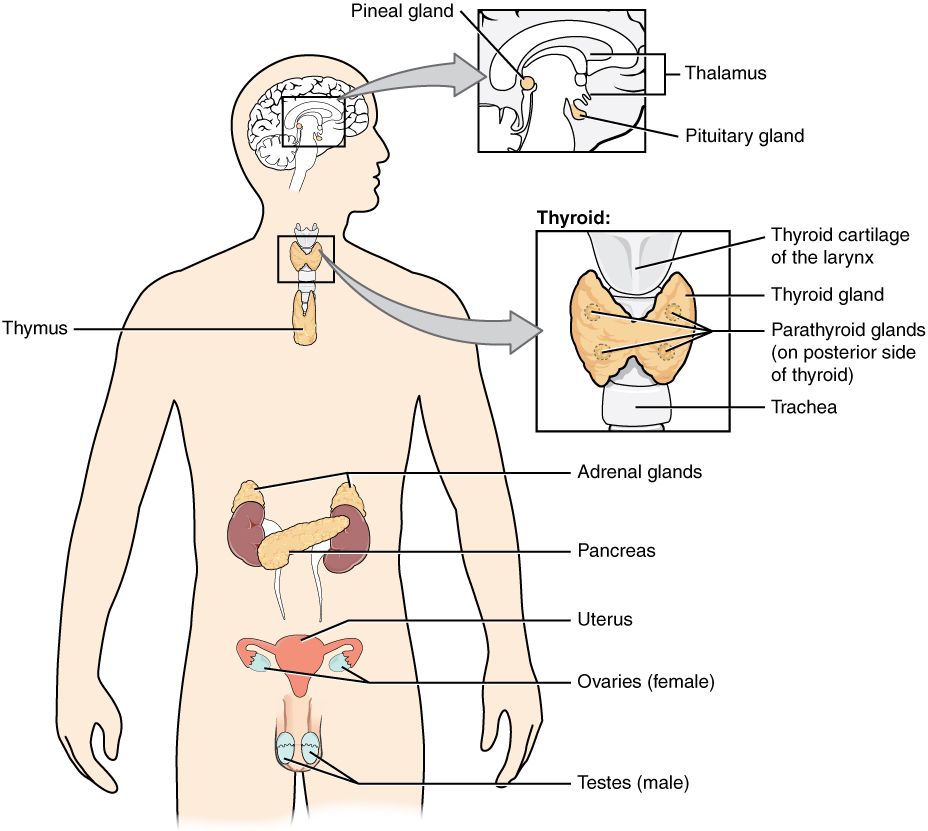
Two systems that share the job of control
Keeping a body coordinated takes two communication systems working side by side. The nervous system sends fast electrical signals down wires (neurons) to precise targets — a message arrives in milliseconds and stops the moment the signal stops. The endocrine system works the opposite way. It has no wires; instead its glands release chemical messengers called hormones directly into the blood, which carries them to the entire body. The trade-off is speed for reach and duration: a hormone may take seconds to minutes to act, but its effect can be broad and long-lasting. Think of the nervous system as a phone call to one person and the endocrine system as a message broadcast to everyone — even though only the people it concerns will act on it.
Endocrine versus exocrine
The word endocrine literally means "to secrete within." Endocrine glands are ductless — they release their hormones straight into the surrounding fluid and blood. This is the key contrast with exocrine glands, which secrete their products through a duct onto a surface: sweat glands, salivary glands, and the tear glands are all exocrine. A few organs do both jobs. The pancreas is the classic example — its exocrine tissue drips digestive enzymes into a duct that empties into the intestine, while scattered islands of endocrine tissue release insulin and glucagon into the blood.
The cast of glands
The pure endocrine glands — organs whose main job is making hormones — include the pituitary, pineal, thyroid, parathyroid, and adrenal glands. The hypothalamus of the brain sits at the top of the chain of command, and several other organs contain endocrine tissue as a side job: the pancreas, the gonads (ovaries and testes), the thymus, and even the heart, kidneys, stomach, and fat tissue all release hormones. Learn the headline glands first; the part-time players will come up in their own chapters.
| Gland | Signature hormone(s) | Main job |
|---|---|---|
| Hypothalamus | Releasing & inhibiting hormones | Commands the pituitary; links brain to endocrine system |
| Pituitary | GH, TSH, ACTH, FSH, LH, ADH, oxytocin | Relays orders to many other glands |
| Thyroid | Thyroid hormone (T₃/T₄), calcitonin | Sets metabolic rate; lowers blood calcium |
| Parathyroid | Parathyroid hormone (PTH) | Raises blood calcium |
| Adrenal | Cortisol, aldosterone, epinephrine | Stress response, salt/water balance |
| Pancreas (islets) | Insulin, glucagon | Regulates blood glucose |
| Pineal | Melatonin | Sets the sleep–wake rhythm |
| Gonads | Estrogen/progesterone; testosterone | Reproduction and sex characteristics |
Tap each gland in the interactive to see where it sits and what it makes.
- The endocrine system controls the body with hormones carried in the blood — slower but broader and longer-lasting than nervous signals.
- Endocrine glands are ductless and secrete into blood; exocrine glands secrete through ducts onto a surface.
- Headline glands: hypothalamus, pituitary, thyroid, parathyroid, adrenal, pancreas, pineal, gonads.
- A hormone acts only on its target cells — those bearing the matching receptor.
Section 2How hormones act
Chemistry decides the delivery
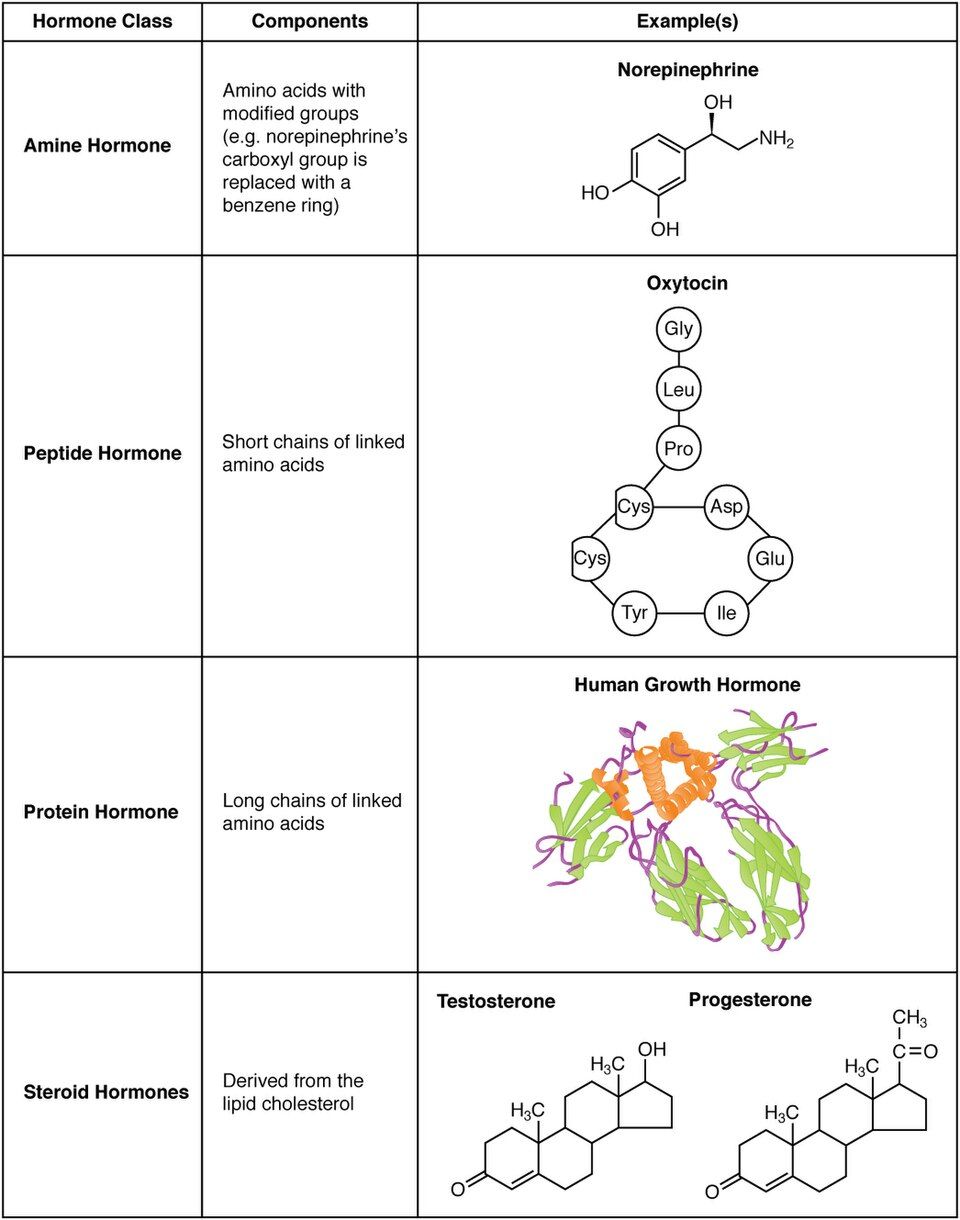
Hormones fall into two broad chemical families, and the difference between them is not a technicality — it decides exactly how the hormone talks to a cell. Most hormones are amino-acid based: peptides and proteins (such as insulin and growth hormone) and amines (such as the adrenal catecholamines). These are water-soluble but lipid-insoluble, so they cannot cross the fatty cell membrane. The second family, the steroid hormones (cortisol, aldosterone, and the sex hormones), is built from cholesterol; these are lipid-soluble and slip through the membrane with ease. That one property — can it cross the membrane or not — splits all of hormone action into two clean stories.
Lipid-soluble hormones: walk right in
Because a lipid-soluble hormone can pass through the membrane, it does not need to knock from outside. It diffuses into the cell and binds an intracellular receptor, usually inside the nucleus. The hormone–receptor pair then acts directly on DNA, switching specific genes on or off. The cell responds by making new proteins — often new enzymes that change how it behaves. Because building proteins takes time, these hormones are slow to start, but because those proteins linger, their effects are long-lasting. Steroid hormones such as cortisol work this way.
Water-soluble hormones: knock from outside
A water-soluble hormone cannot enter the cell, so it binds a receptor on the cell surface instead. That binding does not reach the DNA directly; it triggers a relay inside the cell using a second messenger — most famously cyclic AMP (cAMP). The hormone is the "first messenger" that stays outside; the second messenger carries the signal onward, activating a cascade of enzymes already sitting in the cytoplasm. Because those enzymes are pre-built and simply switched on, the response is fast — but it also fades quickly once the hormone is gone. Peptide hormones like insulin and glucagon, and the amine epinephrine, act through this surface-receptor route.
| Feature | Lipid-soluble (steroid) | Water-soluble (peptide/amine) |
|---|---|---|
| Crosses the membrane? | Yes — enters the cell | No — stays outside |
| Receptor location | Inside the cell (often the nucleus) | On the cell surface |
| Mechanism | Turns genes on/off → new proteins | Second messenger (cAMP) → enzyme cascade |
| Speed of onset | Slow (hours) | Fast (seconds to minutes) |
| Duration | Long-lasting | Brief |
| Examples | Cortisol, aldosterone, estrogen, testosterone | Insulin, glucagon, growth hormone, epinephrine |
Switch between a lipid-soluble and a water-soluble hormone in the interactive and step through each pathway.
- Hormones are either amino-acid based (water-soluble) or steroid (lipid-soluble); solubility decides the mechanism.
- Lipid-soluble hormones enter the cell, bind intracellular receptors, and change gene expression — slow but lasting.
- Water-soluble hormones bind surface receptors and use a second messenger (cAMP) — fast but brief.
- Thyroid hormone is the exception: an amine that is lipid-soluble and acts like a steroid.
Section 3The hypothalamus & pituitary axis
The real chain of command
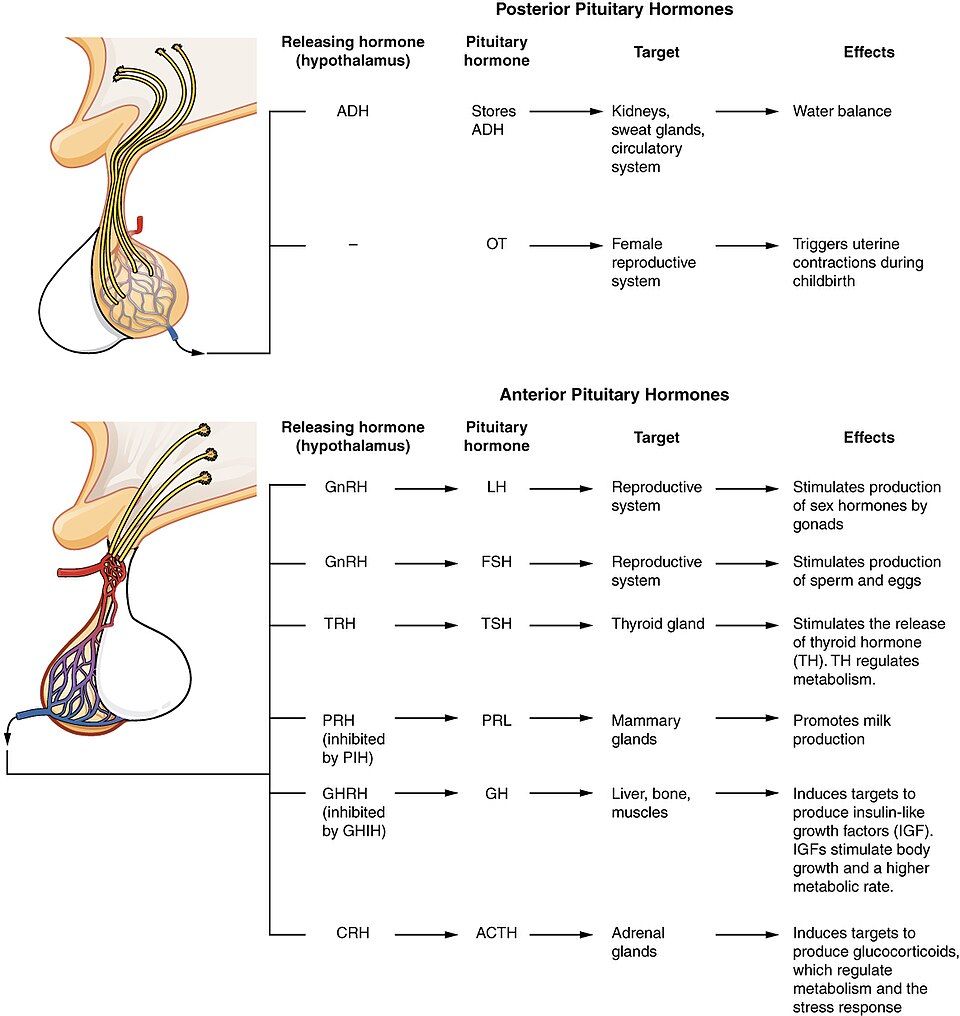
The pituitary gland is a pea-sized structure hanging beneath the brain, and it is often called the "master gland" because it directs so many other endocrine organs. But the pituitary has a boss of its own: the hypothalamus, the small region of brain just above it. The hypothalamus is where the nervous and endocrine systems physically meet — it takes in signals from the brain and translates them into hormonal commands to the pituitary. So the true master is the hypothalamus; the pituitary is its powerful deputy. The gland comes in two lobes that could hardly be more different in how they are wired.
The posterior pituitary: a storage terminal
The posterior pituitary makes no hormones of its own. It is really nervous tissue — an extension of the hypothalamus. Two hormones, antidiuretic hormone (ADH) and oxytocin, are actually manufactured by hypothalamic neurons, then travel down their axons to be stored in the posterior pituitary and released on demand. ADH tells the kidneys to conserve water, concentrating the urine; oxytocin drives uterine contractions in childbirth and milk let-down during nursing. The posterior lobe, then, is a release terminal, not a factory.
The anterior pituitary: a true factory under remote control
The anterior pituitary is glandular tissue that makes and secretes its own hormones, but it does so only when the hypothalamus tells it to. The hypothalamus sends tiny releasing and inhibiting hormones through a private set of blood vessels — the hypophyseal portal system — that carries them the short distance to the anterior lobe. Several anterior pituitary hormones are tropic hormones, meaning their job is to command other glands: TSH drives the thyroid, ACTH drives the adrenal cortex, and FSH and LH drive the gonads. Others act directly on body tissues: growth hormone (GH) on nearly everything, and prolactin (PRL) on the breast.
| Hormone | Lobe | Target & effect |
|---|---|---|
| Growth hormone (GH) | Anterior | Body tissues — growth and metabolism |
| Thyroid-stimulating (TSH) | Anterior | Thyroid — make thyroid hormone |
| Adrenocorticotropic (ACTH) | Anterior | Adrenal cortex — make cortisol |
| Follicle-stimulating (FSH) | Anterior | Gonads — egg/sperm maturation |
| Luteinizing (LH) | Anterior | Gonads — ovulation, sex hormones |
| Prolactin (PRL) | Anterior | Breast — milk production |
| Antidiuretic (ADH) | Posterior | Kidney — conserve water |
| Oxytocin | Posterior | Uterus & breast — contraction, let-down |
Tap a pituitary hormone in the interactive to trace the path from the brain to its target organ.
- The hypothalamus is the true master; it controls the pituitary, which controls many other glands.
- The posterior pituitary only stores and releases ADH and oxytocin, both made in the hypothalamus.
- The anterior pituitary makes six hormones under hypothalamic control; four are tropic (TSH, ACTH, FSH, LH).
- Remember them with FLAT PIG.
Section 4Blood glucose regulation
Two hormones from one gland, pulling opposite ways
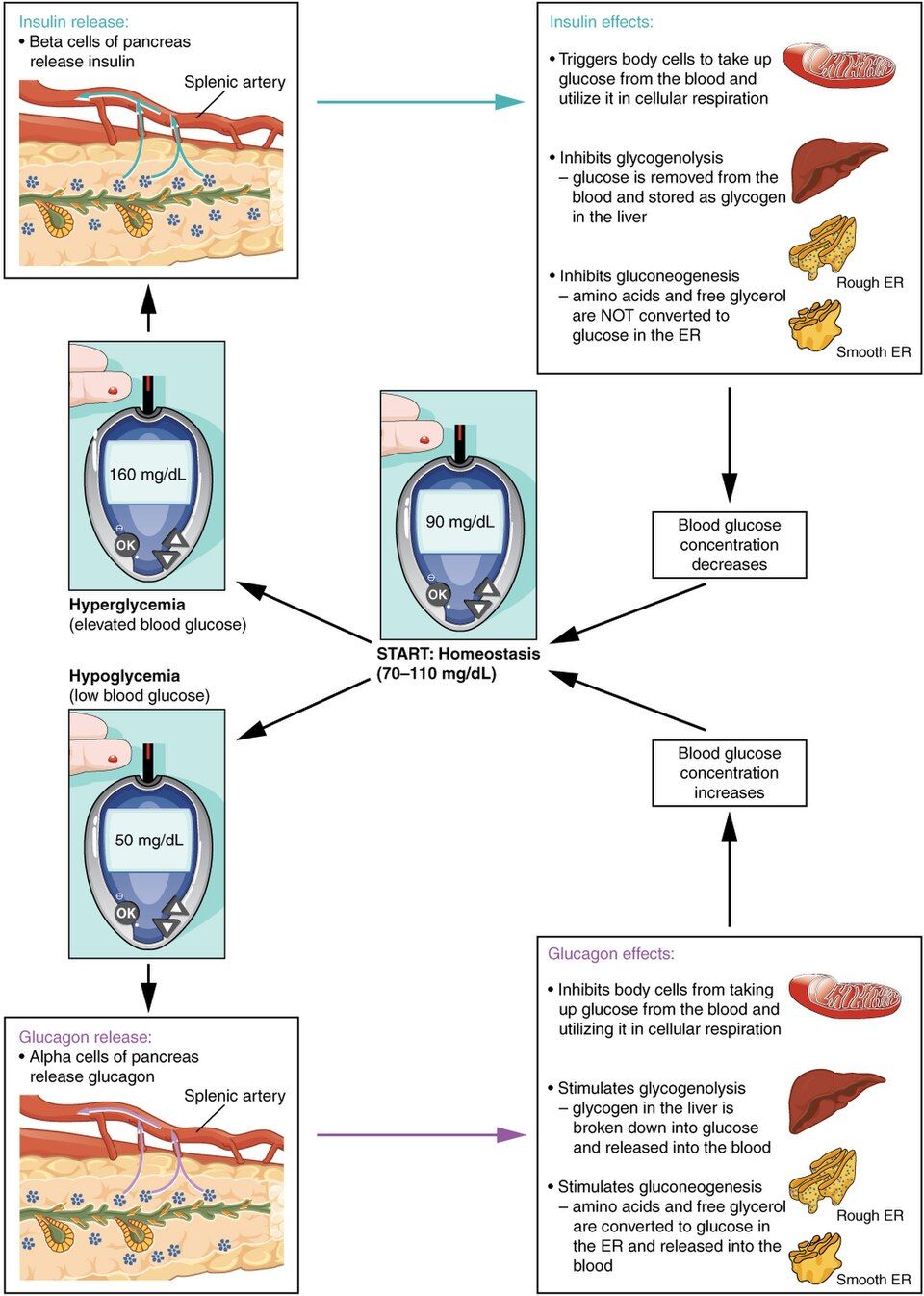
Blood glucose is one of the body's most tightly guarded values, and the pancreas guards it with a pair of hormones that oppose each other — an antagonistic pair. Scattered through the pancreas are clusters of endocrine cells called the pancreatic islets (islets of Langerhans). Their beta cells make insulin, and their alpha cells make glucagon. One hormone lowers blood sugar and the other raises it, so the pancreas can nudge glucose in either direction as needed — a beautiful example of negative feedback with a gas pedal and a brake.
Insulin: the "fed-state" hormone that lowers glucose
After a meal, blood glucose rises. The beta cells sense the rise and release insulin, whose whole purpose is to lower blood glucose. Insulin tells body cells — especially muscle and fat — to open up and take glucose in, and it tells the liver to store the surplus as glycogen. As cells absorb the sugar, blood glucose falls back to normal, and insulin release quiets down. A useful shorthand: insulin is the hormone of the fed state, moving fuel out of the blood and into storage.
Glucagon: the "fasting" hormone that raises glucose
Between meals, blood glucose drifts down. Now the alpha cells release glucagon, which does the reverse of insulin: it raises blood glucose. Glucagon tells the liver to break glycogen back down into glucose (glycogenolysis) and to manufacture fresh glucose from other molecules (gluconeogenesis), releasing that sugar into the blood. Glucose climbs back to the set point, and glucagon quiets down. Glucagon is the hormone of the fasting state, pulling fuel out of storage and back into the blood.
| Feature | Insulin | Glucagon |
|---|---|---|
| Made by | Beta cells | Alpha cells |
| Released when | Blood glucose is high (after eating) | Blood glucose is low (fasting) |
| Effect on glucose | Lowers it | Raises it |
| Action on the liver | Store glucose as glycogen | Break glycogen down; make new glucose |
| Overall role | Fed state — storage | Fasting state — mobilization |
Pick a situation in the interactive — a meal or a fast — and watch insulin or glucagon pull glucose back to normal.
- The pancreatic islets regulate blood glucose with an antagonistic pair of hormones.
- Insulin (beta cells) lowers glucose after a meal by driving uptake and glycogen storage.
- Glucagon (alpha cells) raises glucose during fasting by breaking down glycogen and making new glucose.
- Insulin is the only hormone that lowers blood glucose; its loss or resistance causes diabetes.
Section 5The thyroid axis
The gland that sets your idle speed
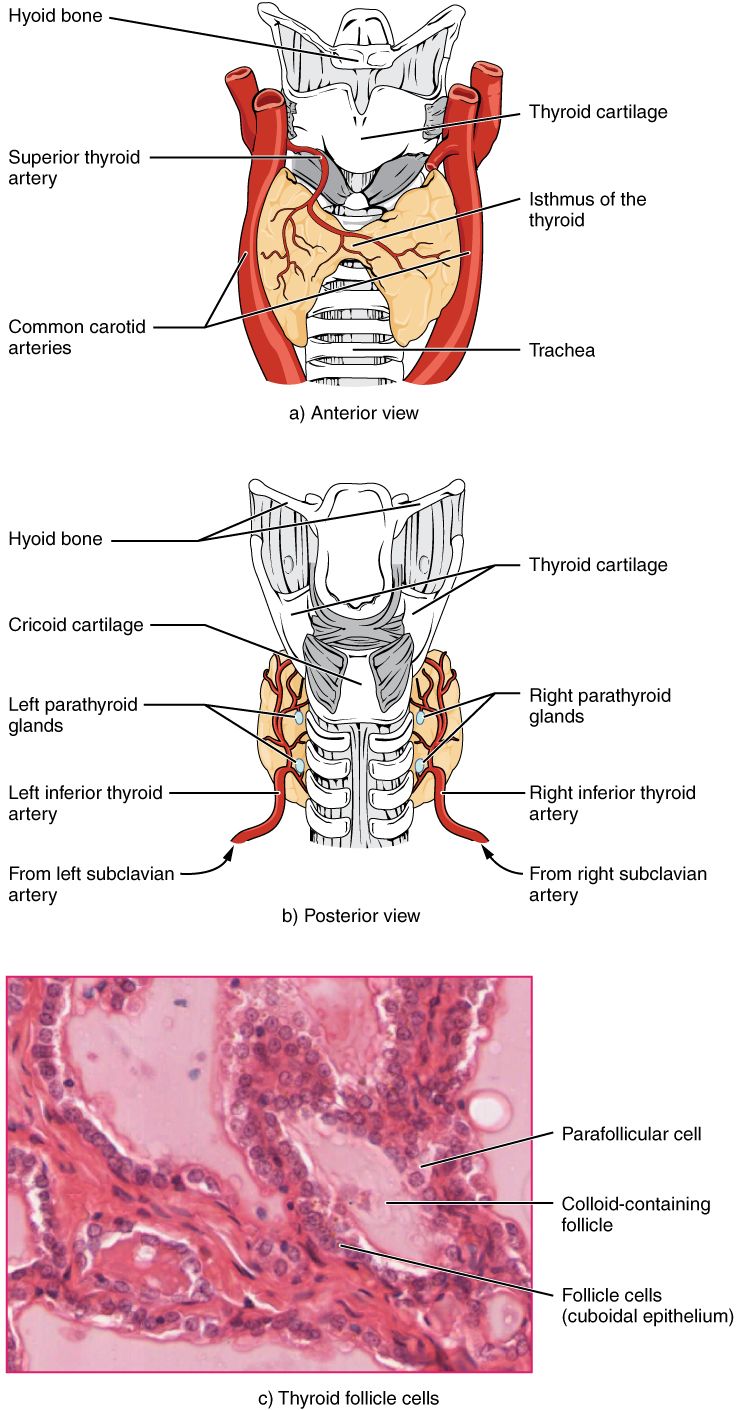
The thyroid gland, a butterfly-shaped organ wrapped around the front of the windpipe, makes thyroid hormone — the two forms are T₃ and T₄, named for the number of iodine atoms each carries (which is why the diet needs iodine to make them). Thyroid hormone sets the body's basal metabolic rate: the speed at which nearly every cell burns fuel and produces heat. Turn it up and the whole body runs faster and hotter; turn it down and everything slows. It is, in effect, the idle setting of the engine.
The feedback loop that keeps it steady
Thyroid hormone is regulated by a three-step chain called the hypothalamus–pituitary–thyroid (HPT) axis, and it is a textbook negative feedback loop. The hypothalamus releases TRH (thyrotropin-releasing hormone), which tells the anterior pituitary to release TSH (thyroid-stimulating hormone), which tells the thyroid to release T₃ and T₄. Here is the elegant part: the thyroid hormones then loop back and inhibit both the hypothalamus and the pituitary, dialing down TRH and TSH. When thyroid hormone is plentiful, that brake keeps it from climbing further; when thyroid hormone falls, the brake releases and TSH rises to push the thyroid harder.
When the thyroid does too little or too much
Because thyroid hormone sets the metabolic pace, its disorders read like opposite ends of a dial. In hypothyroidism (too little), everything slows: weight gain, fatigue, feeling cold, dry skin, and a sluggish heart rate. In hyperthyroidism (too much), everything speeds up: weight loss despite a big appetite, feeling hot, anxiety, and a racing heart. Both can enlarge the gland into a visible goiter. The feedback loop is also a diagnostic gift: in primary hypothyroidism, the failing thyroid produces little hormone, so the brake lifts and TSH rises — which is why a high TSH points to an underactive thyroid.
| Sign | Hypothyroidism (too little) | Hyperthyroidism (too much) |
|---|---|---|
| Metabolic rate | Slowed | Raised |
| Body weight | Gain | Loss |
| Temperature | Cold intolerance | Heat intolerance |
| Heart rate | Slow | Fast |
| Energy & mood | Fatigue, sluggishness | Anxiety, restlessness |
| TSH level (primary) | High | Low |
Run the interactive to see the normal loop, then push the thyroid to do too little or too much.
- Thyroid hormone (T₃/T₄, iodine-based) sets the body's basal metabolic rate.
- The HPT axis — TRH → TSH → T₃/T₄ — is a negative feedback loop; thyroid hormone inhibits TRH and TSH.
- Hypothyroidism slows the body (weight gain, cold, fatigue); hyperthyroidism speeds it up (weight loss, heat, racing heart).
- In primary disease, TSH runs opposite to thyroid output — high TSH signals an underactive gland.
Section 6The adrenal gland
Two glands stacked into one
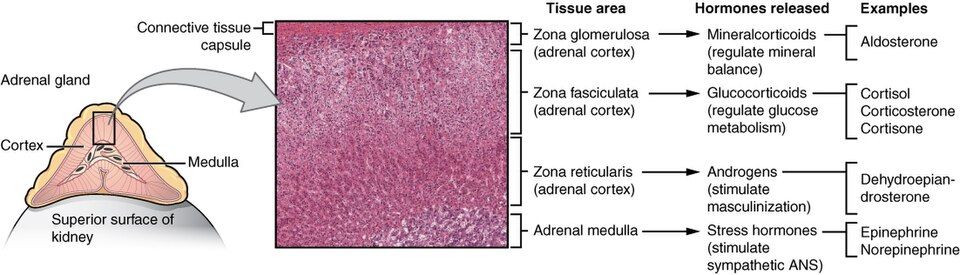
Perched like a cap on top of each kidney, the adrenal gland is really two different glands fused together. The outer adrenal cortex makes steroid hormones and is essential for life; the inner adrenal medulla makes the catecholamines epinephrine and norepinephrine and is a direct extension of the sympathetic nervous system. The two respond on very different timescales — the medulla in seconds, the cortex over minutes to hours — but both are central to how the body handles stress.
The cortex: three layers, three kinds of hormone
The cortex is organized into three zones, and each makes a different class of steroid — a rare case where you can read the function straight off the anatomy, from outside in. The outermost zona glomerulosa makes mineralocorticoids, chiefly aldosterone, which tells the kidney to hold onto sodium (Na⁺) and water and dump potassium (K⁺), raising blood volume and pressure. The broad middle zona fasciculata makes glucocorticoids, chiefly cortisol, the body's main stress hormone — it raises blood glucose, mobilizes fuel, and damps inflammation. The innermost zona reticularis makes small amounts of androgens (sex hormones such as DHEA).
The medulla: instant adrenaline
At the very center, the medulla is wired directly into the sympathetic nervous system, so it fires the moment a threat appears. It floods the blood with epinephrine (adrenaline) and norepinephrine, producing the familiar fight-or-flight surge: pounding heart, dilated airways, glucose released for fuel, blood shunted to muscle. This is the fast, short-lived arm of the stress response — the jolt that fades within minutes. Cortisol, from the cortex, is the slower, sustained arm that carries the body through a long or repeated stress.
| Layer (outside → in) | Hormone class | Chief hormone & effect |
|---|---|---|
| Zona glomerulosa | Mineralocorticoids | Aldosterone — retain Na⁺ & water, raise blood pressure |
| Zona fasciculata | Glucocorticoids | Cortisol — raise glucose, handle stress, reduce inflammation |
| Zona reticularis | Androgens | DHEA — sex-hormone precursors |
| Medulla | Catecholamines | Epinephrine — fast fight-or-flight surge |
Tap each layer of the gland in the interactive, from the outer cortex to the inner medulla.
- The adrenal gland is two glands in one: an outer cortex (steroids) and an inner medulla (catecholamines).
- Cortex zones, outside in: glomerulosa → aldosterone (salt), fasciculata → cortisol (sugar/stress), reticularis → androgens (sex).
- The medulla is an arm of the sympathetic system; it releases epinephrine for the fast fight-or-flight surge.
- Cortisol is the slow, sustained stress hormone; epinephrine is the fast one.
The chapter in one breath
- The endocrine system controls the body with hormones in the blood — slower but broader and longer-lasting than nervous signals; its glands are ductless.
- A hormone reaches every cell but acts only on its target cells, which carry the matching receptor.
- Lipid-soluble (steroid) hormones enter the cell and change genes — slow and lasting; water-soluble (peptide/amine) hormones use surface receptors and a second messenger — fast and brief.
- The hypothalamus commands the pituitary: the posterior lobe stores ADH and oxytocin, and the anterior lobe makes six hormones, four of them tropic (FLAT PIG).
- The pancreatic islets balance blood glucose with an antagonistic pair — insulin lowers it, glucagon raises it — and insulin is the only hormone that lowers it.
- The thyroid sets metabolic rate through the HPT feedback axis; too little slows the body, too much speeds it, and TSH runs opposite to output.
- The adrenal gland is a cortex (aldosterone, cortisol, androgens — salt, sugar, sex) wrapped around a medulla (epinephrine — fast fight-or-flight).
ReferenceWords worth knowing
A quick reference for the terms in this chapter — skim it now, or circle back whenever a word trips you up.
- ACTH (adrenocorticotropic hormone)
- An anterior pituitary tropic hormone that stimulates the adrenal cortex to make cortisol.
- Adrenal cortex
- The outer part of the adrenal gland; makes steroid hormones (aldosterone, cortisol, androgens) in three layered zones.
- Adrenal medulla
- The inner core of the adrenal gland; an extension of the sympathetic nervous system that releases epinephrine and norepinephrine.
- Aldosterone
- A mineralocorticoid from the zona glomerulosa that makes the kidney retain sodium and water, raising blood pressure.
- Anterior pituitary
- The glandular front lobe of the pituitary; makes six hormones (GH, TSH, ACTH, FSH, LH, PRL) under hypothalamic control.
- Cortisol
- The main glucocorticoid, from the zona fasciculata; the chief long-acting stress hormone that raises glucose and reduces inflammation.
- Endocrine gland
- A ductless gland that secretes hormones directly into the blood (contrast: an exocrine gland uses a duct).
- Glucagon
- A hormone from pancreatic alpha cells that raises blood glucose during fasting by breaking down glycogen and making new glucose.
- Glucocorticoid
- A class of adrenal steroid, chiefly cortisol, that regulates glucose and the stress response.
- Hormone
- A chemical messenger secreted into the blood by an endocrine gland that acts on distant target cells.
- Hypothalamus
- The brain region that links the nervous and endocrine systems and controls the pituitary gland.
- Insulin
- A hormone from pancreatic beta cells that lowers blood glucose after a meal by promoting uptake and glycogen storage.
- Lipid-soluble hormone
- A hormone (steroid, plus thyroid hormone) that crosses the cell membrane to bind intracellular receptors and change gene expression.
- Negative feedback
- A control loop in which a hormone's output inhibits its own production, holding the value near a set point.
- Pancreatic islets
- Clusters of endocrine cells in the pancreas; beta cells make insulin, alpha cells make glucagon.
- Posterior pituitary
- The back lobe of the pituitary; nervous tissue that stores and releases hypothalamus-made ADH and oxytocin.
- Second messenger
- An intracellular relay molecule (such as cyclic AMP) that carries a water-soluble hormone's signal after it binds a surface receptor.
- Steroid hormone
- A lipid-soluble hormone built from cholesterol (cortisol, aldosterone, sex hormones) that acts on genes inside the cell.
- Target cell
- A cell that responds to a particular hormone because it carries the matching receptor.
- Thyroid hormone
- The iodine-containing hormones T₃ and T₄ that set the body's basal metabolic rate.
- Tropic hormone
- A hormone whose target is another endocrine gland (for example TSH, ACTH, FSH, LH).
- Water-soluble hormone
- A hormone (peptide/protein or catecholamine) that cannot enter the cell and acts through a surface receptor and second messenger.