Fluid, Electrolyte & Acid-Base Balance
You are, quite truly, mostly water. Staying alive is largely about keeping three things in very narrow ranges. These are that water, the salts dissolved in it, and how acidic it is. This chapter follows the fluid. First you will see the spaces, or compartments, where it lives. Then you will see the daily balance of what comes in and what goes out. Next come the electrolytes, the charged particles that float in the fluid. Then comes pH, a measure of how acidic a fluid is. Every enzyme in your body depends on it.
You will meet the buffers that catch stray acid in an instant. You will see the lungs and kidneys finish the job over minutes and days. You will also meet the four classic acid-base disorders that show up when the whole system slips. By the end, you will be able to read a set of blood numbers. You will be able to say plainly what has gone wrong and how the body is fighting back.
By the end of this chapter you can
- Name the body's fluid compartments. Estimate how much of the body's water is in each. Describe how their ions differ.
- Balance a day's water intake against output. Name the ways water comes in and goes out, including insensible loss (water you lose without noticing).
- Explain how thirst and antidiuretic hormone keep total body water steady.
- List the main electrolytes. Say where each is found, what it does, and which hormone controls it.
- Write the bicarbonate buffer equation. Explain how a buffer fights a change in pH.
- Rank the body's three lines of acid-base defense by speed. Describe how each one works.
- Sort the four acid-base disorders by cause and direction. Predict how the body makes up for each.
- Read a simple set of blood gas numbers and name the acid-base problem.
Section 1The fluid compartments
How much of you is water
In a healthy adult, about 60% of body mass is water. That is about 42 liters in a person who weighs 70 kilograms. The number is not fixed. It is higher in babies, near 75%. It is lower in older adults.
Fat tissue holds very little water. So a leaner body is a wetter body. On average, women carry a bit more fat for their size than men. So their water share is a few points lower. This total body water, all the water in your body, is not one big puddle. It is split into compartments. Living membranes separate them. Fluid balance is really about how water and dissolved substances move between these compartments.
Two great pools, and a smaller subdivision
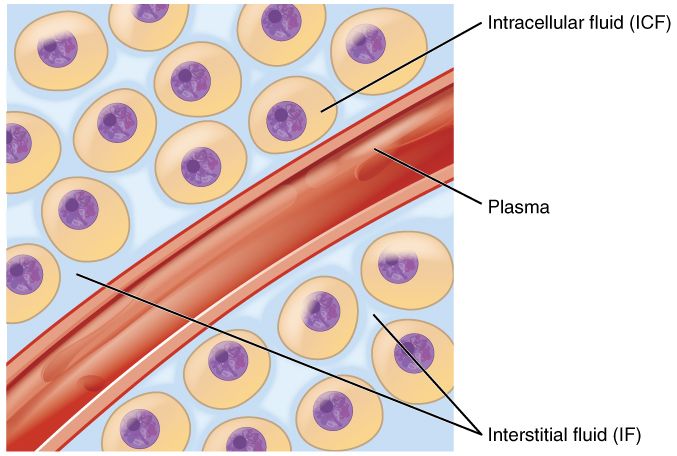
The first and biggest split is made by the cell membrane. About two-thirds of your water is inside your cells. This is the intracellular fluid, or ICF. (Intra means "inside.") The other one-third is outside the cells. This is the extracellular fluid, or ECF. (Extra means "outside.")
The walls of the blood vessels split the ECF again. Most of it bathes the tissues directly. This is interstitial fluid, the water in the gaps between cells. A smaller share is the plasma, the fluid part of blood inside the vessels. A tiny extra part is the transcellular fluid. It includes special pools like the fluid around the brain and spinal cord, joint fluid, and the fluid in the front of the eye.
| Compartment | Share of total body water | Where it is |
|---|---|---|
| Intracellular (ICF) | About 2/3 (about 40% of body weight) | Inside all the cells |
| Extracellular (ECF) | About 1/3 (about 20% of body weight) | Outside the cells. It is split into the two parts below. |
| · Interstitial | About 3/4 of the ECF | In the spaces between cells |
| · Plasma | About 1/4 of the ECF | The fluid part of blood, inside vessels |
| Transcellular | A small extra pool | CSF (brain and spinal fluid), joint fluid, eye fluid, gut juices |
Same water, very different salt
What makes the compartments different is not the water. It is the solutes, the things dissolved in it. The ICF and ECF have very different mixes of ions. (Ions are particles with an electric charge.) The cell membrane and its pumps keep them apart.
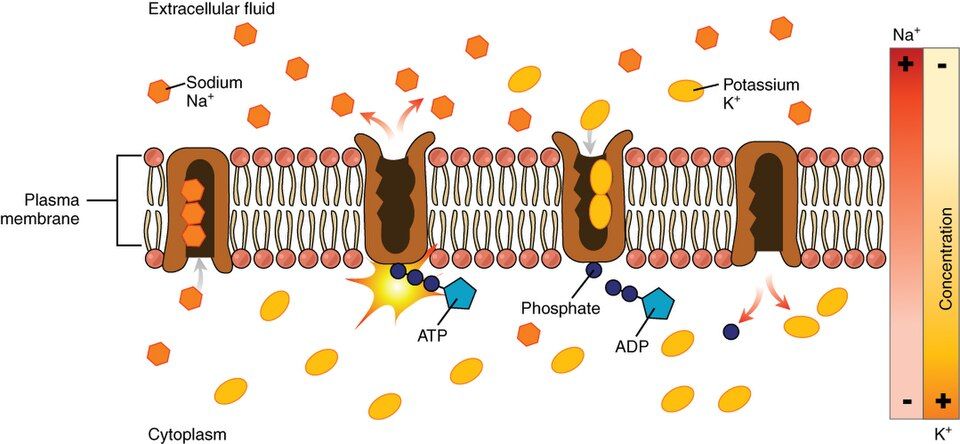
The ECF is a salty sea, a lot like seawater. It is full of sodium (Na⁺) and chloride (Cl⁻). The ICF, on the other hand, is rich in potassium (K⁺), magnesium, phosphate and proteins with a negative charge. Every cell membrane has a sodium-potassium pump. It works around the clock to keep this difference. It pushes Na⁺ out and pulls K⁺ in. That stored difference works like a charged battery. It powers nerve signals, muscle squeezing and much of the traffic across membranes.
Water follows dissolved particles by osmosis. So the amount of dissolved particles in each compartment decides where the water goes. This amount is called osmolarity. Add salt to the ECF, and it becomes more concentrated. It pulls water out of the cells, and they shrink. Make the ECF more watery, and water rushes in. Then the cells swell. Sodium is the most common particle in the ECF. That is why it is the single biggest lever on fluid movement in the body.
Tap each compartment in the interactive below to see where the water lives.
- Water is about 60% of body mass. Leaner bodies and babies hold more. Older adults hold less.
- Two-thirds of body water is intracellular, inside cells. One-third is extracellular, outside cells. The ECF splits into interstitial fluid and plasma.
- ECF is high in Na⁺/Cl⁻. ICF is high in K⁺ and proteins. The sodium-potassium pump keeps this difference.
- Water follows dissolved particles by osmosis. So ECF sodium is the main control on where fluid moves.
Section 2Water in, water out
A ledger that must balance
Total body water stays very steady from day to day. The reason is simple bookkeeping. Over any 24 hours, water in must equal water out. A typical adult moves about 2.5 liters through this "bank account" each day.
On the intake side, most comes from what you drink, about 1.5 L. A good amount comes from water hidden in food, about 0.7 L. Fruit, vegetables and even bread are wetter than you might think. A small but real amount is made inside you. Each time a cell burns sugar or fat for energy, water is a by-product. This metabolic water adds about 0.3 L a day, without you drinking a drop.
The four ways out
Water leaves by four routes. Only one of them is closely controlled. The kidneys make urine, about 1.5 L. It is the largest output and the only one the body tightly controls.
Much of the rest is insensible loss. This is water you lose without noticing. It dries off your skin all the time. It also leaves as vapor in every breath from your lungs. Together, these add up to about 0.9 L. A small amount leaves in the feces, or poop. More pours out as sweat when you are hot or working hard. Fever, heat, exercise, throwing up and diarrhea can all make these losses soar. That is why they can upset the balance so fast.
| Direction | Route | Rough daily amount |
|---|---|---|
| In | Fluids you drink | About 1.5 L |
| In | Water in food | About 0.7 L |
| In | Metabolic water (made by your cells) | About 0.3 L |
| Out | Urine (controlled) | About 1.5 L |
| Out | Skin & lungs (insensible, not noticed) | About 0.9 L |
| Out | Feces | About 0.1 L |
Thirst and the water-saving hormone
You choose when to drink, but much of your water loss cannot be stopped. So the body controls both ends. When you lose water, the ECF gets more concentrated. Its osmolarity goes up. Tiny sensors in the hypothalamus of the brain notice this. They are called osmoreceptors. They do two things.
First, they cause thirst. This drives you to drink, which raises intake. Second, they signal the back part of the pituitary gland to release antidiuretic hormone (ADH), also called vasopressin. ADH travels to the kidney. It tells the collecting ducts to put in water channels called aquaporins. Water flows back into the blood through them. The result is a small amount of concentrated urine.
Drink too much, and the reverse happens. Osmolarity falls, and ADH switches off. The kidney then lets a large amount of watery urine flow. Thirst pulls water in, and ADH works like a tap that holds water back. Together, they keep total body water within about one percent from one day to the next.
Tap each route in the interactive. See how the body keeps water in and water out equal.
- Over a day, intake ≈ output ≈ 2.5 L. Intake is drink + food + metabolic water.
- Output is urine, the only tightly controlled route. It also includes insensible loss from skin and lungs, plus feces and sweat.
- Thirst raises intake. ADH (vasopressin) lowers output by making the kidney take back water.
- A minimum obligatory urine volume must always be passed to clear wastes.
Section 3The electrolytes
Charged particles that do the work
An electrolyte is any substance that breaks apart into charged ions when it dissolves. This lets a fluid carry an electric current. Electrolytes are the reason body fluids can carry current at all. They do much more than just float there. Their uneven spread drives every nerve impulse and every muscle contraction. It also drives every shift of water between compartments.
These jobs are very sensitive. So the body controls electrolyte levels tightly. It measures them in milliequivalents per liter (mEq/L). This unit counts electric charge, not plain weight. Ions with a positive charge are cations (Na⁺, K⁺, Ca²⁺, Mg²⁺). Ions with a negative charge are anions (Cl⁻, bicarbonate, phosphate).
The big four cations
Sodium (Na⁺) is the main cation of the ECF. It is the boss of fluid volume, because where sodium goes, water follows. Its normal level is 135–145 mEq/L. It is guarded mainly by aldosterone. This hormone from the adrenal gland tells the kidney to take back sodium.
Potassium (K⁺) is the main cation of the ICF. It sets the resting membrane potential, the small electric charge across the membrane of nerve and muscle cells at rest. Its normal range is narrow, 3.5–5.0 mEq/L. This matters a lot to the heart. Too much or too little potassium can stop it.
Calcium (Ca²⁺) is 99% stored in bone. It runs muscle contraction, blood clotting and nerve signals. Parathyroid hormone and vitamin D tune its blood level. Magnesium is a quieter partner. It helps hundreds of enzymes work. It also keeps nerves and muscles steady.
| Electrolyte | Mainly in | Key job | Main regulator |
|---|---|---|---|
| Sodium (Na⁺) | ECF | ECF volume & osmolarity; nerve and muscle signals | Aldosterone, ADH, ANP |
| Potassium (K⁺) | ICF | Resting membrane potential; heart rhythm | Aldosterone |
| Calcium (Ca²⁺) | Bone / ECF | Muscle contraction, clotting, nerves | PTH, calcitriol (active vitamin D), calcitonin |
| Chloride (Cl⁻) | ECF | Follows sodium; balances charge; stomach acid | Follows how Na⁺ is handled |
| Bicarbonate (HCO₃⁻) | ECF | The body's main pH buffer | Kidneys |
| Phosphate | ICF / bone | ATP, DNA, bone; buffer | PTH |
When the numbers drift
These ions carry electric charge. So small changes can cause big symptoms. Low sodium is called hyponatremia. (Hypo means "low," and natrium is Latin for sodium.) It draws water into brain cells. This brings confusion, headache and seizures. High sodium dries brain cells out.
Potassium problems are dangerous mainly for the heart. High potassium is hyperkalemia, and low potassium is hypokalemia. (Hyper means "high," and kalium is Latin for potassium.) Both cause arrhythmias, or uneven heartbeats, that can kill. Low calcium makes nerves too jumpy. This leads to tetany, which means muscle spasms and tingling. High calcium dulls nerves, causing weakness and confusion. Doctors check electrolytes every day for a good reason. These are the numbers that keep hearts beating and nerves firing.
Tap each electrolyte in the interactive. See where it lives and what it does.
- Electrolytes are ions (cations and anions) measured in mEq/L. They drive nerves, muscles and fluid balance.
- Sodium rules ECF volume. Potassium sets membrane potential and is vital to the heart. Calcium runs contraction, clotting and nerves.
- Aldosterone keeps sodium and gets rid of potassium. PTH and vitamin D control calcium.
- Small shifts cause big trouble: hyponatremia (brain), hyperkalemia (heart), hypocalcemia (tetany).
Section 4Blood pH and buffers
A razor-thin window
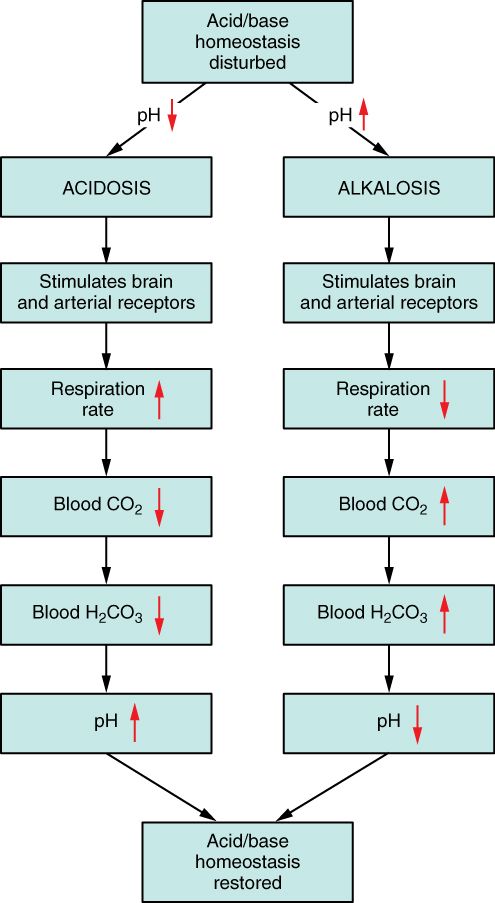
pH measures how acidic or basic a fluid is. The scale runs from 0 to 14, and 7 is neutral. Lower numbers mean more acidic. That means more free hydrogen ions (H⁺). Higher numbers mean more basic.
Blood in the arteries is kept slightly basic. It stays in the tiny band of 7.35 to 7.45. This is not a comfort zone. It is a survival zone. Below 7.35 is acidemia, or acid blood. Above 7.45 is alkalemia, or basic blood. Life is not possible outside about 6.8 to 7.8.
The stakes are high because pH bends the shape of proteins. Enzymes are proteins. So a drifting pH slows or stops the chemistry of every cell at once. The trouble is that your body makes acid all the time. Burning fuel makes carbon dioxide, which turns into acid in water. Hard work or going without food adds lactic acid and ketoacids on top.
What a buffer does
The first defense against this flood of acid is a buffer. A buffer is a pair of chemicals. It soaks up extra H⁺ when acid is added. It gives off H⁺ when base is added. This softens the swing in either direction, like a sponge.
Buffers act in an instant. But they do not remove acid from the body. They only hold on to it for a while, until the lungs or kidneys can get rid of it. The body's most important buffer is the bicarbonate system. It is summed up in one reaction worth learning:
CO₂ + H₂O ⇆ H₂CO₃ ⇆ H⁺ + HCO₃⁻
Read it both ways. When acid floods in, bicarbonate (HCO₃⁻) grabs the extra H⁺. This drives the reaction to the left, toward carbonic acid and CO₂. The lungs can breathe the CO₂ out. When base is added, carbonic acid gives up an H⁺ to replace what was lost. This drives the reaction to the right.
What makes this buffer so strong is that it is open at both ends. The lungs can blow off the CO₂ on the left. The kidneys can change the bicarbonate on the right. So the body can shift the whole equation instead of just using up the buffer.
| Buffer system | Where it works | Note |
|---|---|---|
| Bicarbonate | Blood / ECF | The main ECF buffer. It is linked to the lungs and kidneys, so it can be controlled. |
| Phosphate | Inside cells; urine | Important in the ICF and in making urine acidic |
| Protein | Cells & plasma | Biggest total capacity. Hemoglobin buffers the CO₂ carried in blood. |
Add acid or base in the interactive. Watch the bicarbonate buffer fight to hold the line.
- Blood pH in the arteries is held at 7.35–7.45. Straying from it stops enzymes from working and puts life at risk.
- A buffer soaks up or gives off H⁺ to soften pH swings right away. But it does not remove acid from the body.
- The bicarbonate buffer is CO₂ + H₂O ⇆ H₂CO₃ ⇆ H⁺ + HCO₃⁻. It is central because the lungs control CO₂ and the kidneys control HCO₃⁻.
- Phosphate and protein buffers back it up. Proteins have the biggest total buffering power.
Section 5The three lines of defense
Three defenders, three clocks
The body guards its pH in three ways. Each works at a very different speed. Each one covers for the limits of the others. Think of an emergency response in stages. First comes an instant reflex. Next comes a fast fix. Last comes a slow but complete repair.
The first is chemical buffering, which we just met. It acts within seconds. But it can only handle so much. It also only hides the acid instead of removing it. The second is respiratory control, by the lungs. The third is renal control, by the kidneys. Together, they let the body soak up an acid load right away and then truly clear it.
The lungs: fast and forceful
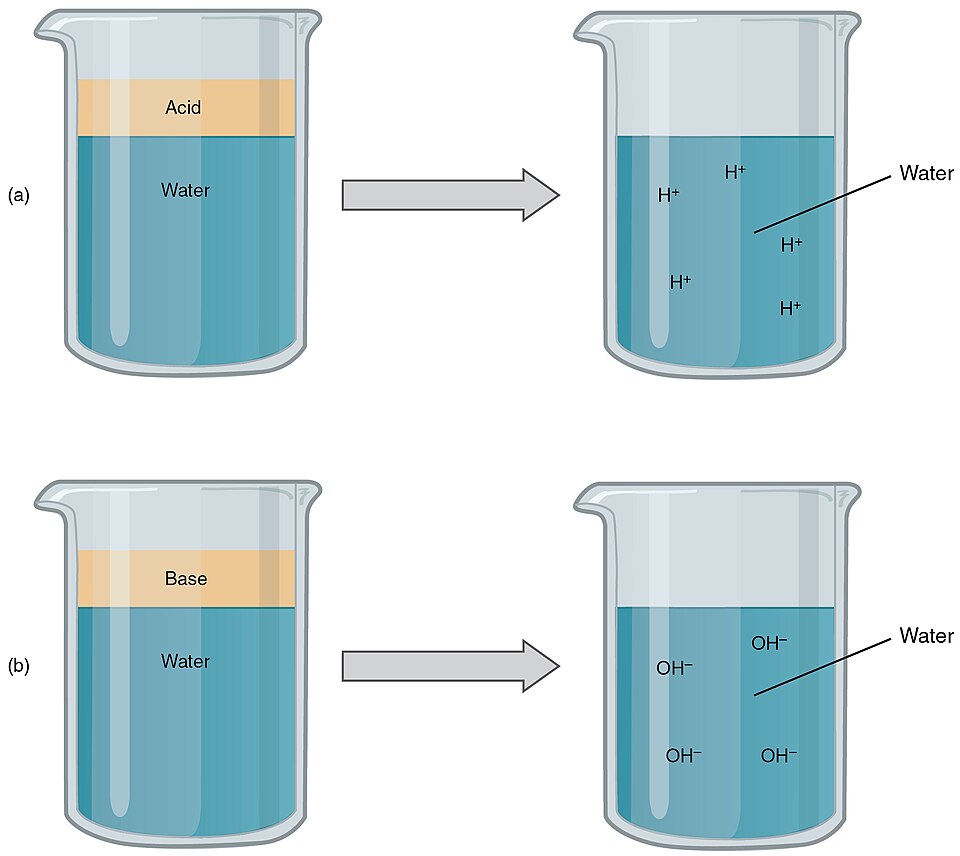
The lungs change pH by controlling how much CO₂ stays in the blood. CO₂ forms acid, so breathing works like a pH dial. When blood gets too acidic, sensors notice the rising H⁺. They tell the breathing center in the brain to breathe faster and deeper. This blows off CO₂ and pulls the buffer equation to the left. pH climbs back up within minutes.
When blood gets too basic, breathing slows. This keeps CO₂ in and lets pH fall. This lung response is quick and very strong. But it has a built-in limit. It cannot fix a problem that the lungs caused.
The kidneys: slow and complete
The last and most thorough defender is the kidney. It can actually add or remove acid and base from the body. It secretes H⁺ into the urine. It also takes back or makes bicarbonate and returns it to the blood. This resets the whole system. But it takes hours to days, not seconds.
The kidney is the slowest line of defense. It is also the only one that can fix an imbalance for good. That is why it has the final say on blood pH. Buffers buy time. The lungs buy more time. The kidneys settle the bill.
| Line of defense | Speed | How it works | Limit |
|---|---|---|---|
| 1. Chemical buffers | Seconds | Grab or give off H⁺ on the spot | Can only handle so much; only hides the acid |
| 2. Respiratory (lungs) | Minutes | Change breathing to blow off or keep CO₂ | Cannot fix a problem caused by the lungs |
| 3. Renal (kidneys) | Hours to days | Get rid of H⁺; take back or make HCO₃⁻ | Slow, but the only complete fix |
Tap each line of defense in the interactive. Watch it act at its own speed.
- Three defenses, in order of speed: chemical buffers (seconds), respiratory (minutes), and renal (hours to days).
- The lungs tune pH by breathing out more or less CO₂. They are fast and strong, but cannot fix problems the lungs caused.
- The kidneys get rid of H⁺ and adjust bicarbonate. They are slow, but they are the only complete fix.
- When one organ system causes the problem, the other compensates, or makes up for it.
Section 6The four acid-base disorders
Two questions sort every case
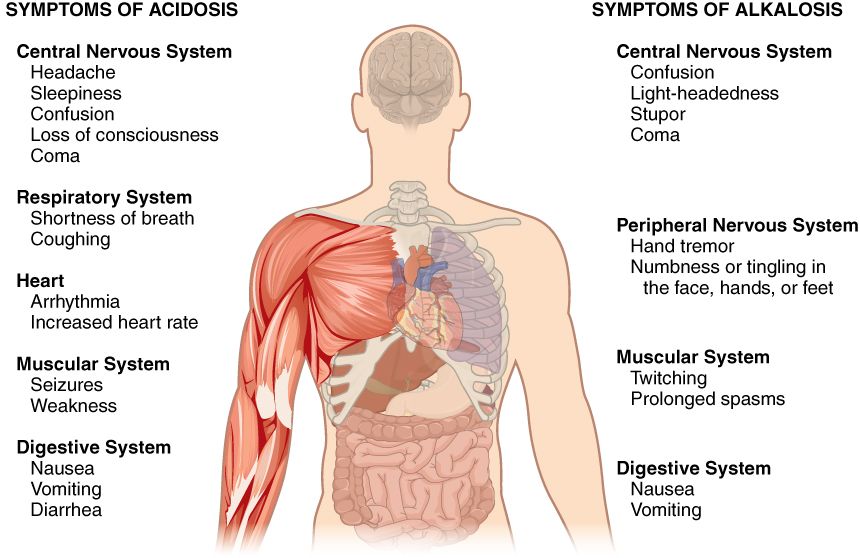
When pH control fails, the result is always one of four core disorders. You can name any of them by asking two questions.
First, which way did the pH go? Is it too acidic? That is acidosis, with pH below 7.35. Or is it too basic? That is alkalosis, with pH above 7.45. Second, what is the cause? Is it a lung problem that changes CO₂? That is respiratory. Or is it a problem that changes bicarbonate or other acids? That is metabolic. Put those two questions together, and you get a simple two-by-two grid. Each box holds one disorder.
| Disorder | Primary change | pH | Typical causes |
|---|---|---|---|
| Respiratory acidosis | CO₂ kept in (hypoventilation, or breathing too little) | Low | COPD (a long-term lung disease), opioid overdose, chest injury |
| Respiratory alkalosis | CO₂ blown off (hyperventilation, or breathing too much) | High | Anxiety, high altitude, fever, pain |
| Metabolic acidosis | HCO₃⁻ lost or acid gained | Low | Diabetic ketoacidosis, lactic acidosis, diarrhea, kidney failure |
| Metabolic alkalosis | HCO₃⁻ gained or acid lost | High | Throwing up (loss of stomach acid), diuretics, too many antacids |
The body fights back: compensation
When one system fails, the other steps in to soften the damage. This is called compensation. If the trouble is metabolic, the lungs respond within minutes. Take diabetic ketoacidosis, where the body builds up acids called ketones. Deep, fast Kussmaul breathing shows up. This is the lungs working hard to blow off CO₂ and fight the acid.
If the trouble is respiratory, the kidneys respond over days. They keep or dump bicarbonate to nudge pH back. Compensation can be partial, with pH still not normal. Or, given time, it can be nearly full. Then pH is back in range, but the other numbers are still off. It never overcorrects past normal. It also never cures the cause. It only buys the patient time.
Reading the numbers
To read a blood gas result, look at three values in order. First is the pH. Which way is it off? Next is the CO₂, the lung number. Last is the bicarbonate, the metabolic number. Then ask which of the two fits the pH.
Say the pH is low and the CO₂ is high. Then the lungs are to blame. This is respiratory acidosis. Now say the pH is low and the bicarbonate is low. Then metabolism is to blame. This is metabolic acidosis. The value that moves along with the problem points to its cause.
Tap a box in the interactive. Explore each of the four disorders by its cause and direction.
- The four disorders come from two questions: direction (acidosis or alkalosis) × cause (respiratory or metabolic).
- Respiratory problems change CO₂. Metabolic problems change bicarbonate.
- Compensation uses the other organ system. The lungs help with metabolic problems (Kussmaul breathing). The kidneys help with respiratory ones.
- Read the numbers with ROME. In respiratory problems, pH and CO₂ move in opposite ways. In metabolic problems, pH and HCO₃⁻ move the same way.
The chapter in one breath
- Water is about 60% of body mass. It is split two-thirds intracellular and one-third extracellular (interstitial fluid plus plasma).
- The compartments differ in what is dissolved in them. ECF is rich in Na⁺/Cl⁻, and ICF is rich in K⁺. Water follows dissolved particles by osmosis.
- Each day, intake equals output at about 2.5 L. Thirst raises intake, and ADH lowers output. This holds total body water steady.
- Electrolytes drive nerves, muscles and fluid balance. Sodium rules volume, potassium rules the heart, and calcium rules contraction. Aldosterone keeps Na⁺ and dumps K⁺.
- Blood pH is held at 7.35–7.45 by the bicarbonate buffer, CO₂ + H₂O ⇆ H₂CO₃ ⇆ H⁺ + HCO₃⁻.
- Three defenses guard pH: buffers (seconds), lungs changing CO₂ (minutes), and kidneys changing HCO₃⁻ (days).
- When they fail, you get four disorders: respiratory or metabolic, and acidosis or alkalosis. You read them with ROME. Compensation softens them.
ReferenceWords worth knowing
Here is a quick list of the terms in this chapter. Skim it now, or come back when a word trips you up.
- Acidosis
- When blood pH falls below 7.35. It is respiratory when CO₂ builds up, and metabolic when bicarbonate is lost or acid is gained.
- Aldosterone
- A hormone from the adrenal gland. It makes the kidney take back sodium (and water) and get rid of potassium, which raises ECF volume and blood pressure.
- Alkalosis
- When blood pH rises above 7.45. It is respiratory when too much CO₂ is lost, and metabolic when bicarbonate is gained or acid is lost.
- Antidiuretic hormone (ADH)
- A hormone from the back part of the pituitary gland, also called vasopressin. It makes the kidney take back water, so urine is concentrated and body water is saved.
- Bicarbonate (HCO₃⁻)
- The main buffer anion of the ECF. It is the metabolic part of the bicarbonate buffer system, and the kidneys control it.
- Buffer
- A pair of chemicals that grabs extra H⁺ or gives it off to resist changes in pH. It acts right away but does not remove acid from the body.
- Compensation
- When one organ system (lungs or kidneys) fights a pH problem caused by the other. It eases the problem but does not cure it.
- Electrolyte
- A substance that breaks into charged ions in water. It lets fluids carry current and drives nerves, muscles and fluid balance.
- Extracellular fluid (ECF)
- The one-third or so of body water outside the cells. It is made of interstitial fluid and plasma, and it is rich in sodium and chloride.
- Insensible loss
- Water you lose without noticing. It dries off the skin and leaves as vapor in the breath you breathe out.
- Interstitial fluid
- The fluid outside cells that fills the spaces between them. It is the biggest part of the ECF.
- Intracellular fluid (ICF)
- The two-thirds or so of body water inside the cells. It is rich in potassium, magnesium, phosphate and proteins.
- Metabolic water
- Water made inside cells when they burn fuel for energy. It is a small daily source of water.
- Osmolarity
- How many particles are dissolved in a fluid. It decides which way water moves by osmosis.
- pH
- A 0–14 scale of how acidic something is, based on how many hydrogen ions it has. Blood is held at 7.35–7.45.
- Potassium (K⁺)
- The main cation inside cells. It sets the resting membrane potential and is vital for a normal heart rhythm.
- Respiratory acidosis
- A fall in pH caused by breathing too little (hypoventilation), which keeps CO₂ in. It happens in COPD or opioid overdose.
- Sodium (Na⁺)
- The main cation outside cells. It is the master control of ECF volume and osmolarity, and aldosterone mainly controls it.
- Thirst
- The urge to drink. Sensors in the hypothalamus trigger it when the ECF gets too concentrated.
- Total body water
- All the water in the body, about 60% of an adult's mass. It is split between the fluid inside and outside cells.