Social Class & Stratification
Every society sorts its members into layers, and where you land shapes almost everything — your health, your schooling, your work, even how long you live. Sociologists call this ranking social stratification, and unlike the differences between individuals, it is a feature of society itself: durable, patterned, and passed from one generation to the next. This chapter asks how societies build these hierarchies, why they persist, and how the great theorists explained them. It then brings the questions home — what a social class is, how we measure poverty and identify who bears it, and whether the American Dream of rising through effort matches the evidence. Class is often invisible to the people who benefit from it; the work of this chapter is to make it visible.
By the end of this chapter you can
- Define social stratification and distinguish closed (caste) from open (class) systems.
- Compare the estate, caste, and class systems and the role of ascribed versus achieved status.
- Explain and critique the Davis–Moore thesis from the functionalist paradigm.
- Summarize Marx's account of class, exploitation, and class consciousness.
- Contrast Weber's three dimensions of stratification — class, status, and power.
- Describe the U.S. class structure and the markers of class: income, wealth, and cultural capital.
- Distinguish absolute from relative poverty and identify who is most likely to be poor.
- Classify the types of social mobility and weigh the American Dream against the evidence.
Section 1Systems of stratification
What stratification is — and isn't
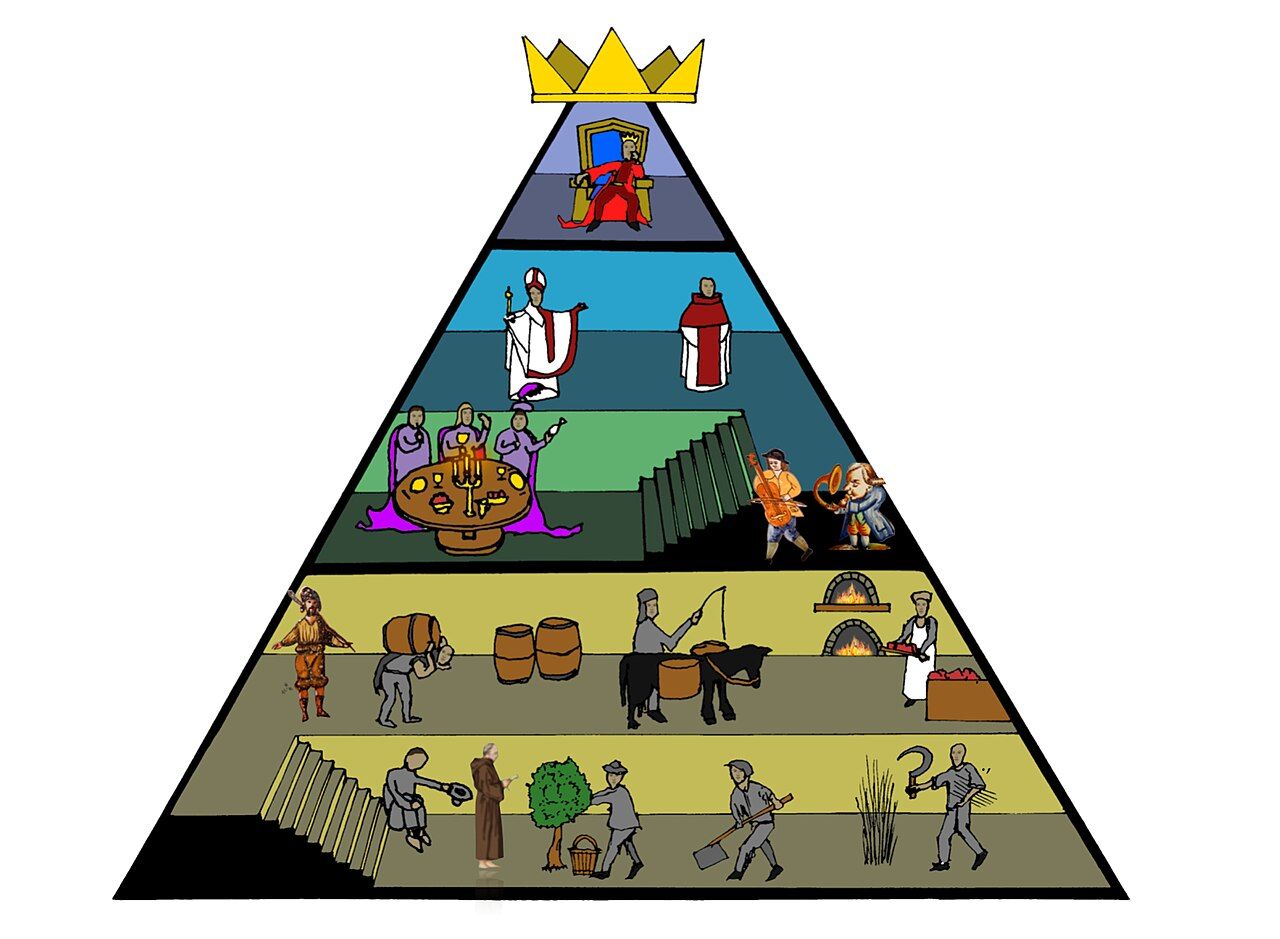
Social stratification is the ranking of whole categories of people into a hierarchy of layers, or strata, that receive unequal shares of a society's resources, power, and prestige. Four ideas make it a social fact rather than a personal one. First, stratification is a trait of society, not of individuals: a talented child born into a poor family and an ordinary child born into a rich one do not, on average, end up in the same place, because the layering exists before either of them is born. Second, it persists across generations — parents pass their position, and its advantages, to their children. Third, it is universal but variable: every known society ranks its members, yet what gets rewarded and how steeply differs enormously from one society to the next. Fourth, it rests not only on force but on belief — every stratification system is supported by an ideology that makes the arrangement seem natural, fair, or inevitable.
Sociologists sort stratification systems along a spectrum from closed to open. Closed systems allow little or no movement between strata and rest on ascribed status — a position assigned at birth, over which the person has no control. Open systems permit movement and give real weight to achieved status — a position earned through a person's own effort and choices. No real society sits at either pure extreme, but the distinction organizes the whole field.
Closed systems: slavery, estate, and caste
Three historical systems sit near the closed end. Slavery — the ownership of some people by others — is the most extreme, treating human beings as property. The estate system of medieval Europe divided society into legally defined orders: a nobility that owned the land, a clergy that owned the moral authority, and a vast commoner class of peasants and, later, townspeople who worked it. Rank was hereditary and enshrined in law.
The purest surviving example of a closed system is the caste system, in which a person's lifelong position is fixed by birth. India's traditional system is organized around ranked categories — the classical varnas of Brahmins (priests and scholars), Kshatriyas (warriors and rulers), Vaishyas (merchants), and Shudras (laborers), with the Dalit communities historically placed outside and below the scheme and long stigmatized as “untouchable.” Caste systems share a recognizable machinery: status is ascribed and permanent, marriage is endogamous (you must marry within your caste), occupation is often inherited, and the whole arrangement is sustained by powerful cultural and, historically, religious beliefs. Apartheid-era South Africa operated a racial caste system by law, and many scholars read the American system of racial segregation in the same terms. Modern India has outlawed caste discrimination, yet caste continues to shape marriage, opportunity, and everyday life — a reminder of how durably these arrangements outlive the laws that once enforced them.
Open systems: class
A class system ranks people by a combination of birth and individual achievement. Its boundaries are blurred rather than legally fixed, its categories shade into one another, and — crucially — it permits social mobility, movement up or down between strata within a lifetime or across generations. Because class systems reward achieved status, they are bound up with the ideology of meritocracy: the belief that social position reflects personal merit — talent plus effort. Meritocracy is a powerful and motivating idea, but it is also, in part, a story a society tells itself, and later sections weigh how much of it the evidence actually supports.
| Feature | Caste (closed) | Class (open) |
|---|---|---|
| Basis of position | Ascribed — fixed at birth | Ascribed and achieved |
| Mobility | Essentially none | Possible, up or down |
| Boundaries | Sharp, legally/ritually enforced | Blurred, informal |
| Marriage | Endogamous (within caste) | Largely open, though class tends to marry class |
| Occupation | Often inherited, assigned | Chosen (in principle) |
| Supporting ideology | Tradition, religion, purity | Meritocracy |
- Social stratification is a society-wide ranking of categories of people; it persists across generations and is upheld by belief.
- Closed systems (slavery, estate, caste) rest on ascribed status and permit little mobility; open (class) systems add achieved status and allow movement.
- A caste system fixes lifelong rank at birth, enforces endogamy, and is sustained by tradition and religion.
- A class system blends birth and achievement, has blurred boundaries, and is justified by the ideology of meritocracy.
Section 2Explaining stratification
The functionalist answer: the Davis–Moore thesis
Why does every society have stratification? The functionalist reply, stated most sharply by Kingsley Davis and Wilbert Moore in 1945, is that inequality is useful — even necessary. Their argument, the Davis–Moore thesis, runs like this: a society has some positions that are more important and harder to fill than others (a surgeon's job matters more, and is harder to train for, than a cashier's). To motivate the most capable people to endure the long, costly training those positions demand, society must attach greater rewards — money, prestige, power — to them. Unequal rewards, on this view, are a device for getting the right people into the right jobs. Stratification is thus a functional necessity, and the greater the functional importance of a position, the greater its reward.
The critique, pressed by Melvin Tumin, is that the thesis assumes a fair race that ascription makes impossible. How do we measure a job's importance — and why do some plainly essential jobs (sanitation, childcare, farm labor) pay so little while others of doubtful social value pay so much? More damning, stratification does not sift the ablest people to the top; it lets the already-advantaged hoard opportunity, blocking talented people born low and cushioning mediocre people born high. Far from placing the best people in key roles, inequality can reproduce itself, wasting talent and calling the result “merit.”
The conflict answer: Marx
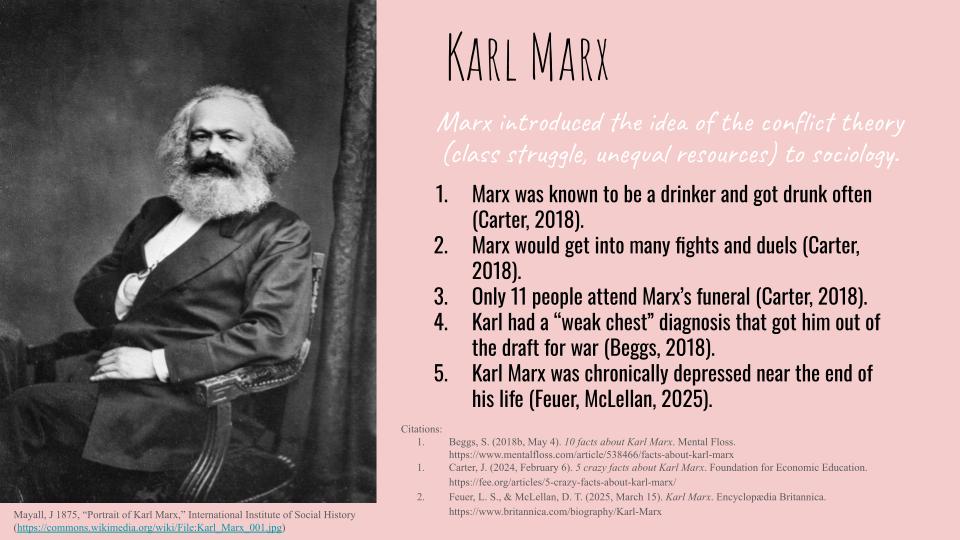
Karl Marx saw stratification not as society's useful glue but as the visible scar of exploitation. For Marx, class in industrial capitalism is defined by one thing: your relationship to the means of production — the factories, land, and capital used to produce wealth. Two great classes result. The bourgeoisie (capitalists) own the means of production; the proletariat (workers) own only their labor, which they must sell to survive. Profit, Marx argued, comes from surplus value: owners pay workers less than the value their labor creates and pocket the difference. Stratification, then, is exploitation dressed up as economics.
Why don't workers revolt? Because, Marx said, they are held in false consciousness — a distorted view of their situation that leads them to accept and even defend a system working against them, blaming themselves or their neighbors instead of the structure. The task of history, in his view, was for workers to develop class consciousness, recognize their shared exploitation, and act collectively to overturn the system. Marx predicted capitalism would deepen inequality until it collapsed into revolution. That specific prediction failed — wages rose, a middle class swelled, reforms softened the edges — but his central insight, that economic ownership structures power and that ideology hides it, remains one of sociology's most influential ideas.
Weber's multidimensional view: class, status, and power
Max Weber accepted much of Marx but thought a single economic axis was too crude. Stratification, he argued, has three distinct dimensions that usually cluster but can come apart. The first is class — a person's economic position and, with it, their life chances, the odds of obtaining the good things a society offers. The second is status (Weber's Stand) — social honor or prestige, the esteem attached to a person's style of life, which money cannot always buy. The third is power (which Weber discussed as party) — the capacity to get one's way over others, often through organized political influence.
The point of separating them is that they do not always line up. A tenured professor or a member of the clergy may enjoy high status on modest income; a lottery winner or an organized-crime boss may command wealth and power with little prestige; a mid-level bureaucrat may wield real power with unremarkable class and status. Weber's own three dimensions are class, status (Stand), and party or power; he did not use the phrase socioeconomic status. Later researchers, drawing on his multidimensional insight, built the composite measure now called socioeconomic status (SES), which typically combines income, education, and occupational prestige. That multidimensional idea underlies most modern measurement of class.
| Question | Functionalism (Davis–Moore) | Conflict (Marx) | Weber |
|---|---|---|---|
| What is stratification? | A functional necessity that rewards important roles | Exploitation rooted in ownership of the means of production | A layering along three axes at once |
| Why does it exist? | To motivate the ablest into the hardest, most vital jobs | Because owners extract surplus value from workers | Because class, status, and power are unequally held |
| Key concept | Functional importance; reward | Bourgeoisie vs. proletariat; false consciousness | Class, status, power; life chances |
| Is it good for society? | Yes — it places the right people in key roles | No — it enriches a few by impoverishing many | It simply is; the analyst describes, not judges |
| Main criticism | Ignores ascription; “importance” is arbitrary (Tumin) | Revolution never came; too economic | Harder to turn into a single measure |
- The Davis–Moore thesis (functionalism) holds that unequal rewards are necessary to fill important, hard-to-train positions; Tumin countered that ascription blocks the fair sorting it assumes.
- Marx (conflict) defined class by ownership of the means of production, located profit in surplus value, and saw false consciousness preventing revolt.
- Weber split stratification into three dimensions — class, status, and power — that cluster but can diverge.
- Life chances — the odds of getting society's rewards — are Weber's enduring bridge between class position and everyday outcomes.
Section 3Social class
What a social class is
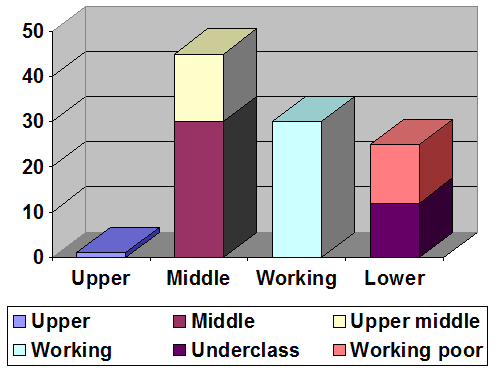
A social class is a large category of people who occupy a similar economic position and, as a result, share broadly similar life chances. Because the United States lacks the legal ranks of an estate or caste system, its classes have fuzzy edges, and sociologists draw the lines in different places. A widely used sociological map, the Gilbert–Kahl model, describes roughly six layers: a tiny capitalist (upper) class that lives on investments and inherited wealth; an upper-middle class of well-paid professionals and managers with advanced degrees; a middle class of semi-professionals, lower-level white-collar workers, and skilled craft workers; a working class in routine manual and clerical jobs with little autonomy; the working poor, employed but below or near the poverty line; and an underclass largely shut out of the regular labor market. The share of national resources each layer commands is wildly uneven — the top sliver holds a share of wealth out of all proportion to its numbers.
Income, wealth, and prestige
Class is measured with several markers, and confusing two of them — income and wealth — is one of the most common mistakes in thinking about inequality. Income is the money a household receives over a period of time: wages, salary, interest, government benefits. Wealth (or net worth) is the total value of everything a household owns — home, savings, stocks, businesses — minus its debts. Wealth is far more concentrated than income, because it compounds and is inherited: the gap in accumulated wealth between the top and bottom is many times wider than the gap in yearly income. Two other markers complete the picture: occupational prestige, the respect a job commands (surveys reliably rank physicians and professors high, and manual and service jobs low), and educational attainment, which both signals and shapes class. Combined, these markers give a person's socioeconomic status (SES).
Cultural capital and the markers of taste
Class is more than a bank balance; it is also a way of moving through the world. The sociologist Pierre Bourdieu called the non-financial resources of class cultural capital — the tastes, manners, vocabulary, credentials, and know-how that a person absorbs, mostly from family, and that pay off in schools, workplaces, and social life. A child raised among books, museum trips, and confident dealings with authority arrives at school already fluent in its unspoken code; the school then rewards that fluency as if it were raw talent, quietly converting inherited advantage into “merit.” Status symbols — the neighborhood, the car, the college sweatshirt, the accent — broadcast class position, and much of what looks like personal preference is in fact a marker of the stratum one was raised in. This is why class can be so hard to see and so hard to escape: it is stitched into everyday habits long before anyone earns a paycheck.
| Class (Gilbert–Kahl) | Roughly | Typical work & resources |
|---|---|---|
| Capitalist / upper | ~1% | Live on investments & inherited wealth; top prestige universities; outsized political influence |
| Upper-middle | ~14% | Professionals & managers; advanced degrees; comfortable income and growing wealth |
| Middle | ~30% | Semi-professionals, lower white-collar & skilled trades; some college; modest security |
| Working class | ~30% | Routine manual/clerical jobs; little autonomy; vulnerable to layoffs |
| Working poor | ~13% | Employed but low-wage; below or near the poverty line; little to no wealth |
| Underclass | ~12% | Largely outside the regular labor market; reliant on assistance |
- A social class groups people of similar economic position and life chances; U.S. models commonly name about six blurred layers.
- Income (money received over time) differs from wealth (net worth); wealth is more concentrated and more inherited.
- Occupational prestige and education round out class; together the markers form a person's socioeconomic status.
- Cultural capital (Bourdieu) — tastes, manners, and know-how — transmits class advantage and gets rewarded as if it were merit.
Section 4Poverty
Measuring poverty: absolute and relative
Poverty comes in two conceptual flavors, and the difference decides who gets counted. Absolute poverty is a lack of the resources needed to survive — enough food, safe water, shelter, basic health care. It is a fixed standard: below this line, life and health are at risk. Relative poverty is a lack of the resources needed to live at the standard considered normal for one's own society. It is a moving line: a family with a roof and food may still be poor relative to a wealthy society if it cannot afford what that society treats as ordinary participation. Absolute poverty asks whether you can survive; relative poverty asks whether you can belong.
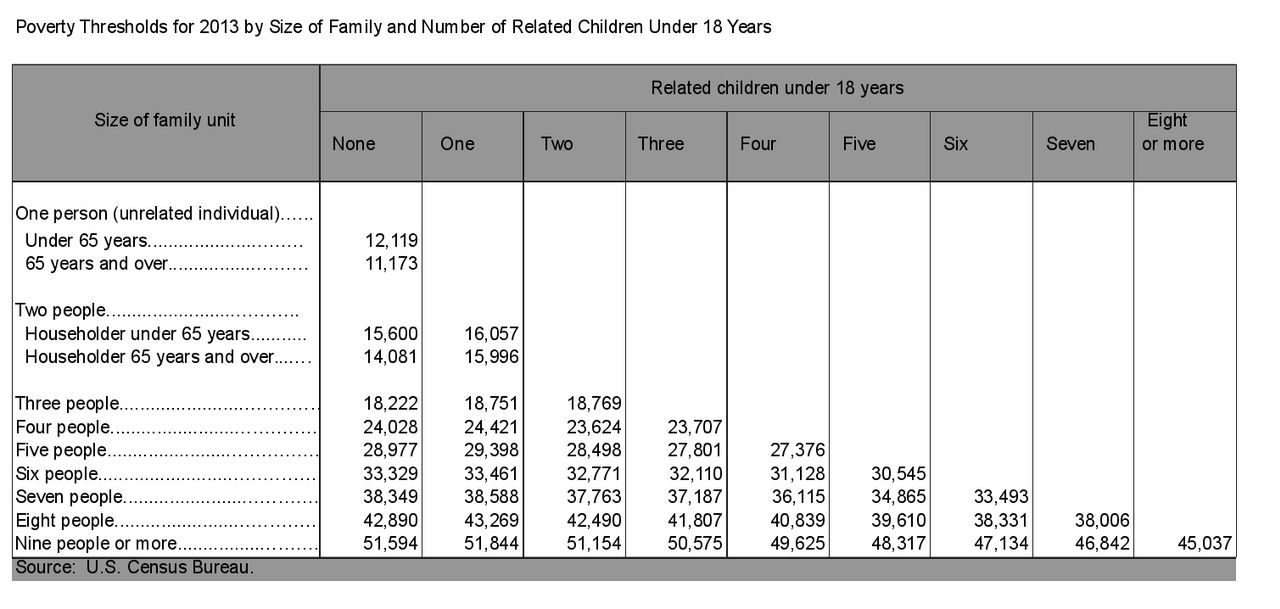
The official U.S. measure is essentially absolute. In the 1960s, economist Mollie Orshansky built the poverty line (the poverty threshold) from the cost of a minimum food budget multiplied by three — a rough figure, adjusted only for inflation and household size ever since. A household whose pre-tax cash income falls below its threshold is officially poor, and the share of people below it is the poverty rate. Critics on all sides fault the measure: it ignores taxes, non-cash benefits like food assistance and housing vouchers, and huge regional differences in the cost of living. To address these gaps, the Census Bureau also publishes a Supplemental Poverty Measure (SPM) that folds in benefits, taxes, and local costs — often changing the picture of who counts as poor.
Who is poor?
Poverty is not spread evenly; it concentrates in predictable ways. Children are among the poorest age groups, and childhood poverty leaves long shadows on health and schooling. Poverty is also increasingly female: the feminization of poverty describes the rising share of the poor who live in households headed by women, driven by the wage gap, the costs of unpaid caregiving, and single parenthood. Racial and ethnic minorities face poverty rates well above the national average, the accumulated residue of historical exclusion from wealth-building. And poverty has a geography — concentrated in some rural regions and in segregated urban neighborhoods where disadvantage compounds. One group deserves special notice: the working poor, people who hold jobs, sometimes more than one, yet still fall below the line because wages are too low or hours too few.
Explaining poverty: the person or the structure?
Two broad explanations compete. The first blames individuals or their culture. Oscar Lewis's culture of poverty thesis argued that persistent poverty breeds values — fatalism, short time horizons — that get passed down and trap the next generation. The second blames structure: poverty is produced by how a society is organized — by low-wage labor markets, unequal schools, discrimination, and economic shifts that erase whole categories of jobs. The two explanations point to very different remedies: fix the person, or fix the system. Most sociological evidence favors structural accounts — poverty rates rise and fall with the economy and with policy far faster than any culture could change — while cautioning that blaming the poor for their poverty is itself a form of the false consciousness Marx described, one that conveniently excuses the arrangement that produces it.
| Absolute poverty | Relative poverty | |
|---|---|---|
| The question | Can you survive? | Can you take part in normal life? |
| The standard | Fixed (basic necessities) | Moving (society's median) |
| Typical use | Global development, the official U.S. line | Comparing inequality within rich nations |
| Can it ever reach zero? | In principle, yes | Almost never — the line rises with society |
- Absolute poverty is lacking the means to survive; relative poverty is falling below one's society's normal standard.
- The U.S. poverty line (Orshansky) is a food budget × 3, adjusted for inflation; the SPM adds benefits, taxes, and local costs.
- Poverty falls hardest on children, female-headed households (the feminization of poverty), racial minorities, and the working poor.
- Structural explanations of poverty (labor markets, discrimination, policy) hold up better than individual/culture-of-poverty accounts.
Section 5Social mobility
The types of mobility
Social mobility is movement between positions in a stratification system, and sociologists slice it several ways. The most important cut is by time frame. Intergenerational mobility compares a person's position to that of their parents — the daughter of factory workers who becomes a physician. Intragenerational mobility tracks a single person's movement across their own working life — the mailroom clerk who retires as a manager. Mobility also has a direction: vertical mobility moves a person up or down the hierarchy, while horizontal mobility shifts them between positions at roughly the same level (a nurse who becomes a paralegal). Finally, mobility can be structural — whole groups rise or fall because the economy itself changed, as when industrialization lifted millions into new middle-class jobs or when the loss of manufacturing pushed communities down — as opposed to exchange mobility, where individuals swap places while the overall shape of the ladder stays the same. Structural mobility is a reminder that a person's rise or fall is often the tide of history, not just the strength of their swimming.
The American Dream and the evidence
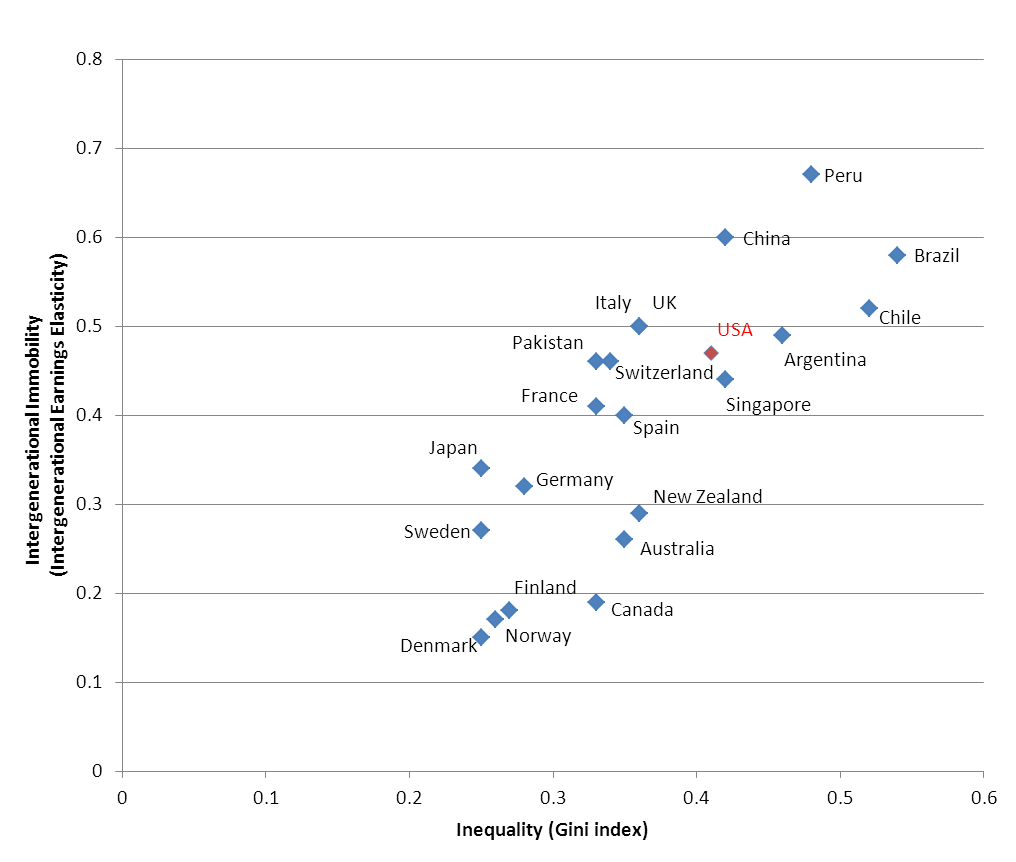
The American Dream — the belief that anyone who works hard can rise — is a story about upward, intergenerational, largely structural mobility, and for much of the twentieth century a growing economy made it broadly true. The recent evidence is more sobering. Researchers measure how tightly a child's adult income is tied to their parents' (a bond called intergenerational elasticity), and in the United States that bond is strong: where you start explains a great deal about where you finish. Comparative studies place the U.S. below several other wealthy nations, such as Canada and the Nordic countries, on the odds that a child born poor will reach the top. The pattern is captured by the “Great Gatsby Curve,” which shows that more unequal societies tend to have less mobility, not more. Studies of “absolute” mobility add a further worry: the share of children who grow up to earn more than their parents did has fallen sharply for cohorts born in the later twentieth century.
What drives who moves? The strongest lever is education, especially a four-year degree — but access to good schooling is itself patterned by class, so education both opens the door and guards it. Family wealth, neighborhood, health, and plain luck matter too. The upshot is not that mobility is a myth — people do rise and fall every generation — but that it is more limited, and more shaped by the accident of birth, than the Dream implies. The two ends of the ladder are especially sticky: children born at the very top and the very bottom are the most likely to stay put.
| Type of mobility | What it compares | Example |
|---|---|---|
| Intergenerational | You vs. your parents | Child of laborers becomes a physician |
| Intragenerational | You over your own career | Clerk retires as a manager |
| Vertical | Up or down the hierarchy | A promotion — or a layoff into poverty |
| Horizontal | Sideways, same level | Nurse becomes a paralegal |
| Structural | Whole groups, economy-driven | Industrialization lifts millions into new jobs |
- Social mobility is movement in the stratification system; it can be intergenerational or intragenerational, vertical or horizontal.
- Structural mobility moves whole groups because the economy changed; exchange mobility swaps individuals while the ladder's shape holds.
- The U.S. shows relatively low intergenerational mobility for a rich nation, and absolute upward mobility has declined for recent cohorts.
- Education is the strongest lever of mobility, but access to it is patterned by class — and the top and bottom rungs are the stickiest.
The chapter in one breath
- Social stratification ranks whole categories of people; it is a trait of society, persists across generations, and is upheld by belief.
- Systems run from closed (caste, resting on ascribed status, little mobility) to open (class, adding achieved status and justified by meritocracy).
- The Davis–Moore thesis calls inequality a functional necessity; Tumin answers that ascription blocks the fair sorting it assumes.
- Marx located class in ownership of the means of production and profit in surplus value; Weber split stratification into class, status, and power.
- The U.S. class structure has about six blurred layers; income differs from the more concentrated wealth, and cultural capital transmits advantage as “merit.”
- Absolute poverty is about survival, relative poverty about belonging; the official line falls hardest on children, women, minorities, and the working poor.
- Social mobility comes in several types; U.S. intergenerational mobility is relatively low, and the American Dream is real but more limited than it claims.
ReferenceWords worth knowing
A quick reference for the terms in this chapter — skim it now, or circle back whenever a word trips you up.
- Absolute poverty
- A lack of the resources needed to survive — adequate food, water, shelter, and health care; a fixed standard.
- Achieved status
- A social position earned through a person's own effort, talent, or choices.
- Ascribed status
- A social position assigned at birth or involuntarily, over which the individual has no control.
- Bourgeoisie
- In Marx's theory, the capitalist class that owns the means of production.
- Caste system
- A closed stratification system in which lifelong position is fixed by birth and marriage is endogamous.
- Class consciousness
- Workers' awareness of their shared exploitation and common interests as a class (Marx).
- Class system
- An open stratification system based on both birth and achievement, permitting social mobility.
- Cultural capital
- The tastes, manners, knowledge, and credentials, transmitted mainly by family, that yield advantage in schools and society (Bourdieu).
- Davis–Moore thesis
- The functionalist claim that stratification is necessary because unequal rewards motivate people to fill important, hard-to-train positions.
- False consciousness
- A distorted understanding that leads the disadvantaged to accept, or defend, a system that works against them (Marx).
- Feminization of poverty
- The trend by which women, especially heads of single-parent households, make up a growing share of the poor.
- Income
- The money a household receives over a period of time, such as wages, interest, and benefits.
- Intergenerational mobility
- A change in social position between one generation and the next (parents to children).
- Life chances
- Weber's term for the odds that a person will obtain the good things a society offers, given their class position.
- Meritocracy
- A system, or the belief in one, in which social position reflects personal merit — talent plus effort.
- Poverty line (threshold)
- The official income level below which a household is counted as poor; in the U.S., built from a minimum food budget.
- Proletariat
- In Marx's theory, the working class that owns no means of production and must sell its labor.
- Relative poverty
- A lack of the resources needed to live at the standard considered normal for one's own society; a moving standard.
- Social mobility
- Movement of individuals or groups between positions in a stratification system.
- Social stratification
- A society's ranking of categories of people into a hierarchy of layers with unequal resources, power, and prestige.
- Structural mobility
- Mobility of whole groups caused by changes in the economy or society rather than individual effort.
- Wealth
- The total value of everything a household owns (net worth) minus its debts; more concentrated than income.