Ancient Greece: Polis, Philosophy and Democracy
Greece is a poor country. Its soil is thin, its rain unreliable, its mountains slice the mainland into pockets too small to feed an empire. That poverty shaped everything. Because no Greek king could tax a Nile-fed grain surplus, no Greek king could pay a standing army or a permanent priesthood, and so Greeks organized themselves instead into hundreds of small, fiercely independent citizen-states. Out of that fragmentation came the loudest arguments in the ancient world: about who counts as a citizen, whether the many can govern themselves, what a good life is, and how we know anything at all. Greeks did not invent writing, law, monumental architecture or mathematics—Mesopotamia and Egypt got there first. What Greeks did was insist on giving reasons. This chapter follows that habit from Mycenaean palaces through Athenian assemblies, Spartan barracks, Socratic questioning and Alexander’s empire, and asks what survived and what did not.
By the end of this chapter you can
- Explain how geography and the collapse of the Mycenaean palace economies produced the polis rather than a territorial kingdom.
- Describe the hoplite phalanx and evaluate the argument that military change drove political change.
- Compare Sparta and Athens as answers to the same problem—how a small state survives—including the role of helots and of colonization.
- Trace Athenian constitutional development from Solon through Cleisthenes to the radical democracy of Pericles, naming the institutions of Ekklesia, Boule and dikasteria.
- Assess who was excluded from Athenian citizenship—women, metics, and the enslaved—and what that exclusion means for calling Athens a democracy.
- Analyze the causes and consequences of the Persian Wars and the Peloponnesian War, using Herodotus and Thucydides critically.
- Distinguish the projects of the Presocratics, the Sophists, Socrates, Plato and Aristotle, and explain why the trial of Socrates mattered.
- Characterize the Hellenistic world after Alexander, including Stoicism, Epicureanism and the science of Alexandria.
- Identify which Greek legacies passed intact to later Europe and which were reinvented and only labeled Greek.
Section 1From Palace to Polis: Collapse, Recovery and the Invention of the City-State
The Bronze Age world and its collapse
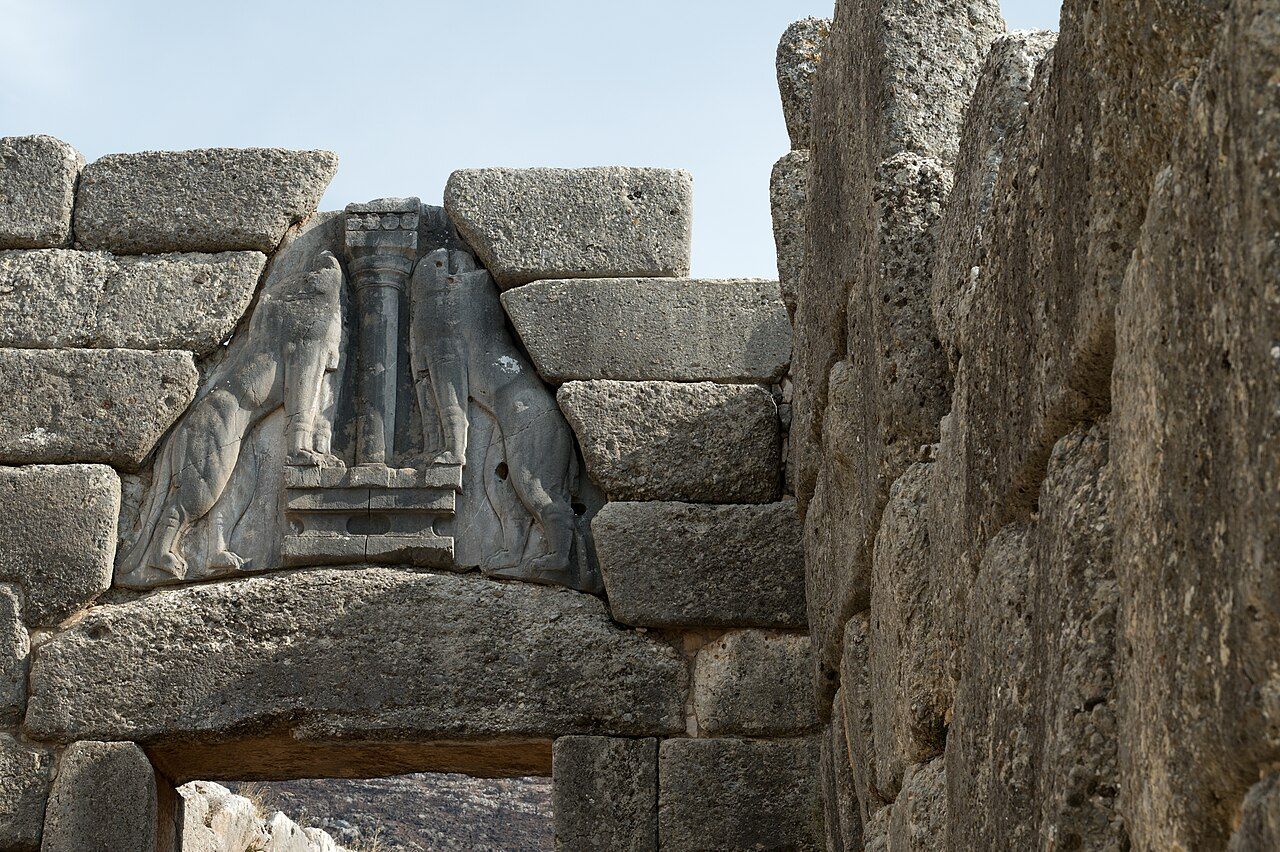
Before there were Greeks arguing in assemblies, there were Greeks living under kings. From roughly 1600 to 1200 BCE, fortified palace centers at Mycenae, Pylos, Tiryns and Thebes ran a redistributive economy that would have looked familiar to a scribe in Ur or Thebes-in-Egypt. Clay tablets written in a script called Linear B—deciphered in 1952 by Michael Ventris, an architect who built on the sign-grid analysis of the American scholar Alice Kober and proved the language was an early form of Greek—record sheep counts, bronze allocations, chariot wheels, rations for named workers. They are inventories, not literature. A king called the wanax sat atop this system. Crete’s earlier Minoan palaces at Knossos had supplied the model, and Mycenaeans seem to have taken over Knossos outright around 1450 BCE.
Then, between about 1200 and 1150 BCE, that whole eastern Mediterranean order came apart. The Hittite capital burned. Ugarit was destroyed and never reoccupied. Egyptian reliefs at Medinet Habu show Ramesses III fighting off seaborne coalitions that modern scholars lump together as the Sea Peoples, a collective label the Egyptians themselves never used. Every major Mycenaean center was burned or abandoned. Historians argue hard about why: raiders, earthquakes, drought recorded in pollen and speleothem data, systems collapse in which highly specialized palace economies could not absorb a shock, or—most plausibly—several of these compounding one another. No single explanation commands consensus, and honest textbooks should say so.
What matters for our story is the consequence. Writing disappeared from Greece for roughly four hundred years. Populations fell sharply; some sites lost most of their inhabitants. Long-distance trade thinned. Monumental building stopped. This stretch, roughly 1100 to 800 BCE, is conventionally called the Greek Dark Age, though archaeologists increasingly dislike the term because excavations at Lefkandi on Euboea revealed a huge tenth-century building with a warrior burial, gold, and an imported bronze urn—evidence that elites and contacts survived. Call it a reset rather than a blackout.
Why the polis and not a kingdom
When Greece recovered in the eighth century BCE, it did not rebuild palaces. It built something structurally new: the polis, a self-governing community of citizens centered on an urban core with a fortified high point (the acropolis), a public square for gathering and trade (the agora), and a surrounding stretch of farmland (the chora). By the classical period there were perhaps a thousand of them. Most were tiny. Modern estimates suggest the typical polis had a few thousand residents and territory smaller than a mid-sized American county; only Athens and Sparta controlled anything approaching a region.
Geography helps explain this. Mainland Greece is about eighty percent mountain, cut into small plains that drain separately to the sea. No river system unifies it the way the Nile unified Egypt, and no floodplain generates the enormous grain surplus that funds a bureaucracy. Hauling grain overland was ruinously expensive; hauling it by sea was cheap, which is why Greeks faced outward. But geography does not determine politics—the same landscape had held palace kingdoms four centuries earlier. The likelier decisive fact is that the collapse destroyed the institutional memory of centralized kingship, and the communities that reassembled did so around local landholding families who never let a single ruler recover monopoly power.
The Greeks themselves understood the polis as people, not place. Thucydides has the Athenian general Nicias tell his soldiers that men make a city, not walls or ships. When a polis founded a colony, it exported the whole package—cult, calendar, constitution—and the daughter city was independent from the start, tied to the mother city by sentiment rather than sovereignty.
Colonization, coinage and the alphabet
Between roughly 750 and 550 BCE Greeks planted settlements from Spain to the Crimea: Syracuse in Sicily (founded from Corinth in 733 BCE), Massalia at modern Marseille, Byzantium on the Bosporus, Cyrene in Libya, Naples in Italy. Cicero later wrote that the Greeks had sewn a fringe of settlements onto the shores of the barbarian lands. Motives were mixed and specific—land hunger after population recovery, political exile after a failed faction fight, trade, drought. The consequences were large: Greek cities became grain importers and oil-and-wine exporters, which made naval power and commercial classes matter.
Two technologies traveled with them. The Greek alphabet, adapted from Phoenician around 800 BCE, added signs for vowels, producing a compact set of two dozen-odd characters that could be learned in weeks rather than years—a genuine break from the scribal monopolies of Linear B and cuneiform. And coined money, invented in Lydia in Asia Minor in the late seventh century BCE and adopted quickly by Greek cities, made wealth portable, divisible and impersonal. Both technologies loosened aristocratic control of information and value.
The destruction of Mycenaean palace kingship, not Greek geography alone, cleared the ground for the polis—a small, fiercely independent community of citizens that became the basic political unit of Greek life.
Section 2Two Answers to One Problem: Sparta and Early Athens
The hoplite and the shape of citizenship
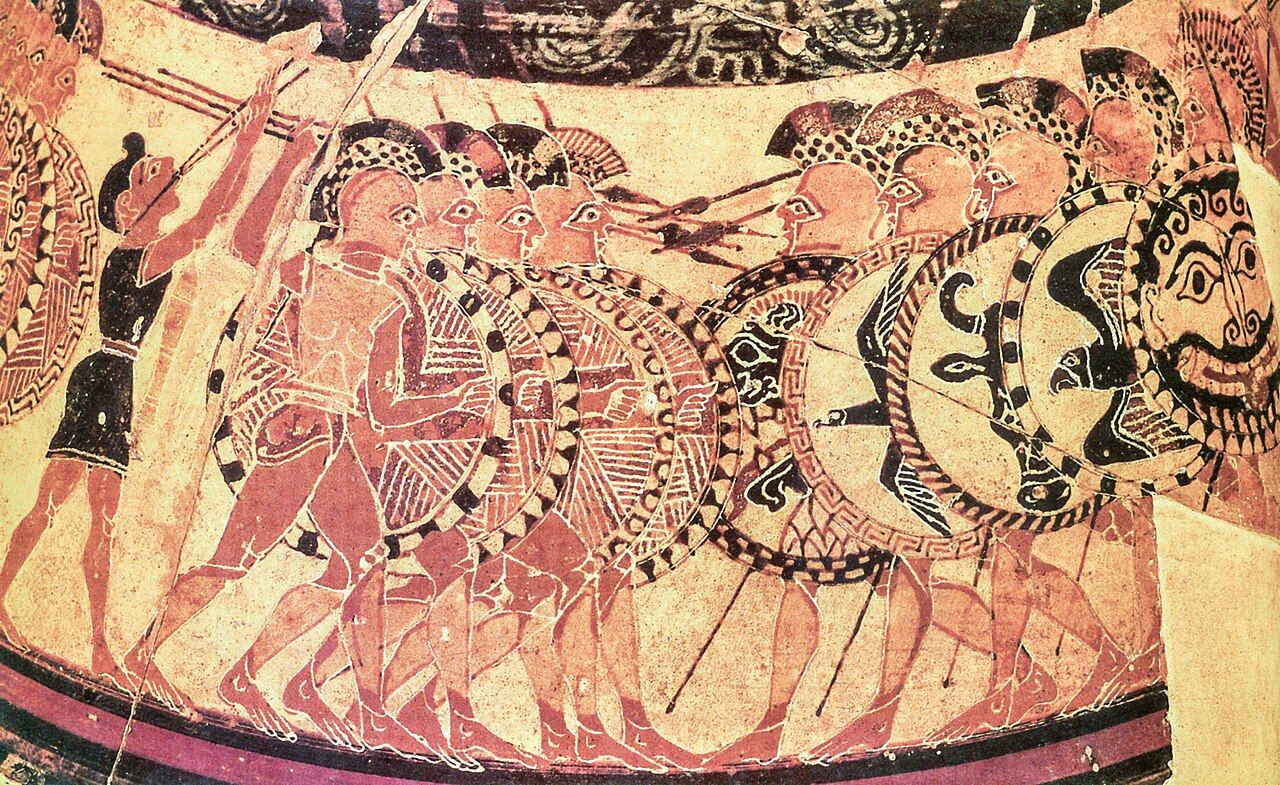
Around 700 BCE Greek warfare changed. Instead of aristocratic champions dueling before a crowd, cities fielded a phalanx: ranks of heavy infantry called hoplites, each carrying a thrusting spear and a distinctive round shield—the aspis, conventionally but probably wrongly called the hoplon—about ninety centimeters across, strapped at the forearm and gripped at the rim so that it covered the bearer’s left side and the exposed right side of the man to his left. That grip is the whole political argument in bronze. A phalanx works only if every man holds his place; the coward exposes the man beside him. Battles were short, brutal collisions decided by cohesion, not individual skill.
Hoplite equipment was expensive but not aristocratic—a prosperous farmer could buy it. The traditional “hoplite revolution” thesis argues that once the state’s survival depended on several thousand middling farmers rather than a few dozen horsemen, those farmers acquired political leverage they eventually cashed in for rights. Recent scholarship has complicated this. The phalanx probably developed gradually over a century rather than arriving as a shock, and the city with the most formidable hoplite army of all, Sparta, never became a democracy. The safer formulation: military participation and political participation tracked each other closely in Greece, and the direction of causation ran both ways.
Sparta: a state built on a conquered population
Sparta solved the land problem by conquest. In two long wars during the eighth and seventh centuries BCE, the Spartans took neighboring Messenia and reduced its population to helots—state-owned agricultural laborers bound to plots that supported Spartan citizens. Helots vastly outnumbered Spartiates, perhaps seven to one. Every year the Spartan magistrates formally declared war on the helots so that killing one carried no ritual pollution, and a secret police of young men, the krypteia, murdered those who seemed dangerous. Everything distinctive about Sparta follows from the need to sit permanently on top of that population.
Spartan boys entered the agoge at seven: communal barracks, deliberate hunger to teach foraging, endurance rituals at the sanctuary of Artemis Orthia. Adult male citizens, the homoioi or “similars,” dined nightly in common messes and were barred from trade and craft. The constitution mixed two hereditary kings (military commanders from separate royal houses), a council of elders called the gerousia, an assembly of citizens that shouted approval, and five annually elected ephors with sweeping executive power—a system Aristotle admired as a mixture and criticized as unstable. Spartan women, uniquely in Greece, exercised publicly, married later, inherited property, and by Aristotle’s day owned perhaps two-fifths of Spartan land. He considered this a defect. Most modern readers do not.
Sparta’s fatal flaw was arithmetic. Citizenship required contributing produce to a mess; a Spartiate who lost his land lost his status and could not regain it. The citizen body shrank from roughly eight thousand at the time of the Persian Wars to fewer than a thousand by 371 BCE, when Thebes broke Spartan power at Leuctra; roughly eighteen months later, in the winter of 370/369 BCE, a Theban army under Epaminondas invaded the Peloponnese, and Messene was refounded as a free city in 369 BCE. A society designed for one purpose could not replace its own members.
Athens before democracy: tension, tyranny and reform
Athens took a different road because it never conquered a helot population. Seventh-century Attica was instead being torn apart by debt. Poor farmers borrowed against their own persons; default meant enslavement, sometimes sale abroad. In 621 BCE Draco published the first written Athenian law code—harsh enough that “draconian” entered English—but writing law down was itself a concession, because unwritten law is whatever the aristocrat interpreting it says.
In 594 BCE the Athenians appointed Solon as archon with extraordinary powers to fix the crisis. He cancelled outstanding debts and the mortgage-stones that marked encumbered land (the seisachtheia, or shaking-off of burdens), banned lending on the security of a person, bought back Athenians sold abroad, and reorganized political rights by measured agricultural income rather than birth—four property classes, with the poorest, the thetes, gaining the right to attend the assembly and sit on juries even if they could not hold office. What he refused to do was redistribute land, which is what the poor had actually demanded. Herodotus and the Constitution of the Athenians report that he then left Athens for ten years so nobody could pressure him into revisions. In his surviving verse Solon notes that he satisfied neither the rich nor the poor and takes that as proof he held his shield over both.
Reform did not prevent tyranny. Peisistratus made himself tyrant for the third and lasting time in 546 BCE, two earlier attempts having collapsed. A Greek tyrannos was an unconstitutional ruler, not necessarily a cruel one, and Peisistratus was largely popular: he lent money to small farmers, expanded the Panathenaic festival and the City Dionysia (from which drama grew), built, and under his dynasty Athens began striking the silver owls that became the standard coin of the Aegean. His son Hippias turned repressive after his brother was assassinated in 514 BCE and was expelled in 510 BCE with Spartan help. The vacuum that followed produced Cleisthenes.
| Feature | Sparta | Athens (classical) |
|---|---|---|
| Economic base | Helot agriculture in Laconia & Messenia | Smallholding, olives & pottery, silver from Laurion, imported grain |
| Citizen body | c. 8,000 falling below c. 1,000 by 371 BCE | c. 40,000–60,000 adult males in 431 BCE; c. 30,000 by the fourth century |
| Unfree labor | Helots: state-owned, tied to land, could not be sold abroad | Chattel slavery: privately owned individuals, often purchased abroad |
| Decisive arm | Hoplite infantry | Trireme navy, rowed largely by poorer citizens |
| Executive | Two kings, five ephors, gerousia of 28 elders plus the kings | Ten annually elected generals; nearly all other offices by lot |
| Women’s position | Public athletics, property ownership, later marriage | Legally under a male guardian, secluded ideal, no property control |
| Attitude to outsiders | Periodic expulsion of foreigners (xenelasia) | Large resident-foreigner (metic) population, taxed and tolerated but never enfranchised |
Sparta and Athens faced the same shortage of land and labor and answered it oppositely—permanent conquest of a neighboring people versus debt reform, trade and overseas settlement—and those choices set their constitutions.
Section 3Athenian Democracy: How It Worked and Who It Left Out
Cleisthenes and the engineering of a citizen body
In 508–507 BCE Cleisthenes, an aristocrat who won a factional struggle by, in Herodotus’ phrase, taking the people into his party, redesigned Athenian society from the ground up. He abolished the political weight of the four old kinship tribes, which aristocratic families controlled, and created ten new tribes. The trick was in the construction. Attica was divided into about 139 demes—villages and city neighborhoods—grouped into thirty units called trittyes, ten each from the coast, the inland, and the city. Each new tribe received one trittys from each region. A tribe was therefore a deliberately artificial cross-section of Attica whose members had no shared ancestral loyalty to exploit.
Membership in your deme became hereditary and was the register of citizenship; Cleisthenes meant Athenians to be identified in public by deme rather than by father’s name, and although in practice both were used, the intent was a small revolution in identity. The Council, or Boule, now numbered 500, fifty from each tribe, chosen annually by lot from men over thirty, with a two-term lifetime limit. Each tribal contingent of fifty served as the standing executive committee for a tenth of the year, sleeping in the round tholos building; a chairman was drawn by lot each day and could serve only once in his life. That man—possibly a farmer who had never spoken in public—held the state seal for twenty-four hours. It is hard to imagine a system more hostile to professional politics.
The machinery of the radical democracy
By the age of Pericles, who dominated Athenian politics from about 461 to his death in the plague of 429 BCE, the institutions were these. The Ekklesia, the assembly of all adult male citizens, met about forty times a year on the Pnyx hill, a slope below the Acropolis holding perhaps six thousand men. It decided war, peace, treaties, taxation, grain supply and public building, by show of hands, after open debate in which any citizen could speak—the right called isegoria. The Boule set the agenda but could not decide. The courts, the dikasteria, seated juries of 201, 501, or in great cases 1,501 citizens over thirty, allotted—by the fourth century on the morning of the trial itself—through a slotted stone machine, the kleroterion, into which each juror’s bronze identity ticket was fed, specifically to defeat bribery. There were no judges and no lawyers; litigants spoke for themselves, timed by a water clock, and the jury voted by secret ballot without deliberating.
Almost every other office—perhaps 700 in all—was filled by lot for one year, on the principle that any citizen was competent to serve and that election favored the rich and famous. Aristotle states it flatly: selection by lot is democratic, election is oligarchic. The great exception was the board of ten strategoi, the generals, who were elected and could be re-elected indefinitely, because Athenians were willing to gamble on amateurs in the treasury but not on the battlefield. Pericles held that elected generalship year after year; his power was won by persuasion in the assembly, not by office. Pericles also introduced state pay for jury service, later extended to other offices, which made participation possible for men who worked with their hands—the change conservatives most resented and that made the democracy “radical.”
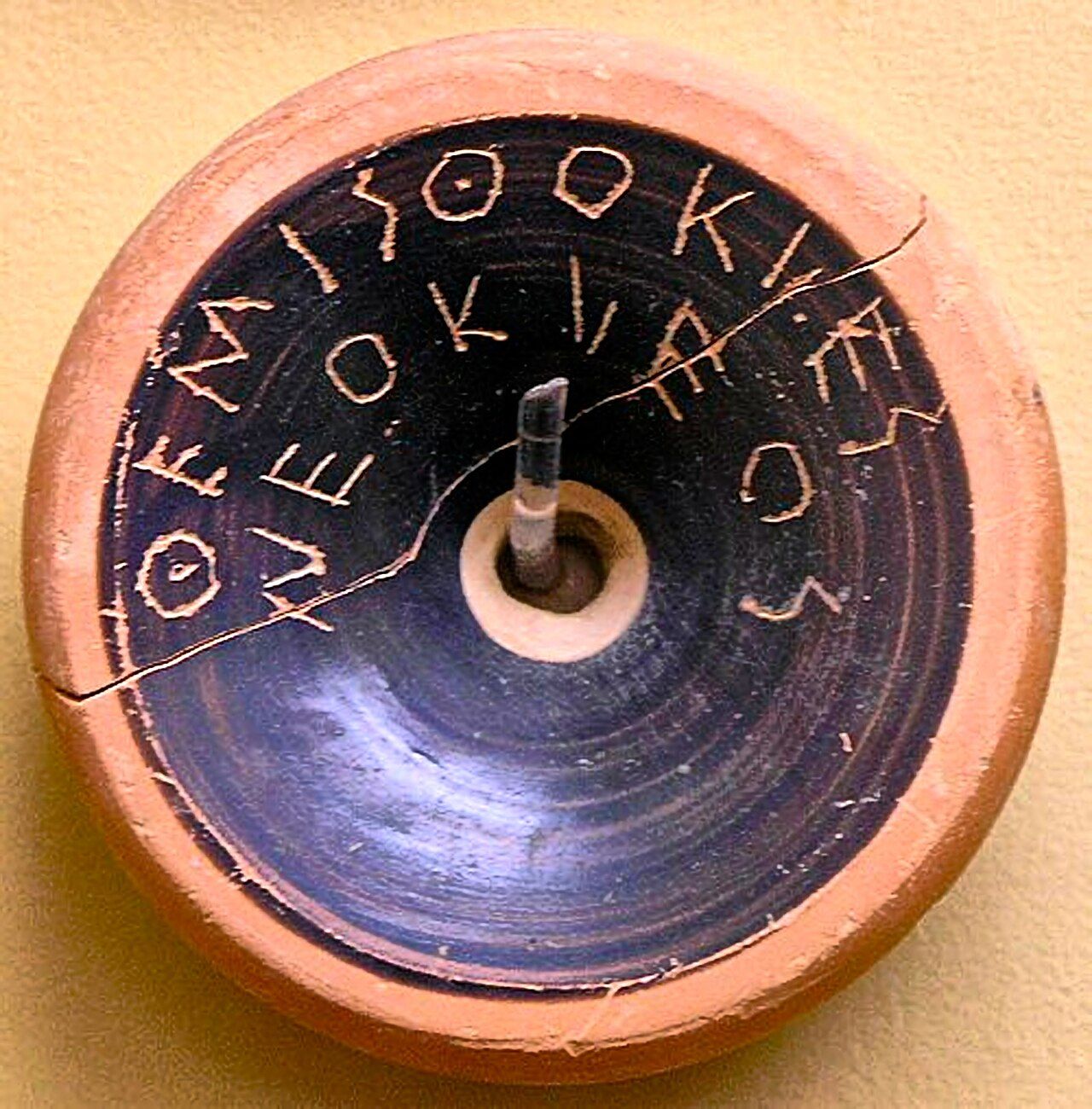
Ostracism completed the design. Once a year the assembly asked whether to hold one; if yes, citizens scratched a name on a pottery shard, and with a quorum of six thousand the leading name went into exile for ten years without loss of property or honor. It was not a punishment but a pressure valve, a way to resolve a deadlock between two powerful men without civil war. Thousands of ostraka have been excavated, including a cache of 190 bearing Themistocles’ name written in only a few hands—evidence that someone was mass-producing ballots.
The boundaries of the demos
Now the hard part. Attica in 431 BCE held perhaps 300,000 to 350,000 people; these are reconstructions from military and grain figures, not census data, and specialists disagree. Adult male citizens numbered somewhere between 40,000 and 60,000. Everyone else was excluded from political life. Women, whether rich or poor, could not vote, hold office, or represent themselves in court; a citizen woman acted through a male guardian, her kyrios. Pericles’ own citizenship law of 451 BCE tightened the boundary further by requiring both parents to be Athenian—which raised the status of citizen women as bearers of citizenship while narrowing the citizen body. Metics, free resident foreigners who might be wealthy bankers or philosophers (Aristotle was one), paid a residence tax, served in the army, and never voted. And a large enslaved population, variously estimated at 60,000 to 150,000, did domestic work, craft labor and, in the worst case, mining at Laurion, where the silver that funded the fleet was cut by men working in tunnels barely tall enough to kneel in.
Two conclusions have to sit together without cancelling each other. First, Athenian democracy was more direct and more participatory than any modern representative system: a randomly selected citizen actually governed, and the assembly actually decided. Second, it rested on the labor of people it defined as not-people, and its most famous defenders—Plato, Aristotle, the anonymous conservative called the Old Oligarch—did not think this needed justifying. Historians disagree about how much slavery was strictly necessary to the democracy’s functioning; they do not disagree that it existed on a large scale. Reading Athens honestly means holding the achievement and the exclusion in one hand.
| Institution | Who served | How chosen | What it did |
|---|---|---|---|
| Ekklesia (Assembly) | All adult male citizens, c. 6,000 attending | Open to all who came | Final vote on war, treaties, laws, finance |
| Boule (Council of 500) | Citizens over 30, max two terms in a lifetime | Lot, 50 per tribe, annually | Prepared the assembly’s agenda; daily administration |
| Prytaneis | The 50 councillors of one tribe | Rotation by lot, one tenth of the year | Standing executive; chairman drawn daily by lot |
| Dikasteria (Courts) | Citizens over 30, paid a daily wage | Lot on the day, via the kleroterion | Tried cases; also reviewed officials and laws |
| Strategoi (Generals) | Usually wealthy, experienced men | Elected, re-electable without limit | Commanded forces; in practice led policy |
| Areopagus | Ex-archons, for life | By past office | Reduced in 462 BCE to homicide and religious cases |
Athenian democracy governed by lottery, rotation and mass juries rather than by professional representatives—an extraordinary experiment in ordinary citizens’ competence, built on the exclusion of women, foreigners and tens of thousands of enslaved people.
Section 4Persia, Empire and the Peloponnesian War
The Persian Wars, 499–479 BCE
The Achaemenid Persian empire under Darius I ran from the Indus to the Aegean—the largest state the world had yet seen, and by ancient standards a tolerant one. Greek cities on the coast of Asia Minor were its subjects. In 499 BCE they revolted, and Athens and Eretria sent modest help; Persia broke the Ionian fleet at Lade and sacked Miletus in 494 BCE, mopping up the rest the following year. In 490 BCE Darius sent a punitive expedition that landed at Marathon, twenty-six miles from Athens, where roughly 10,000 Athenians and Plataeans under Miltiades broke the Persian line. Herodotus reports 192 Athenian dead against thousands of Persians; the numbers are surely skewed but the outcome was not.
Ten years later Darius’ son Xerxes came with an army and fleet in overwhelming force. Herodotus’ figure of 1.7 million soldiers is impossible; modern estimates run from 80,000 to perhaps 300,000, still an enormous logistical feat requiring a pontoon bridge across the Hellespont and a canal cut through the Athos peninsula. In 480 BCE a Spartan-led force under Leonidas held the pass at Thermopylae for three days before a local man showed the Persians a mountain path; Leonidas and his 300 Spartiates died covering the retreat, along with 700 Thespians and several hundred helots. The Theban contingent, Herodotus says, surrendered. Persia burned Athens. But Themistocles had persuaded the Athenians in 483 BCE to spend a new silver strike at Laurion on 200 triremes rather than distribute it as a dividend, and that fleet, luring the Persian navy into the narrows at Salamis, shattered it. The following year the allied Greeks won on land at Plataea and at sea off Mycale, and the invasion was finished—though fighting with Persia went on in the Aegean for another generation.
The consequences outran the battles. Athens ended the war with the best navy in the Aegean and a conviction, expressed in tragedy and in stone, that free men fighting for their own laws had beaten a king’s subjects. That story hardened into an ideology of Greek versus “barbarian” that had not existed with the same force before 480 BCE—and that later Europeans would enthusiastically borrow.
From alliance to empire
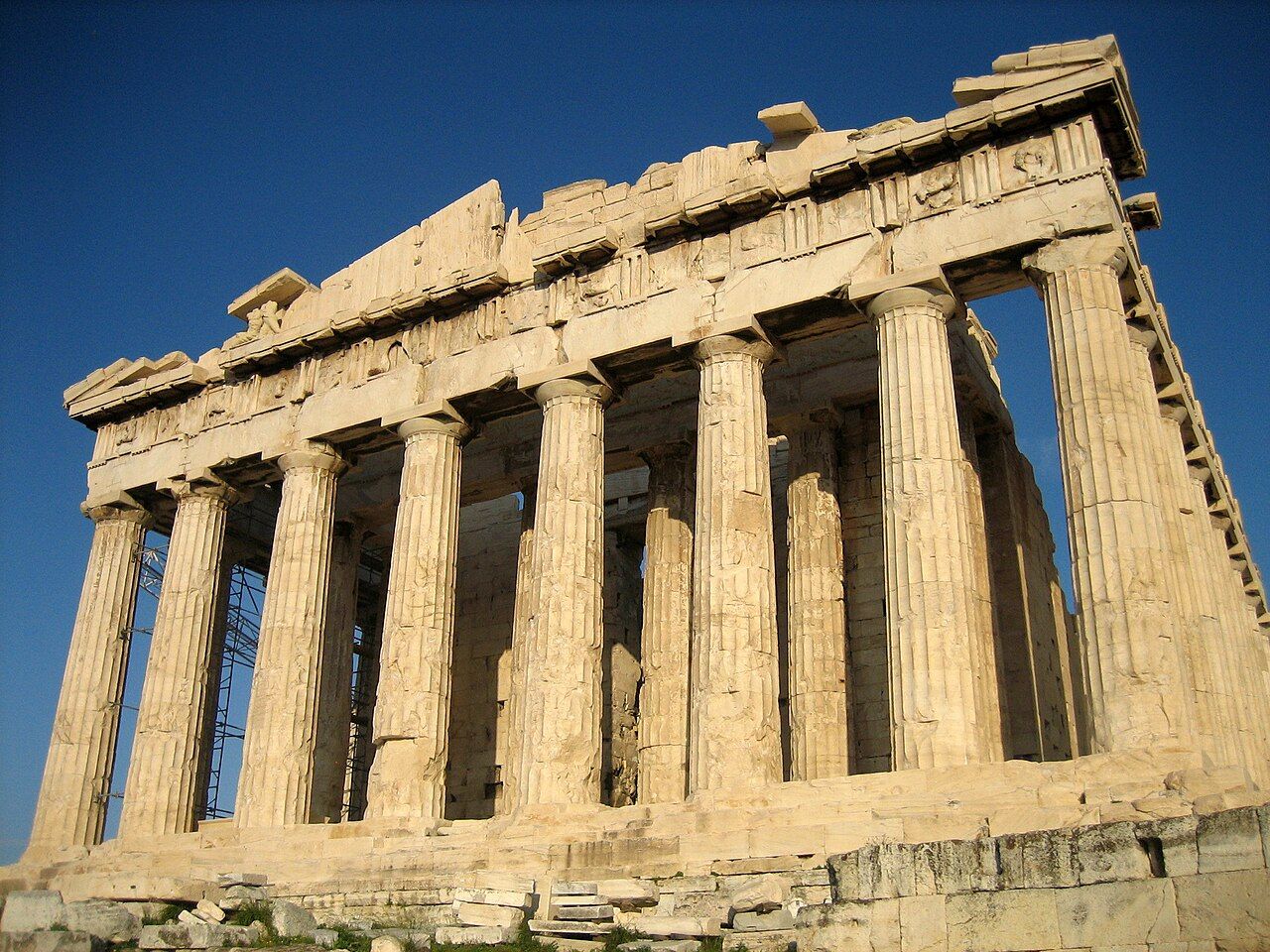
In 478 BCE the Aegean states formed the Delian League to continue the war, with a treasury on the sacred island of Delos and Athens providing leadership. Members contributed ships or, increasingly, cash. Over three decades the alliance became something else. Naxos tried to leave around 470 BCE and was besieged into submission. Thasos revolted in 465 BCE and lost its fleet, walls and mines. In 454 BCE the treasury was moved to Athens, ostensibly for safety, and one-sixtieth of the tribute was thereafter paid to Athena—the records of those payments, inscribed on marble, are our best financial documents from the ancient world. A decree whose date is still disputed required allied cities to use Athenian coins, weights and measures, and major legal cases had to be brought to Athenian courts. Pericles spent tribute money on the Acropolis building program, and when critics said this was dressing Athens up like a vain woman with her allies’ money, he replied that the allies were paying for protection and had no claim on how the money was spent. Both halves of that exchange are true.
The Peloponnesian War, 431–404 BCE
Thucydides, an Athenian general exiled after failing to save Amphipolis, wrote the war’s history and framed its cause in a sentence that historians have argued about ever since: the truest cause, least openly stated, was that the growth of Athenian power frightened the Spartans and forced them to war. He distinguished this underlying cause from the immediate grievances—Corcyra, Potidaea, the Megarian decree—and the distinction between deep structural cause and proximate trigger is one of his lasting gifts to historical method.
The war ran twenty-seven years. Athens was a sea power, Sparta a land power, and neither could strike the other’s strength. Pericles’ strategy was to abandon the countryside, shelter the population behind the Long Walls to Piraeus, and let the fleet feed the city and raid the coast. Crowding brought catastrophe: a plague, probably arriving via Egypt in 430 BCE, killed perhaps a quarter to a third of the Athenian population, Pericles among them. Thucydides caught it, survived, and described the symptoms with clinical precision so that it might be recognized again—the earliest surviving attempt at a case definition. He also described the social collapse that followed: people spent freely, ignored law and burial custom, because neither punishment nor piety seemed likely to arrive in time.
After Pericles the war coarsened. At Melos in 416 BCE Athens demanded submission from a neutral island, and Thucydides stages a dialogue in which the Athenians say the strong do what they can and the weak suffer what they must; the Athenians then killed the adult men and enslaved the women and children. In 415 BCE the assembly voted an enormous expedition to Syracuse in Sicily, urged on by the brilliant, unstable Alcibiades, who was then recalled on a charge of religious sacrilege and defected to Sparta. The Sicilian expedition ended in 413 BCE with the fleet destroyed and the survivors dying in the stone quarries. Persia then funded a Spartan navy—the decisive intervention—and Lysander destroyed the last Athenian fleet at Aegospotami in 405 BCE. Athens surrendered in 404 BCE, pulled down its walls, and endured a brutal oligarchy, the Thirty Tyrants, before restoring democracy in 403 BCE with a general amnesty.
| Year BCE | Event | Why it mattered |
|---|---|---|
| 490 | Battle of Marathon | Athenians and Plataeans beat Persia without Sparta; huge boost to democratic confidence |
| 480 | Thermopylae and Salamis | Naval victory saves Greece and makes the poorer rowers politically weighty |
| 478 | Delian League founded | Alliance that becomes the financial base of Athenian empire |
| 462–461 | Ephialtes strips the Areopagus | Radical democracy begins; Ephialtes is assassinated |
| 454 | League treasury moved to Athens | Alliance becomes empire in fact |
| 431 | Peloponnesian War opens | Sparta acts on fear of Athenian growth |
| 430–426 | Plague of Athens | Kills Pericles and up to a third of the population |
| 415–413 | Sicilian expedition | Catastrophic overreach; fleet and army annihilated |
| 405–404 | Aegospotami; Athens surrenders | Persian-funded Spartan fleet ends the war |
| 403 | Democracy restored with amnesty | Shows the system’s resilience, not its death |
Athenian sea power built after the Persian Wars turned an alliance into an empire, and Spartan fear of that empire—funded at the end by Persian gold—produced a twenty-seven-year war that exhausted every Greek state that fought it.
Section 5Reason on Trial: Philosophy, Tragedy and the Hellenistic Aftermath
Asking what things are made of
Around 585 BCE, a man in Miletus named Thales reportedly predicted a solar eclipse and proposed that everything is ultimately water. Both claims matter less than the move behind them: he explained the world without invoking the will of a god. His successors argued with him rather than repeating him—Anaximander proposed a boundless indefinite substance and suggested humans descended from fish-like creatures; Anaximenes chose air, condensing and rarefying. These Presocratics disagree wildly, and that is the point. They established a tradition of publicly criticizing your teacher.
Others pushed harder. Pythagoras and his followers in southern Italy found that harmonious musical intervals correspond to simple whole-number ratios of string length and concluded that number is the structure of reality—a claim that runs straight through to modern physics. Heraclitus of Ephesus insisted that everything is in flux and that the world is governed by an ordering principle he called logos. Parmenides argued from pure logic that change is impossible and the senses deceive. Democritus, extending his teacher Leucippus’ answer to Parmenides, proposed that everything consists of indivisible particles—atomoi—moving in void. He was right for entirely the wrong reasons, which is a useful lesson about the history of science.
The turn to human things: Sophists, Socrates, Plato, Aristotle
Fifth-century Athens, rich and litigious, generated a market for teachers of persuasion. The Sophists—Protagoras, Gorgias, Thrasymachus—taught rhetoric and argument for fees. Protagoras’ famous line that man is the measure of all things, and his admission that he could not know whether the gods exist, made them look like relativists undermining traditional morality, and Plato’s hostile portraits fixed that reputation. Fairly read, they were the first people to insist that law and custom (nomos) are human conventions rather than facts of nature (physis), which is a genuine intellectual achievement even when the conclusions drawn from it were cynical.
Socrates (c. 469–399 BCE) wrote nothing, charged nothing, and claimed to know nothing except the extent of his ignorance. He cross-examined Athenians about courage, piety and justice until their confident definitions collapsed—the method called elenchus. In 399 BCE, five years after the defeat and the oligarchic terror, he was tried before a jury of 501 on charges of impiety and corrupting the young, convicted by a narrow margin, and executed by hemlock. The political subtext is hard to miss: several of his associates, including Critias and Alcibiades, had betrayed the democracy, and the amnesty of 403 BCE forbade prosecuting men for their conduct under the Thirty. It has been argued that Athens killed him for what his students did. Whatever the motive, the democracy executed a citizen for asking questions, and that fact permanently complicated the Western memory of Athens.
Plato (c. 428–348 BCE), Socrates’ student, founded the Academy around 387 BCE and wrote dialogues in which Socrates usually leads. His central claim is that the changing things we see are imperfect copies of unchanging Forms grasped by reason—beauty itself, justice itself—and that knowledge therefore is not sense experience. The allegory of the cave in the Republic makes ordinary opinion into shadows on a wall. Politically, Plato concluded from Socrates’ death that democracy is rule by the flattered ignorant, and proposed government by philosopher-rulers trained for decades and holding no private property. It is the earliest surviving systematic utopia and the earliest systematic argument against democracy, and both lineages are still with us.
Aristotle (384–322 BCE) studied under Plato for twenty years, tutored the young Alexander of Macedon, and founded the Lyceum in Athens. He rejected separate Forms: form exists in things, and knowledge starts with observation. He essentially invented formal logic, systematic biology—his marine observations at Lesbos were not surpassed for two millennia—literary criticism, and comparative politics, collecting 158 constitutions before analyzing them. His Nicomachean Ethics locates the good life in eudaimonia, human flourishing achieved through habituated virtue, a mean between excesses, exercised over a whole life. He also defended slavery as natural for some people and considered women deficient in deliberative capacity—errors that later Europeans quoted with enthusiasm precisely because his authority was so enormous.
Tragedy, history and the public examination of life
Philosophy was not the only place Greeks argued about first things. At the City Dionysia each spring, thousands of Athenians watched tragedies staged in competition and paid for by wealthy citizens as a public duty. Aeschylus’ Oresteia (458 BCE) traces blood vengeance until Athena replaces it with a homicide jury on the Areopagus—a founding myth of the rule of law, staged three years after Ephialtes had cut that same court back to precisely this jurisdiction. Sophocles’ Antigone sets divine obligation against the state’s command and refuses to make either side simply wrong. Euripides’ Trojan Women, produced in 415 BCE just after the massacre at Melos, shows the war’s victims as the victors watched. Aristophanes’ comedies mocked living generals and philosophers by name in front of the men they mocked. A society that funds its own criticism is doing something unusual.
History as a genre began here too. Herodotus of Halicarnassus set out to preserve the memory of great deeds and to explain why Greeks and Persians fought; he traveled widely, reported conflicting versions, and often declined to choose between them. Thucydides mocked storytellers and claimed to write a possession for all time based on eyewitness testing—while composing speeches according to what he judged the occasion demanded. Both are indispensable and neither is neutral.
Alexander and the Hellenistic world
The independent polis ended not by internal decay but by conquest. Philip II ruled Macedon, a northern kingdom most Greeks regarded as half-barbarian. He combined a longer pike, the sarissa, with heavy cavalry and siege engineering, and in 338 BCE defeated the allied armies of Athens and Thebes at Chaeronea. His son Alexander, taking the throne at twenty in 336 BCE, invaded the Persian empire in 334 BCE and broke it in four campaigning seasons—Granicus in 334, Issus in 333, Gaugamela in 331, then Persepolis—before driving on through Bactria to the Punjab, where in 326 BCE his exhausted army refused to go further. He died in Babylon in 323 BCE at thirty-two. His generals carved the empire into the Hellenistic kingdoms: Ptolemaic Egypt, Seleucid Asia, Antigonid Macedon.
That world was larger, wealthier and more cosmopolitan than the classical polis, and its thought shifted accordingly. When you are a subject of a distant king rather than a voting member of a small city, ethics turns inward. Stoicism, founded by Zeno of Citium around 300 BCE, taught that virtue alone is good, that a rational order pervades the cosmos, and that all humans share in reason—the seed of natural-law and human-rights thinking, later transmitted through Cicero and Roman jurists. Epicureanism taught that the good is freedom from pain and disturbance, that the gods do not interfere, and that death is nothing to us since when we exist death does not, a doctrine of consolation rather than indulgence. Meanwhile the Museum and Library at Alexandria funded the best science of antiquity: Euclid’s Elements, Eratosthenes calculating the earth’s circumference from shadow lengths at Syene and Alexandria (how close he came depends on which stade he used, but the method was sound and the answer was in the right range), Aristarchus proposing that the earth orbits the sun—a heliocentric model that convinced almost nobody for eighteen hundred years. Archimedes, working in Syracuse but formed by the same tradition, established the law of the lever and the principle of buoyancy.
| Thinker or school | Dates | Central claim | Long shadow |
|---|---|---|---|
| Thales & the Milesians | c. 600–530 BCE | Nature has natural causes | The premise of all science |
| Pythagoreans | from c. 530 BCE | Reality has numerical structure | Mathematical physics |
| Democritus | c. 460–370 BCE | Indivisible atoms in void | Revived by Epicurus, then by early modern chemistry |
| Sophists | fifth century BCE | Law and custom are human conventions | Rhetoric, legal argument, cultural relativism debates |
| Socrates | c. 469–399 BCE | The unexamined life is not worth living | Ethics as self-examination; the martyr of free inquiry |
| Plato | c. 428–348 BCE | Unchanging Forms are the objects of knowledge | Christian theology, idealism, critiques of democracy |
| Aristotle | 384–322 BCE | Knowledge begins in observation; virtue is a habit | Logic, biology, scholasticism, virtue ethics |
| Stoics | from c. 300 BCE | Virtue suffices; reason is shared by all humans | Natural law, Roman jurisprudence, modern resilience therapy |
| Epicureans | from c. 307 BCE | Absence of pain and fear is the good | Secular ethics; Lucretius; Enlightenment materialism |
Greek thought moved from asking what the world is made of, to asking how humans should live together, to consoling individuals inside vast kingdoms—and its methods of argument, not its conclusions, are the durable inheritance.
The chapter in one breath
When the Mycenaean palaces burned around 1200 BCE, Greece lost writing, kings and bureaucracy, and when it recovered three centuries later it built something without precedent: hundreds of small self-governing city-states in which armed farmers considered themselves each other’s equals. Scarcity pushed Greeks outward into colonies from Marseille to the Black Sea and inward into argument about who should rule. Sparta answered by enslaving Messenia and turning itself into a garrison; Athens answered with Solon’s debt reform, Cleisthenes’ artificial tribes, and finally a radical democracy run by lot, rotation and mass juries—an astonishing experiment resting on the excluded labor of women, metics and tens of thousands of enslaved people. Victory over Persia gave Athens a navy, the navy gave it an empire, the empire frightened Sparta, and the resulting twenty-seven-year war ruined the winner along with the loser. Through all of it Greeks did something rarer than any battle: they demanded reasons—from Thales to Aristotle, from tragedy to Thucydides. Macedon ended the independence of the polis at Chaeronea in 338 BCE, and Athenian democracy itself in 322. The habit of argument outlived both, and Rome would inherit it.
Words worth knowing
| Term | What it means |
|---|---|
| Polis | A self-governing Greek city-state: an urban center, its farmland, and above all its body of citizens. |
| Linear B | The syllabic script of Mycenaean palace records, deciphered in 1952 and shown to encode an early form of Greek. |
| Hoplite | A citizen heavy infantryman who supplied his own armor and fought shoulder to shoulder in the phalanx. |
| Phalanx | A dense rectangular formation of hoplites whose effectiveness depended on every man holding his position. |
| Helot | A member of the conquered Messenian and Laconian population held in state servitude by Sparta. |
| Agoge | Sparta’s compulsory state upbringing for boys from age seven, designed to produce disciplined soldiers. |
| Ephor | One of five Spartan magistrates elected annually with power to oversee, and even prosecute, the kings. |
| Seisachtheia | Solon’s “shaking off of burdens”: cancellation of debts and the ban on enslaving Athenians for debt. |
| Tyrannos | A ruler who seized power outside the constitution; not necessarily cruel, but never legitimate. |
| Deme | One of about 139 local Athenian villages or wards; hereditary membership defined citizenship after Cleisthenes. |
| Ekklesia | The Athenian assembly of adult male citizens, meeting on the Pnyx and holding final decision-making power. |
| Boule | The Council of 500, chosen by lot, that prepared business for the assembly and ran daily administration. |
| Dikasteria | Athenian people’s courts staffed by large allotted juries of citizens, with no judges or professional lawyers. |
| Ostracism | A procedure the assembly could vote to hold each year: citizens named a prominent man on a potsherd, and the leading name went into ten-year exile without loss of property. |
| Metic | A free foreigner resident at Athens who paid a special tax, could serve militarily, but never voted. |
| Delian League | The 478 BCE anti-Persian alliance led by Athens that hardened into the Athenian empire. |
| Sophist | A paid fifth-century teacher of rhetoric and argument who treated law and custom as human convention. |
| Elenchus | Socrates’ method of cross-examination that exposes contradictions in a person’s stated beliefs. |
| Forms | In Plato, the unchanging realities—justice itself, beauty itself—that reason grasps and the senses cannot. |
| Hellenistic | The period and culture from Alexander’s death in 323 BCE to Roman dominance, marked by large kingdoms and cosmopolitan Greek culture. |