Absolutism, the Scientific Revolution and the Enlightenment
Between roughly 1600 and 1789 Europeans rebuilt two things at once: the machinery of the state and the machinery of knowing. Kings who had once bargained with nobles, towns and provincial estates now taxed harder, drilled larger armies and claimed to answer to God alone — while in England and the Dutch Republic a different settlement gave law-making power to assemblies and made public credit, not royal glory, the sinew of power. In the same decades a small, quarrelsome network of astronomers, physicians and instrument-makers replaced Aristotle’s cosmos with a mathematical one, and then argued that the same methods could be turned on law, religion, punishment and trade. The result was the Enlightenment: not a single doctrine but an argument conducted in salons, coffeehouses and smuggled books. This chapter traces how power was concentrated, how it was checked, how nature was re-described, and what happened when reformers tried to govern by reason.
By the end of this chapter you can
- Define absolutism and explain what it actually achieved — and what it never controlled — using Louis XIV’s France as the test case.
- Compare the fiscal-military states of France, Brandenburg-Prussia, Russia and the Austrian Habsburg lands.
- Trace the English road from the Petition of Right to the Glorious Revolution and the Bill of Rights, and say why a constitutional monarchy borrowed money more cheaply than an absolute one.
- Explain the heliocentric argument from Copernicus through Kepler, Galileo and Newton, and identify what each actually contributed.
- Distinguish empiricism from rationalism and describe how new institutions such as the Royal Society made knowledge public and repeatable.
- Analyze the core Enlightenment texts — Montesquieu, Voltaire, Diderot’s Encyclopédie, Rousseau, Beccaria, Smith, Kant — and the public sphere that carried them.
- Evaluate enlightened absolutism under Frederick II, Catherine II and Joseph II, separating rhetoric from measurable reform.
- Assess the Enlightenment’s contradictions on slavery, race and women’s status, and its concrete gains in medicine and public health, including variolation and vaccination.
Section 1The Sinews of Power: Absolutism and Its Limits
What absolutism claimed
Absolutism is the doctrine that sovereignty is indivisible and rests wholly in the monarch, who is accountable to God rather than to any assembly, court or corporate body. Its clearest statement came from Jacques-Bénigne Bossuet, tutor to Louis XIV’s son, in Politics Drawn from the Very Words of Holy Scripture: the king’s person is sacred, his authority paternal, absolute and subject to reason. Behind Bossuet stood Jean Bodin, who in 1576 had defined sovereignty as the power to make law without consent, and Thomas Hobbes, who in Leviathan (1651) reached a similar conclusion from an entirely secular premise: without an undivided sovereign, life is a war of all against all.
The claim was a response to trauma. France had endured four decades of religious civil war, then the Fronde of 1648–1653, a tangled revolt of law courts and great nobles during which the boy king Louis XIV was hustled out of Paris in the night. He never forgot it. When Cardinal Mazarin died in 1661, the twenty-two-year-old announced that he would govern without a chief minister — and, remarkably for a man of his era, actually did the paperwork, meeting his councils several hours a day for fifty-four years.
The famous line L’état, c’est moi is almost certainly a later invention; what Louis is reliably reported to have said on his deathbed is closer to the opposite: Je m’en vais, mais l’État demeurera toujours — I depart, but the State will remain. That distinction matters. Absolutism was less a cult of personality than a theory of the state, and its practical content was administrative.
Building the fiscal-military state
What made the seventeenth-century monarchy formidable was money and men. Jean-Baptiste Colbert, controller-general of finances from 1665 until his death in 1683, attacked tax farming, audited accounts, chartered manufactures, subsidized the Gobelins tapestry works and the navy, and pursued mercantilism — the assumption that world trade was a fixed pot and that a state grew rich by exporting more than it imported. He also extended the intendants, royal commissioners posted to each généralité who reported directly to the royal council and could override local officials. The intendant, not Versailles’ mirrors, was the real innovation.
Meanwhile the army swelled from perhaps 70,000 men in the 1660s to over 340,000 on paper by the 1690s, with uniforms, standardized muskets, magazines and Vauban’s ring of frontier fortresses. Historians call this the fiscal-military state: a government whose primary business is extracting revenue to pay for war, and whose bureaucracy grows because war debts do. Louis fought in four major conflicts. The last, the War of the Spanish Succession (1701–1714), ended at Utrecht and Rastatt with his grandson on the Spanish throne but barred from ever inheriting France, and France itself exhausted, its people taxed through the taille, the gabelle salt monopoly and the new capitation head tax, and the famines of 1693–94 and 1709 killing well over a million people between them.
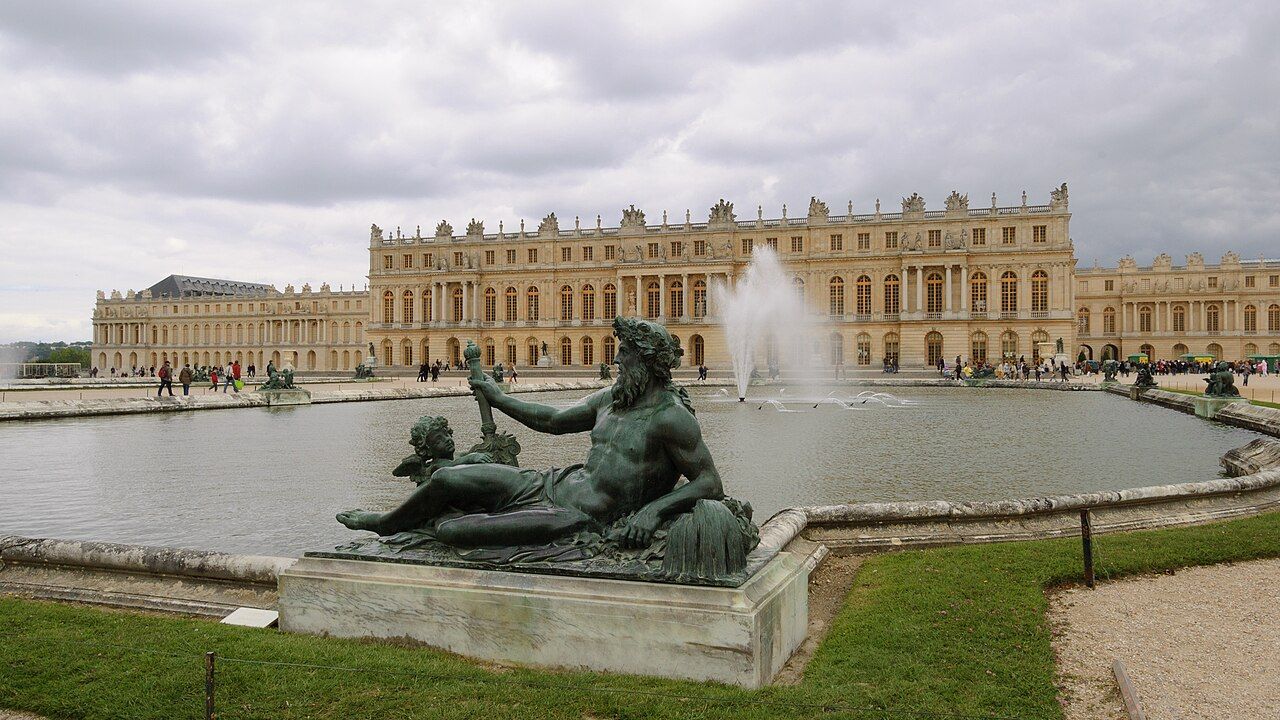
Versailles itself, occupied by the court from 1682, was a political instrument. By requiring the high nobility to attend the king’s rising and retiring, to compete for the right to hand him his shirt, Louis converted a warrior aristocracy into courtiers whose careers depended on visibility rather than on provincial armies. It worked, at a price: the nobles kept their fiscal exemptions, and the crown kept borrowing.
Variants: Prussia, Russia, Austria, Spain
The French model was copied unevenly. In Brandenburg-Prussia, Frederick William the Great Elector (1640–1688) struck a bargain that would define the state: the Junker nobility surrendered political resistance and paid little tax, and in exchange received unchallenged authority over their serfs plus, in time, a near-monopoly on officer commissions. His grandson Frederick William I (1713–1740) drilled an army of 80,000 out of a population of some 2.2 million, ran the treasury like a miser and created the General Directory. Prussia was, in a phrase usually credited to Mirabeau though its origin is disputed, not a state with an army but an army with a state.
In Russia, Peter the Great (r. 1682–1725) forced a top-down transformation: a new capital, St Petersburg, begun in 1703 on conquered marshland at enormous human cost; the beard tax and Western dress imposed on the service nobility; the Table of Ranks (1722) tying status to state service rather than birth; the patriarchate replaced by a Holy Synod under a lay procurator. Victory over Sweden at Poltava (1709) and the peace of Nystad (1721) made Russia a European great power. It also deepened serfdom exactly as western Europe was shedding it — the great east-west divergence of early modern Europe.
The Austrian Habsburgs ruled a composite monarchy of Austrian, Bohemian and Hungarian lands, each with its own laws and diets; after breaking the Ottoman siege of Vienna in 1683 and winning Hungary at Karlowitz (1699), they expanded outward but never centralized as thoroughly. Spain moved the other way. Burdened by American silver that fuelled inflation rather than industry, by the expulsion of the Moriscos and by chronic war, it lost Portugal in 1640, revolted in Catalonia, and by 1700 was a prize to be fought over rather than a power.
| State | Key ruler | Instrument of control | Structural weakness |
|---|---|---|---|
| France | Louis XIV, 1643–1715 | Intendants, standing army, court ritual at Versailles | Tax exemptions for clergy and nobility; venal offices; war debt |
| Brandenburg-Prussia | Frederick William I, 1713–1740 | Junker–crown bargain; canton recruitment; General Directory | Small population; scattered, indefensible territories |
| Russia | Peter I, 1682–1725 | Table of Ranks; Holy Synod; conscription from serf villages | Reform reached only the elite; serfdom hardened |
| Austria | Leopold I, 1658–1705 | Dynastic marriage; Catholic renewal; army against the Ottomans | Composite monarchy of separate diets and legal systems |
| Spain | Charles II, 1665–1700 | Councils and viceroys inherited from the sixteenth century | Debt, depopulation, revolt in Catalonia and Portugal |
Absolutism was a theory of undivided sovereignty whose real achievement was a tax-raising, army-feeding bureaucracy — built, everywhere, by leaving noble privilege intact.
Section 2The Other Path: England, the Dutch and the Politics of Consent
Civil war, regicide and the failure of republican rule
England’s crown was chronically poor. Without a standing army or a professional bureaucracy, Stuart kings needed Parliament to vote taxes, and Parliament used the moment to press grievances. Charles I accepted the Petition of Right in 1628 — no taxation without parliamentary consent, no arbitrary imprisonment, no billeting of troops — then ruled without Parliament for eleven years, raising money through revived medieval devices such as ship money. The system held until he tried to impose an Anglican prayer book on Presbyterian Scotland in 1637. The Scots invaded; Charles needed money; the Long Parliament met in 1640 and never let go.
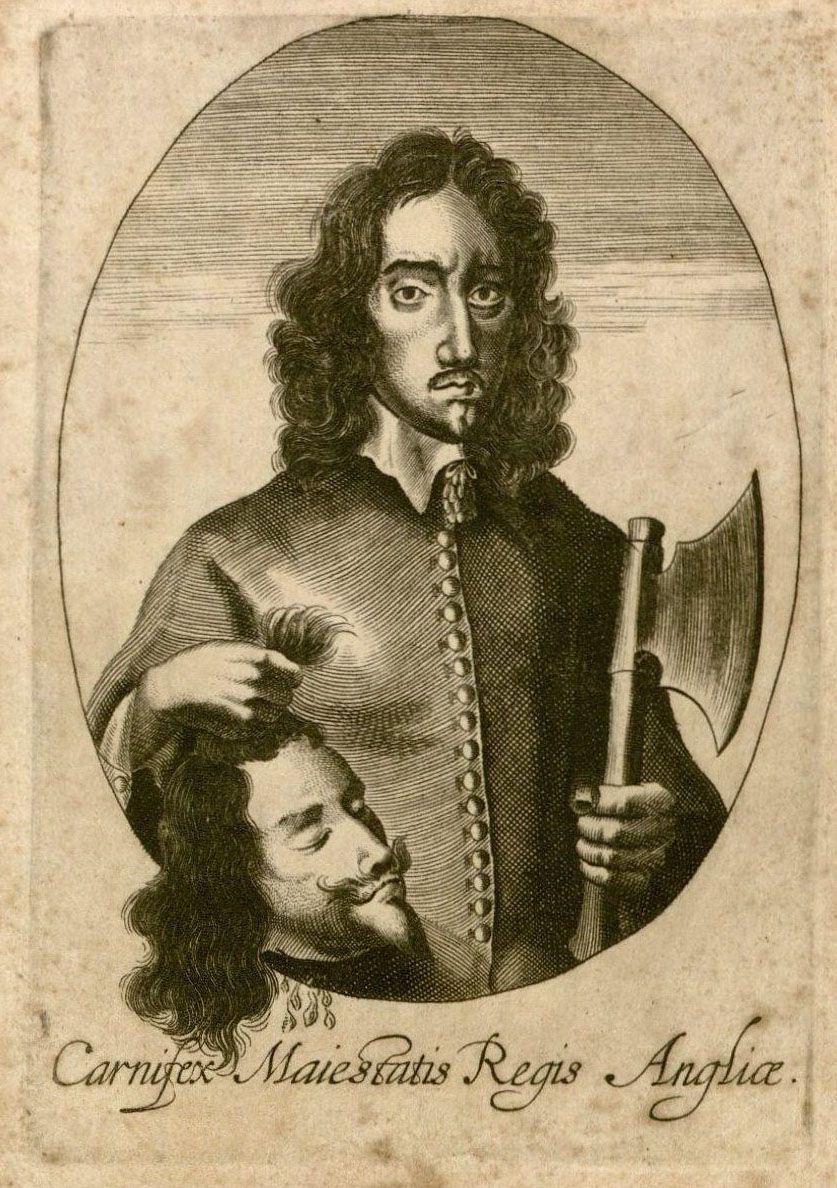
Civil war broke out in 1642. It was fought over religion as much as taxation, and it radicalized fast: at Putney in 1647 the New Model Army’s council, chaired by Oliver Cromwell, heard Colonel Thomas Rainsborough insist that “the poorest he that is in England hath a life to live as the greatest he.” In January 1649 a purged Parliament tried the king for treason against his own people and beheaded him — an act that horrified Europe precisely because it made the monarch a defendant. The republic that followed, and then Cromwell’s Protectorate (1653–1658), never solved the problem of legitimacy without a king. In 1660 Charles II was invited back.
The Restoration settlement papered over the real dispute: whether a Catholic could inherit. The Exclusion Crisis of 1679–1681 produced the labels Whig and Tory. When James II succeeded in 1685, suspended penal laws by royal prerogative, packed the army with Catholic officers and then fathered a Catholic heir in June 1688, seven leading men invited his Protestant son-in-law William of Orange to intervene.
1688 and its settlement
The Glorious Revolution was neither bloodless nor purely English — William landed with roughly 15,000 troops, and the accompanying wars in Ireland and Scotland were savage. But in England the outcome was constitutional. The Declaration and then the Bill of Rights (1689) barred the crown from suspending laws, keeping a standing army in peacetime or levying taxes without parliamentary consent, guaranteed free elections and free speech in Parliament, and excluded Catholics from the throne. The Toleration Act of the same year gave Protestant dissenters freedom of worship, though not full civil rights. The Act of Settlement (1701) secured judges’ tenure and the Hanoverian succession; the Union with Scotland followed in 1707.
John Locke’s Two Treatises of Government, published in 1689, was long read as the revolution’s official apology. Since Peter Laslett’s work most scholars date its composition a decade earlier, during the Exclusion Crisis, making it a justification for resistance rather than a rationalization of a fait accompli. Its argument is still the load-bearing one in liberal political thought: individuals possess natural rights to life, liberty and property; government is a trust created by consent to protect them; when a ruler breaks that trust, the people may replace him.
The practical payoff was financial. A monarch who could not repudiate debts unilaterally, whose budgets Parliament audited, was a better credit risk. The Bank of England (1694) and a funded national debt let Britain borrow at rates France could not match, which is how a smaller country outspent a larger one through a century of war. This is the great irony of the period: the constitutional state proved more powerful than the absolutist one, because consent was cheaper than coercion.
| Year | Event | What it settled |
|---|---|---|
| 1628 | Petition of Right | No taxation or imprisonment without due parliamentary or legal process |
| 1642–1651 | Civil wars | Military defeat of the royalist claim to rule without Parliament |
| 1649 | Trial and execution of Charles I | A king could, in fact, be judged by his subjects |
| 1660 | Restoration of Charles II | Monarchy restored, but the fiscal question left unresolved |
| 1679 | Habeas Corpus Act | Enforceable remedy against detention without charge |
| 1688–89 | Glorious Revolution; Bill of Rights | Parliamentary consent for taxes and armies; Protestant succession |
| 1694 | Bank of England | Public credit backed by Parliament, not by the king’s promise |
Republics that were not democracies
The Dutch Republic offered a third model: seven sovereign provinces, a States General that voted by province, no monarch, and a stadholder from the House of Orange who commanded the armed forces. Amsterdam merchants ran the richest economy in Europe on the back of the Baltic grain trade, the herring fishery, the Bank of Amsterdam (1609) and the Dutch East India Company (1602). Religious pluralism was pragmatic rather than principled — Catholics worshipped in “hidden churches,” Sephardic Jews found refuge, and Amsterdam’s presses printed what French censors banned, which is why so much of the century’s scientific and philosophical writing carries a Dutch imprint.
It is worth being blunt about the limits. The Dutch Republic was governed by a closed oligarchy of regent families; England’s post-1689 electorate was perhaps four or five percent of the population, and constituencies were wildly unequal. Neither was democratic in any modern sense. What they had was accountable government: rulers who could be checked, budgets that could be scrutinized, and a press that could not be silenced.
The counterexample is instructive. The Polish-Lithuanian Commonwealth had an elective monarchy and a Sejm in which any single deputy could annul an entire session by invoking the liberum veto, used destructively from 1652 onward. Liberty without an effective executive proved fatal: between 1772 and 1795 Russia, Prussia and Austria partitioned the Commonwealth out of existence. Consent had to be paired with capacity.
England and the Dutch Republic showed that dividing sovereignty could increase a state’s power, because governments answerable to taxpayers could borrow far more cheaply than governments answerable to no one.
Section 3A New Way of Knowing: The Scientific Revolution
Breaking the closed cosmos
The inherited picture of the universe was Aristotle’s, refined by Ptolemy: a motionless Earth at the center, surrounded by nested crystalline spheres carrying the moon, sun, planets and fixed stars in perfect circles. Below the moon, things were made of earth, water, air and fire and were subject to change; above it, an unchanging fifth element. It was elegant, matched everyday experience and had been fused with Christian theology since the thirteenth century.
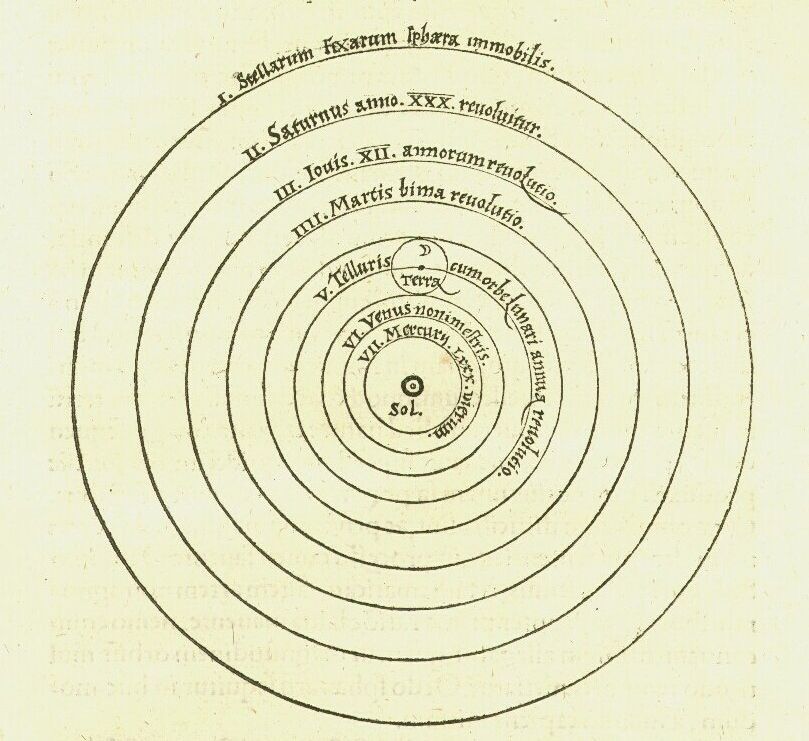
Nicolaus Copernicus, a Polish canon and physician, published On the Revolutions of the Heavenly Spheres in 1543, the year of his death. Putting the sun at the center explained the retrograde loops of the planets far more simply. But it created problems he could not answer: if the Earth moves, why is there no perceptible stellar parallax, and why are we not thrown off? Copernicus kept circles and epicycles, and his book was read for decades mainly as a calculating device.
Evidence accumulated from unexpected directions. Tycho Brahe, from his observatory Uraniborg, produced the most accurate naked-eye measurements ever made, and his observations of the new star of 1572 and the comet of 1577 showed changes above the moon and a path that should have shattered crystalline spheres. Johannes Kepler, using Tycho’s Mars data, abandoned circles altogether: planets travel in ellipses with the sun at one focus, sweep equal areas in equal times (1609), and their orbital periods relate to their distances by a fixed mathematical ratio (1619). Galileo Galilei turned a telescope on the sky from 1609 and found mountains on the moon, four satellites of Jupiter, sunspots and, late in 1610, the full cycle of phases of Venus — the last a direct refutation of the Ptolemaic arrangement, though not of Tycho’s compromise scheme.
Method, mathematics and the body
Two rival accounts of how to know emerged. Francis Bacon, in the Novum Organum (1620), argued for empiricism: systematic observation and controlled experiment, working upward from particulars, with the mind purged of its “idols” — the biases of language, tradition and self. René Descartes, in the Discourse on Method (1637), argued for rationalism: doubt everything doubtable until you reach an indubitable starting point, then deduce. His analytic geometry made curves algebraic, and his mechanical philosophy pictured the universe — and animal bodies — as matter in motion, obeying laws. Cartesian dualism, mind separate from an extended machine-like body, shaped medical thinking for centuries and still colors how clinicians talk about the “mind–body problem.”
Medicine supplied one of the era’s cleanest demonstrations. William Harvey, in De motu cordis (1628), used dissection, vivisection, ligature experiments on the arm and simple arithmetic — multiply stroke volume by heart rate and the blood pumped in an hour vastly exceeds body weight — to show that blood must circulate rather than being continuously manufactured and consumed as Galen had taught. He could not see the capillaries; Marcello Malpighi found them with a microscope in 1661. Robert Hooke’s Micrographia (1665) coined “cell,” and Antoni van Leeuwenhoek’s single-lens instruments revealed bacteria and protozoa in the 1670s. Robert Boyle, meanwhile, insisted chemistry describe matter as corpuscles rather than Aristotelian elements, and published the pressure–volume relation in 1662.
Isaac Newton’s Philosophiæ Naturalis Principia Mathematica (1687) closed the circle. Three laws of motion plus a single law of universal gravitation — every mass attracts every other in proportion to the product of the masses and inversely as the square of the distance — derived Kepler’s ellipses, the tides, the precession of the equinoxes and the path of comets from one principle. The same physics governed a falling apple and the moon. Newton candidly refused to explain what gravity is: hypotheses non fingo, I frame no hypotheses — a line he added to the second edition of 1713. Mathematical description that predicts, without a mechanical story, became the standard for science.
| Year | Work and author | Why it mattered |
|---|---|---|
| 1543 | Copernicus, On the Revolutions | Sun-centered model simplifies planetary motion |
| 1609, 1619 | Kepler, Astronomia Nova; Harmonices Mundi | Elliptical orbits; three quantitative laws replace circles |
| 1610 | Galileo, Sidereus Nuncius | Telescopic evidence against an unchanging heavens |
| 1628 | Harvey, De motu cordis | Circulation of the blood, proved by measurement |
| 1637 | Descartes, Discourse on Method | Systematic doubt; analytic geometry; mechanical philosophy |
| 1665 | Hooke, Micrographia | Microscopy as a discipline; the word “cell” |
| 1687 | Newton, Principia | Universal gravitation unifies terrestrial and celestial motion |
Who was allowed in the room
Discovery became durable because it became institutional. The Royal Society of London, founded in 1660 and chartered in 1662, adopted the motto Nullius in verba — take nobody’s word for it. Its secretary Henry Oldenburg launched the Philosophical Transactions in 1665, initially as his own venture, and it created something new: dated, credited, citable, criticizable publication. The Académie Royale des Sciences in Paris (1666) took the opposite approach, salaried and state-directed, aimed at maps, ballistics and engineering. Between them they established peer scrutiny, replication and priority disputes as the ordinary business of science.
Access was sharply bounded by sex and status. Margaret Cavendish, Duchess of Newcastle, published natural philosophy and visited the Royal Society in 1667 — as a spectacle, and no woman was elected to full fellowship until 1945. Maria Winkelmann-Kirch discovered a comet in 1702 while working in her husband’s Berlin observatory; after his death the Academy refused her the post on the grounds that it would set a precedent. Émilie du Châtelet translated the Principia into French with a commentary that remains the standard version; Laura Bassi held a chair at Bologna from 1732. Artisans, instrument-makers and apothecaries did essential work and are largely anonymous in the record.
Historians also disagree about the phrase itself. Herbert Butterfield popularized “the Scientific Revolution” in 1949; Steven Shapin opened a well-known 1996 book by denying there was any such thing — and then explaining why we talk about it anyway. The point of the debate is real: alchemy, theology and biblical chronology occupied Newton at least as much as optics did, and change was slower and messier than the word revolution suggests. Something decisive nevertheless happened by 1700, namely the settled expectation that claims about nature must be tested publicly and expressed mathematically where possible.
The Scientific Revolution replaced argument from authority with public, repeatable, preferably mathematical evidence — and built the journals and academies that kept it that way.
Section 4The Enlightenment: Reason Goes Public
From Newton’s method to society’s laws
The core Enlightenment wager was an analogy: if a few simple laws explain the heavens, then reasoned inquiry can find the laws of politics, economics, education and morality. Locke supplied the psychological half. His Essay Concerning Human Understanding (1690) denied innate ideas and described the mind at birth as blank paper written on by experience. If character comes from environment, then schools, laws, prisons and religions make people what they are — and can be redesigned. Reform became thinkable in a way it had not been when human nature was fixed by original sin.
Immanuel Kant gave the movement its slogan in 1784: enlightenment is humanity’s emergence from self-imposed immaturity, and its motto is sapere aude — dare to know. Note “self-imposed.” Kant blamed laziness and cowardice as much as tyranny, and he distinguished the private use of reason, where an official must do his job, from the public use, where a scholar addressing the reading world must be entirely free.
Skepticism cut both ways. Pierre Bayle’s Historical and Critical Dictionary (1697) modeled the corrosive footnote, showing that atheists might be virtuous and that most persecution rested on bad history. David Hume pushed further, arguing that causation is a habit of expectation rather than something we observe, and that no report of a miracle can outweigh uniform experience. A movement that began by trusting reason ended by interrogating reason’s own limits — which is precisely why Kant felt obliged to write the Critique of Pure Reason (1781).
The great texts and what they argued
Montesquieu, a Bordeaux magistrate, published The Spirit of the Laws in 1748 after two decades of comparative research. Laws, he argued, are not arbitrary; they arise from climate, religion, commerce and custom, and each form of government has an animating principle — virtue in a republic, honor in a monarchy, fear in a despotism. His prescription, drawn from an idealized reading of England, was the separation of legislative, executive and judicial powers so that, in his phrase, power checks power. American constitution-writers cited him more often than any other modern author.
Voltaire was the movement’s publicist and its conscience. After exile in England he praised its religious pluralism and its Newtonianism in the Letters on the English (1733), lampooned facile optimism in Candide (1759) after the Lisbon earthquake, and in 1762 took up the case of Jean Calas, a Toulouse Protestant broken on the wheel for a murder he did not commit. Three years of pamphleteering got the verdict annulled. That campaign, more than any treatise, showed what a writer with a public could do to a judicial system.
The Encyclopédie edited by Denis Diderot and Jean le Rond d’Alembert (28 volumes, 1751–1772) was the movement’s engine. It described stocking-frames and glassworks in exact detail, dignifying craft knowledge, and buried heterodoxy in cross-references — the article on cannibals sent readers to “Eucharist,” “Communion” and “Altar,” leaving them to draw the conclusion. Suppressed twice, it still sold thousands of sets. Rousseau, the movement’s great dissenter, denied that arts and sciences improved morals, argued in the Discourse on Inequality (1755) that property founded oppression, and in The Social Contract (1762) grounded legitimacy in the general will — a formula that has been read as democratic and as authoritarian ever since. Cesare Beccaria’s On Crimes and Punishments (1764) argued that certainty of punishment deters better than severity, and demanded the end of torture and the death penalty; Adam Smith’s Wealth of Nations (1776) explained how self-interested exchange, division of labour and open markets generate general prosperity — while warning that merchants seldom meet without conspiring against the public.
| Text | Author, year | Central claim | Downstream effect |
|---|---|---|---|
| The Spirit of the Laws | Montesquieu, 1748 | Separate and balance the powers of government | US Constitution; French constitutional debates |
| Encyclopédie | Diderot & d’Alembert, 1751–72 | All useful knowledge, including craft, belongs to the public | Model for reference publishing; diffusion of critique |
| The Social Contract | Rousseau, 1762 | Sovereignty lies in the general will of the people | Jacobin politics; modern democratic theory |
| On Crimes and Punishments | Beccaria, 1764 | Proportionate, certain punishment; no torture | Penal codes in Tuscany, Austria, later France; quoted but not enacted in Catherine II’s Nakaz |
| The Wealth of Nations | Smith, 1776 | Specialization and exchange, not hoarded bullion, create wealth | Free-trade policy; the discipline of economics |
| What Is Enlightenment? | Kant, 1784 | Dare to think for yourself; free public use of reason | The movement’s self-definition |
Salons, coffeehouses and the book trade
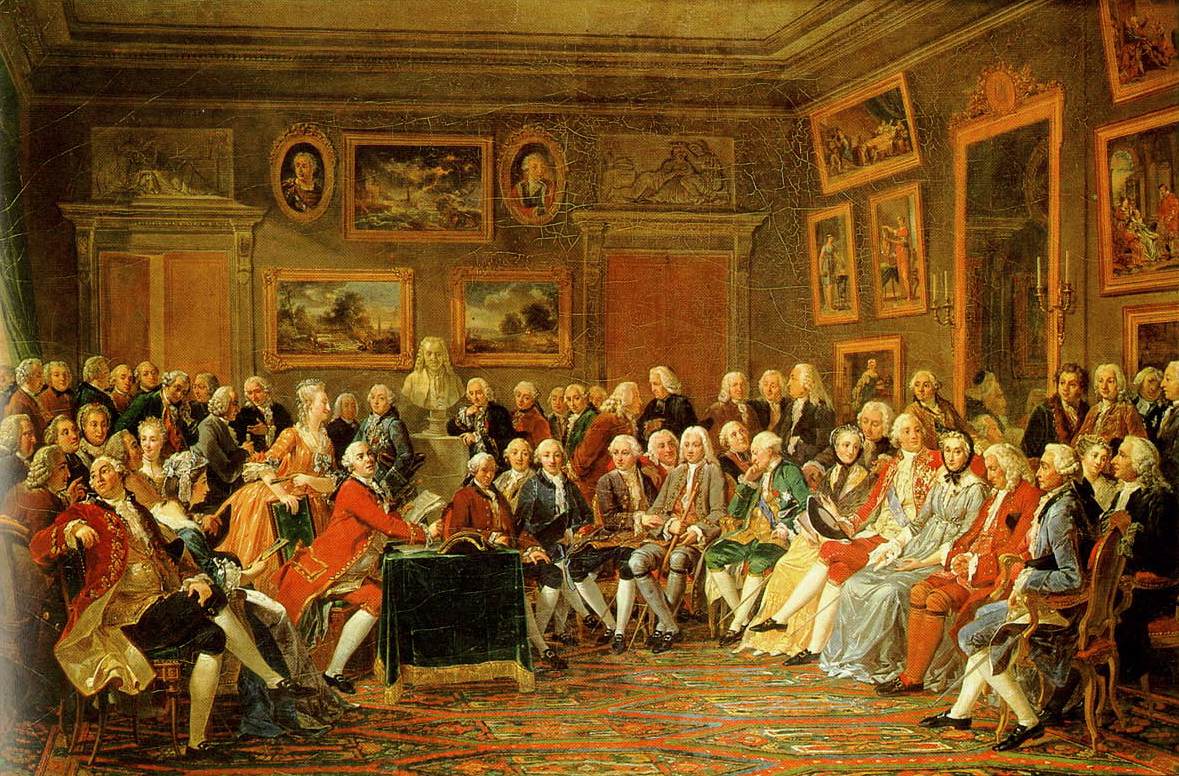
Ideas needed carriers. The public sphere — Jürgen Habermas’s term for a space between household and state where private people reason together about common affairs — took physical form in London coffeehouses (roughly 550 by 1740, each a penny university), in Masonic lodges, in provincial academies and reading clubs, and above all in the Parisian salon. Madame Geoffrin fed the encyclopedists on Mondays and Wednesdays; Julie de Lespinasse and Suzanne Necker managed conversation with a firm hand. Shut out of universities and public office almost everywhere, women nonetheless controlled introductions as salonnières, enforced the rules of civil argument and effectively curated who was heard.
Censorship shaped the trade rather than stopping it. French books carried false imprints reading Amsterdam or London; publishers in Neuchâtel and the Dutch Republic supplied the market; smugglers carried bales over the Jura. Robert Darnton’s research on those networks shows that the best sellers of the illegal trade were often not the polished treatises but scandal sheets, pornographic satires of the court and cheap philosophical pamphlets — which may have done more to corrode royal prestige than Montesquieu ever did.
Historians now stress the plural. There was a moderate Enlightenment that sought reform within monarchy and Christianity, and, in Jonathan Israel’s influential account, a radical Enlightenment descending from Spinoza that was materialist, democratic and hostile to revealed religion. There were distinct national flavours: a Scottish Enlightenment of Hume, Smith and Adam Ferguson centred on universities; a German Aufklärung respectful of the state and of Lutheran piety; a Jewish Haskalah around Moses Mendelssohn; a Catholic Enlightenment in Naples and Milan. Most philosophes were deists or heterodox believers, not atheists — and the same century produced Methodism, Pietism and Hasidism, revivals of feeling that were not simply reason’s enemies but its contemporaries.
The Enlightenment applied the prestige of Newtonian method to human affairs, and its decisive novelty was the public sphere — a reading, arguing audience before which every institution had to defend itself.
Section 5Reason in Power: Reform, Empire and Contradiction
Enlightened absolutism, tested
Enlightened absolutism describes rulers who adopted the philosophes’ vocabulary — utility, tolerance, codified law, rational administration — without surrendering an ounce of sovereignty. Frederick II of Prussia (r. 1740–1786) called himself the first servant of the state, restricted judicial torture on his accession in 1740 and abolished it outright in 1754, allowed wide religious latitude, hosted Voltaire until they quarrelled bitterly, and ordered the legal codification that became the Prussian General Code of 1794. He also seized Silesia in 1740 in a naked war of aggression, tightened the Junkers’ grip on serfs and pressed hardest for the first partition of Poland in 1772, taking the smallest share by area but the one that mattered — the land bridge joining Brandenburg to East Prussia.
Catherine II of Russia (r. 1762–1796) corresponded with Voltaire and Diderot, bought Diderot’s library and left him its keeper with a salary, and in 1767 convened a Legislative Commission for which she wrote a Nakaz or Instruction lifted substantially from Montesquieu and Beccaria. The commission produced no code. After Pugachev’s massive Cossack and peasant revolt of 1773–1775 she reversed course, reorganized provincial government to strengthen noble control, and issued the Charter to the Nobility (1785) confirming their privileges. Serfdom expanded into newly conquered Ukraine. Rhetoric and reality had parted company.
Joseph II of Austria (sole ruler 1780–1790) was the genuine radical, and his failure is the most instructive. His Patent of Toleration (1781) granted Lutherans, Calvinists and Orthodox private worship and civil rights; the Edict of Tolerance for Jews (1782) opened trades and schools while pressing assimilation; he abolished personal serfdom in 1781 and, in his criminal code of 1787, the death penalty for almost all civil offences — judicial torture had already gone in 1776, under his mother Maria Theresa. He dissolved hundreds of contemplative monasteries and redirected their wealth to parishes and hospitals, including the great Vienna General Hospital. He also imposed German on Hungary, alienated the Church, the nobles and many peasants at once, and on his deathbed most of it was being repealed. Reform by decree, without consent, was brittle.
| Ruler | Real reform | Limit or reversal |
|---|---|---|
| Frederick II, Prussia | Torture curbed 1740 and abolished 1754; religious latitude; legal codification begun | Serfdom entrenched; aggressive wars; Poland partitioned |
| Catherine II, Russia | Nakaz of 1767; provincial reform; education and inoculation promoted | No code enacted; noble power confirmed 1785; serfdom extended |
| Joseph II, Austria | Toleration 1781–82; personal serfdom abolished; hospitals funded | Forced Germanization; near-total repeal after 1790 |
| Charles III, Spain | Jesuits expelled 1767; free internal trade; Madrid public works | Colonial reforms provoked revolt in Peru and New Granada |
| Gustav III, Sweden | Torture abolished 1772; fewer capital crimes; free grain trade 1775 | Seized power by coup 1772; later curbed the press; assassinated by nobles 1792 |
Evidence at the bedside
The century’s most defensible achievements were medical and demographic. John Graunt’s Natural and Political Observations on the London Bills of Mortality (1662) had already invented population statistics by treating death registers as data. James Lind ran what is usually called the first controlled clinical trial aboard HMS Salisbury in 1747, dividing twelve scurvy patients into six pairs and giving each pair a different remedy; the two men on oranges and lemons recovered, and his Treatise on the Scurvy (1753) followed — though the Royal Navy took four decades to act, and Lind himself hedged about the cause.
Smallpox drove the biggest change. Variolation — deliberately infecting a person with material from a mild case — was long practised in Africa, Anatolia, India and China. Lady Mary Wortley Montagu observed it in Istanbul, had her son inoculated in 1718 and her daughter in London in 1721, and pushed it into elite English practice. In Boston, where the enslaved African Onesimus had years earlier described the West African practice to Cotton Mather, the epidemic of 1721 prompted the physician Zabdiel Boylston to inoculate some 240 people; comparative death rates — roughly two percent among the inoculated against fourteen percent among the naturally infected — were among the first published epidemiological statistics in America. In 1796 Edward Jenner tested the folk observation that dairymaids who caught cowpox did not take smallpox, inoculating eight-year-old James Phipps with cowpox and then challenging him with smallpox. Vaccination was safer than variolation, and it spread across Europe within a decade.
These were Enlightenment achievements in method, not only in outcome: count the cases, compare the groups, publish the numbers, let strangers check them. That habit — not any particular remedy — is what modern clinical practice inherited from the eighteenth century.
The contradiction at the center
The same decades that produced declarations of natural rights saw the Atlantic slave trade reach its peak, with more Africans forcibly transported in the eighteenth century than in the sixteenth and seventeenth combined. Enlightenment writers built the intellectual case against it: Montesquieu’s savage irony in The Spirit of the Laws, the Abbé Raynal and Diderot’s History of the Two Indies (1770 onward), Condorcet’s Reflections on Negro Slavery (1781), Adam Smith’s argument that slave labour was economically inefficient. Organized abolition followed — Quaker-led petitioning, the Somerset ruling of 1772 that no master could forcibly remove a slave from England, the London Society for Effecting the Abolition of the Slave Trade (1787), the Société des Amis des Noirs (1788), and above all the testimony of formerly enslaved authors such as Olaudah Equiano, whose 1789 narrative went through nine editions in his lifetime.
But the same intellectual toolkit produced racial classification. Linnaeus sorted humans into varieties with temperamental traits attached; Blumenbach’s craniology, begun in 1775, coined “Caucasian” in its 1795 edition; Hume appended a footnote asserting the inferiority of Africans, and Kant lectured on race in terms no reader can defend today. A philosophy that grounded rights in a universal human nature also supplied the pseudo-scientific machinery for denying that some humans possessed it. Historians such as Sankar Muthu emphasize a genuine anti-imperial strand in Diderot, Kant and Herder; others stress how thin it was against the century’s racial thinking. The honest reading holds both.
Women’s position is the parallel case. Rousseau’s Emile prescribed for Sophie an education entirely oriented to pleasing men — from the author of a book on liberty. Yet the reading public he helped create included women in growing numbers, and the reply came quickly: Olympe de Gouges’s Declaration of the Rights of Woman (1791) and Mary Wollstonecraft’s Vindication of the Rights of Woman (1792), which argued that women appear frivolous because they are educated to be so, and demanded rational schooling as a matter of justice and of public utility. That argument, and the revolutions it collided with, carry directly into the next chapter.
Reason in power produced real gains — tolerance edicts, penal reform, vaccination, statistics — and real hypocrisies, and the same universal language that justified slavery’s abolition had to be pried out of the hands of those who denied it applied to everyone.
The chapter in one breath
Two revolutions ran in parallel. Politically, the wreckage of the religious wars pushed rulers toward undivided sovereignty: Louis XIV’s intendants, standing army and choreographed court became the model, copied by Peter the Great and the Hohenzollerns, while Spain declined and the Habsburgs governed a patchwork. England and the Dutch Republic went the other way, dividing power between crown and assembly, and discovered that accountable government could borrow more cheaply and therefore fight longer — a lesson Poland-Lithuania, paralysed by the liberum veto and partitioned out of existence, learned in reverse. Intellectually, Copernicus, Kepler, Galileo, Harvey, Boyle and Newton replaced Aristotle’s closed cosmos with a mathematical universe and, more importantly, established that claims must be tested publicly and published for criticism. Enlightenment writers turned that method on society itself, arguing over the separation of powers, tolerance, punishment, markets and the general will before a new reading public of salons, coffeehouses and smuggled books. Monarchs borrowed the vocabulary; Joseph II meant it and failed; vaccination and statistics delivered where decrees did not. The unfinished business — slavery, race, the rights of women — became the agenda of the revolutions to come.
Words worth knowing
| Term | What it means |
|---|---|
| Absolutism | Doctrine that sovereignty is indivisible and lodged in a monarch answerable to God alone, not to assemblies or courts. |
| Divine right of kings | Claim, argued by Bossuet, that royal authority is conferred by God and so cannot lawfully be resisted. |
| Fronde | French revolts of 1648–1653 by law courts and nobles whose humiliation of the boy Louis XIV shaped his later politics. |
| Intendant | Royal commissioner sent to a French district with authority over taxation, justice and policing, reporting straight to the crown. |
| Mercantilism | Policy assuming a fixed volume of world trade, favouring exports, bullion accumulation, colonies and protected home manufactures. |
| Fiscal-military state | A government organized primarily to extract revenue and credit for war, expanding its bureaucracy as its debts grow. |
| Serfdom | Legal bondage of peasants to land and lord; abolished in much of western Europe but intensified east of the Elbe after 1600. |
| Constitutional monarchy | Rule by a monarch whose powers are limited by law and by a legislature controlling taxation. |
| Bill of Rights (1689) | English statute barring suspension of laws, peacetime standing armies and taxation without parliamentary consent. |
| Liberum veto | Right of any single deputy in the Polish-Lithuanian Sejm to void an entire session, crippling the Commonwealth’s government. |
| Heliocentrism | Model placing the sun rather than the Earth at the centre of planetary motion. |
| Empiricism | View, associated with Bacon and Locke, that knowledge derives from observation and experiment rather than innate ideas. |
| Rationalism | View, associated with Descartes, that certain knowledge is reached by deduction from indubitable first principles. |
| Scientific method | The public cycle of hypothesis, controlled test, mathematical description, publication and replication by strangers. |
| Philosophe | An eighteenth-century public intellectual who wrote for a general audience about reform rather than for the academy. |
| Public sphere | Arena of salons, coffeehouses, journals and clubs where private people debated public affairs and formed opinion. |
| Deism | Belief in a creator known through nature and reason, without revelation, miracles or a priesthood. |
| Enlightened absolutism | Rule by monarchs who adopted reformist, utilitarian language while retaining undivided sovereign power. |
| Variolation | Deliberate inoculation with smallpox matter to induce a milder infection and lasting immunity. |
| Vaccination | Jenner’s safer method of inducing smallpox immunity using cowpox material, published in 1798. |