Exploration, Encounter and Empire
Between 1400 and 1700 the Atlantic Ocean stopped being an edge and became a highway. Portuguese captains crept down the African coast looking for gold and a way around the Muslim-controlled spice routes; Spanish crowns gambled on a westward shortcut and stumbled into two continents whose existence Europe had not imagined. What followed was not a tidy story of discovery. It was an entanglement: microbes, silver, sugar, enslaved people, printed maps, horses, potatoes and smallpox all moving in currents that no monarch controlled. Within a century the population of the Americas collapsed by perhaps eighty percent, West African societies were reorganized around a slave trade that would put roughly 12.5 million people on ships bound west, and Chinese demand for silver was pulling Bolivian ore across the Pacific. This chapter asks how a poor, fragmented, plague-scarred western peninsula of Eurasia ended up at the center of the first genuinely global economy — and at what cost, to whom.
By the end of this chapter you can
- Explain the technological, financial and religious preconditions — the caravel, the astrolabe, Ptolemaic cartography and the Reconquista — that made Iberian voyaging possible.
- Trace Portuguese expansion from Ceuta (1415) to Vasco da Gama’s arrival at Calicut (1498) and describe the trading-post empire model.
- Analyze why the conquests of the Aztec and Inca states succeeded, weighing epidemic disease, indigenous alliances and technology against the myth of European invincibility.
- Describe the Columbian Exchange and evaluate its demographic, ecological and nutritional consequences on four continents.
- Explain the labor systems of the Spanish Americas — encomienda, repartimiento, the mita — and the plantation chattel slavery of the Atlantic system.
- Assess the volume, organization and human cost of the transatlantic slave trade and the Middle Passage.
- Compare Spanish, Portuguese, Dutch, French and English imperial strategies, including the role of the joint-stock company.
- Evaluate competing explanations for the price revolution and the rise of mercantilism.
- Weigh the moral arguments raised at the time — by Bartolomé de las Casas, Juan Ginés de Sepúlveda and Michel de Montaigne — about conquest, slavery and human difference.
Section 1Why Europe Went to Sea
A poor continent with an expensive habit
It is worth starting with a correction. In 1400 Europe was not the wealthiest, largest or most technologically advanced region on earth. Ming China had a population roughly twice that of all Latin Christendom, a bureaucracy of examined officials, printing centuries older than Gutenberg’s, and between 1405 and 1433 sent Zheng He’s treasure fleets — ships far larger than anything Columbus commanded — as far as the Swahili coast. The Ottoman Empire was expanding, not contracting. The sultanates of India were wealthy, and within a century the Mughal and Safavid empires would be wealthier still. Europe was a peninsula recovering from the Black Death, fractured into hundreds of jurisdictions, and chronically short of what it wanted most: spices, silk, sugar and gold, all of which arrived through intermediaries.
That poverty was itself a motive. European buyers paid Venetian merchants, who paid Mamluk officials in Alexandria, who paid Indian Ocean traders. Every hand took a cut. Pepper that cost a few grams of silver in Calicut sold for many times that in Antwerp. The Ottoman capture of Constantinople in 1453 did not simply close the eastern routes — historians now emphasize that trade continued and the Ottomans were happy to profit from it — but it did sharpen the sense in Lisbon and Seville that the terms of trade were set by someone else. A sea route to the source would cut out every middleman at once.
Religion was tangled up with profit rather than separate from it. The Iberian kingdoms had spent nearly eight centuries in the intermittent campaigns later called the Reconquista, ending with the fall of Granada in January 1492. That long war produced a warrior nobility with no more Iberian frontier to conquer, a crusading vocabulary that framed expansion as holy work, and institutions — military orders, royal grants of conquered land, the Inquisition established in Castile in 1478 — that were exported almost intact to the Atlantic. The persistent legend of Prester John, a Christian king somewhere beyond the Muslim world who might be recruited as an ally, gave the search a strategic gloss.
The tools: caravel, compass, quadrant, chart
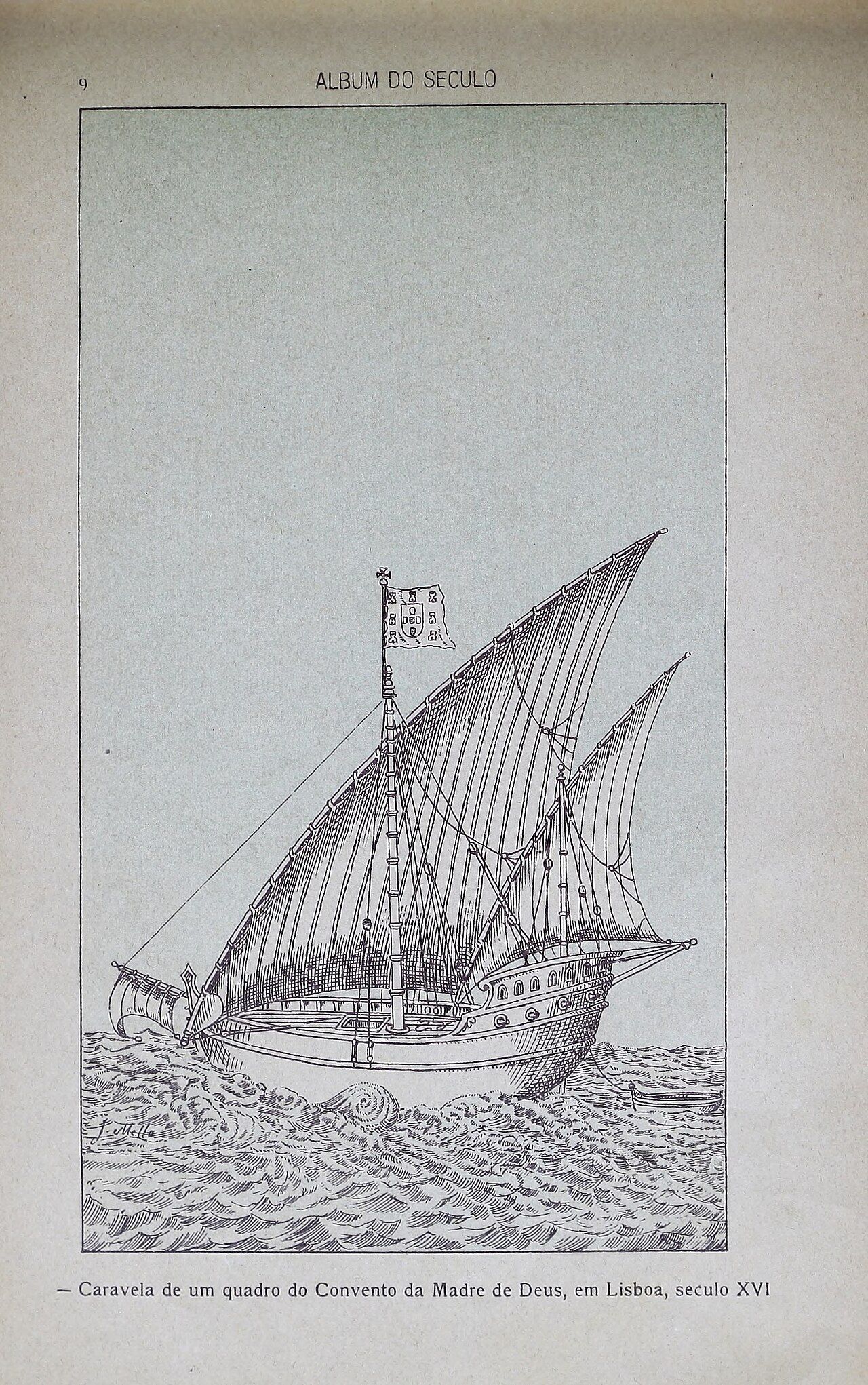
Almost none of the enabling technologies originated in Europe, and that matters. The magnetic compass came from China by way of the Indian Ocean; the astrolabe was a Greek instrument perfected by Islamic astronomers; the triangular lateen sail had been standard in Mediterranean and Indian Ocean shipping for centuries. What the Portuguese did was integrate them. The caravel, developed through the fifteenth century, was small (often 50 to 70 tons), shallow-drafted enough to nose into river mouths, and rigged with lateen sails that let it sail closer to the wind than square-rigged vessels. The larger carrack (Portuguese nau) carried cargo and guns for the long ocean crossings.
The decisive navigational discovery was not a device but a pattern. Sailing south along Africa, ships rode favorable winds and currents; returning north against them was nearly impossible. Portuguese pilots learned to swing far out into the Atlantic on the way home, catching westerlies in a great arc — the volta do mar, the turn of the sea. This counterintuitive move, sailing away from your destination to reach it, is what converted African exploration from suicide into commerce. Columbus later used the same logic across the Atlantic: out on the northeast trades, home on the westerlies.
Cartography was catching up unevenly. The recovery of Ptolemy’s Geography in Latin translation around 1406 gave Europeans a coordinate grid and the concept of latitude and longitude, but it also embedded errors — notably an underestimate of the earth’s circumference and an overestimate of Asia’s eastward extent. Educated Europeans knew perfectly well the earth was a sphere; that had been standard since antiquity. What they argued about was its size. Columbus’s critics at the Castilian court were not flat-earthers. They were right, and he was wrong, and he sailed anyway.
Money, monarchy and the profit motive
Voyages were expensive and risky, so they required a financing structure. Portugal’s early efforts were driven by the crown and by Prince Henry (called “the Navigator” only by nineteenth-century writers — he never sailed on the voyages he funded and was as interested in crusading revenue as in geography). Henry drew income from the Order of Christ, a successor to the Templars, and plowed it into expeditions from his base in the Algarve. Italian capital and expertise mattered enormously: Genoese and Florentine bankers, cut out of the eastern Mediterranean by Venetian dominance and Ottoman expansion, moved money and men west. Columbus himself was Genoese; Amerigo Vespucci, Florentine.
Centralizing monarchies could do what feudal fragmentation could not: guarantee a monopoly, enforce a contract at a distance, and grant a share of future revenue. The Capitulations of Santa Fe (April 1492) made Columbus Admiral of the Ocean Sea and promised him a tenth of the proceeds of whatever he found. That is a business agreement, and it tells you how the enterprise was understood at the time.
| Enabling factor | Where it came from | What it made possible |
|---|---|---|
| Lateen sail / caravel | Mediterranean & Arab shipping, adapted in Portugal | Sailing against the wind; coastal exploration with return |
| Magnetic compass | China, via Indian Ocean trade | Heading in cloud or open ocean |
| Astrolabe / quadrant / cross-staff | Islamic astronomy, simplified for sea use | Latitude from the sun or Polaris |
| Volta do mar | Portuguese trial and error, 1430s–1480s | Reliable return voyages from the South Atlantic |
| Ptolemy’s Geography (Latin, c.1406) | Hellenistic Egypt via Byzantine manuscripts | Coordinate mapping — and a fatally small earth |
| Naval gunnery on sailing ships | European casting, 15th–16th c. | Coercion at sea against non-gunned shipping |
| Genoese/Florentine credit | Italian banking displaced eastward | Financing high-risk, long-payback voyages |
Europe went to sea not because it was strong but because it was peripheral, hungry for Asian goods, and had just assembled — largely from borrowed technologies — the ability to make an ocean voyage a round trip.
Section 2Portugal, Spain and the First Voyages
Down the African coast, 1415–1498
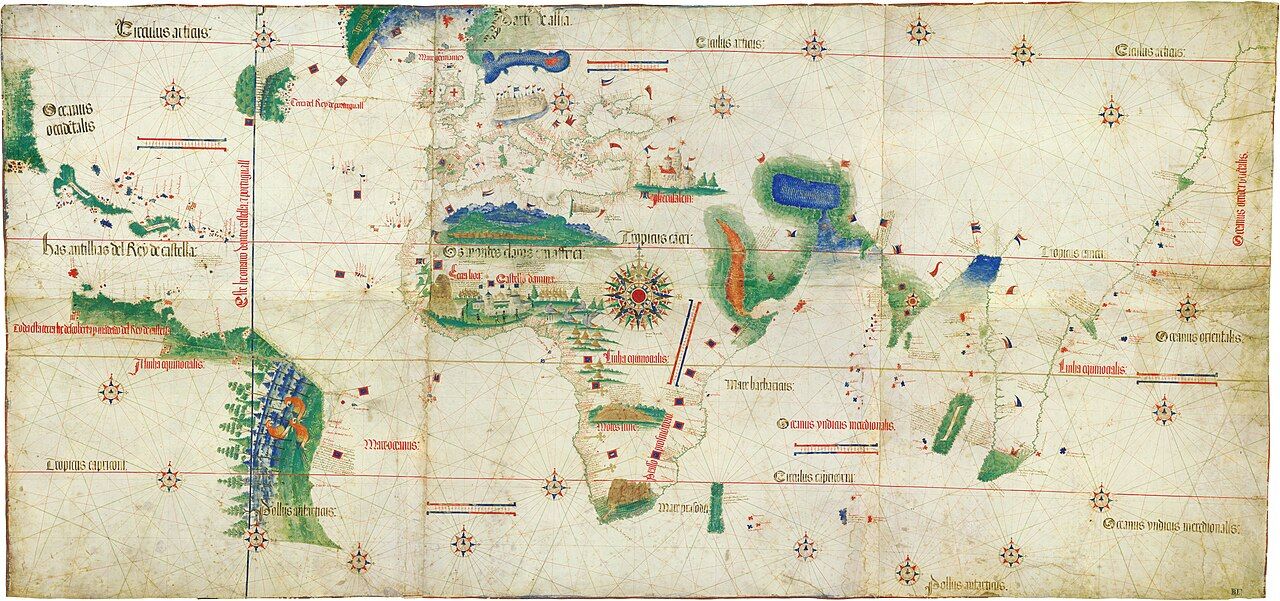
Portuguese expansion began with a raid. In 1415 a Portuguese force took Ceuta, a Muslim port on the Moroccan side of the Strait of Gibraltar. It proved less lucrative than hoped — the caravan trade simply rerouted — but it established the pattern of seizing a coastal strongpoint rather than conquering an interior. Over the next seventy years captains crept south in increments: Cape Bojador rounded in 1434, the Senegal and Gambia rivers reached by the 1440s, São Jorge da Mina (Elmina, in present-day Ghana) fortified in 1482 as a gold-trading castle, the Congo estuary in 1483. Bartolomeu Dias rounded the southern tip of Africa in 1488, blown past it before he realized it; his crew forced him to turn back.
The commercial logic changed along the way. West African gold was the first prize — Elmina’s name means “the mine” — and the Portuguese inserted themselves into an existing trans-Saharan gold economy from the seaward side. But they also bought and seized enslaved people almost immediately: the first large cargo was auctioned at Lagos, in the Algarve, in 1444. At first these captives worked in Iberia and the Atlantic islands. That last detail is the hinge of the whole chapter, because on Portuguese Madeira and above all São Tomé — and on the Canaries, which Castile was conquering over the same decades — Europeans built the sugar plantation worked by enslaved Africans. The Atlantic plantation complex was invented in the eastern Atlantic before Columbus sailed, and then shipped west.
In July 1497 Vasco da Gama left Lisbon with four ships, swung deep into the South Atlantic, rounded the Cape, worked up the East African coast to Malindi, and with a local pilot crossed to Calicut on the Malabar coast in May 1498. His trade goods — cloth, hats, coral, washbasins — were laughed at by merchants who dealt in far finer things. He returned with a cargo of pepper and cinnamon that nevertheless repaid the voyage many times over, having lost roughly two-thirds of his men, largely to scurvy. The route was open.
Columbus and the accidental hemisphere
Christopher Columbus had been shopping his proposal for years. Portuguese experts rejected it because they were right about the distance; Ferdinand and Isabella accepted it in 1492, in the flush of Granada’s fall, because the downside was three small ships and the upside was Asia. He made landfall on 12 October 1492 on an island in the Bahamas that the Taino called Guanahani and that he renamed San Salvador, then coasted Cuba and Hispaniola. He went to his death in 1506 insisting he had reached the outskirts of Asia. Four voyages and considerable evidence did not shake him.
The naming injustice is instructive. It was Amerigo Vespucci, in letters describing voyages along the South American coast around 1499–1502, who argued that this was a mundus novus, a new world, not Asia’s fringe. The German cartographer Martin Waldseemüller put “America” on a map in 1507 in Vespucci’s honor, and the label stuck before anyone could reconsider. Whether Vespucci’s letters were partly fabricated or embellished by publishers remains genuinely disputed among scholars.
Spain and Portugal now had overlapping claims, and they resolved them the way Christian monarchs did: by papal arbitration and then by negotiation. The Treaty of Tordesillas (1494) drew a line 370 leagues west of the Cape Verde Islands; everything east was Portuguese, everything west Spanish. The line was fixed without knowing what lay on either side, which is why Brazil — reached by Pedro Álvares Cabral in 1500 while swinging wide into the Atlantic to catch the winds, though whether by accident or design is still argued — fell to Portugal and speaks Portuguese today. No other European power, and certainly no non-European one, ever accepted the treaty’s authority. Francis I of France reportedly asked to see the clause in Adam’s will that divided the world between two kings.
The trading-post empire and its limits
What Portugal built in the Indian Ocean was not a territorial empire but a trading-post empire, the Estado da Índia: a chain of fortified ports and a claim to control the sea lanes between them. Under Afonso de Albuquerque, governor from 1509, the Portuguese took Goa (1510), Malacca (1511) and Hormuz (1515), and tried to take Aden. The strategy was to hold the choke points — the Red Sea mouth, the Persian Gulf mouth, the Strait of Malacca — and force Asian shipping to buy a Portuguese pass, the cartaz, or be treated as a prize.
The one real European advantage was shipboard artillery. Indian Ocean trade had been largely peaceful and unarmed for centuries; Portuguese ships arrived carrying cannon and a willingness to use them, as at Diu in 1509 against a combined Gujarati–Mamluk fleet. But we should be careful not to overstate it. On land the Portuguese were weak, dependent on local allies, and repeatedly defeated — catastrophically at Alcazarquivir in Morocco in 1578, where King Sebastian died and the dynasty effectively ended. They never controlled more than a fraction of Asian trade; most pepper still moved through the Red Sea by the mid-sixteenth century. Portugal skimmed a rich margin off an enormous system it could not command.
Portugal sought a route to existing Asian wealth and built a seaborne network of forts and tolls; Spain, aiming at the same target, blundered into two continents and improvised a very different kind of empire.
Section 3Conquest, Collapse and the Columbian Exchange
Two conquests
In 1519 Hernán Cortés landed on the Gulf coast of Mexico with roughly 500 men, sixteen horses and a few small cannon. Two years later the Mexica (Aztec) capital of Tenochtitlan — a lake city of perhaps 200,000 people, larger than any city in Spain — had fallen. In 1532 Francisco Pizarro, with about 168 men, seized the Inca emperor Atahualpa at Cajamarca, collected a room filled with gold and silver as ransom, and executed him anyway. By 1533 the Spanish held Cuzco.
These numbers invite a bad explanation: that European technology and courage simply overwhelmed. The evidence points elsewhere. First, alliances. The Mexica ran a tribute empire resented by its subjects; Cortés arrived with a translator, the Nahua woman Malintzin (doña Marina, often called La Malinche), and rapidly recruited tens of thousands of Tlaxcalan warriors who had their own reasons to want Tenochtitlan destroyed. The final siege was overwhelmingly an indigenous army with a Spanish command element. In Peru, Pizarro walked into a civil war: Atahualpa had just defeated his half-brother Huáscar, and the losing faction was willing to deal.
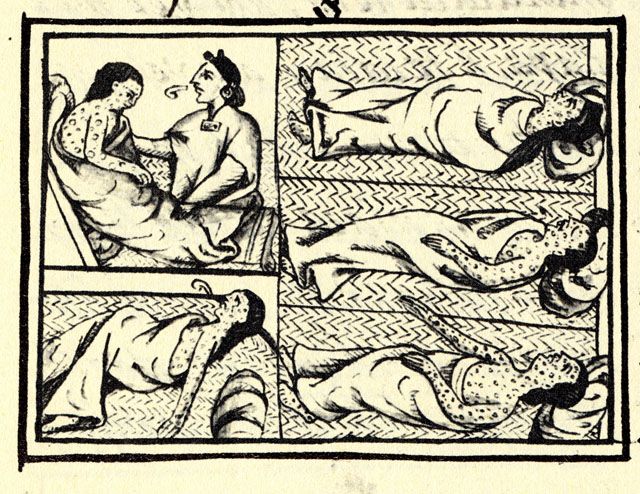
Second, disease. Smallpox reached Tenochtitlan in 1520 and killed a large share of the population, including the emperor Cuitláhuac, during the months the Spanish were regrouping after being driven from the city on the Noche Triste. In the Andes, an epidemic — probably smallpox — had already killed the emperor Huayna Capac around 1524–27, which is what triggered the succession war Pizarro exploited. Third, technology mattered at the margin. Steel blades, crossbows and especially horses gave shock advantages in open field battle; firearms of the period were slow and unreliable. None of this is a story of inevitability. It is a story of contingency stacked on catastrophe.
The demographic catastrophe
The population of the Americas in 1492 is genuinely contested. Estimates run from about 40 million to more than 100 million, with many current specialists clustering around 50–60 million. What is not seriously contested is the direction and scale of the collapse: by 1600–1650 the indigenous population had fallen by something in the range of 80 to 95 percent in the hardest-hit regions. Hispaniola’s Taino population, plausibly several hundred thousand in 1492, was functionally extinguished within fifty years. Central Mexico fell from perhaps 15–25 million to around one million by 1620.
The primary cause was epidemiological, not military. The Americas had been isolated from Afro-Eurasian disease pools for millennia and had few domesticated herd animals, the source of many crowd diseases. Smallpox, measles, typhus, influenza and later malaria and yellow fever arrived in waves against populations with no acquired immunity and no cultural experience of such epidemics. Because everyone fell ill at once, no one could nurse, farm or harvest — so famine followed infection. In Mexico the catastrophic cocoliztli epidemics of 1545 and 1576 killed millions; recent genetic work on burial sites has recovered Salmonella enterica Paratyphi C, suggesting enteric fever as at least one agent, though the identification remains debated.
To say disease did most of the killing is not to acquit conquest. Forced labor, war, dispossession, forced resettlement and the deliberate destruction of food systems all raised mortality and prevented recovery, and colonial regimes concentrated survivors in exactly the conditions that spread epidemics. Historians increasingly frame this as a compound catastrophe rather than a purely biological accident. The demographic hole was so deep that some climate scientists argue reforestation of abandoned American farmland drew down enough atmospheric carbon dioxide to contribute to the cooling of the “Little Ice Age” around 1610 — a striking, and still argued, claim.
The exchange in both directions
The historian Alfred Crosby named the whole biological transfer the Columbian Exchange in 1972, and the term stuck because it captures something the old vocabulary of “discovery” missed: the traffic ran both ways and much of it was invisible.
Eastward went crops that reshaped Old World diets and populations. The potato, an Andean domesticate, produced more calories per acre than grain on poor northern soils and underwrote population growth in Ireland, northern Europe and Russia — and, when a single clonal crop met Phytophthora infestans in the 1840s, catastrophic famine. Maize became a staple in southern Europe, west Africa and China; cassava, also American, became an African famine crop. Tomatoes, chilies, cacao, vanilla, peanuts, squash and tobacco all crossed east. Chilies reached India and Sichuan within decades and are now inseparable from those cuisines.
Westward went wheat, rice, sugarcane, bananas, coffee and citrus — and animals. Cattle, pigs, sheep and goats bred explosively in grasslands with no comparable grazers, transforming ecosystems and sometimes destroying indigenous fields. The horse, extinct in the Americas for millennia, reached the Great Plains through Spanish New Mexico and by the eighteenth century had remade Comanche, Lakota and Blackfeet societies into mounted powers that checked European expansion for two hundred years. And westward went the pathogens. The one plausible major transfer east is a virulent form of syphilis, which appeared in Naples in 1495 and swept Europe; the “Columbian hypothesis” for its origin has substantial skeletal evidence behind it but is not settled.
| Moving west (to the Americas) | Moving east (to Afro-Eurasia) | Consequence |
|---|---|---|
| Smallpox, measles, typhus, influenza | — | Population collapse of 80–95% in many regions |
| Wheat, sugarcane, rice, coffee, bananas | Maize, potato, cassava, sweet potato | Plantation economies west; population growth east |
| Horses, cattle, pigs, sheep, goats | Turkeys, guinea pigs (minor) | Ecological transformation; mounted Plains societies |
| — | Tomato, chili, cacao, vanilla, peanut, tobacco | Remade cuisines from Italy to Sichuan; global tobacco habit |
| — | Possibly virulent syphilis (disputed) | European epidemic from 1495 |
| Enslaved Africans (forced migration) | American silver | Atlantic slave system; global monetization via China |
The conquests turned on indigenous alliances, civil war and above all epidemic collapse — and the biological exchange that followed reorganized diet, ecology and population on every continent it touched.
Section 4Silver, Sugar and Slavery: the Atlantic System
The mountain of silver
In 1545 Spanish prospectors, following indigenous knowledge, opened the Cerro Rico at Potosí in the Andes at 4,000 meters altitude. It became the largest silver deposit the world had known. A second great strike at Zacatecas in Mexico followed in 1546. By 1600 Potosí was a city of perhaps 160,000 people — comparable to London — sitting in thin air on a barren mountain, fed entirely by imported food and coerced labor. Between roughly 1500 and 1800 the Americas produced on the order of 150,000 tons of silver, something like 80 percent of world output.
The technology that made it possible was the patio process, refined at Pachuca in the 1550s, which used mercury amalgamation to extract silver from low-grade ore. Mercury came from Huancavelica in Peru and Almadén in Spain, and it poisoned the men who handled it. Labor came from the mita, a rotational draft the Spanish adapted from an Inca institution and turned into something far harsher: villages across a vast catchment were required to send a proportion of their adult men to Potosí each year. Mortality was severe enough that communities hid people, fled, or paid substitutes.
Where did the silver go? Not mainly to Spain, in the end. Ming China had shifted its tax system toward silver payment (the “single whip” reform), creating enormous demand and a silver price roughly double Europe’s. Silver therefore flowed east: across the Atlantic to Seville and onward to Amsterdam, Genoa and Asia, and directly across the Pacific on the Manila galleon from Acapulco, running from 1565 to 1815. This is the first genuinely global trade circuit, and it is worth noticing that its engine was Chinese fiscal policy, not European demand. Some historians argue that when Ming silver demand slackened in the 1630s–40s the shock rippled back to Spanish America; others think the link has been overdrawn.
Labor systems: encomienda, repartimiento, chattel slavery
Spain never intended a settler-labor colony; it intended to extract wealth from existing populations. The encomienda granted a Spanish conquistador the right to demand tribute and labor from a specified group of indigenous people, in theory in exchange for protection and Christian instruction. In practice it was close to enslavement. The New Laws of 1542, pushed through by the Dominican friar Bartolomé de las Casas, banned indigenous slavery and ordered encomiendas to lapse on the holder’s death; colonists revolted, a viceroy was killed in Peru, and enforcement was partial. The system slowly gave way to the repartimiento (wage-labor drafts) and to debt peonage on haciendas.
Where indigenous populations collapsed and the crop was sugar, planters turned to Africa. Sugar is the crucial variable. It is brutally labor-intensive: cane must be cut and crushed within hours, boiling houses run day and night through harvest, and the work killed people at rates that required constant replacement. Brazil, under Portugal, became the first great sugar colony from the 1550s; the English Caribbean followed after Barbados converted to sugar in the 1640s, and Saint-Domingue (Haiti) became the most profitable colony on earth in the eighteenth century.
What developed was chattel slavery: hereditary, lifelong, racially defined, and legally classifying human beings as movable property. This form was historically distinctive. Slavery existed in Africa, in the Islamic world, in ancient Rome and in medieval Europe, and Europeans did not invent it. But the Atlantic system’s combination of scale, heritability through the mother, near-total legal disability, and an ideology of racial difference constructed to justify it produced something new. Racial categories hardened as the system expanded; they were a product of it as much as a cause.
The Middle Passage and its arithmetic
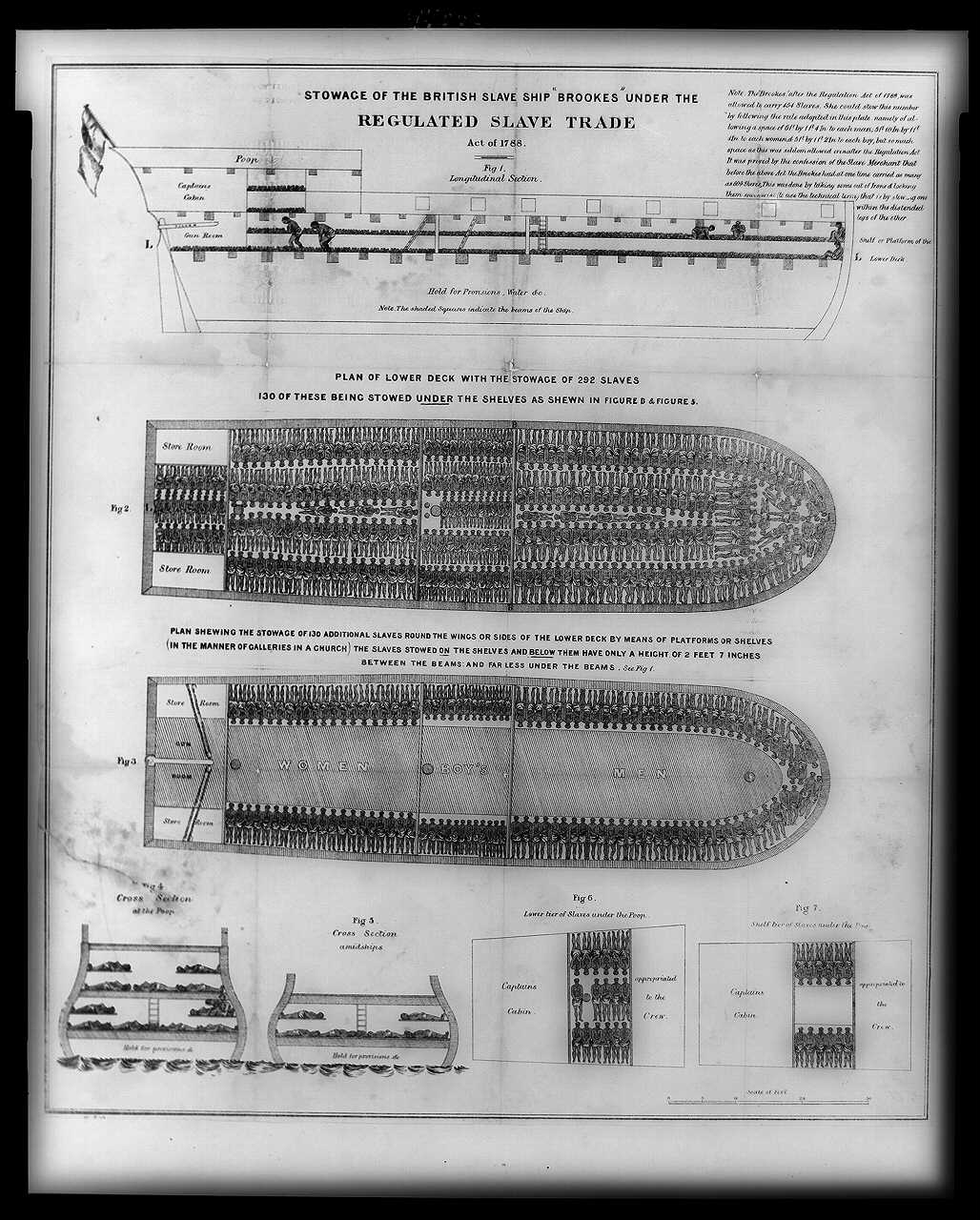
The Trans-Atlantic Slave Trade Database, built from surviving voyage records, is the best evidence we have. It indicates roughly 12.5 million Africans were embarked on slave ships between 1501 and 1866, and about 10.7 million survived to disembark — meaning some 1.8 million died at sea, an average mortality of roughly 15 percent that was far higher on some routes and in some decades. Millions more died in the marches to the coast and in coastal barracoons before ever boarding.
The destinations surprise students. Under 4 percent of those who landed alive — roughly 390,000 people — disembarked in British North America and later the United States. Brazil received nearly half; the Caribbean took most of the rest, with the British islands alone absorbing about a fifth of the whole trade. The reason the United States nonetheless had a large enslaved population by 1860 is that its enslaved population grew by natural increase, while Caribbean and Brazilian sugar regimes consumed lives faster than they reproduced.
The trade was not something Europeans simply imposed on a passive Africa. European traders rarely marched inland; they bought captives at coastal factories from African merchants and states. Kingdoms such as Dahomey, Asante and Oyo were transformed by the trade, some enriched and militarized by it, others devastated. Guns flowed in, people flowed out. Historians debate the trade’s demographic effect on Africa — the economist Nathan Nunn has shown a statistical association between the intensity of slave exports from a region and its later economic underdevelopment, and Joseph Inikori and Walter Rodney argued the case earlier in different terms — but the direction of harm is not seriously disputed. African complicity in supply does not distribute moral responsibility evenly; the demand, the capital, the ships and the plantations were European.
| Region of disembarkation | Approx. share of arrivals | Dominant economy |
|---|---|---|
| Brazil | ~45–46% | Sugar, later gold and coffee |
| British Caribbean | ~22% | Sugar (Barbados, Jamaica) |
| French Caribbean | ~11% | Sugar, coffee (Saint-Domingue) |
| Spanish Americas | ~11–12% | Mining, ranching, later Cuban sugar |
| Dutch/Danish Caribbean | ~5% | Sugar, transshipment |
| British North America / USA | under 4% | Tobacco, rice, later cotton |
American silver monetized a global economy and American sugar consumed human lives, and the two together produced an Atlantic system whose profits depended on coerced labor at a scale without precedent.
Section 5Rivals, Companies and the Argument Over Empire
Latecomers with better institutions
Spain and Portugal had a century’s head start and lost it. Part of the reason was structural. Spanish American wealth flowed to a crown that spent it on European wars — against the Ottomans, the Dutch rebels, the French, the English — and defaulted on its debts repeatedly (1557, 1560, 1575, 1596, and on into the seventeenth century). Silver passed through Seville and out to German and Genoese bankers. The economist’s phrase is the resource curse; the contemporary Spanish phrase, from Martín González de Cellorigo in 1600, was that Spain had become a nation of “the bewitched, living outside the natural order.”
The Dutch did something different. After revolting against Spanish rule, the northern Netherlands built financial institutions of remarkable sophistication: the Amsterdam Exchange Bank (1609), a bourse, marine insurance, low interest rates, and above all the joint-stock company. The Dutch East India Company (VOC, founded 1602) pooled capital from many investors in permanent, tradable shares, spreading risk across voyages instead of betting on one. It was granted sovereign powers — to make war, sign treaties, coin money, hang people. The English East India Company (1600) worked on similar lines, though it financed itself voyage by voyage until it adopted permanent capital in 1657; the Dutch West India Company followed in 1621. This is the birth of the corporation as an instrument of empire, and it let private capital do what strained royal treasuries could not.
The VOC displaced the Portuguese systematically: Amboina in 1605, Batavia founded in 1619, Malacca taken in 1641, Ceylon by 1658, and a monopoly on nutmeg enforced on the Banda Islands with a 1621 massacre and deportation under Jan Pieterszoon Coen that killed or removed most of the population of roughly 15,000. Monopoly here was not a metaphor. It was enforced by extermination.
Different empires, different logics
By 1700 the European presence overseas had sorted into recognizable types. The Spanish built a territorial empire of viceroyalties, cities, cathedrals and universities (Mexico City and Lima, both 1551), governed through the Council of the Indies, with a large mixed population and a formal caste hierarchy — the sistema de castas — that classified people by ancestry. The Portuguese ran coastal trading factories plus a genuinely territorial plantation colony in Brazil. The French in Canada were few, dispersed and heavily invested in the fur trade, which made alliance with Huron and Algonquian nations essential and produced deep diplomatic entanglement rather than displacement. The English came to farm — indentured servants, mostly young and male, in the Chesapeake; whole families in New England — and so took land rather than labor, having less use for indigenous workers and therefore less use for indigenous people — a settler-colonial logic with its own grim consequences.
Everywhere, the crown’s theory of empire was some version of mercantilism: the belief that global wealth is roughly fixed, that a nation grows rich by exporting more than it imports and accumulating bullion, and that colonies exist to supply raw materials and buy finished goods from the mother country alone. England’s Navigation Acts (from 1651) required colonial trade to move in English ships; Spain funneled everything through a single licensed fleet system, the flota, at Seville and later Cádiz. Mercantilist rules were routinely evaded — smuggling was the real economy of the Caribbean — and Adam Smith would demolish the theory in 1776. But it shaped policy, and it made colonies a reason for war.
Inflation, and the argument that would not go away
Between about 1500 and 1650 prices in western Europe rose roughly sixfold — modest by modern standards, roughly one to two percent a year, but unprecedented in a society used to stable prices. The classic explanation, from Earl Hamilton in the 1930s, was monetary: American silver expanded the money supply, so prices rose. That explanation is now considered partial. Population recovery after the plague years increased demand for food faster than agricultural output could grow, which is why grain prices rose far more than manufactured goods; currency debasement by cash-strapped governments added more. Most historians today treat the price revolution as demographic and monetary together, with the balance still argued.
Whatever its cause, the distributional effect was sharp. Landlords who could raise rents and farmers selling surplus did well. Wage laborers, whose pay lagged badly, saw real income fall by perhaps half over the period. Nobles on fixed feudal dues were squeezed. The winners were commercial farmers, merchants and the state’s creditors — a reshuffling that fed into the social conflicts of the seventeenth century.
And from the beginning there was moral argument, which is worth taking seriously rather than treating as a modern afterthought. In 1511 the Dominican Antonio de Montesinos preached on Hispaniola asking his congregation by what right they held the Indians in servitude. Bartolomé de las Casas, once an encomendero himself, spent fifty years documenting atrocities in works such as the Brevísima relación (1552) and lobbying the crown. At Valladolid in 1550–51 he debated Juan Ginés de Sepúlveda, who argued from Aristotle that some peoples are natural slaves and that conquest was therefore lawful. Neither side was declared a clear winner. The theologian Francisco de Vitoria at Salamanca had already argued that indigenous peoples held genuine dominion over their lands, laying groundwork for international law. In France, Montaigne’s essay “Of Cannibals” (1580) turned the mirror around, suggesting the Europeans were the barbarians. Las Casas’s own record is not clean — he early on proposed importing African slaves to spare the Indians, and later repented of it in writing. That contradiction is instructive: the moral categories were being built in real time, unevenly, by people who were also implicated.
| Power | Model | Main assets by 1700 | Chief instrument |
|---|---|---|---|
| Portugal | Trading posts + plantation Brazil | Goa, Macau, Angola, Brazil | Royal monopoly, cartaz system |
| Spain | Territorial, extractive | Mexico, Peru, Philippines, Caribbean | Viceroyalties, flota, encomienda/mita |
| Netherlands | Commercial monopoly | Batavia, Ceylon, Cape, Surinam | VOC / WIC joint-stock companies |
| England | Settler colonies + company trade | Mainland colonies, Barbados, Jamaica, Bengal foothold | EIC, Navigation Acts, chartered colonies |
| France | Fur trade + sugar islands | New France, Saint-Domingue, Louisiana | Alliances, royal companies, Colbert’s policy |
Northern European latecomers overtook Iberia by inventing financial institutions rather than finding new coasts, while the moral legitimacy of the whole enterprise was contested from the first decades by Europeans themselves.
The chapter in one breath
A poor, divided Europe wanted Asian goods it could not afford at second hand, and by borrowing the compass, the lateen sail and the astrolabe and adding gunnery, ocean-going hulls and Italian credit, it found ways around the middlemen. Portugal built a chain of fortified tollbooths from Elmina to Malacca. Spain, aiming at Asia, hit two continents whose peoples had no immunity to Eurasian disease, and within a century their populations fell by 80 to 95 percent — a catastrophe that made conquest possible and then created a labor vacuum the conquerors filled with drafted indigenous workers at Potosí and, on the sugar coasts, with enslaved Africans — 12.5 million of whom were shipped west between 1501 and 1866, of whom 10.7 million survived the crossing. The exchange ran both ways: potatoes and maize fed Europe, Asia and Africa; horses remade the Great Plains; American silver, pulled by Chinese fiscal demand, closed the first global trade circuit. Northern Europeans then overtook Iberia not by sailing better but by inventing the joint-stock company and the financial machinery to sustain distant, decade-long ventures. From Montesinos in 1511 to Valladolid in 1550 to Montaigne in 1580, Europeans argued about whether any of it was just. The argument did not stop the ships.
Words worth knowing
| Term | What it means |
|---|---|
| Caravel | Small, shallow-draft Portuguese sailing ship with lateen sails, able to sail closer to the wind than square-rigged vessels. |
| Volta do mar | “Turn of the sea” — sailing far out into the Atlantic to catch favorable winds home, the technique that made return voyages possible. |
| Reconquista | The long, intermittent Christian campaigns to take Iberia from Muslim rule, completed with the fall of Granada in 1492. |
| Treaty of Tordesillas (1494) | Spanish–Portuguese agreement dividing non-Christian lands along a line 370 leagues west of the Cape Verde Islands; gave Brazil to Portugal. |
| Trading-post empire | Portuguese model of fortified coastal ports controlling sea lanes and tolls rather than governing territory. |
| Cartaz | A pass Portuguese authorities required of Asian shipping in the Indian Ocean; ships without one could be seized. |
| Columbian Exchange | Alfred Crosby’s term for the transfer of plants, animals, people and pathogens between the Americas and Afro-Eurasia after 1492. |
| Encomienda | Spanish grant of the right to demand tribute and labor from a group of indigenous people, nominally in exchange for protection and instruction. |
| Mita | Rotational labor draft adapted from Inca practice; under Spain it supplied coerced workers to the Potosí silver mines. |
| Repartimiento | Later Spanish labor draft assigning paid but compulsory indigenous work, replacing the encomienda in principle. |
| Chattel slavery | Hereditary, lifelong slavery in which people are legally movable property; in the Atlantic system defined by race. |
| Middle Passage | The Atlantic crossing of slave ships, with average mortality of roughly 15 percent of those embarked. |
| Manila galleon | Annual Spanish voyage from Acapulco to Manila (1565–1815) trading American silver for Asian goods. |
| Patio process | Mercury-amalgamation refining method that made low-grade American silver ore profitable from the 1550s. |
| Joint-stock company | Business owned through tradable shares held by many investors; the VOC (1602) was the first with permanent capital. |
| Mercantilism | Policy doctrine that national wealth is fixed and grows by trade surplus and bullion; colonies exist to serve the mother country. |
| Navigation Acts | English laws from 1651 requiring colonial trade to travel in English ships, enforcing a closed imperial market. |
| Price revolution | The roughly sixfold rise in European prices, c.1500–1650, attributed to some mix of silver inflow, population growth and debasement. |
| Sistema de castas | Spanish American classification of people by ancestry, tying legal and social standing to descent. |
| Valladolid debate (1550–51) | Formal dispute between Las Casas and Sepúlveda over whether conquest and forced labor of indigenous Americans were lawful. |