The World Wars and Totalitarianism
Between 1914 and 1945 Europe tried to destroy itself twice, and very nearly succeeded. Barely thirty-one years separate the assassination in Sarajevo from the ashes of Berlin, and inside that span the continent that had confidently exported its factories, its science and its empires to the rest of the world produced industrial trench slaughter, three revolutions, a global depression, purpose-built death camps and the first use of nuclear weapons. This chapter asks the hard question underneath the chronology: how did societies that were literate, urban, scientifically advanced and formally law-governed generate the most systematic mass killing in recorded history? The answer is not that Europeans went mad. It lies in specific choices made by identifiable people under identifiable pressures — alliance commitments, economic collapse, revolutionary ideology, bureaucratic ambition and ordinary careerism — and in the terrible new capacity of the modern state to organize everything, including murder.
By the end of this chapter you can
- Explain the long-term and immediate causes of the First World War, and evaluate competing historical arguments about responsibility, including the Fischer thesis.
- Describe how total war transformed economies, gender roles, empires and the reach of the state between 1914 and 1918.
- Trace the Russian Revolution of 1917 from the fall of the Romanovs through the Bolshevik seizure of power and the civil war.
- Assess the Treaty of Versailles and the wider Paris settlement as both a peace and a source of future instability.
- Compare fascism, Nazism and Stalinism as regimes, and explain what the contested term totalitarianism does and does not capture.
- Analyze how the Great Depression and the failure of appeasement converted a fragile peace into a second world war.
- Explain the course and the global scale of the Second World War, including the war on the Eastern Front and the war in the Pacific.
- Describe the Holocaust as a process — from exclusion to mass shooting to the extermination camps — and identify the debates over how the decision to murder European Jewry was made.
- Evaluate the postwar reckoning at Nuremberg and the birth of the modern language of genocide and human rights.
Section 1The Great War, 1914–1918
Sarajevo and the July Crisis
On 28 June 1914 Archduke Franz Ferdinand, heir to the Habsburg throne, was shot dead in Sarajevo along with his wife Sophie by Gavrilo Princip, a nineteen-year-old Bosnian Serb armed and trained by officers connected to the Serbian secret society commonly called the Black Hand. Assassinations of royalty were not rare in this era. What made this one catastrophic was the machinery it triggered.
Vienna wanted a war with Serbia and used the murder as its occasion, but it would not move without Berlin. On 5–6 July, Kaiser Wilhelm II and Chancellor Bethmann Hollweg gave Austria-Hungary what became known as the blank cheque — unconditional German backing. On 23 July, Austria delivered an ultimatum deliberately written to be rejected; Serbia accepted nearly all of it anyway, and Austria declared war on 28 July regardless. Russia, patron of Serbia and unwilling to be humiliated again after the Bosnian annexation crisis of 1908, ordered general mobilization on 30 July. Because Germany’s war plan required defeating France before Russia could concentrate, German mobilization was inseparable from invasion. Germany declared war on Russia on 1 August, on France on 3 August, and invaded neutral Belgium on 4 August, which brought Britain in that same night.
Under it all lay pressures built up over decades: a rigid alliance system, an Anglo-German naval race, mass conscript armies whose timetables punished hesitation, imperial rivalry, a press that traded in national humiliation, and a Habsburg monarchy convinced that Balkan nationalism was an existential threat. None of that made war inevitable. Men in a handful of capitals chose it in about five weeks.
Stalemate and industrial killing
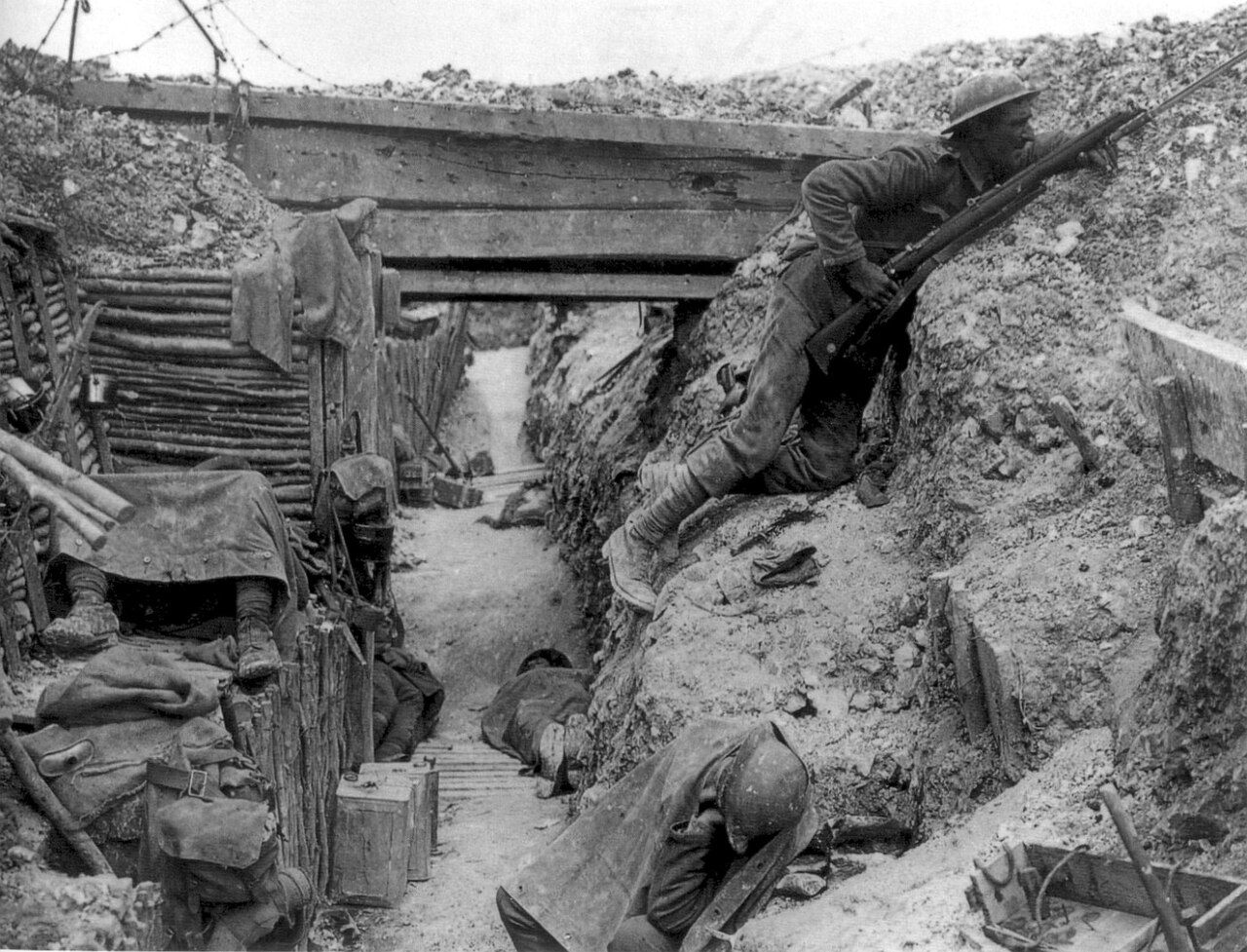
The German advance through Belgium into France was halted at the First Battle of the Marne in September 1914. Both sides then tried to outflank each other northward until they ran out of ground at the sea. By November the Western Front was a continuous line of trenches roughly 440 miles long, and it barely moved for more than three years.
The reason was technological asymmetry. Defensive firepower — magazine rifles, machine guns, barbed wire and above all quick-firing artillery — had outrun the ability of infantry to cross open ground, while radio was too primitive to coordinate an attack once it left the start line. Roughly 60 per cent of battlefield casualties came from shellfire. Generals were not uniformly stupid; they were solving a problem for which no solution yet existed, and they solved it eventually with combined-arms tactics, creeping barrages, tanks and aircraft. The learning curve cost millions of lives.
The numbers still shock. At Verdun, from February to December 1916, French and German casualties together approached three-quarters of a million. On the first day of the Somme, 1 July 1916, the British Army suffered 57,470 casualties, of whom 19,240 were killed — the worst single day in its history. Lethal chemical weapons arrived on a large scale at Ypres in April 1915, when German troops released chlorine gas; by 1918 both sides used gas routinely. Nor was the war confined to France: Tannenberg destroyed a Russian army in August 1914, the Gallipoli landings of 1915 failed bloodily, Italy and Austria fought twelve battles along the Isonzo, and the Ottoman government used wartime emergency to carry out the Armenian Genocide of 1915–1916, in which roughly a million or more Armenians died.
Total war and the state
What distinguished this conflict from earlier European wars was the mobilization of entire societies. Governments took powers they had never held in peacetime: conscription, rationing, censorship, direction of labour, nationalization of railways, control of prices and raw materials. Britain’s Defence of the Realm Act, Germany’s Hindenburg Programme, and the French wartime ministries all pointed the same way — the state as economic manager. Enemy civilians became legitimate economic targets: the British naval blockade of Germany caused severe malnutrition, most visibly in the “turnip winter” of 1916–1917, and German submarines answered by sinking merchant shipping. That precedent did not disappear in 1918. It became the template for the planned economies and command states of the following decades.
Millions of women entered munitions factories, transport and clerical work. The consequences were uneven: many were pushed back out after 1918, but the franchise followed in Britain (1918, for women over thirty with property qualifications; equal suffrage in 1928), Germany, Austria and elsewhere. Empires were mobilized too. Around 1.3 million Indian troops served, along with Senegalese, Algerian, Canadian, Australian, New Zealand and South African forces; their service fed postwar demands for self-government that European governments were unwilling to meet.
The war ended not in a clean military conquest but in exhaustion and internal collapse. Unrestricted submarine warfare and the Zimmermann Telegram brought the United States in on 6 April 1917. Russia left the war after two revolutions. Germany’s spring offensives of 1918 came close and then broke; the Allied counteroffensive from August rolled the German army back, the Habsburg and Ottoman fronts disintegrated, sailors mutinied at Kiel, and the Kaiser abdicated. The armistice took effect at 11 a.m. on 11 November 1918. About nine to ten million soldiers were dead, with comparable civilian losses, and the influenza pandemic of 1918–1919 would kill tens of millions more worldwide.
| Country | Military dead (approx.) | Share of mobilized men killed | Political outcome by 1923 |
|---|---|---|---|
| Germany | 2.0 million | about 15% | Monarchy fell; Weimar Republic |
| Russia | 1.8 million | about 14% | Two revolutions; civil war |
| France | 1.4 million | about 16% | Victor; northern departments devastated |
| Austria-Hungary | 1.1 million | about 14% | Empire dissolved into successor states |
| Britain and Empire | 0.9 million | about 11% | Victor; imperial strains, Irish war |
| Ottoman Empire | 0.8 million | about 27% | Occupied 1918; partition imposed 1920; Turkish republic 1923 |
| Italy | 0.6 million | about 11% | Victor; “mutilated victory” grievance |
| United States | 117,000 | about 3% | Creditor power; rejects League |
The First World War began as a Balkan crisis that alliance obligations and mobilization timetables turned continental, and it ended by handing modern states both the habit and the tools of organizing whole societies for destruction.
Section 2Revolution, Versailles and the Fragile Peace
1917: the Romanovs fall, the Bolsheviks rise
Russia entered the war with the largest army in Europe and the weakest administration. By early 1917 the cities were short of bread and fuel, the transport network was breaking down, and Nicholas II had made the fatal error of taking personal command at the front, so that every defeat was his. In late February by the Russian calendar — early March by ours — bread queues and a women’s demonstration in Petrograd turned into a general strike; the garrison refused to fire and joined the crowds. On 15 March the Tsar abdicated. Three hundred years of Romanov rule ended in about a week, with no organized revolutionary party directing it.
What followed was dual power: a Provisional Government of liberal and moderate socialist politicians, and alongside it the Petrograd Soviet of Workers’ and Soldiers’ Deputies, which actually controlled the garrison and the railways. The Provisional Government made a decision that destroyed it — to stay in the war — and postponed the land question to a future Constituent Assembly while peasants were already seizing estates without waiting for legislation. Vladimir Lenin, returned from Swiss exile in April with German assistance, offered the opposite in three words: peace, land, bread. Through the summer, as the Kerensky offensive failed and General Kornilov’s attempted coup discredited the right, Bolshevik support in the soviets grew from a fringe to a majority in Petrograd and Moscow.
On the night of 25 October (7 November), Bolshevik-led forces under the Military Revolutionary Committee seized bridges, telegraph offices and finally the Winter Palace. It was less a mass insurrection than a well-timed coup by a disciplined party inside a collapsing state. When elections to the Constituent Assembly gave the Bolsheviks only about a quarter of the vote, Lenin dissolved it after one day in January 1918. The Treaty of Brest-Litovsk in March 1918 bought peace with Germany at the price of Poland, the Baltic provinces, Finland and Ukraine — roughly a third of the empire’s population.
The Russian Civil War that followed, from 1918 to 1921, killed far more people than the revolution: perhaps seven to ten million, mostly from famine and typhus. Under War Communism the Bolsheviks requisitioned grain and nationalized industry, while the Cheka — the political police founded in December 1917, months before War Communism began — ran a Red Terror that set the pattern for what came later. They won because they held the centre, the railways and the arms factories, and because their opponents were a geographically scattered coalition with no common political programme. In 1921, with peasant revolts spreading and the Kronstadt sailors in open mutiny, Lenin retreated to the New Economic Policy, allowing small-scale private trade. He died in January 1924, leaving a party that had won a war it had not expected and had built a dictatorship in the process.
Making the peace
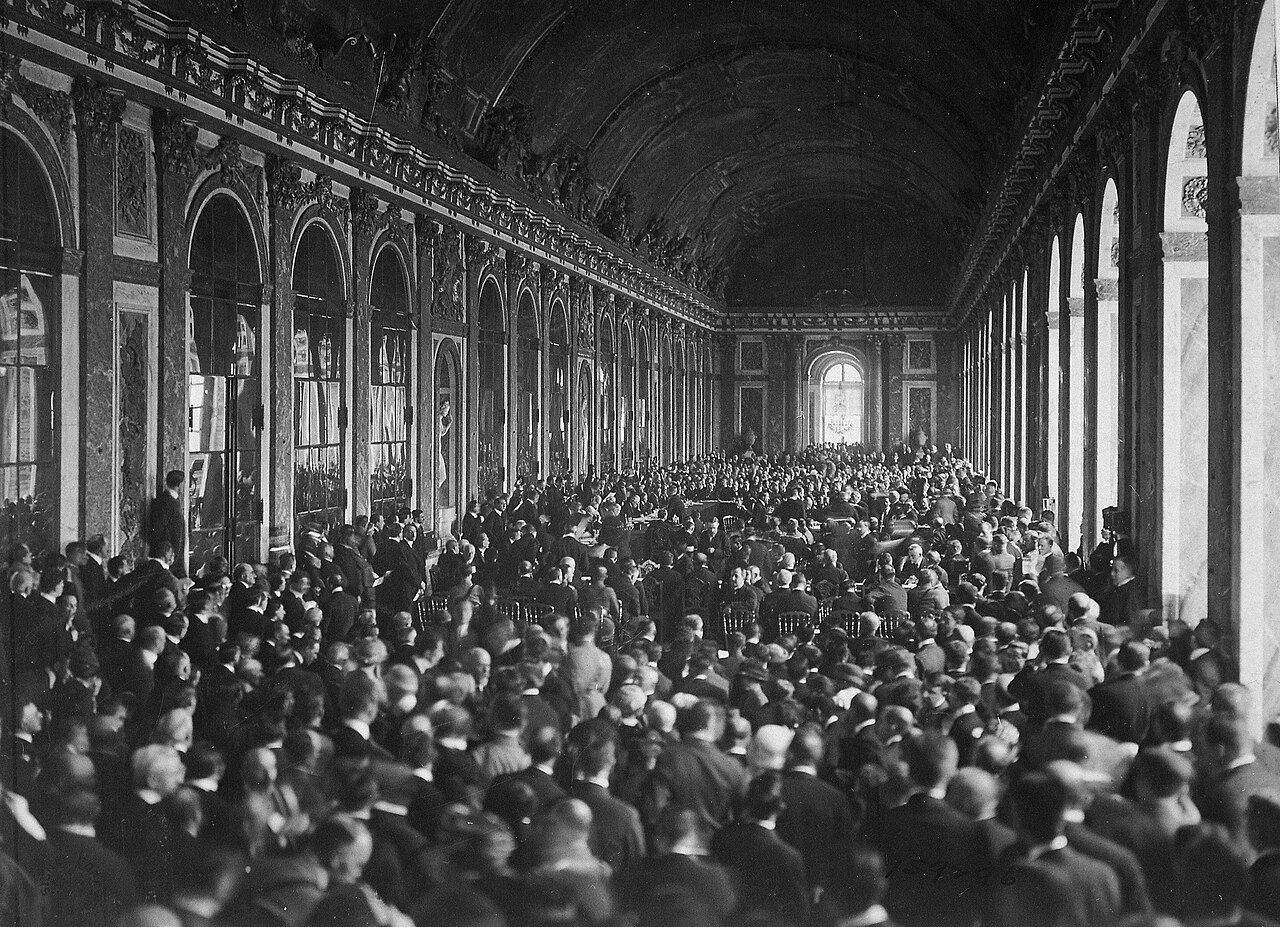
The Paris Peace Conference opened in January 1919 with delegations from thirty-two states and decisions made by four men: Woodrow Wilson, David Lloyd George, Georges Clemenceau and, marginally, Vittorio Orlando. Wilson had arrived with the Fourteen Points and the principle of national self-determination; Clemenceau wanted French security against a Germany with sixty million people to France’s forty; Lloyd George wanted a Germany weak enough to be safe and strong enough to buy British exports.
The Treaty of Versailles, signed on 28 June 1919, returned Alsace-Lorraine to France, gave Poland access to the sea through a corridor that split East Prussia from the rest of Germany, placed the Saar under League administration, demilitarized the Rhineland, stripped Germany of its colonies, capped the army at 100,000 men with no tanks, submarines or air force, and required reparations whose total was fixed in 1921 at 132 billion gold marks — though the bond structure meant the realistically collectable sum was closer to fifty billion. Article 231, the so-called war guilt clause, was drafted as a legal basis for liability. Germans read it as a moral verdict, and it became the single most effective propaganda gift ever handed to the German right.
Four further treaties dismantled the rest. Saint-Germain reduced Austria to a small German-speaking rump forbidden to unite with Germany; Trianon cost Hungary about two-thirds of its prewar territory and left roughly three million ethnic Hungarians outside the new borders, a grievance still audible in Hungarian politics; Neuilly punished Bulgaria; Sèvres partitioned the Ottoman Empire so harshly that Turkish nationalists under Mustafa Kemal fought and overturned it, producing the Treaty of Lausanne in 1923. Ottoman Arab lands became mandates under British and French administration — empire with a League of Nations label. Self-determination, in practice, was applied to Europeans and denied to nearly everyone else.
The golden years, 1924–1929
The early 1920s were violent and unstable. France and Belgium occupied the Ruhr in January 1923 to extract reparations in kind; German passive resistance and money-printing produced hyperinflation so extreme that by November 1923 a dollar cost more than four trillion marks, wiping out savings and pensions and permanently discrediting the Weimar Republic among the middle class. That same month Adolf Hitler attempted a putsch in a Munich beer hall and went to prison, where he wrote Mein Kampf.
Then came a genuine recovery. The American-brokered Dawes Plan of 1924 rescheduled reparations and opened a flow of US loans into German industry. Gustav Stresemann, as foreign minister, negotiated the Locarno treaties of 1925, in which Germany voluntarily accepted its western borders; Germany joined the League in 1926; and the Kellogg-Briand Pact of 1928, eventually signed by more than sixty states, renounced war as an instrument of national policy. Weimar Germany in these years produced the Bauhaus, Fritz Lang, Bertolt Brecht and a scientific establishment second to none. It was, however, a prosperity built on short-term foreign credit, and the eastern borders were never guaranteed at all.
The revolutions of 1917 and the settlements of 1919–1923 replaced four empires with unstable successor states and a peace that depended on American money and Allied unity — both of which vanished after 1929.
Section 3Depression and the Totalitarian Turn
The crash and its politics
The Wall Street collapse of October 1929 mattered to Europe because American short-term loans were the hinge of the whole postwar financial system. When they were called in, Central Europe went first: the Austrian Creditanstalt failed in May 1931, taking German banks with it; Britain abandoned the gold standard in September 1931; world trade fell by roughly two-thirds in value between 1929 and 1932. In Germany, industrial production halved and registered unemployment passed six million — close to a third of the workforce, with many more on short time. Chancellor Heinrich Brüning, unable to command a Reichstag majority and governing after July 1930 by presidential emergency decree under Article 48, responded with deflation, cutting wages and benefits to defend the currency and, not incidentally, to prove reparations unpayable. The policy worked politically for his enemies. Every quarter of misery pushed voters toward the extremes.
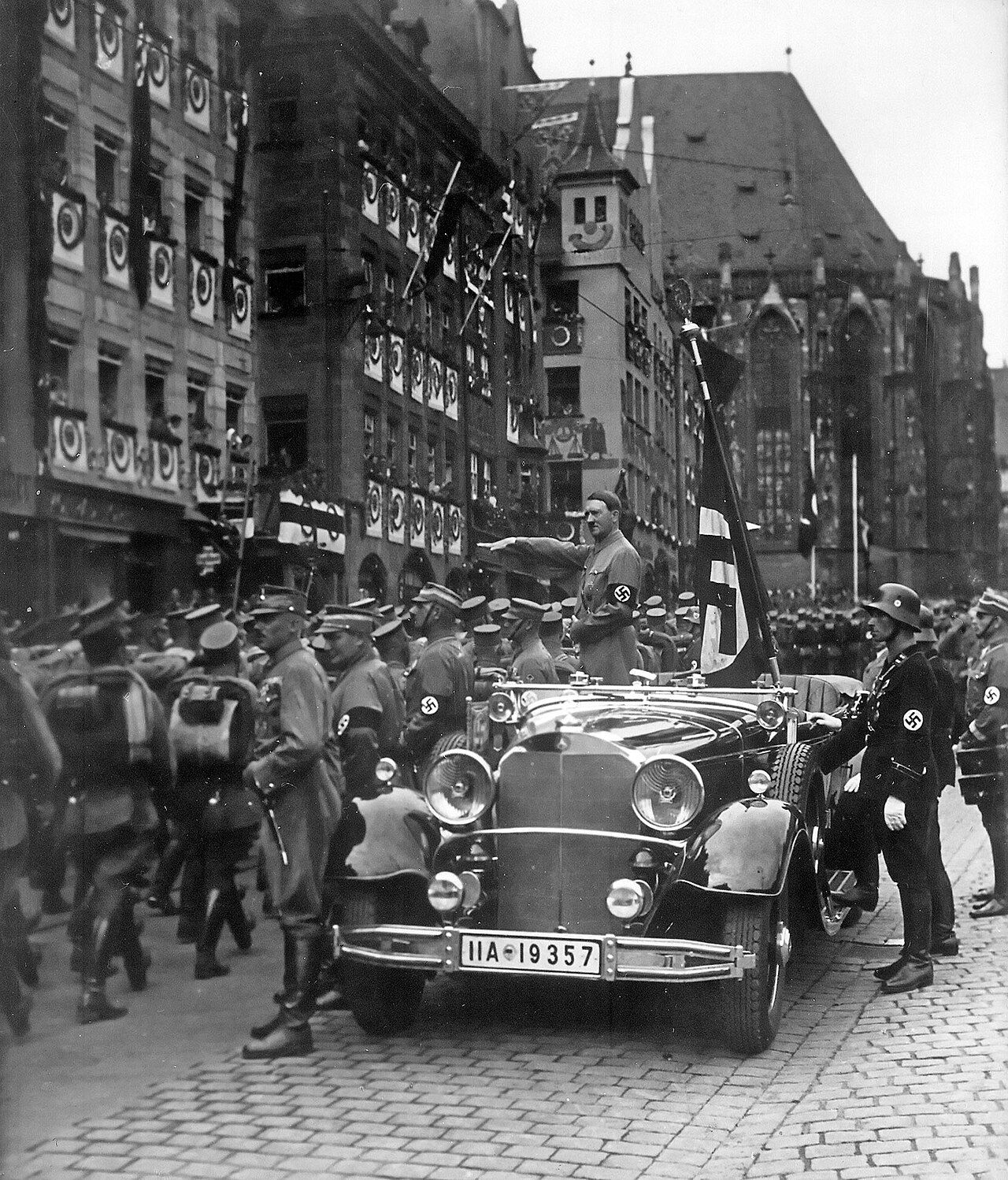
Look at the German election results and the mechanism is unmistakable. In May 1928 the Nazis took 2.6 per cent of the vote and twelve Reichstag seats. In September 1930, after a year of depression, they took 18.3 per cent. In July 1932 they took 37.3 per cent and became the largest party in the Reichstag. They never won a free majority — their vote actually fell to 33.1 per cent in November 1932 — and Hitler became chancellor on 30 January 1933 because a circle of conservative politicians around President Hindenburg, led by Franz von Papen, believed they could use him and contain him. Within six months there were no other legal parties left in Germany.
Italy: fascism invents itself
Italy got there first. Benito Mussolini, a former revolutionary socialist and newspaper editor, founded the Fasci Italiani di Combattimento in Milan in March 1919, drawing on demobilized soldiers, futurist intellectuals and a widespread sense that Italy had been cheated at Paris of the territory promised in 1915 — the “mutilated victory.” His squads offered landowners and industrialists something the state seemed unable to provide during the strike wave of 1919–1920: organized violence against socialists. In October 1922, after the theatrical March on Rome, King Victor Emmanuel III appointed him prime minister rather than declare martial law.
The dictatorship was assembled piece by piece: the Acerbo Law of 1923 rigged the electoral system; the murder of the socialist deputy Giacomo Matteotti in 1924 provoked a crisis that Mussolini survived by claiming full responsibility and doubling down; by 1926 opposition parties were banned and a secret police established. Fascism as an ideology celebrated the nation as an organism, the state as absolute, violence as regenerative, and the leader as the will of the people made flesh. Mussolini also made peace with the Catholic Church in the Lateran Accords of 1929, creating Vatican City and buying enormous domestic legitimacy. His regime was brutal but, by the standards of what came next, far less lethal at home — a distinction worth keeping, because fascism and Nazism are related, not identical.
Germany: from chancellor to Führer in eighteen months
Hitler’s consolidation of power is a case study in how a legal order can be dismantled using its own instruments. On 27 February 1933 the Reichstag burned; a Dutch communist, Marinus van der Lubbe, was caught at the scene. The next day Hindenburg signed the Reichstag Fire Decree suspending civil liberties — freedom of speech, press, assembly, privacy of correspondence, protection from arbitrary arrest — and it was never lifted. Thousands of communists were arrested; the first permanent concentration camp opened at Dachau in March. On 23 March, with communist deputies imprisoned or in flight and SA men lining the hall, the Reichstag passed the Enabling Act by 441 votes to 84, granting the cabinet the power to make law without parliament. Only the Social Democrats voted no.
What followed was Gleichschaltung, the “coordination” of German life: trade unions abolished in May, all other parties banned by July, the civil service purged of Jews and opponents, universities and professional associations brought into line. On 30 June 1934, the Night of the Long Knives, Hitler had the SA leadership murdered along with assorted conservative enemies, which reassured the army; when Hindenburg died on 2 August, Hitler merged the presidency with the chancellorship and the armed forces swore a personal oath to him. The Nuremberg Laws of September 1935 stripped German Jews of citizenship and criminalized marriage and sexual relations between Jews and other Germans. On the night of 9–10 November 1938, Kristallnacht destroyed hundreds of synagogues and thousands of Jewish businesses, killed at least ninety-one people, sent 30,000 Jewish men to concentration camps, and then fined the Jewish community a billion marks for the damage.
The Soviet Union: revolution from above
Joseph Stalin won the succession struggle after Lenin’s death not through charisma but through the general secretaryship, which let him place clients throughout the party apparatus. Having defeated Trotsky, Zinoviev and Kamenev on the left, he then adopted their economic programme and destroyed Bukharin on the right. The first Five-Year Plan, launched in 1928, drove breakneck industrialization — Magnitogorsk, the Dnieper dam, tractor factories — paid for by extracting grain from the countryside.
Collectivization was the instrument. Peasants were forced onto collective farms, and the more prosperous, labelled kulaks, were deported or shot; roughly two million were exiled to special settlements. Peasants slaughtered livestock rather than surrender it, and grain procurement quotas were maintained through catastrophic harvests. The result was the famine of 1932–1933, in which perhaps five to seven million people died across the USSR — concentrated in Ukraine, Kazakhstan, the Volga and the North Caucasus, and proportionally worst among Kazakh herders, of whom something like 1.5 million died. Some 3.5 to 5 million of the dead were in Ukraine — the Holodomor, which many states and a substantial body of scholarship now classify as genocide, while other historians argue it was a lethal consequence of policy applied brutally across several grain regions rather than a plan to destroy Ukrainians as such. The disagreement is real and turns on evidence of intent.
The Great Terror of 1937–1938 turned the machinery inward. Public show trials in Moscow in 1936, 1937 and 1938 saw the old Bolshevik leadership confess to fantastical conspiracies before execution. Far larger was the secret operation: NKVD Order 00447 set arrest and execution quotas by region for “anti-Soviet elements,” and national operations targeted Poles, Germans, Koreans and others. Approximately 1.5 million were arrested and around 680,000 to 750,000 shot in those two years alone; millions more passed through the Gulag camp system. Stalin also destroyed his own officer corps, executing three of five marshals and a large share of senior commanders — a decision Germany would exploit in 1941.
| Fascist Italy | Nazi Germany | Stalin’s USSR | |
|---|---|---|---|
| Core claim | The nation-state as supreme organism | Race and living space (Lebensraum) | Class struggle and building socialism |
| Route to power | Street violence plus royal appointment, 1922 | Mass electoral surge plus elite bargain, 1933 | Coup 1917, then apparatus control by 1929 |
| Property | Private, under corporatist direction | Private, subordinated to rearmament | Abolished; state ownership and planning |
| Terror organ | OVRA | Gestapo, SS, SD | Cheka–OGPU–NKVD |
| Principal victims | Socialists, Slovenes, Libyans, Ethiopians | Jews, Roma, Slavs, disabled, political and sexual minorities | Peasants, national minorities, party cadres, “class enemies” |
| Scale of killing | Thousands at home; tens to hundreds of thousands in the colonies (Libya, Ethiopia) | Millions (mostly outside Germany, in wartime) | Millions (mostly in peacetime, 1930–1938) |
The Depression did not create fascism or communism, but it destroyed the credibility of liberal democracy in states with shallow democratic roots, and let movements promising order, work and national rebirth convert protest into power.
Section 4The Second World War, 1939–1945
The road from Munich
Hitler dismantled the Versailles order in stages, each time gambling that his opponents would not fight. He left the League and the disarmament conference in 1933; announced conscription and an air force in 1935; remilitarized the Rhineland in March 1936 with orders to his outnumbered troops to withdraw if the French moved, which they did not. Mussolini invaded Ethiopia in 1935 and the League’s sanctions failed conspicuously. From 1936 to 1939 both dictators intervened in the Spanish Civil War on Franco’s side while Britain and France declared non-intervention; the bombing of Guernica by the German Condor Legion in April 1937 previewed what aircraft would do to cities.
Then came 1938. In March, German troops entered Austria to general acclaim — the Anschluss. In September, at the Munich Conference, Neville Chamberlain and Édouard Daladier handed Hitler the Czechoslovak Sudetenland without Czechoslovak participation, and Chamberlain came home to describe it as peace for our time. In March 1939 Germany occupied the rest of the Czech lands, which had no German-population justification at all and finally destroyed the argument that Hitler wanted only to unite Germans. Britain and France guaranteed Poland.
Appeasement deserves a fair hearing. Britain was rearming but not ready, its public remembered 1916, its Dominions were reluctant, its planners feared bombing would kill hundreds of thousands in the first weeks, and the Soviet Union looked no more trustworthy than Germany. That said, the guarantee to Poland was unenforceable, and the decisive blow came on 23 August 1939, when Ribbentrop and Molotov signed a non-aggression pact whose secret protocol divided Poland, the Baltic states, Finland and Bessarabia into spheres of interest. With his eastern flank secured, Hitler invaded Poland on 1 September. Britain and France declared war on 3 September. The Soviet Union invaded Poland from the east on 17 September.
Axis triumph, 1939–1942
Poland fell in five weeks. After a quiet winter, Germany took Denmark and Norway in April 1940 and then, on 10 May, attacked in the west. The decisive stroke was an armoured thrust through the Ardennes, judged impassable by French planners, which cut the Allied armies in two. The British evacuated some 338,000 men from Dunkirk between 26 May and 4 June, abandoning their equipment. France signed an armistice on 22 June; the north was occupied and a collaborationist French state under Marshal Pétain governed from Vichy. The Nazi advantage was not superior numbers of tanks — the French had comparable numbers and often better armour — but concentration, radio coordination, air support and operational nerve, the package popularly called blitzkrieg.
Britain fought on under Winston Churchill. In the Battle of Britain from July to October 1940, RAF Fighter Command, aided by radar and an integrated control system, denied the Luftwaffe air superiority and made invasion impossible; the Blitz that followed killed some 43,000 British civilians without breaking morale or war production. Then, on 22 June 1941, Hitler launched Operation Barbarossa against the Soviet Union with more than three million Axis troops along a front of 1,800 miles. This was the war he had always intended: a war of conquest and annihilation for Lebensraum, fought under explicit orders, such as the Commissar Order, that suspended the laws of war. Soviet losses in 1941 were staggering — whole army groups encircled at Minsk, Smolensk and Kiev — but the Germans failed to take Moscow before winter, and a Soviet counteroffensive in December ended any hope of a quick decision.
On 7 December 1941 Japan attacked Pearl Harbor, and on 11 December Hitler declared war on the United States — a decision he was not obliged to make and which ensured that the world’s largest economy would be fully committed against him. The war was now genuinely global, joining a European conflict to a Pacific and Asian war that Japan had been fighting in China since 1937.
The turn and the reckoning
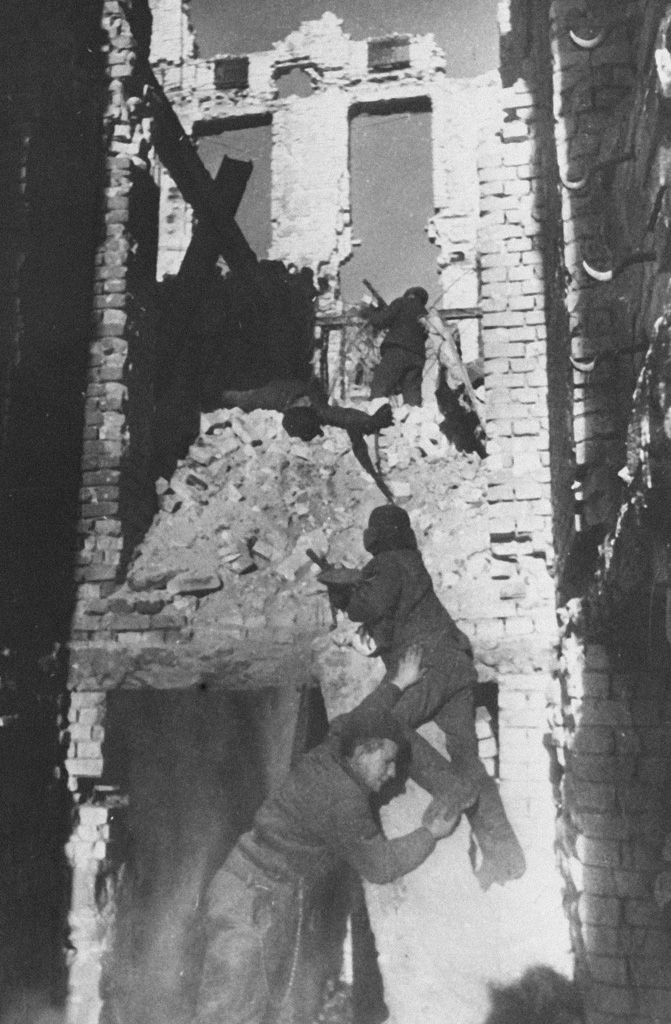
Three battles in a twelve-month span reversed the direction of the war. At Midway in June 1942, American carriers, aided by broken Japanese codes, sank four Japanese fleet carriers and ended Japanese naval initiative. At El Alamein in October and November 1942, Montgomery’s Eighth Army broke Rommel in North Africa. And at Stalingrad, Soviet forces encircled the German Sixth Army in November 1942; about 91,000 men surrendered on 2 February 1943, of whom roughly 5,000 ever came home. In July 1943 the Germans failed at Kursk, the largest armoured battle in history, and thereafter never mounted a strategic offensive in the east again.
Production decided the rest. The United States built more than 300,000 aircraft and around 2,700 Liberty ships during the war; Soviet factories evacuated beyond the Urals turned out T-34s faster than Germany could destroy them; Lend-Lease supplied the Red Army with trucks, radios and food that made its offensives mobile. Allied strategic bombing devastated German cities — Hamburg in July 1943, Dresden in February 1945 — at a cost of some 400,000 to 500,000 German civilian lives and about 55,000 British bomber crew; historians continue to debate both its military effectiveness and its morality.
The Anglo-American armies landed in Sicily in July 1943, which brought down Mussolini, and in Normandy on D-Day, 6 June 1944. On 22 June the Soviets launched Operation Bagration, destroying German Army Group Centre and advancing to the Vistula. Paris was liberated in August. A last German gamble in the Ardennes in December 1944 failed. Soviet troops entered Berlin in April 1945; Hitler killed himself in his bunker on 30 April; Germany surrendered unconditionally on 8 May. In the Pacific, island campaigns of extraordinary savagery brought American bombers within range of Japan; atomic bombs destroyed Hiroshima on 6 August and Nagasaki on 9 August, killing well over 100,000 people immediately and many more from injury and radiation, and the Soviet Union declared war on 8 August. Japan announced surrender on 15 August and signed on 2 September 1945.
| Country | Total deaths (approx.) | Share of prewar population | Note |
|---|---|---|---|
| Soviet Union | 26–27 million | about 14% | Roughly two-thirds civilian |
| China | 15–20 million | about 3–4% | War from 1937; famine and occupation |
| Poland | 5.6–6 million | about 17% | Includes about 3 million Polish Jews |
| Germany | 6.6–8.8 million | about 8–10% | Includes about 0.5 million from bombing |
| Japan | 2.5–3.1 million | about 4% | Includes about 0.8 million civilians |
| Yugoslavia | 1.0–1.7 million | about 7–10% | Occupation plus internal civil war |
| France | 0.6 million | about 1.4% | Occupation, deportation, bombing |
| Britain | 0.45 million | about 1% | Mostly military and merchant marine |
| United States | 0.42 million | about 0.3% | Almost entirely military |
Hitler won spectacular early victories with operational skill against unprepared opponents, then lost decisively once the war became a contest of industrial output and manpower against the Soviet Union, the United States and the British Empire together.
Section 5The Holocaust and the Reckoning
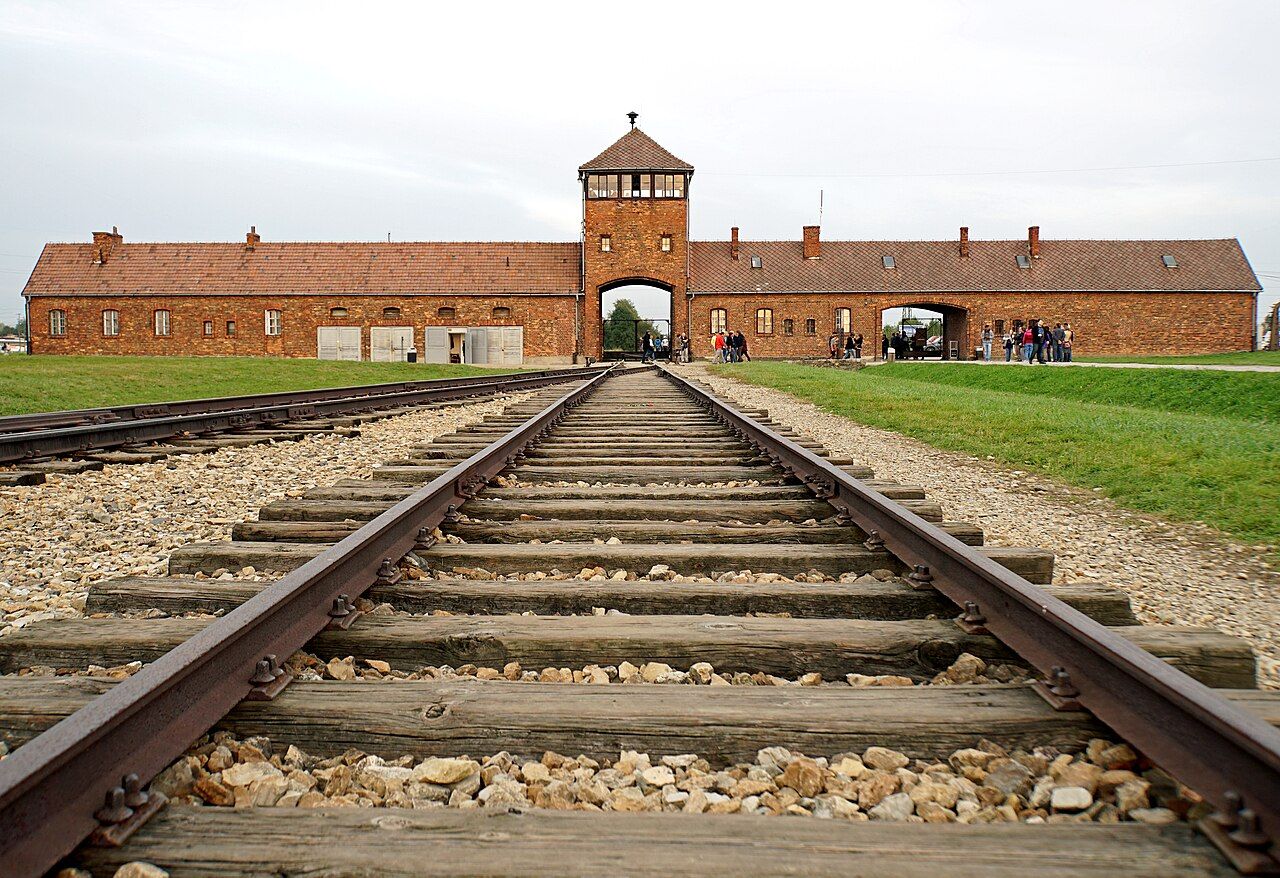
From exclusion to extermination
The Holocaust was not a single decision but a process that escalated over roughly a decade, and understanding the escalation is the point. The years 1933 to 1939 were years of legal exclusion: dismissal from the civil service and the professions, the boycott of April 1933, the Nuremberg Laws of 1935, forced “Aryanization” of businesses, the violence of Kristallnacht. The intent then was emigration by pressure, and roughly half of Germany’s 525,000 Jews had left by 1939 — a figure that would have been higher had other countries, including the United States and Britain, opened their doors. The Evian Conference of July 1938 produced sympathy and almost no visas.
War changed the arithmetic. The conquest of Poland in 1939 brought nearly two million Jews under German control; they were concentrated into sealed ghettos, of which Warsaw held some 400,000 people in about 1.3 square miles, where tens of thousands died of starvation and disease. The invasion of the Soviet Union in June 1941 opened the next phase. Four Einsatzgruppen, mobile killing units of the SS and police, followed the army and shot Jewish men, then women and children too: at Babi Yar outside Kiev on 29–30 September 1941, 33,771 Jews were murdered in two days. By the end of 1941 mass shooting had killed roughly half a million people, and the perpetrators themselves complained of its psychological cost and inefficiency.
The Wannsee Conference of 20 January 1942 did not decide on genocide — killing was already under way — but it coordinated the bureaucracy for the “final solution of the Jewish question in Europe,” a plan whose own minutes counted eleven million potential victims. In 1942 the killing became industrial. Under Operation Reinhard, camps at Belzec, Sobibor and Treblinka existed for nothing but murder: transports arrived, and within hours nearly everyone aboard was dead in carbon-monoxide gas chambers. Treblinka alone killed roughly 800,000 people. At Auschwitz-Birkenau, which combined a slave-labour complex with extermination facilities using Zyklon B, about 1.1 million died, including 430,000 Hungarian Jews deported in a period of eight weeks in 1944, when the war was already lost.
Approximately six million Jews were murdered, about two-thirds of European Jewry and roughly nine of every ten Jews in Poland and the Baltic states. The Nazi regime also murdered between 250,000 and 500,000 Roma and Sinti; killed some 70,000 disabled Germans in the Aktion T4 gassing programme and tens of thousands more afterward by starvation and injection; worked and starved to death approximately 3.3 million Soviet prisoners of war; and imprisoned or killed Jehovah’s Witnesses, homosexual men, Polish elites and political opponents. All of it required accountants, railway schedulers, chemists, physicians, clerks and local collaborators — ordinary professionals doing their jobs.
Resistance, rescue and complicity
Resistance existed and was punished with collective reprisal. The Warsaw Ghetto Uprising of April and May 1943 pitted a few hundred poorly armed fighters against SS troops for nearly a month. There were revolts at Treblinka and Sobibor, and a Sonderkommando rising at Auschwitz in October 1944. Partisan movements in Yugoslavia, the Soviet Union, Greece, Poland, France and Italy tied down Axis divisions; the French Resistance mattered militarily around D-Day and mattered morally far more. In Germany itself, the Kreisau Circle, the students of the White Rose — Hans and Sophie Scholl, executed in 1943 — and the army officers who tried to kill Hitler on 20 July 1944 all failed and paid for it.
Rescue was rare and consequential. Denmark ferried roughly 7,200 Jews to neutral Sweden in October 1943. Bulgaria, under pressure from its own parliament and church, refused to deport the roughly 48,000 Jews of Bulgaria proper — though it handed over more than 11,000 from the Greek and Yugoslav territories it occupied. Diplomats including Raoul Wallenberg in Budapest and Chiune Sugihara in Kaunas issued papers that saved thousands. Set against this were the auxiliary police, militias and administrations across occupied Europe without whose participation the killing could not have proceeded at the speed it did — a subject that remains politically explosive in several countries today. Allied governments knew a great deal by 1942 and declared it publicly in December of that year, but rescue never became a strategic priority.
Judgment and the new vocabulary
In 1944 the Polish-Jewish jurist Raphael Lemkin coined the word genocide because existing law had no name for the destruction of a people. Within a year the language of law was tested at the Nuremberg Trials, where an International Military Tribunal of American, British, French and Soviet judges tried twenty-two major German defendants between November 1945 and October 1946 on charges including crimes against humanity — a category that had barely existed in enforceable form. Twelve were sentenced to death, three acquitted. Twelve subsequent American trials at Nuremberg prosecuted doctors, judges, industrialists and Einsatzgruppen commanders; the Doctors’ Trial produced the Nuremberg Code on informed consent in human experimentation, which underlies research ethics in medicine and nursing to this day. A parallel tribunal sat in Tokyo.
The criticisms were serious and were made at the time: victors’ justice, retroactive law, and the presence on the bench of a Soviet state that had itself invaded Poland and massacred Polish officers at Katyn. Yet the alternative on the table — summary execution, which Churchill initially favoured — would have left no evidentiary record. Nuremberg established that following orders is not a defence, that heads of state are not immune, and that the documents would be preserved.
The institutional aftermath was rapid. The United Nations Charter was signed in June 1945; the Genocide Convention and the Universal Declaration of Human Rights were both adopted in December 1948. Europe itself was transformed: perhaps eleven million displaced persons, twelve to fourteen million ethnic Germans expelled from eastern Europe, cities in ruins, and a continent divided along the line where the armies had stopped. That division is the subject of the next chapter.
The Holocaust escalated from legal exclusion to mass shooting to purpose-built extermination camps through the initiative of a modern bureaucracy at war, and the postwar trials created the legal vocabulary — genocide, crimes against humanity, informed consent — that we still use to name such crimes.
The chapter in one breath
A pistol shot in Sarajevo in June 1914 caught the European great powers in a web of alliances and mobilization schedules, and produced four years of industrial siege warfare that killed roughly ten million soldiers and taught governments how to command entire societies. That lesson outlived the war. Russia’s collapse gave Lenin a state to remake; the revolutions of 1917–1918 and the Paris settlement together replaced four empires with unstable successor states, humiliated Germany without disabling it, and depended on American money that vanished in 1929. The Depression then destroyed liberal government wherever its roots were shallow, opening the way for Mussolini’s Italy, Hitler’s Germany and Stalin’s revolution from above, each claiming the whole of life for the party and each answering opposition with terror. Appeasement bought time and lost credibility; the Nazi-Soviet Pact of August 1939 removed the last obstacle. The war that followed killed sixty million or more, was decided chiefly on the Eastern Front and in the factories of the United States and the Urals, and included within it the deliberate murder of six million Jews by a literate, technically accomplished state. Out of the wreckage came a new legal vocabulary — genocide, crimes against humanity, human rights — and a divided continent.
Words worth knowing
| Term | What it means |
|---|---|
| Total war | Conflict in which the state mobilizes the whole economy and population, and civilians become both producers and targets. |
| Blank cheque | Germany’s unconditional promise of support to Austria-Hungary in July 1914, which emboldened Vienna to attack Serbia. |
| Fischer thesis | Fritz Fischer’s 1961 argument that Germany deliberately sought a continental war for world-power status; still debated. |
| Dual power | The 1917 arrangement in which Russia’s Provisional Government and the soviets each held part of real authority. |
| Bolsheviks | Lenin’s faction of Russian Marxists, committed to a disciplined vanguard party; seized power in October 1917. |
| War Communism | Bolshevik civil-war policy of grain requisitioning, nationalization and terror, replaced by the New Economic Policy in 1921. |
| Article 231 | The Versailles clause assigning Germany and its allies responsibility for war damage; read in Germany as a guilt verdict. |
| Mandate | League of Nations arrangement placing former Ottoman and German territories under Allied administration — empire renamed. |
| Hyperinflation | Germany’s 1923 currency collapse, which wiped out middle-class savings and permanently damaged faith in the republic. |
| Fascism | Mussolini’s movement and its imitators: ultranationalist, anti-liberal, anti-Marxist, glorifying violence, the state and the leader. |
| Enabling Act | The law of 23 March 1933 allowing Hitler’s cabinet to legislate without the Reichstag; the legal end of German democracy. |
| Gleichschaltung | The Nazi “coordination” of unions, parties, professions and associations under party control during 1933–1934. |
| Lebensraum | “Living space” — the Nazi aim of conquering and colonizing eastern Europe at the expense of its Slavic and Jewish populations. |
| Collectivization | Stalin’s forced consolidation of peasant farms from 1929, which produced mass deportation and the famine of 1932–1933. |
| Holodomor | The Ukrainian famine of 1932–1933; recognized by many states and scholars as genocide, a classification some historians contest. |
| Gulag | The Soviet forced-labour camp administration, through which many millions of prisoners passed under Stalin. |
| Appeasement | The British and French policy of conceding Hitler’s demands to avoid war, discredited after the occupation of Prague in March 1939. |
| Blitzkrieg | Popular label for German operations combining concentrated armour, radio coordination and air support to break through and encircle. |
| Einsatzgruppen | SS and police mobile killing units that shot roughly 1.5 million Jews and others behind the Eastern Front from 1941. |
| Crimes against humanity | The Nuremberg charge covering large-scale atrocities against civilians, including a state’s own, regardless of domestic legality. |