Sociology
The Sociological Perspective
Why did you choose the major you chose, marry the person you married, or believe the things you believe? It feels like a string of private decisions — and it is — but sociology begins with a stubborn observation: those private decisions fall into patterns. People who share a social position tend to choose, marry, vote, worship, and even die in strikingly similar ways. Sociology is the systematic study of those patterns and the social forces that produce them. This chapter introduces the perspective itself — the habit of seeing the general in the particular — along with the thinkers who founded the field, the three great theoretical lenses sociologists still use, and the reason any of it matters for understanding your own life.
By the end of this chapter you can
- Define sociology and explain what makes its way of looking at the world distinctive.
- Use C. Wright Mills's sociological imagination to connect personal troubles to public issues.
- Summarize the contributions of Comte, Durkheim, Marx, and Weber to the founding of the discipline.
- Distinguish the three major theoretical paradigms — structural functionalism, conflict theory, and symbolic interactionism.
- Apply each paradigm correctly to the same social topic and predict the questions it would ask.
- Distinguish microsociology from macrosociology and place a research question at the right level of analysis.
- Explain how social facts and social forces shape outcomes that feel purely personal, using Durkheim's study of suicide as the classic case.
Section 1What sociology is
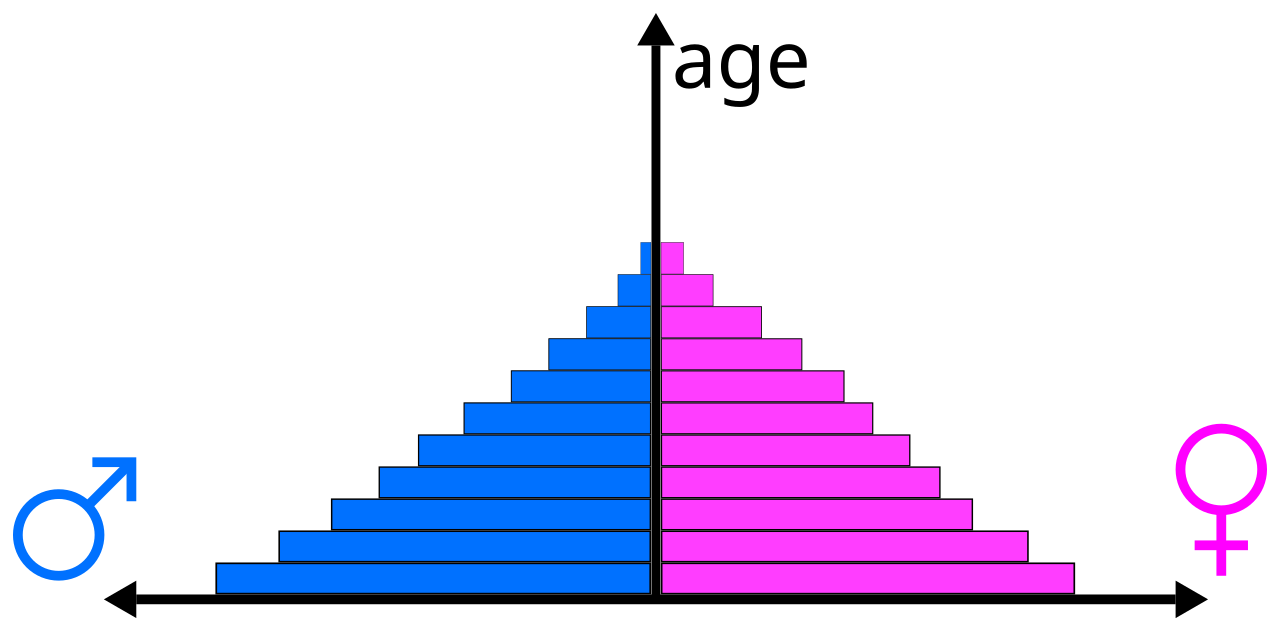
The study of society
Sociology is the systematic, evidence-based study of human social life — of groups, institutions, and whole societies, and of the relationships that bind individuals to them. Where psychology looks inward at the mind and biology looks at the body, sociology looks outward and across: it asks how the groups you belong to shape what you think, feel, and do. Its core insight is that human behavior is not simply the sum of individual choices. Rates of marriage, unemployment, church attendance, and even suicide stay remarkably stable from year to year within a given society, even though the specific people involved change entirely. That stability is the fingerprint of social forces — regularities that exist above the level of any single person and press on all of us.
Sociologists call these external regularities social facts, a term from Émile Durkheim. A social fact — a law, a custom, a rate of divorce, the expectation that you shake hands or bow — is external to any one individual, general across the group, and able to constrain behavior. You did not invent your language, your money, or your manners; you were born into them, and they shape you whether you consent or not. Studying social facts is what makes sociology a discipline and not just opinion about people.
The sociological imagination
In 1959 the American sociologist C. Wright Mills gave the perspective its most famous name: the sociological imagination, "the vivid awareness of the relationship between experience and the wider society." It is the capacity to step outside your own routine and see your private life as the intersection of biography and history — to grasp that what happens to you is bound up with the era and society you happen to live in. Mills's sharpest tool was a distinction between personal troubles and public issues. A trouble is private, felt by an individual within the range of their immediate relationships. An issue is public, rooted in the structure of society itself, and it cannot be solved by any one person's effort.
His example still lands. When one worker in a city of 100,000 is unemployed, that is a personal trouble, and we look sensibly to that person — their skills, their choices, their luck. But when 15 million workers are unemployed in a nation of 50 million employees, that is a public issue, and no amount of individual grit will fix it, because the problem lies in the economy's structure, not in any one résumé. The sociological imagination is the discipline of asking, of any personal experience, how many other people are in the same boat, and what social arrangement put them there?
Seeing the general in the particular
The sociologist Peter Berger described this move as "seeing the general in the particular" — recognizing, in the individual case, the workings of broad social patterns. It requires what Berger called a willingness to be surprised by the familiar, to treat your own everyday world as strange enough to question. Why do you queue politely, tip a server, or feel embarrassed by a silence in conversation? None of these is written in your genes; each is a social pattern you absorbed so thoroughly it feels like instinct. Learning to see it — to make the familiar strange — is the first skill of the discipline.
| Situation | As a personal trouble | As a public issue |
|---|---|---|
| One person divorces | Their specific relationship, choices, and history | Divorce rates near 40–50%; changing law, economics, and gender roles |
| A student drops out | That student's motivation and circumstances | Tuition costs, work demands, unequal school funding |
| A person is obese | Individual diet and exercise habits | Food deserts, marketing, the built environment, poverty |
| Someone can't find a job | Their skills, effort, and interview luck | Recession, automation, where jobs are located |
- Sociology is the systematic study of human social life — groups, institutions, and societies — and the forces that pattern them.
- Social facts (Durkheim) are external, general, constraining regularities that shape individuals from outside.
- The sociological imagination (Mills) links private biography to public history and distinguishes personal troubles from public issues.
- The perspective means "seeing the general in the particular" — making the familiar strange enough to question.
Section 2The founders
Comte and the birth of a science
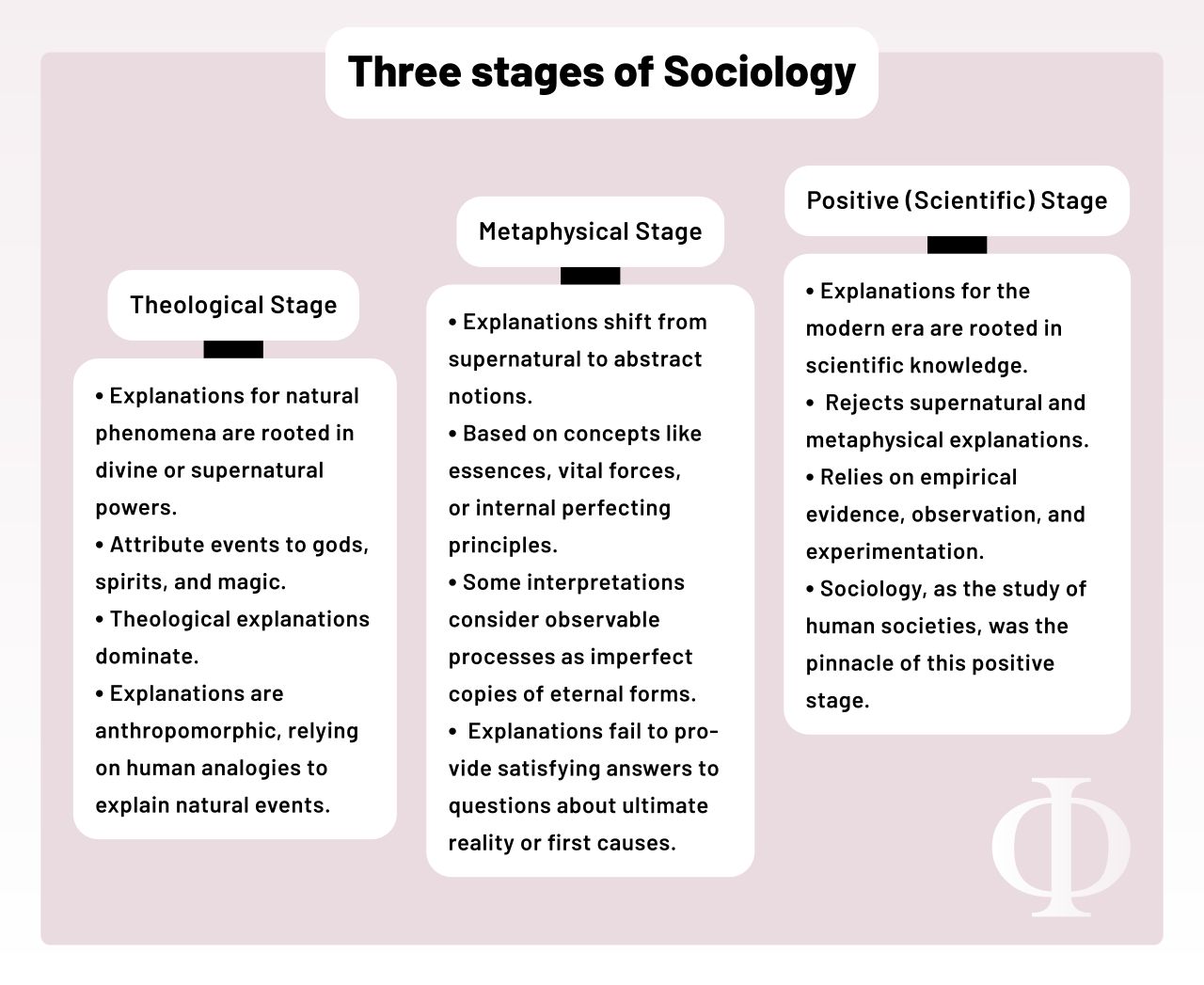
Sociology was born in the upheaval of the 1800s — the French and Industrial Revolutions had shattered the old order of village, church, and monarchy, and thinkers scrambled to explain the new world of cities, factories, and mass politics. The Frenchman Auguste Comte (1798–1857) coined the word sociology in the 1830s and argued that society could be studied with the same rigor as physics. He championed positivism, the view that knowledge should rest on observable, measurable evidence rather than speculation, and proposed a "law of three stages" through which he believed human understanding progressed. Comte produced little empirical research himself, but he set the founding ambition: a science of society. The English writer Harriet Martineau, who translated and condensed Comte for the English-speaking world and studied morals and manners on both sides of the Atlantic, is often recognized as the first woman sociologist.
Durkheim: society as a reality of its own
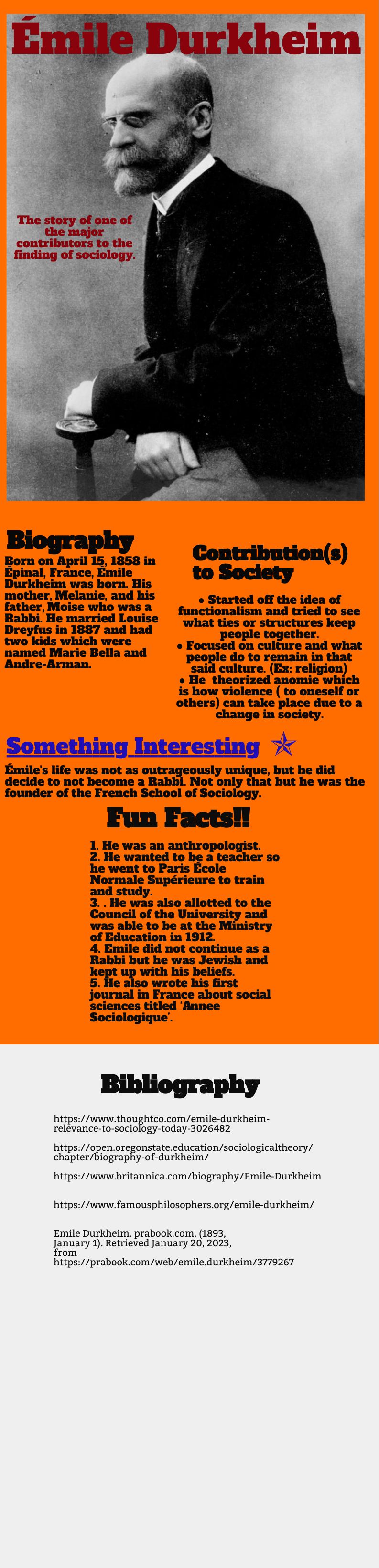
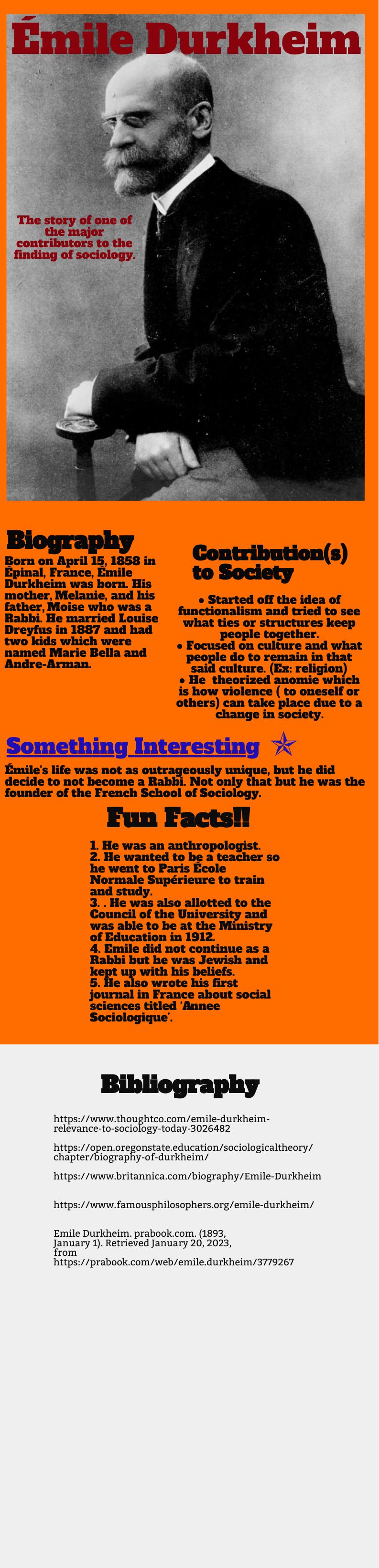
Émile Durkheim (1858–1917), a founder of French academic sociology, gave the field its central object of study: the social fact. Society, he insisted, is not reducible to the individuals in it — it is a reality sui generis, of its own kind, that must be explained on its own terms. He analyzed social solidarity, the glue holding groups together, distinguishing the mechanical solidarity of small traditional societies (bound by sameness and shared belief) from the organic solidarity of modern ones (bound by interdependence and a complex division of labor). When that binding weakens and norms lose their grip, he warned, people fall into anomie — a state of normlessness. His landmark study Suicide (1897) showed that even this most private act follows social patterns, and it made him the intellectual ancestor of structural functionalism.
Marx: society as a struggle over resources
Karl Marx (1818–1883) was not a professor of sociology, but no thinker shaped the field more. He argued that the engine of history is class conflict — the struggle between those who own the means of production (the bourgeoisie) and those who must sell their labor to survive (the proletariat). Under industrial capitalism, Marx held, workers are exploited (paid less than the value they create) and alienated (cut off from their work, its products, and one another). Economic arrangements, in his view, form the base that shapes everything else — law, religion, politics, ideas. Whatever one makes of his politics, Marx's focus on power, inequality, and conflict became the foundation of conflict theory.
Weber: society as meaning and rationality
The German scholar Max Weber (1864–1920) both built on Marx and pushed back. Where Marx put economics first, Weber insisted that ideas also drive history — famously arguing in The Protestant Ethic and the Spirit of Capitalism that a religious worldview helped give rise to capitalism itself. His signature method was verstehen (German for "understanding"): to explain social action you must grasp the subjective meaning it holds for the people doing it. Weber saw the master trend of modern life as rationalization — the steady replacement of tradition and emotion by calculation, efficiency, and rules — and identified bureaucracy as its purest, and potentially most dehumanizing, expression.
| Founder | Big question | Key ideas | Legacy paradigm |
|---|---|---|---|
| Comte | Can society be studied scientifically? | Coined "sociology"; positivism; law of three stages | Scientific method in sociology |
| Durkheim | What holds society together? | Social facts; solidarity; anomie; Suicide | Structural functionalism |
| Marx | Who has power, and how do they keep it? | Class conflict; bourgeoisie vs proletariat; alienation | Conflict theory |
| Weber | What meanings drive social action? | Verstehen; rationalization; bureaucracy; Protestant ethic | Interpretive & interactionist work |
- Comte coined sociology and championed positivism — a science of society built on observable evidence.
- Durkheim made the social fact sociology's object of study and analyzed solidarity, anomie, and suicide.
- Marx centered class conflict, exploitation, and alienation, founding the conflict tradition.
- Weber stressed meaning (verstehen), rationalization, and bureaucracy, balancing Marx's economics with the power of ideas.
Section 3The three paradigms
Structural functionalism
A paradigm is a broad theoretical lens — a set of basic assumptions that shapes the questions a researcher asks. Sociology's first great lens is structural functionalism, which grew from Comte, Durkheim, and Herbert Spencer and was refined by Talcott Parsons and Robert K. Merton. It views society as a system of interconnected parts — family, economy, education, religion, government — each performing a function that helps keep the whole stable, much as organs keep a body alive. Merton distinguished manifest functions (the intended, recognized consequences of a social pattern) from latent functions (its unintended, often unnoticed ones), and added the idea of a dysfunction, a consequence that disrupts the system. A university's manifest function is to educate; a latent function is to introduce future spouses and delay entry into a crowded job market.
Conflict theory
Conflict theory, rooted in Marx and extended by many others, sees society not as a harmonious body but as an arena of competition over scarce resources — wealth, power, prestige. Where functionalism asks how society holds together, conflict theory asks who benefits from the way it is arranged and who is kept down. Social order, in this view, reflects the ability of dominant groups to protect their advantages, and change comes through struggle. The tradition has broadened far beyond economic class: feminist theory analyzes conflict along lines of gender, and the American sociologist W. E. B. Du Bois pioneered the study of racial inequality and "the color line." To a conflict theorist, a university does not just educate — it reproduces privilege by tracking children of the wealthy toward the top.
Symbolic interactionism
The third lens works at ground level. Symbolic interactionism, developed by George Herbert Mead and named by Herbert Blumer, holds that society is built and rebuilt through countless everyday interactions in which people exchange and interpret symbols — words, gestures, objects that carry shared meaning. We act toward things based on the meanings they hold for us, and those meanings arise in interaction. Charles Horton Cooley captured this with the looking-glass self: we come to see ourselves by imagining how we appear to others. Erving Goffman extended it into dramaturgy, analyzing social life as a theater in which we manage the impressions we give off. Where the first two paradigms zoom out to whole societies, interactionism zooms in on the handshake, the classroom exchange, the profile photo.
| Paradigm | Level | View of society | Guiding question | Key figures |
|---|---|---|---|---|
| Structural functionalism | Macro | A stable system of interdependent parts | What function does this serve for the whole? | Durkheim, Parsons, Merton |
| Conflict theory | Macro | An arena of struggle over scarce resources | Who benefits, and who is disadvantaged? | Marx, Du Bois, feminist theorists |
| Symbolic interactionism | Micro | A fabric woven from everyday meaningful interaction | How do people create and interpret meaning? | Mead, Cooley, Blumer, Goffman |
- A paradigm is a theoretical lens that decides which questions a sociologist asks.
- Structural functionalism (macro) sees society as interdependent parts serving functions; note manifest vs latent functions and dysfunctions.
- Conflict theory (macro) sees society as competition over scarce resources and asks who benefits — by class, gender, and race.
- Symbolic interactionism (micro) sees society built from meaningful everyday interaction; note the looking-glass self and dramaturgy.
Section 4Micro and macro
Two altitudes for one world
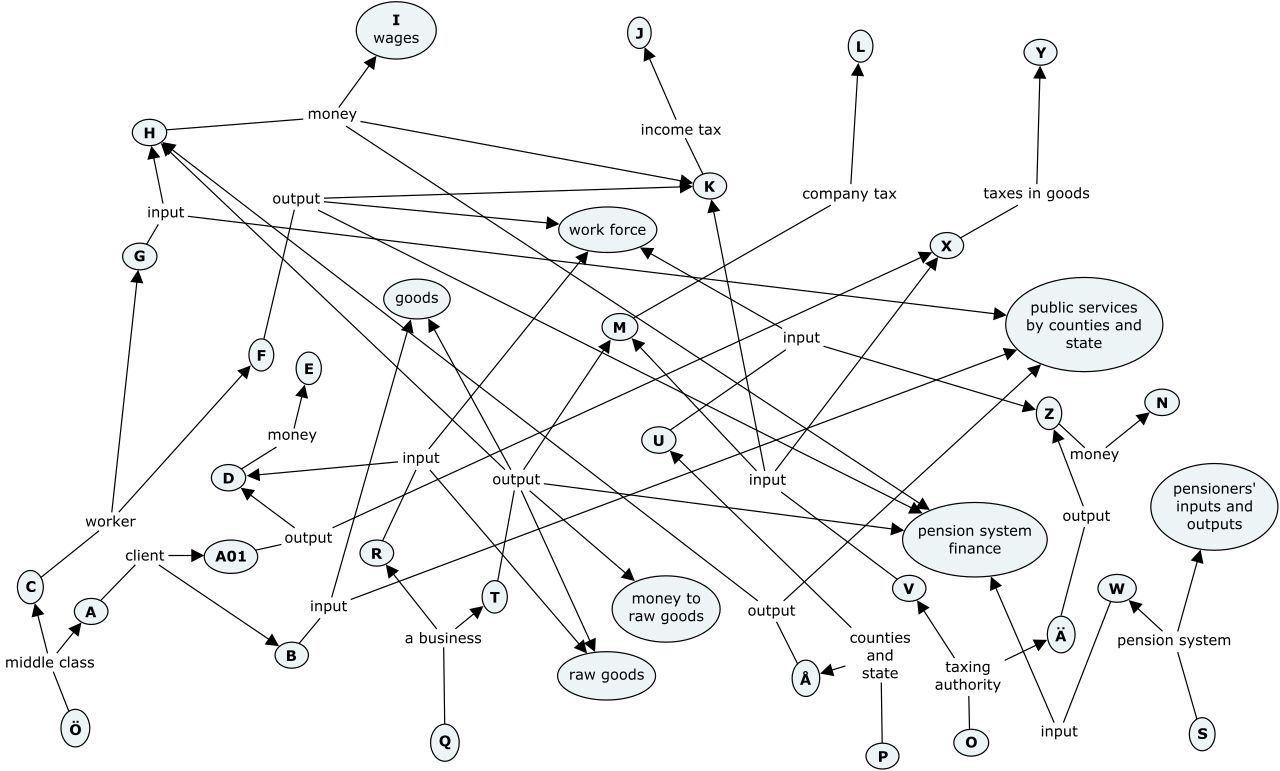
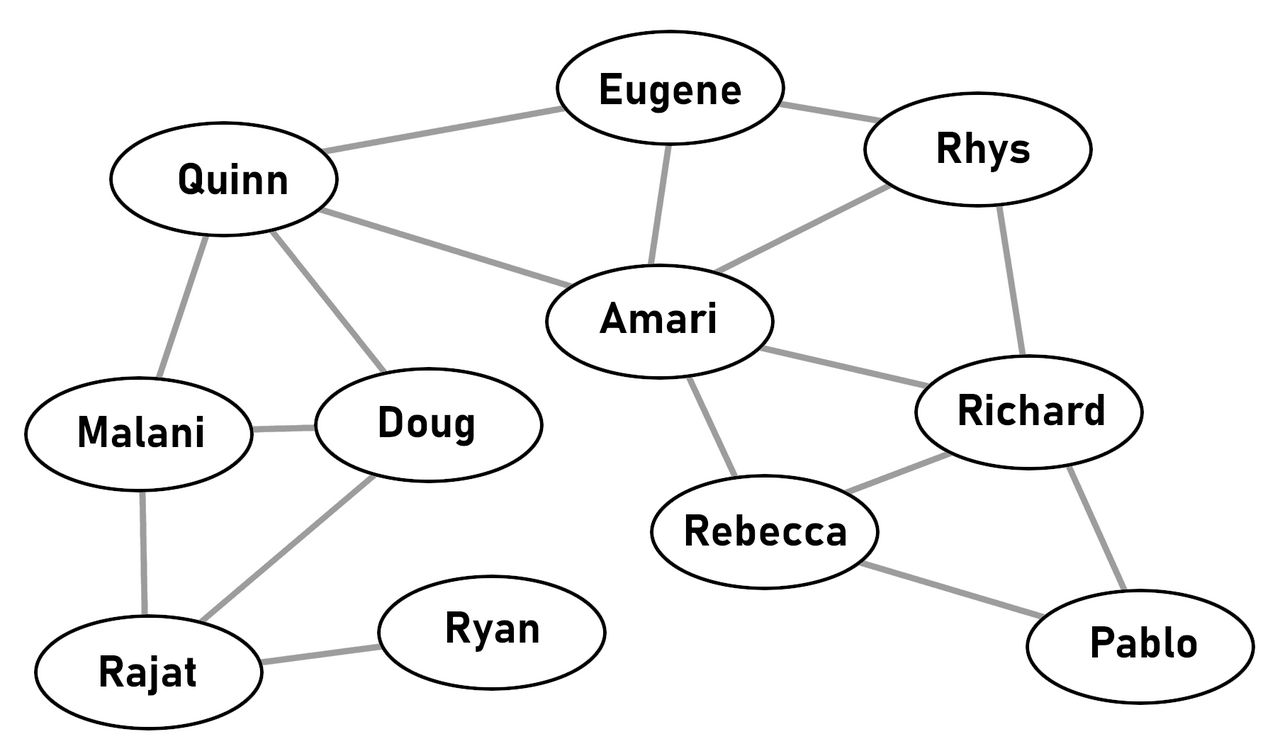
Sociologists study the same social world from different altitudes, and it is worth naming them. Microsociology examines small-scale, face-to-face interaction — a conversation, a family dinner, a doctor and patient, a job interview. Macrosociology examines large-scale structures and whole populations — the economy, the education system, social class, migration, a nation's rising average age. Some sociologists add a middle rung, the meso level, for organizations and communities that sit between the two. Symbolic interactionism is the natural home of micro work; functionalism and conflict theory usually operate at the macro level. Neither altitude is more "real" than the other, and the best sociology often links them.
The same phenomenon at each level
The levels are not different subjects — they are different resolutions on the same subject. Take education. At the macro level a sociologist charts graduation rates across income groups, funding gaps between districts, and the payoff of a degree in the labor market. At the micro level, another sociologist sits in a single classroom and watches how a teacher's expectations, a student's body language, and the give-and-take of praise and correction shape who comes to see themselves as "smart." The macro pattern (unequal outcomes by class) is produced, one interaction at a time, by the micro processes — and the micro interactions are steered by the macro structures the participants were born into. Good sociology keeps both in view.
| Feature | Microsociology | Macrosociology |
|---|---|---|
| Scale | Individuals and small groups | Institutions, populations, whole societies |
| Typical focus | Face-to-face interaction, meaning, identity | Structure, inequality, social change |
| Home paradigm | Symbolic interactionism | Functionalism, conflict theory |
| Example question | How do strangers negotiate space in an elevator? | Why is wealth distributed the way it is? |
| Typical evidence | Observation, interviews, ethnography | Surveys, census data, historical records |
- Microsociology studies face-to-face interaction; macrosociology studies large structures and whole societies.
- Some analyses add a meso level for organizations and communities.
- Micro and macro are two resolutions on the same reality — macro patterns are built from micro interactions, which are steered by macro structures.
- The paradigms map onto the levels: interactionism is micro; functionalism and conflict theory are macro.
Section 5Why it matters
The social forces behind private life
The reason the sociological perspective is worth learning is that it reveals causes you cannot see from inside your own life. The forces that shape you — your class, your era, your gender, your nationality, the institutions you pass through — are like water to a fish: so constant and surrounding that they become invisible. Sociology is the practice of noticing the water. It repeatedly shows that outcomes we experience as purely personal — whom we love, what we earn, how long we live, what we believe about ourselves — are patterned by social position in ways no individual chose. That is not a comforting message, but it is a clarifying one, and it is often the first step toward changing conditions that private effort alone cannot fix.
Durkheim's suicide: the classic proof
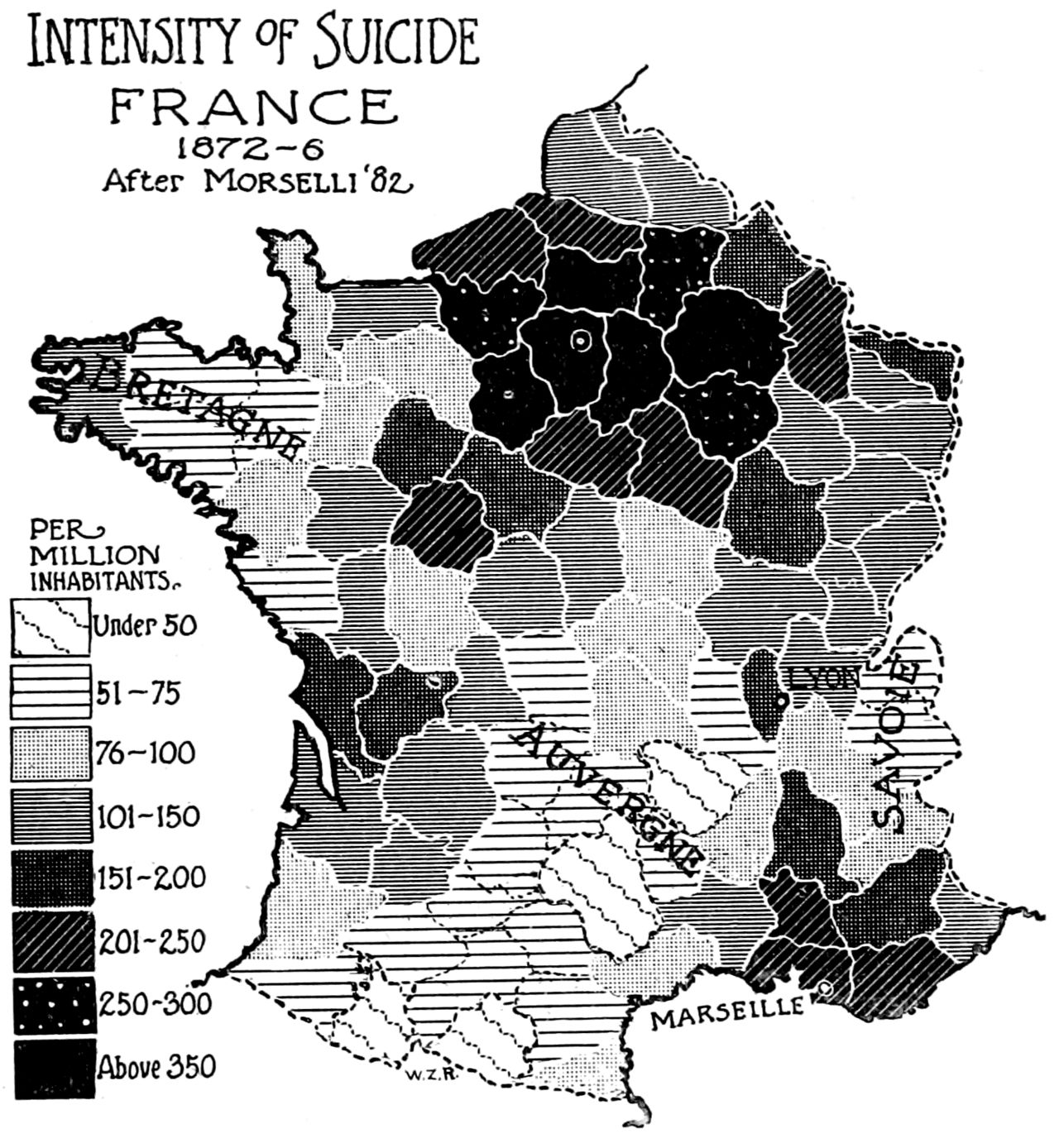
Nothing feels more individual than suicide, and that is exactly why Durkheim chose it. Studying official statistics across the regions of Europe, he found that suicide rates held steady within groups year after year and varied systematically between them: they were consistently higher among the unmarried than the married, among Protestants than Catholics, among the childless than parents, and they rose in times of sudden social disruption. Individual psychology could not explain a stable group rate — only a social fact could. Durkheim's answer was social integration: the more tightly a person is woven into a group with shared bonds and clear norms, the more protected they are; weak integration and normlessness (anomie) raise the risk. The most private act imaginable turned out to have a social address.
A perspective for citizens, not just scholars
You need not become a sociologist for the perspective to pay off. It makes you a sharper reader of the news, less quick to reduce a social problem to individual character and better at spotting the structure underneath. It trains a habit that Berger called debunking — looking past a society's official story to how it actually works. And it is practical: the skills of sociology — framing questions, gathering evidence, reading data on people and organizations — feed careers in public health, business, law, policy, social work, marketing, and management. Above all, the sociological imagination is a tool for humility and for agency at once: it locates you honestly within forces larger than yourself, and in doing so shows you where those forces might be changed.
| Feels like… | Is also shaped by… |
|---|---|
| "I chose my career freely" | Family resources, gender expectations, which majors your school offered |
| "My health is my own doing" | Income, neighborhood, occupation, access to care |
| "Whom I love is private" | Who is in your social networks, homogamy, cultural scripts about romance |
| "My beliefs are just mine" | How you were raised, your generation, your community and its institutions |
- Social forces are "the water" — so pervasive they become invisible; sociology is the practice of noticing them.
- Durkheim's study of suicide proved that even the most private act follows social patterns, explained by social integration, not individual psychology alone.
- The perspective trains debunking — seeing past a society's official story to how it works.
- Sociological skills apply widely — public health, policy, business, law, social work — and offer both humility and agency.
The chapter in one breath
- Sociology is the systematic study of social life — groups, institutions, and societies — and the social forces that pattern private behavior.
- Social facts (Durkheim) are external, general, constraining regularities; the sociological imagination (Mills) links personal troubles to public issues.
- The founders each set an agenda: Comte (positivism), Durkheim (social facts, solidarity), Marx (class conflict), Weber (meaning and rationalization).
- Structural functionalism sees society as interdependent parts serving functions; note manifest vs latent functions and dysfunctions.
- Conflict theory sees competition over scarce resources and asks who benefits — by class, gender, and race.
- Symbolic interactionism sees society built from meaningful everyday interaction — the looking-glass self, dramaturgy.
- Microsociology studies face-to-face interaction; macrosociology studies large structures — two resolutions on one reality.
- The perspective matters because it reveals the social causes of outcomes that feel personal, as Durkheim's Suicide classically showed.
ReferenceWords worth knowing
A quick reference for the terms in this chapter — skim it now, or circle back whenever a word trips you up.
- Anomie
- A condition of normlessness in which social norms weaken or break down, associated by Durkheim with higher rates of deviance and suicide.
- Bourgeoisie
- In Marx's theory, the class that owns the means of production and profits from the labor of others.
- Bureaucracy
- A large, formal organization run by rules, hierarchy, and impersonal procedure; for Weber, the purest expression of rationalization.
- Class conflict
- The struggle between social classes over resources and power that Marx saw as the engine of historical change.
- Conflict theory
- A macro-level paradigm that views society as an arena of competition over scarce resources and asks who benefits from social arrangements.
- Dramaturgy
- Goffman's approach analyzing social interaction as theater, in which people manage the impressions they present to others.
- Dysfunction
- A consequence of a social pattern that disrupts the stability or working of the larger system.
- Latent function
- An unintended, often unrecognized consequence of a social pattern (contrast with manifest function).
- Looking-glass self
- Cooley's idea that we develop a self-image by imagining how we appear to and are judged by others.
- Macrosociology
- The study of large-scale social structures, institutions, and whole societies.
- Manifest function
- The intended, openly recognized consequence of a social pattern.
- Microsociology
- The study of small-scale, face-to-face social interaction.
- Paradigm
- A broad theoretical framework whose basic assumptions shape the questions a researcher asks.
- Positivism
- The view, championed by Comte, that knowledge should be based on observable, measurable evidence.
- Proletariat
- In Marx's theory, the working class, who own no means of production and must sell their labor to survive.
- Social fact
- Durkheim's term for a way of acting or thinking that is external to the individual, general across the group, and able to constrain behavior.
- Social solidarity
- The bonds that hold a society together; Durkheim contrasted mechanical (based on sameness) with organic (based on interdependence).
- Sociological imagination
- Mills's term for the capacity to connect personal experience to broader social and historical forces.
- Sociology
- The systematic, evidence-based study of human social life, groups, institutions, and societies.
- Structural functionalism
- A macro-level paradigm that views society as a system of interdependent parts, each serving a function that maintains the whole.
- Symbolic interactionism
- A micro-level paradigm holding that society is constructed through everyday interaction in which people exchange and interpret shared symbols.
- Verstehen
- Weber's method of interpretive understanding — grasping the subjective meaning that social action holds for the people performing it.
Check yourself
Sociological Research
Sociology is not opinion, and it is not common sense dressed up in long words. It is a science — a disciplined way of asking questions about human social life and answering them with evidence rather than hunches. This chapter walks through how sociologists actually do their work: how they turn a curiosity into a testable question, how they gather data through surveys, fieldwork, experiments, and existing records, and how they reason from what they find. Along the way you will meet the three great theoretical lenses that shape which questions get asked, and the ethical rules that protect the people who agree to be studied. Master this chapter and every claim in the rest of the book stops being something to memorize and becomes something you can interrogate.
By the end of this chapter you can
- Describe the steps of the scientific method as sociologists apply them, and distinguish a theory from a hypothesis.
- Explain how the three theoretical paradigms shape which research questions get asked.
- Design a survey and explain sampling, representativeness, and generalizability.
- Compare participant observation and ethnography, and weigh the trade-offs of field research.
- Explain how experiments establish causation and how secondary data analysis reuses existing evidence.
- Distinguish reliability from validity, and correlation from causation.
- Apply the core principles of research ethics: value neutrality, informed consent, confidentiality, and protection from harm.
- Explain how historical abuses such as the Tuskegee study reshaped today's ethical safeguards.
Section 1The research process
From common sense to social science
Everyone has theories about people. Why do the poor stay poor? Why do some marriages last? Common sense offers quick, confident answers — and it is wrong a great deal of the time. The whole point of sociology, a term coined by Auguste Comte in the 1830s, is to replace the confident guess with empirical evidence: information we can observe, measure, and check. Comte's positivism held that the social world, like the physical world, obeys discoverable patterns and can be studied with the methods of science. When Émile Durkheim set out to explain suicide — seemingly the most personal, private act imaginable — he did not speculate. He gathered official death records across regions and religions and found stable, predictable rates: Protestants died by suicide more often than Catholics, the unmarried more than the married, soldiers more than civilians. Something social, not merely individual, was at work. That study is the founding demonstration that human behavior leaves patterns a researcher can find.
The scientific method, step by step
Sociologists follow the same broad logic as any scientist, adapted to a subject that talks back. The process usually runs in this order: define the problem as a clear, answerable question; review the literature to see what is already known; state a hypothesis; give each idea an operational definition so it can actually be measured; collect data using a chosen method; analyze the results; and draw a conclusion, then report it so others can replicate the work. A study nobody can repeat is a story, not a finding. Central to the design are variables — things that change. The independent variable is the presumed cause the researcher varies; the dependent variable is the outcome that may respond to it. Asking whether class size (independent) affects test scores (dependent) is answerable; asking whether schools are "good" is not, until "good" is operationalized.
Theory and hypothesis, and the lens you choose
Beginners mix these two words up, so pin them down. A theory is a broad, evidence-tested explanation of how facts relate to one another — Durkheim's theory that weak social bonds raise suicide risk. A hypothesis is a single, narrow, testable prediction drawn from a theory, usually stated as a relationship between variables: "communities with more civic organizations will have lower suicide rates." A theory is the map; a hypothesis is the specific route you test today. Researchers reach hypotheses two ways. Deductive reasoning starts with a theory and tests a prediction from it; inductive reasoning starts with observations and builds toward a theory. And which questions you even think to ask depends on your paradigm — the theoretical lens through which you view society. The three dominant paradigms send researchers looking for very different things.
| Paradigm | Core idea & key thinkers | Level | A question it asks about schooling |
|---|---|---|---|
| Structural functionalism | Society is a system of interlocking parts, each serving a function that keeps the whole stable (Durkheim; Merton) | Macro | What functions — teaching skills, sorting talent, socializing children — does school perform for society? |
| Conflict theory | Society is an arena of competition over scarce resources; institutions reflect the interests of the powerful (Marx) | Macro | How does schooling reproduce class and racial inequality across generations? |
| Symbolic interactionism | Society is built and rebuilt through the meanings people create in everyday interaction (Mead; Cooley; Goffman) | Micro | How do a teacher's expectations shape how a student sees, and labels, herself? |
Notice that no paradigm is "the true one." Each is a flashlight pointed at a different corner of the same room. A complete picture of schooling needs all three, which is why sociologists learn to switch lenses deliberately rather than defend one to the death.
- Sociology replaces common-sense guessing with empirical evidence gathered by the scientific method.
- A theory explains how facts relate; a hypothesis is one testable prediction, usually about an independent and a dependent variable.
- Operational definitions turn fuzzy ideas into measurable ones; replication tests whether a finding is real.
- The three paradigms — functionalism, conflict theory, symbolic interactionism — shape which questions a researcher asks.
Section 2Surveys
Questionnaires and interviews
The survey is the workhorse of sociology — the most common way to gather data from a large number of people. A survey collects self-reported answers using either a written questionnaire that respondents fill out themselves, or an interview in which a researcher asks the questions aloud. The two formats trade breadth against depth. A questionnaire mailed or posted online can reach thousands cheaply, but it cannot ask a follow-up or read a hesitation. An interview reaches fewer people at greater cost, but it can probe, clarify, and follow a surprising answer where it leads.
Question wording is a craft. Closed-ended questions offer fixed choices — yes/no, or a Likert scale running from "strongly agree" to "strongly disagree" — and produce tidy quantitative data that is easy to compare and count. Open-ended questions let respondents answer in their own words, yielding rich qualitative detail that is harder to tabulate. Interviews themselves range from structured (every respondent gets identical questions in identical order, for comparability) to unstructured (a guided conversation that adapts). Whatever the format, surveys battle a constant enemy: social-desirability bias, the human tendency to report the flattering answer rather than the true one. People overstate how often they vote, exercise, and give to charity, and understate how much they drink.
Sampling: studying a few to learn about many
No one can interview an entire country, so researchers study a sample — a manageable subset — and reason back to the whole population they care about. The magic is not in the size of the sample but in how it is chosen. A probability (random) sample gives every member of the population a known, non-zero chance of selection; when that chance is equal for everyone, it is a simple random sample. Done right, it produces a representative sample: a miniature of the population, mirroring its mix of age, income, region, and everything else. That is what lets a poll of 1,200 people estimate the views of a nation of millions to within a few percentage points. The opposite is a convenience sample — whoever is easy to reach — which is fast, cheap, and usually biased in ways you cannot see.
| Sampling approach | How members are chosen | Representative? | Can you generalize? |
|---|---|---|---|
| Simple random | Every person has an equal chance (a lottery) | Yes, if done well | Yes |
| Stratified random | Population split into groups, then sampled at random within each | Yes — often more precise | Yes |
| Convenience | Whoever is easy to reach — a mall, a class, a website | No | No — findings apply only to those sampled |
| Volunteer / self-selected | People opt in themselves | No — joiners differ from non-joiners | No |
Generalizability
Generalizability is the payoff of good sampling: the confidence that what is true of your sample is true of the population. It is earned by representativeness, not by sheer numbers — a lesson learned the hard way. In 1936 the magazine Literary Digest mailed out ten million mock ballots and predicted, from over two million replies, that Alf Landon would defeat Franklin Roosevelt. It was one of the largest polls in history, and it was catastrophically wrong. The names had been drawn from telephone directories and automobile registrations — luxuries that, in the depths of the Depression, skewed toward the wealthy. George Gallup, using a scientifically representative sample a fraction of the size, correctly predicted Roosevelt's landslide. The magazine folded soon after.
- A survey gathers self-reported data by questionnaire or interview; closed questions count easily, open questions go deep.
- Researchers study a sample to learn about a population; a probability sample can be representative, a convenience sample cannot.
- Generalizability comes from representativeness, not raw sample size.
- Surveys must guard against social-desirability bias in what people are willing to report.
Section 3Field research

Into the field: participant observation
Some questions cannot be answered on a questionnaire. To understand how a street gang keeps order, how nurses cope with death, or how a religious commune sustains belief, a researcher has to be there. Field research is the study of people in their natural settings — the sidewalk, the shop floor, the waiting room — rather than in a lab or on a form. Its signature method is participant observation, in which the researcher joins the group being studied, taking part in daily life while systematically recording field notes. The classic example is William Foote Whyte's Street Corner Society, for which he spent years embedded with young men in an Italian-American neighborhood, learning their world from the inside. In nonparticipant observation, by contrast, the researcher watches without joining in — useful when participating would distort the very thing being studied.
Ethnography
Ethnography is field research at its most ambitious: the immersive, long-term study of an entire social setting or culture, aiming to describe it as its own members understand it. Borrowed from anthropology, where Bronisław Malinowski pioneered living among the people he studied, ethnography prizes thick description — capturing not just what people do but what it means to them. Erving Goffman's study of a mental hospital, Asylums, is a landmark of the form. Good ethnographers practice reflexivity: they examine how their own presence and background shape what they see. The occupational hazard is "going native" — identifying so completely with the group that critical distance is lost, and observation slides into membership.
Strengths and limits
Field research buys something no survey can: validity, the sense that you are measuring what really happens, in context, in its full messy detail. Its price is generalizability and reliability — the consistency that would let another researcher repeat the measurement and get the same result. One researcher's years in one neighborhood cannot be assumed to describe every neighborhood, and no one can exactly replicate a unique immersion. A study can be highly valid yet low in reliability, or the reverse; a good design seeks both. Field research is also slow, demanding, and vulnerable to the researcher's own bias. And it raises a sharp ethical edge: observing people who may not know they are being studied.
| Field method | What the researcher does | Key trade-off |
|---|---|---|
| Participant observation | Joins the group and takes part while recording field notes | Rich insider view, but risks reactivity and "going native" |
| Nonparticipant observation | Watches systematically without joining in | Less intrusive, but misses the insider's meaning |
| Ethnography | Immerses long-term to describe a whole culture or setting | Deep, contextual validity, but not generalizable or repeatable |
| Case study | Studies a single person, group, or event in exhaustive depth | Vivid detail, but one case may not represent others |
- Field research studies people in natural settings; participant observation joins the group, nonparticipant observation watches from outside.
- Ethnography is the deep, immersive study of a whole culture, prizing thick description and reflexivity.
- Field research delivers strong validity but weak generalizability and is hard to replicate.
- The Hawthorne effect — people changing because they are watched — threatens every observational study.
Section 4Experiments and secondary data
The experiment
Surveys and field research reveal patterns, but a pattern alone cannot prove that one thing causes another. To establish cause and effect, sociologists turn to the experiment: a controlled test in which the researcher deliberately changes one factor and watches what happens. The changed factor is the independent variable; the outcome measured is the dependent variable. The design's power comes from comparison. Participants are split, ideally by random assignment, into an experimental group that receives the treatment and a control group that does not. If the two groups were alike to begin with and differ only in the treatment, any difference in outcome can be credited to the treatment. Experiments may run in a laboratory, where control is tight but the setting artificial, or in the field, where realism is high but stray influences creep in. The famous Hawthorne studies were, in effect, a field experiment whose surprise result — the observation itself mattered — became a lesson in its own right.
Secondary data analysis
Not every study requires new data. Secondary data analysis mines information that already exists — government censuses, crime and health statistics, historical archives, court records, and the raw data from other researchers' surveys. It is fast, inexpensive, and often vast in scope: a lone scholar can analyze a national census that took thousands of workers to collect. Because the people involved are not reacting to a researcher in the room, secondary data is nonreactive (unobtrusive) — free of the Hawthorne effect. Durkheim's suicide study was itself a masterpiece of secondary analysis, built entirely from official records already on file. A specialized branch, content analysis, applies the same logic to texts and media — systematically coding advertisements, news stories, or song lyrics to reveal patterns, such as how gender roles are portrayed over time.
Strengths and limits of each
The experiment's gift is causation; its curse is artificiality and scale — you cannot randomly assign people to be rich or poor, and lab behavior may not match real life. Secondary data's gift is reach and low cost; its curse is fit — the data were gathered by someone else, for some other purpose, and may miss exactly the variable you need or define it in a way you would not have chosen.
| Method | What you do | Best for | Watch out for |
|---|---|---|---|
| Experiment | Change an independent variable; compare experimental and control groups | Establishing cause and effect | Artificial settings; many social variables can't be assigned |
| Secondary data analysis | Analyze existing records, statistics, or archives | Big-picture patterns, trends over time, low cost | Data fit the original purpose, not yours; gaps and coding issues |
| Content analysis | Systematically code texts, images, or media | Patterns in culture and communication | Coding choices can inject the researcher's bias |
- An experiment tests causation by comparing an experimental group and a control group, ideally with random assignment.
- Secondary data analysis reuses existing records; it is cheap, wide-reaching, and nonreactive.
- Content analysis is secondary analysis applied to texts and media.
- Correlation alone never proves causation; a third variable may drive both.
Section 5Research ethics
Value neutrality
Sociologists study things they care about — poverty, racism, crime — and caring can quietly bend a study toward the answer the researcher hoped to find. Max Weber insisted that scholars practice value neutrality (in German, Wertfreiheit): keeping personal values and politics from distorting the design, conduct, and interpretation of research. Value neutrality does not mean having no values, and it does not forbid studying injustice; it means being honest and transparent, following the evidence even when it contradicts your beliefs, and disclosing your assumptions so others can judge them. The goal is not a researcher without a heart, but a method that does not let the heart forge the data.
Informed consent and voluntary participation
People are not lab rats, and the modern rules exist to keep them from being treated as such. Informed consent requires that participants understand what the study involves, including its risks, and agree to take part freely. Voluntary participation means no one is coerced and anyone may withdraw at any time. Researchers protect identities through confidentiality (the researcher knows who said what but does not reveal it) or, more strongly, anonymity (not even the researcher can link answers to a name). Deception is discouraged and, where unavoidable, must be minimal and followed by a debriefing. In the United States, the American Sociological Association publishes a Code of Ethics, and virtually all research with human subjects must first be approved by an Institutional Review Board (IRB) that weighs risks against benefits before a single participant is recruited.
Protecting subjects: lessons written in harm
These safeguards were not born in the abstract; they were written in response to real damage. The Tuskegee syphilis study (1932–1972) deceived roughly 600 poor Black men in Alabama, leaving hundreds with untreated syphilis and withholding penicillin even after it became the standard cure — all to observe the disease's course. Stanley Milgram's obedience experiments and Philip Zimbardo's Stanford prison study inflicted serious psychological distress under deception. Laud Humphreys' Tearoom Trade covertly observed private behavior and traced participants to their homes. Public outrage over Tuskegee led to the National Research Act and the Belmont Report, whose three principles — respect for persons, beneficence, and justice — anchor research ethics and the IRB system today.
| Ethical principle | What it requires | What a violation looks like |
|---|---|---|
| Informed consent | Participants understand the study and its risks before agreeing | Tuskegee subjects were never told they had syphilis |
| Voluntary participation | No coercion; participants may quit at any time | Pressuring students or prisoners who cannot easily refuse |
| Confidentiality / anonymity | Identities and answers are protected | Publishing details that reveal who a respondent is |
| Protection from harm | Minimize physical and psychological risk | The lasting distress caused in the Stanford prison study |
| Value neutrality | Keep personal bias from shaping the findings | Designing a study so it can only confirm your politics |
- Value neutrality (Weber) means keeping personal bias out of the research, not pretending to have no values.
- Informed consent, voluntary participation, and confidentiality or anonymity protect the people studied.
- An IRB reviews studies in advance, guided by the Belmont Report: respect for persons, beneficence, justice.
- Modern safeguards were written in response to abuses like the Tuskegee study, Milgram, and Zimbardo.
The chapter in one breath
- Sociology is a science: it answers questions about social life with the scientific method and empirical evidence, not common sense.
- A theory explains how facts relate; a hypothesis is one testable prediction linking an independent to a dependent variable.
- The three paradigms — functionalism, conflict theory, symbolic interactionism — decide which questions get asked.
- Surveys reach many people by questionnaire or interview; a probability sample earns generalizability, a convenience sample does not.
- Field research and ethnography deliver deep validity in natural settings but sacrifice generalizability and are shadowed by the Hawthorne effect.
- Experiments establish causation with experimental and control groups; secondary data analysis reuses existing records cheaply and unobtrusively.
- Correlation is never proof of causation, and all research is bound by ethics: value neutrality, informed consent, confidentiality, and protection from harm.
ReferenceWords worth knowing
A quick reference for the terms in this chapter — skim it now, or circle back whenever a word trips you up.
- Control group
- The participants in an experiment who do not receive the treatment, used as a baseline for comparison.
- Correlation
- A relationship in which two variables change together; it does not, by itself, prove causation.
- Dependent variable
- The outcome a study measures — the factor that may respond to the independent variable.
- Ethnography
- The immersive, long-term study of a whole social setting or culture from its members' point of view.
- Experiment
- A controlled test of cause and effect in which a researcher varies an independent variable and compares groups.
- Field research
- The study of people in their natural, everyday settings rather than in a lab or on a form.
- Generalizability
- The extent to which findings from a sample can be applied to the larger population.
- Hypothesis
- A specific, testable prediction, usually stated as a relationship between variables.
- Independent variable
- The factor a researcher changes or presumes to be the cause of an outcome.
- Informed consent
- A participant's free agreement to take part after understanding the study and its risks.
- Operational definition
- A precise statement of how an abstract concept will be measured in a given study.
- Participant observation
- Field research in which the researcher joins the group being studied while recording observations.
- Population
- The entire group a researcher wants to understand and draw conclusions about.
- Positivism
- Comte's view that society can be studied scientifically to discover observable, law-like patterns.
- Probability sample
- A sample in which every member of the population has a known, non-zero chance of selection; when every chance is equal, it is a simple random sample.
- Reliability
- The consistency of a measure — whether it yields the same result when repeated.
- Sample
- The subset of a population that is actually studied.
- Secondary data analysis
- Research that analyzes existing data, such as censuses, archives, or other studies' records.
- Survey
- A method that gathers self-reported data from many people via questionnaire or interview.
- Theory
- A tested, evidence-based explanation of how and why facts are related.
- Validity
- Whether a measure actually captures the concept it claims to measure.
- Value neutrality
- Weber's principle of keeping personal values and bias from distorting research.
Check yourself
Culture
Take a fish out of water and it finally notices the water. Culture is like that: the ocean of shared meaning you swim in every day and almost never see, because you have never known anything else. It is the language you think in, the food that tastes like home, the gestures you make without deciding to, and the values you defend as simply “right.” Sociologists study culture precisely because it feels so natural and stays so invisible — and because nearly everything else in social life is built on top of it. This chapter pulls the water into view: what culture is made of, the rules and symbols that hold it together, why human cultures differ so wildly, how the major theories explain it, and how it changes.
By the end of this chapter you can
- Define culture and distinguish material from nonmaterial culture with examples.
- Explain how values, norms, and symbols organize everyday behavior.
- Classify norms as folkways, mores, taboos, and laws by the sanction each carries.
- State the Sapir–Whorf hypothesis and explain how language can shape thought.
- Contrast subcultures with countercultures, and ethnocentrism with cultural relativism.
- Apply the functionalist, conflict, and symbolic–interactionist paradigms to culture.
- Explain cultural change through innovation, diffusion, and cultural lag.
Section 1What culture is

A working definition
In everyday speech, “culture” means opera, museums, and knowing which fork to use. Sociologists mean something far broader. Culture is the entire way of life of a group of people — the beliefs, values, behaviors, language, and material objects they share and pass on to the next generation. By this definition everyone has culture, and no way of life is more “cultured” than another. A tailgate party, a hip-hop lyric, and a wedding ritual are all culture in exactly the same sense that a symphony is.
Two features make culture sociologically important. First, it is shared: it lives in the group, not in any one person, which is why you can be born into a culture you never chose. Second, it is learned, not inherited in your genes — a newborn adopted across the world grows up speaking the language and holding the values of wherever it is raised. Because culture is learned and shared, it can be studied, compared, and changed, and that is the whole project of this chapter.
Material and nonmaterial culture
Sociologists split culture into two halves. Material culture is the physical stuff a society makes and uses — smartphones, chopsticks, wedding rings, skyscrapers, currency, weapons, and food. Nonmaterial culture is everything you cannot touch — the ideas, beliefs, values, norms, gestures, and language that give the objects meaning. The two are welded together: a wedding ring (material) is a worthless band of metal until a shared belief about marriage (nonmaterial) makes it mean lifelong commitment. Hand someone a smartphone and the glass rectangle is material; the etiquette about when it is rude to check it is nonmaterial.
| Feature | Material culture | Nonmaterial culture |
|---|---|---|
| Made of | Physical objects you can touch | Ideas and meanings you cannot touch |
| Examples | Tools, buildings, clothing, money, food, technology | Values, beliefs, norms, language, symbols, gestures |
| How it is studied | Examining artifacts, architecture, technology | Observing behavior and interpreting meaning |
| How fast it changes | Often fast — a new device can spread in a year | Often slow — beliefs and habits lag behind |
That last row is not a throwaway. The fact that material culture usually races ahead while nonmaterial culture drags behind is the seed of a whole theory of social change — cultural lag — that we return to in Section 5. Keep it in the back of your mind.
- Culture is a group’s whole learned, shared way of life — and everyone has it.
- Material culture is physical objects; nonmaterial culture is ideas, values, norms, and language.
- Culture is learned and shared, never inherited biologically, which is why it can be studied and changed.
- Material culture tends to change faster than nonmaterial culture — the setup for cultural lag.
Section 2Values, norms & symbols
Values: what a culture calls good
Values are a culture’s deeply held standards of what is good, desirable, and worth striving for. They are broad and abstract — freedom, family, wealth, equality, honor, faith — and they rarely tell you what to do in a specific moment. The sociologist Robin Williams famously catalogued core U.S. values such as achievement, individualism, and progress; other societies rank collective harmony or deference to elders far higher. Values are the why behind behavior, which is why two cultures can look at the identical act and reach opposite verdicts.
Values also come in an idealized and a realistic version. Ideal culture is what a group says it believes; real culture is what its members actually do. A society can prize honesty as an ideal value while tolerating everyday dishonesty — the gap between the two is itself a favorite object of sociological study.
Norms: the rules that put values into action
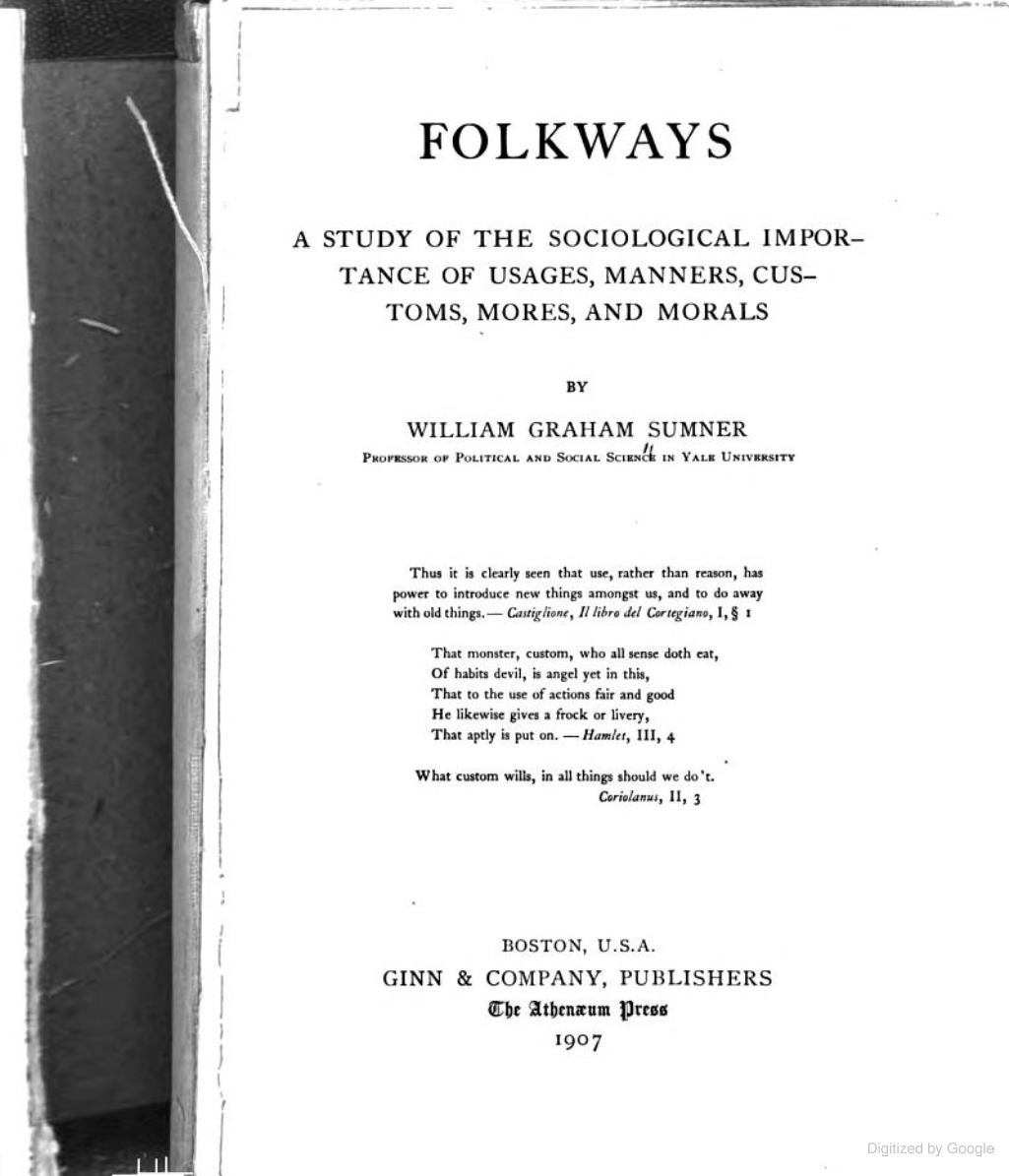
If values are abstract goals, norms are the concrete rules and expectations that translate them into behavior — the do’s and don’ts of daily life. Norms are enforced by sanctions, the rewards for conformity and punishments for violation, which can be as small as an approving nod or as large as a prison term. In 1906 William Graham Sumner sorted norms by how strongly a society reacts when they are broken, and his scheme is still used today.
Folkways are everyday customs and manners — facing forward in an elevator, saying “bless you,” not standing too close in line. Break one and you get a strange look, not a lawsuit. Mores (say “MOR-ays”) carry real moral weight; violating them — cheating, plagiarism, theft — brings shame, ostracism, or punishment. Taboos are the strongest norms of all, prohibitions so deep that the mere thought of violation provokes disgust, such as incest or cannibalism. When a society decides a norm matters enough to write down and enforce through the state, it becomes a law.
| Type of norm | What it governs | Reaction to violation | Example |
|---|---|---|---|
| Folkway | Everyday custom & manners | Mild — a look, light disapproval | Chewing with your mouth closed; queue etiquette |
| More | Morally significant behavior | Strong — shame, ostracism, punishment | Cheating, plagiarism, adultery |
| Taboo | The nearly unthinkable | Revulsion, exile | Incest, cannibalism |
| Law | Norms formalized by the state | Official — fines, imprisonment | Traffic codes, criminal statutes |
Symbols and language
A symbol is anything — a word, a gesture, an object, a color — that carries a meaning recognized by people who share a culture. A red octagon means “stop,” a raised middle finger means insult, a white dress can mean a wedding in one place and a funeral in another. Symbols have no natural meaning; the culture assigns it, which is exactly why the same gesture can be a compliment in one country and an obscenity in the next.
Language is the most powerful symbol system of all — an organized set of symbols that lets people not only communicate but store and transmit an entire culture across generations. The Sapir–Whorf hypothesis (also called linguistic relativity) pushes the point further: the language you speak does not just express your thoughts, it partly shapes them. Speakers whose language has many words for a concept may perceive finer distinctions in it; a language that marks gender on every noun may nudge attention toward gender. The strong version — that language traps thought — is now considered overstated, but the softer version, that language influences habitual perception, has real support.
- Values are broad standards of good; norms are the specific rules that enact them, enforced by sanctions.
- Sumner ranked norms by reaction: folkways (mild) → mores (moral) → taboos (unthinkable); laws are formalized norms.
- Symbols carry culturally assigned meaning; language is the master symbol system that transmits culture.
- The Sapir–Whorf hypothesis holds that language shapes, not merely reflects, how we perceive and think.
Section 3Cultural diversity
Variety within: subcultures and countercultures
No large society is a single seamless culture. Inside it are countless subcultures — groups that share the wider culture but also maintain their own distinct patterns of language, dress, and values. Surfers, gamers, bikers, jazz musicians, competitive weightlifters, and physicians all form subcultures with their own slang, heroes, and unwritten rules. A subculture is a variation on the mainstream, not a rebellion against it; you can belong to several at once.
A counterculture goes further: its values actively reject and oppose those of the dominant culture. The 1960s hippie movement, certain radical political or religious communes, and some youth movements set themselves consciously against the mainstream way of life. Countercultures are worth studying because their opposition often becomes tomorrow’s norm — ideas that once seemed subversive, from environmentalism to organic food, frequently migrate into the center over time.
Judging others: ethnocentrism and cultural relativism
When people meet an unfamiliar culture, the reflex is to measure it against their own — and their own always wins. Ethnocentrism, another term coined by Sumner, is the practice of judging another culture by the standards of your own and assuming yours is superior. It is why an outsider might call an unfamiliar dish “disgusting” rather than “different,” and it shades easily into prejudice. A mild dose builds group loyalty; a heavy dose fuels contempt, discrimination, and worse.
The sociological antidote is cultural relativism: the practice of understanding a culture on its own terms, in its own context, before judging it. Relativism does not demand that you approve of everything — it is a research stance, not a surrender of ethics — but it insists you first ask why a practice makes sense to the people who live it. A related idea, culture shock, names the disorientation travelers feel when the taken-for-granted rules suddenly stop applying.
| Concept | Core idea | Example | Watch out for |
|---|---|---|---|
| Subculture | Distinct group within the mainstream | Gamers, surfers, a profession | Not opposed — simply different |
| Counterculture | Values that reject the mainstream | 1960s hippies, radical communes | Often drives later social change |
| Ethnocentrism | Judging others by your own yardstick | “Their customs are backward” | Breeds prejudice; blocks understanding |
| Cultural relativism | Understanding a culture on its own terms | Studying a ritual in its context | A research stance, not “anything goes” |
- Subcultures differ from the mainstream but coexist with it; countercultures actively oppose it.
- Ethnocentrism judges other cultures by one’s own standards and assumes superiority.
- Cultural relativism seeks to understand a culture in its own context before judging — a stance, not moral blankness.
- Countercultural ideas often move, over time, from the margin to the mainstream.
Section 4Theoretical views of culture
Three lenses on the same thing
Sociology looks at culture through three major paradigms — broad theoretical frameworks that each ask a different question. None is the whole truth; each is a lens that brings some features into focus and blurs others. Learning to switch between them lets sociologists see an object from several angles at once. This many-sided habit of mind is a close cousin to what C. Wright Mills called the sociological imagination — the capacity to connect personal experience to the larger social and historical forces that shape it.
Structural functionalism asks what culture does to keep society running. In this view, worked out by Auguste Comte and Émile Durkheim and refined by Talcott Parsons and Robert Merton, shared values are the glue that binds strangers into a society — Durkheim’s collective conscience. A holiday, a flag, a wedding: each reinforces common values and social solidarity. Merton added that customs have manifest functions (obvious, intended) and latent functions (hidden, unintended) — a football game manifestly entertains, but latently teaches teamwork and sells a city’s identity back to itself.
Conflict theory asks whose interests a culture serves. Following Karl Marx, this lens sees culture not as neutral glue but as a resource the powerful use to protect their advantage. The “ruling ideas” of an era, Marx argued, tend to be the ideas of the ruling class — values that make an unequal arrangement feel natural and fair to those on the bottom. Later thinkers extended this to popular culture, arguing that what looks like harmless entertainment can quietly reproduce inequalities of class, race, and gender.
Symbolic interactionism asks how culture is built and rebuilt in everyday life. Drawing on George Herbert Mead, Charles Horton Cooley, and Erving Goffman — and on Max Weber’s call to grasp the meaning (verstehen) behind action — this lens zooms in on face-to-face interaction. Culture, from here, is not a thing handed down whole but a living web of shared symbols that people negotiate, perform, and revise every time they talk, greet, or disagree.
| Paradigm | Key thinkers | What culture is | The question it asks |
|---|---|---|---|
| Structural functionalism | Comte, Durkheim, Parsons, Merton | Shared values that hold society together (social glue) | How does this custom keep society stable? |
| Conflict theory | Marx, and critics after him | A resource the powerful use to protect privilege | Whose interests does this culture serve? |
| Symbolic interactionism | Mead, Cooley, Goffman (Weber’s verstehen) | Meaning built and re-built in everyday interaction | How do people create and share this meaning? |
- Functionalism (Durkheim, Merton): culture is shared value that produces solidarity and stability; it has manifest and latent functions.
- Conflict theory (Marx): culture reflects and reproduces inequality, serving the interests of the powerful.
- Symbolic interactionism (Mead, Cooley, Goffman): culture is meaning created and maintained through everyday interaction.
- The paradigms are complementary lenses, not rivals for a single right answer.
Section 5Cultural change
Innovation: new from within
No culture stands still, and change enters through three doors. The first is innovation — the appearance of something new — which itself comes in two forms. Discovery is recognizing or understanding something that already existed but was not yet grasped, such as realizing the Earth orbits the Sun, or that unseen germs cause disease. Invention is combining existing elements into something genuinely new: the wheel, the printing press, the vaccine, the smartphone. Every discovery and invention ripples outward, changing other parts of the culture in ways no one intended — the automobile did not just move people faster; it reshaped courtship, cities, and the family vacation.
Diffusion: borrowed from beyond
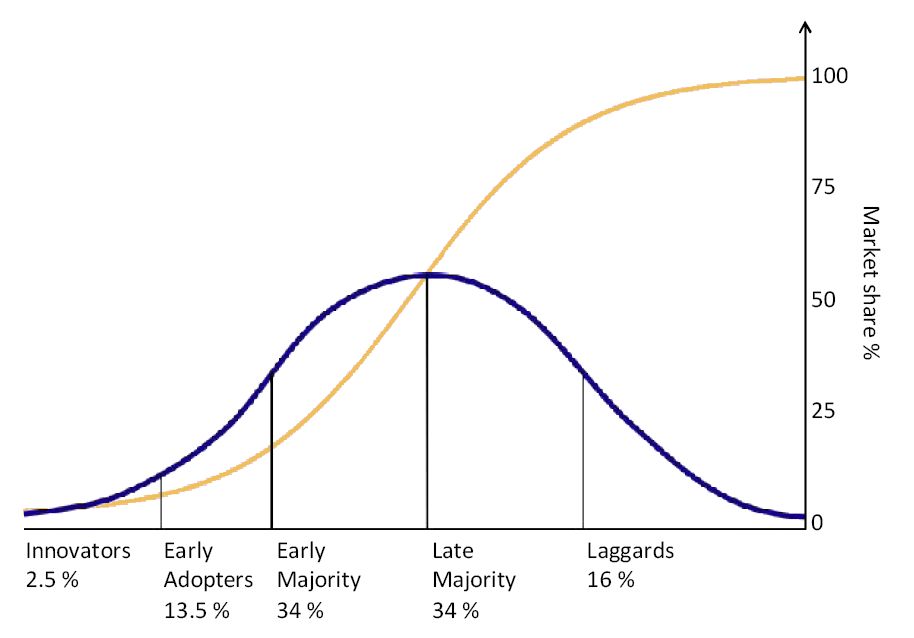
The second door is diffusion — the spread of cultural traits from one group or society to another. Most of what any culture contains was not invented there; the anthropologist Ralph Linton estimated that the overwhelming majority of any culture is borrowed. Your morning likely runs on coffee (Ethiopia), tea (China), an alphabet adapted from the Phoenicians, and numerals from India by way of the Arab world. Diffusion follows a recognizable path — the S-shaped curve in the figure — as a new trait moves from a handful of early adopters to the majority and finally to the last holdouts. In the age of the internet, that curve has grown steeper: a dance, a slang word, or a protest tactic can circle the planet in days.
Cultural lag: when the rulebook falls behind
The third door is really a side effect of the first two. The sociologist William F. Ogburn observed that the two halves of culture do not change at the same speed: material culture tends to race ahead while nonmaterial culture — laws, ethics, customs, beliefs — lumbers behind. He named the gap cultural lag, the uncomfortable stretch of time during which a society has a powerful new technology but has not yet worked out the rules for using it. We are living in several such gaps right now: gene editing, social media, surveillance tools, and self-driving cars have all arrived faster than our ethics and statutes can decide what to do with them.
| Engine of change | What it means | Example |
|---|---|---|
| Innovation — discovery | Recognizing something that already existed | The Earth orbits the Sun; germs cause disease |
| Innovation — invention | Combining existing things into something new | The wheel, printing press, the internet |
| Diffusion | Traits spreading from one culture to another | Coffee, yoga, pizza, Arabic numerals, K-pop |
| Cultural lag | Nonmaterial culture trailing material culture | Law and ethics scrambling to catch up with gene editing |
- Innovation introduces the new through discovery (grasping what exists) and invention (combining into something new).
- Diffusion spreads traits between cultures; most of any culture is borrowed, and the internet accelerates it.
- Cultural lag (Ogburn): nonmaterial culture trails material culture, leaving a gap where the rules have not caught up.
- The same change often has unintended ripple effects far beyond its original purpose.
The chapter in one breath
- Culture is a group’s whole learned, shared way of life; it splits into material (objects) and nonmaterial (ideas, values, norms, language).
- Values define what is good; norms are the rules that enact them, enforced by sanctions.
- Sumner ranked norms as folkways (mild), mores (moral), and taboos (unthinkable); laws are norms formalized by the state.
- Symbols carry culturally assigned meaning, and language — per the Sapir–Whorf hypothesis — can shape thought itself.
- Subcultures vary from the mainstream while countercultures oppose it; ethnocentrism judges others by one’s own standards, and cultural relativism resists that pull.
- The three paradigms read culture differently: functionalism as social glue, conflict theory as a tool of power, symbolic interactionism as meaning built in interaction.
- Cultures change through innovation (discovery and invention), diffusion (borrowing), and the cultural lag between fast technology and slow custom.
ReferenceWords worth knowing
A quick reference for the terms in this chapter — skim it now, or circle back whenever a word trips you up.
- Counterculture
- A group whose values and norms actively reject and oppose those of the dominant culture.
- Cultural lag
- Ogburn’s idea that nonmaterial culture (laws, customs, ethics) changes more slowly than material culture, leaving a gap.
- Cultural relativism
- The practice of understanding a culture on its own terms and in its own context before judging it.
- Cultural universal
- A pattern or trait — such as marriage, cooking, or funerals — found in every known human culture.
- Culture
- The learned, shared beliefs, values, behaviors, language, and material objects of a group, passed to the next generation.
- Diffusion
- The spread of cultural traits, ideas, or objects from one group or society to another.
- Ethnocentrism
- Judging another culture by the standards of one’s own and assuming one’s own is superior.
- Folkways
- Everyday customs and manners whose violation brings only mild disapproval.
- Innovation
- The introduction of something new to a culture, through discovery or invention.
- Invention
- Combining existing cultural elements into something genuinely new, such as the printing press.
- Language
- An organized system of symbols that lets people communicate and transmit culture across generations.
- Material culture
- The physical objects a society creates and uses — tools, buildings, clothing, technology.
- Mores
- Norms with strong moral significance whose violation brings serious social sanctions.
- Nonmaterial culture
- The intangible parts of culture: ideas, beliefs, values, norms, symbols, and language.
- Norm
- A rule or expectation that guides behavior within a culture, enforced by sanctions.
- Sanction
- A reward for conforming to a norm or a punishment for violating it.
- Sapir–Whorf hypothesis
- The idea (linguistic relativity) that the language one speaks shapes how one perceives and thinks.
- Subculture
- A group that shares the wider culture but maintains its own distinct values, norms, and style.
- Symbol
- Anything — word, gesture, object, image — that carries a meaning recognized by those who share a culture.
- Taboo
- A norm so strong that violating it is nearly unthinkable and provokes revulsion.
- Values
- A culture’s broad standards of what is good, desirable, and worth pursuing.
Check yourself
Society & Social Interaction
Every morning you step into a world you did not build, yet you know exactly how to move through it — where to stand in line, how loudly to speak, when to shake a hand and when to bow out. That effortless competence is not instinct; it is society, the largest structure sociologists study, working through the smallest thing they study, interaction. This chapter zooms out to the grand scale — the kinds of societies humans have built as their tools changed — and then zooms all the way in to the moment two people meet and quietly agree on what is going on. Along the way you will meet the theorists who taught us that reality is negotiated, that we all wear masks, and that the positions we occupy hand us scripts we did not write. Keep both lenses open at once, because the macro world and the micro moment are the same world seen at different magnifications.
By the end of this chapter you can
- Define society and trace its major types from hunter-gatherer to postindustrial and information societies.
- Explain how subsistence technology (Gerhard Lenski) drives the transition from one kind of society to the next.
- Summarize the social construction of reality and state the Thomas theorem.
- Explain the self-fulfilling prophecy and how a shared definition of a situation produces real consequences.
- Distinguish ascribed from achieved status, and identify a master status and a status set.
- Tell role conflict apart from role strain, and describe role exit.
- Describe Erving Goffman’s dramaturgy — front stage, back stage, and impression management.
- Identify the major social institutions and read them through the three sociological paradigms.
Section 1Types of societies
What we mean by “a society”
A society is a group of people who share a territory and a culture and who interact with one another over time. That definition sounds mild, but it hides a puzzle that has driven sociology since Auguste Comte coined the discipline’s name: how does a crowd of separate individuals cohere into a durable order that outlives any one of them? Émile Durkheim gave the classic answer with the idea of social solidarity — the glue that binds members together. In small, traditional societies people are bound by mechanical solidarity, a likeness of belief and work; everyone does roughly the same things and shares the same conscience. As societies grow and specialize, that gives way to organic solidarity, in which people are bound precisely because they differ and depend on one another’s specialized labor — the farmer needs the mechanic needs the nurse needs the coder.
The subsistence ladder
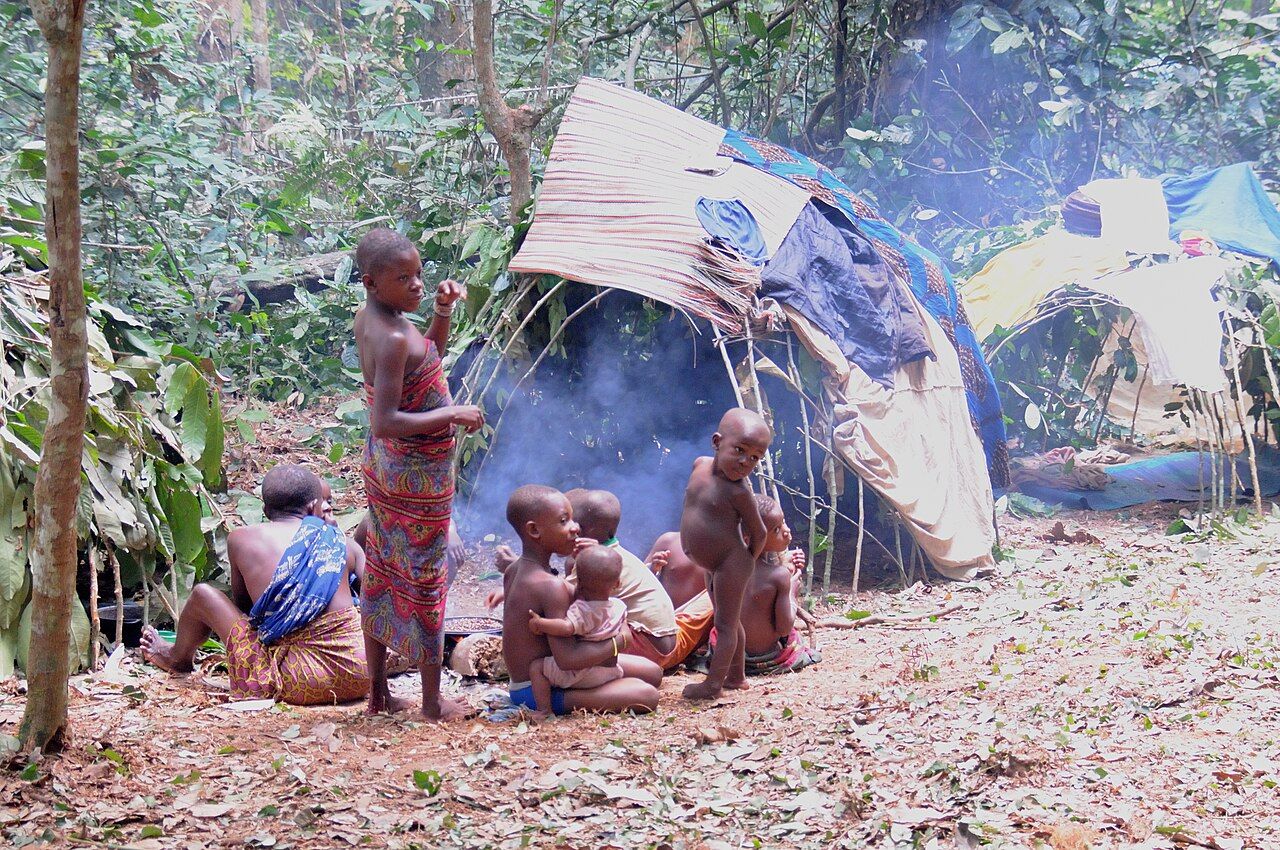
The sociologist Gerhard Lenski argued that the single best predictor of what a society looks like is its subsistence technology — how it gets food and energy. As that technology advances, everything else shifts with it: population size, the division of labor, the amount of surplus, and, fatefully, the degree of inequality. Hunter-gatherer (foraging) societies, the oldest and for most of history the only kind, survive by collecting wild plants and hunting game. They are small, nomadic, organized around kinship, and strikingly egalitarian — with no stored surplus, there is little to hoard and little to fight over. Pastoral societies domesticate animals and horticultural societies cultivate plants in garden plots. Horticultural societies settle into permanent or semi-permanent villages, because garden plots must be tended in place; pastoral societies stay nomadic or semi-nomadic, following pasture with their herds. Both, however, produce a surplus and support larger populations than foraging bands do, and with that surplus the first durable inequalities appear.
The agricultural (agrarian) revolution — the plow, irrigation, and animal power — multiplied the surplus enormously and gave us cities, writing, standing armies, and steep feudal hierarchies of nobles and peasants. Then the Industrial Revolution harnessed fossil-fuel energy to machines, pulling people off the land into factories and cities, and produced the mass, bureaucratic, class-divided world that Marx, Weber, and Durkheim spent their careers explaining. The most recent turn is the postindustrial society, named by Daniel Bell, in which the economy pivots from making things to providing services and, above all, handling information. In an information society, knowledge itself is the key resource, and the person who can find, interpret, and move data holds the leverage that land once gave the noble and the factory once gave the industrialist.
| Society type | Subsistence / technology | Scale | Social organization | Inequality |
|---|---|---|---|---|
| Hunter-gatherer | Foraging wild plants & game | Small mobile bands | Kinship; nomadic; sharing | Minimal |
| Pastoral | Herding domesticated animals | Larger, semi-nomadic | Trade of surplus; chiefs emerge | Growing |
| Horticultural | Small-plot plant cultivation | Settled villages | Property; hereditary status | Growing |
| Agricultural | Plow, irrigation, animal labor | Cities & states | Feudal hierarchy; division of labor | Steep |
| Industrial | Machines & fossil-fuel energy | Mass urban society | Factories, wage labor, bureaucracy | Class-based |
| Postindustrial / information | Services, knowledge, digital data | Global & networked | Information & services dominate | Knowledge-based |
- A society is people who share territory and culture and interact over time.
- Lenski: a society’s subsistence technology shapes its size, division of labor, surplus, and inequality.
- The sequence runs hunter-gatherer → pastoral / horticultural → agricultural → industrial → postindustrial / information.
- Durkheim’s mechanical solidarity (likeness) gives way to organic solidarity (interdependence) as societies specialize.
Section 2The social construction of reality
Reality as a social product
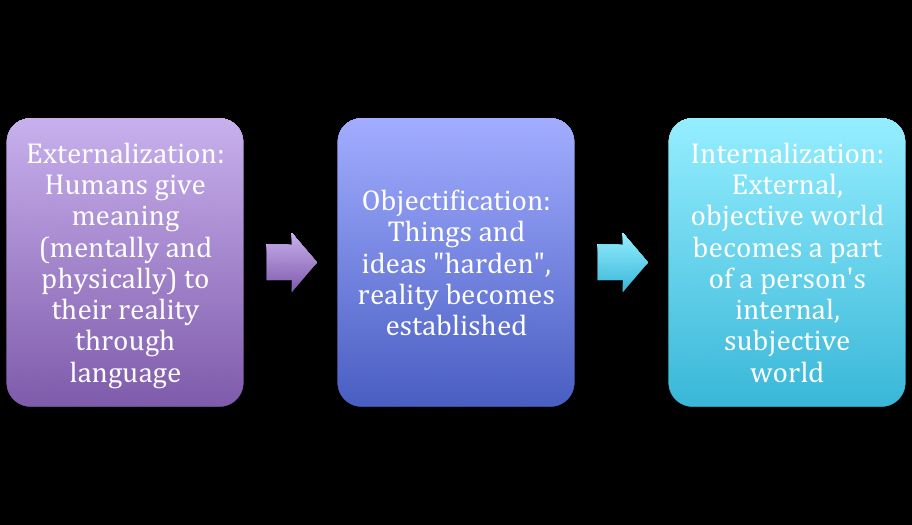
Sociologists take a claim that sounds outrageous at first and then becomes obvious: much of what we treat as simply “real” is in fact agreed upon. In their 1966 book The Social Construction of Reality, Peter Berger and Thomas Luckmann argued that we build our shared world through repetition. A behavior gets done once, then again, until it becomes a habit (habitualization); habits shared across people harden into rules and roles (institutionalization); and eventually the arrangement is passed to newcomers as simply “the way things are.” Money is the tidy example: a paper bill has value only because millions of us behave as though it does. Nothing about the paper compels that agreement — and the moment the agreement collapses, so does the value.
The Thomas theorem
The engine of this process was stated most sharply by William Isaac Thomas and Dorothy Swaine Thomas in 1928: “If men define situations as real, they are real in their consequences.” This is the Thomas theorem, and it is deceptively powerful. It does not say wishing makes things true. It says that once people act on their definition of a situation, their actions produce genuine effects — regardless of whether the original definition was accurate. Your definition of the situation — is this a date or a business meeting? a joke or an insult? a friendly dog or a threat? — steers what you do next, and what you do next reshapes the situation for everyone in it.
Self-fulfilling prophecies
Robert K. Merton drew out the theorem’s most striking consequence: the self-fulfilling prophecy, a false belief that causes its own confirmation. His classic case is a run on a solvent bank: a rumor that the bank will fail leads depositors to yank their money out, and the withdrawals themselves bankrupt a bank that was perfectly healthy. The prophecy was false when it was uttered and true once people acted on it. The same loop runs through labels in a classroom, reputations in a neighborhood, and stereotypes in a hiring pool — which is exactly why sociologists insist that a “definition” is never just talk.
| Situation defined as… | …action people take | …real consequence |
|---|---|---|
| “This bank is about to fail” (false) | Depositors rush to withdraw | The solvent bank actually collapses |
| A student labeled “gifted” | Teachers invest more attention | The student achieves more |
| A neighborhood defined as “dangerous” | People and businesses avoid it | Disinvestment and real decline |
- The social construction of reality (Berger & Luckmann) holds that much of “reality” is built and sustained through shared, repeated human activity.
- The Thomas theorem: situations defined as real become real in their consequences.
- Your definition of the situation guides your action, which then reshapes the situation itself.
- A self-fulfilling prophecy (Merton) is a false belief that triggers behavior making it come true.
Section 3Status and role
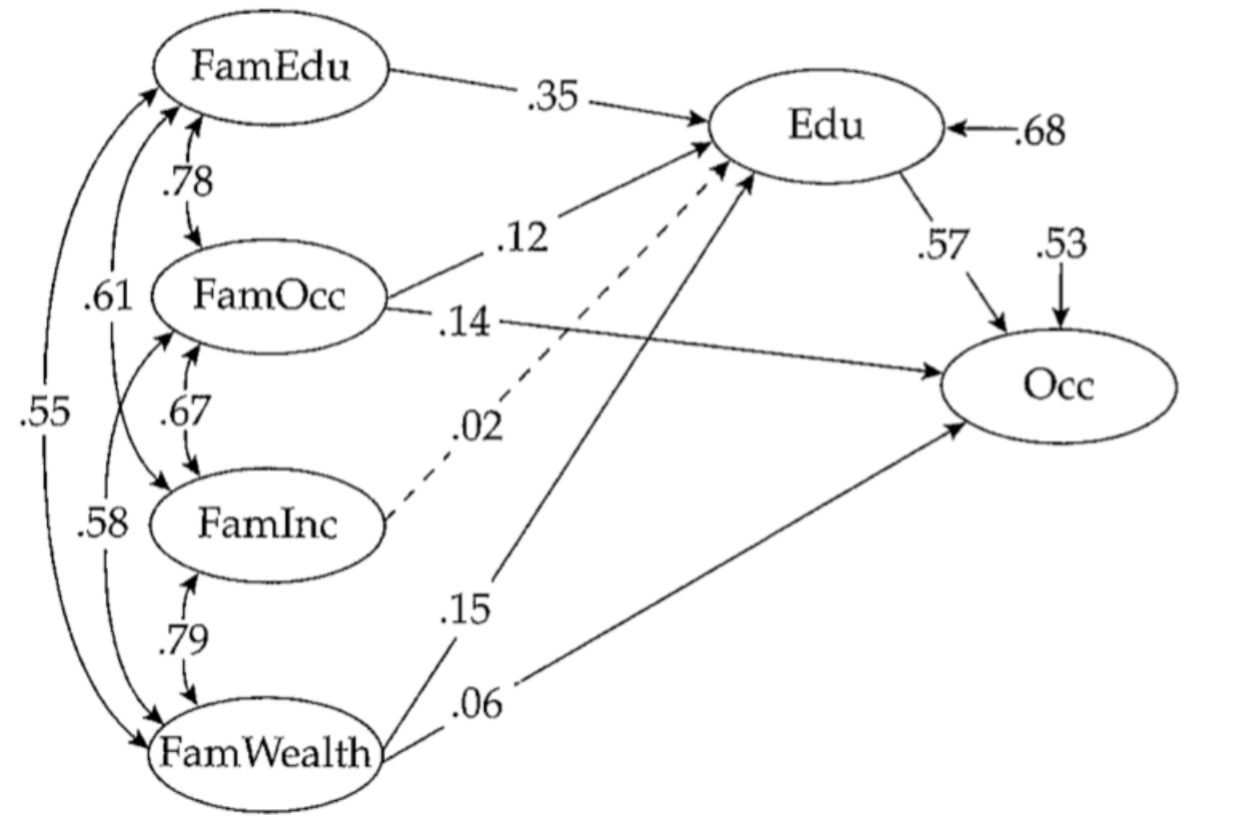
Status: your position in the structure
In everyday speech “status” means prestige. In sociology it means something more neutral and more useful: a status is any recognized social position a person occupies — daughter, student, cashier, citizen, patient. You hold many at once, and the whole bundle is your status set. Usually the statuses coexist quietly, but one can come to dominate how others see you and how you see yourself. That is a master status — a position so central it colors everything else. A surgeon’s title, a celebrity’s fame, or the stigma of a criminal record can each function as a master status, overshadowing every other position the person holds.
Ascribed versus achieved
Statuses come to us in two ways. An ascribed status is one you are born into or assigned involuntarily, with little effort or choice of your own — your age category, your family of birth, the sex or race others assign you, being someone’s sibling. An achieved status is one you earn or take on through effort, talent, and choice — college graduate, welder, marathon finisher, spouse, felon. The line can blur (an ascribed status like being born wealthy makes the achieved status of “Ivy League graduate” far easier to reach), and that blurring is one of sociology’s great themes: the head start you were handed shapes the finish line you can “achieve.”
Roles, and the tension inside them
If a status is a position, a role is the set of behaviors, obligations, and expectations attached to it — the status is the hat, the role is how society expects you to wear it. Because a single status can carry several roles at once, Robert Merton called that bundle a role set. And precisely because we hold many statuses and many roles, tension is built in, and sociologists distinguish two kinds. Role strain is friction within a single role whose demands pull against each other — the professor expected to be both a warm mentor and a hard grader. Role conflict is friction between the roles of two different statuses — the working parent whose shift and whose child’s recital fall at the same hour. When the strain or conflict becomes unbearable, people may undertake role exit (a process mapped by Helen Rose Fuchs Ebaugh), disengaging from a role central to their identity — leaving the clergy, the marriage, or the profession — and building a new sense of self on the far side.
| Role strain | Role conflict | |
|---|---|---|
| Where the tension sits | Within one role | Between the roles of two statuses |
| Source | Competing demands of a single position | Two positions demanding you at once |
| Example | A nurse who must comfort a patient and enforce painful care | A student-athlete with a game and a final exam the same day |
| Typical response | Balance or prioritize inside the role | Compartmentalize, negotiate, or exit a role |
- A status is a social position; your status set is all of them together; a master status dominates the rest.
- Ascribed statuses are assigned; achieved statuses are earned — and the two interact.
- A role is the behavior expected of a status; a status can carry a whole role set.
- Role strain is tension within a role; role conflict is tension between roles of different statuses.
Section 4Dramaturgy
Life as theater
Erving Goffman built an entire sociology out of a single metaphor. In The Presentation of Self in Everyday Life (1959), he proposed dramaturgy: we should analyze social interaction the way a critic analyzes a play. Each of us is a performer; the people around us are the audience; and every encounter is a small production in which we try to manage the impression others form of us. Goffman called this effort impression management — the constant, mostly unconscious work of controlling how we come across through dress, speech, posture, and setting. This is symbolic interactionism at its most vivid: the self is not a fixed object you carry around but something produced, moment by moment, in front of others.
Front stage and back stage
The heart of the theory is a distinction between two regions. The front stage is wherever an audience is present and we deliver the polished, expected performance — the server who smiles, upsells, and calls you “folks.” The back stage is where the audience cannot see and we drop the act, rehearse, and relax — the same server rolling their eyes and venting the moment the kitchen door swings shut. We use a personal front (appearance and manner) and a setting (props and scenery, like a doctor’s white coat and diploma-lined office) to make the performance convincing. Much of the anxiety of social life comes from the risk that the two regions will collide — that a customer will wander into the kitchen, or a text meant for a friend will reach the boss.
Teams, face, and failed performances
Performances are often collaborative: a team of performers cooperates to stage a single impression, as waiters and cooks together produce “the restaurant,” or two parents present a united front to a child. When a performance slips — a stumble, a contradiction, an embarrassing reveal — people scramble to do face-work, the repairs that save the situation from collapse: the nervous laugh, the quick apology, the tactful looking-away by an audience that pretends not to notice. Goffman’s theater connects back to Charles Horton Cooley’s looking-glass self — the idea that we come to know ourselves by imagining how we appear to others — and to George Herbert Mead’s insight that the self arises only in interaction. We perform for the audience, and in their reactions we read who we are.
| Feature | Front stage | Back stage |
|---|---|---|
| Audience present? | Yes | No |
| Behavior | Idealized; follows the social script | Relaxed; rehearse and drop the act |
| Restaurant example | Server smiling and upselling at the table | Server venting and joking in the kitchen |
| Goffman’s term | The performance region | The region where the act is prepared |
- Dramaturgy (Goffman) analyzes interaction as theatrical performance.
- Impression management is the work of controlling how others perceive us.
- The front stage hosts the polished performance; the back stage is where we drop it.
- The performed self links to Cooley’s looking-glass self and Mead’s claim that the self is born in interaction.
Section 5Social institutions

What a social institution is
Zoom back out from the two-person encounter and you find that interactions do not float free — they are channeled by social institutions, the enduring patterns of roles, norms, and organizations that a society develops to meet its basic and recurring needs. An institution is not a building and not a single organization; it is the whole standardized way a society handles a fundamental task. Every society must reproduce and socialize its young, transmit knowledge, produce and distribute goods, keep order, and answer questions of ultimate meaning — and around each of those tasks a durable institution grows.
The major institutions
Sociologists conventionally identify a handful. The family organizes reproduction, care, and the first socialization of children. Education transmits knowledge and skills and sorts people into positions. Religion addresses meaning, morality, and the sacred, and binds communities — Durkheim thought it was society worshipping itself. The economy organizes the production and distribution of goods and services. Government (the polity) holds legitimate power, makes and enforces law, and manages conflict. And modern societies have elevated further institutions to the same rank: medicine and healthcare, the legal and criminal-justice system, the military, and the mass media, which increasingly shape the shared reality every other institution operates within. What makes all of them institutions is that they persist beyond the individuals passing through them — the university outlives its students, the family form outlives any one household.
Three lenses on the same institution
The three great sociological paradigms read institutions differently, and the differences are instructive rather than contradictory. Structural functionalism (Comte, Durkheim, Talcott Parsons, Robert Merton) sees institutions as organs of a social body, each performing functions that keep the whole stable; Merton usefully split these into manifest functions (intended and recognized, e.g., schools teach reading) and latent functions (unintended but real, e.g., schools also provide childcare and matchmaking). Conflict theory (Karl Marx, Max Weber, C. Wright Mills) sees the same institutions as arenas where powerful groups protect their advantage — schooling that quietly reproduces class, laws written to guard property. Symbolic interactionism (Weber’s verstehen, Mead, Cooley, Goffman) drops to the micro level and asks how institutions are actually experienced and enacted in the daily meanings people make — what “being a good student” or “a real family” means to the people living it.
| Structural functionalism | Conflict theory | Symbolic interactionism | |
|---|---|---|---|
| Level of analysis | Macro | Macro | Micro |
| Society is… | A system of interdependent parts seeking stability | An arena of inequality and competition over resources | A fabric woven from everyday interaction and shared symbols |
| Institutions… | Perform functions that meet society’s needs | Preserve the dominance of powerful groups | Are enacted and negotiated in face-to-face meaning |
| Key thinkers | Comte, Durkheim, Parsons, Merton | Marx, Weber, Mills | Weber, Mead, Cooley, Goffman |
- A social institution is an enduring pattern of roles and norms that meets a basic societal need.
- The core institutions are family, education, religion, economy, and government, with medicine, law, military, and media alongside them.
- Merton distinguished manifest (intended) from latent (unintended) functions.
- The three paradigms — functionalist, conflict, interactionist — read the same institution at different altitudes.
The chapter in one breath
- A society is people sharing territory and culture; its subsistence technology (Lenski) drives its move from hunter-gatherer to postindustrial and information forms.
- Durkheim’s mechanical solidarity of likeness yields to organic solidarity of interdependence as societies specialize.
- The social construction of reality (Berger & Luckmann) and the Thomas theorem show that situations defined as real become real in their consequences.
- A false definition can produce a self-fulfilling prophecy (Merton), as in a run on a solvent bank.
- A status is a social position (ascribed or achieved); a role is its expected behavior; role strain is tension within a role and role conflict is tension between roles.
- Goffman’s dramaturgy casts life as theater, with front-stage performance, back-stage relief, and constant impression management.
- Social institutions (family, education, religion, economy, government, and more) organize society’s recurring needs.
- The three paradigms — functionalist, conflict, and symbolic interactionist — read society and its institutions at complementary altitudes.
ReferenceWords worth knowing
A quick reference for the terms in this chapter — skim it now, or circle back whenever a word trips you up.
- Achieved status
- A social position earned or chosen through effort, talent, or action, such as graduate, welder, or spouse.
- Agricultural society
- A society based on large-scale farming with the plow and irrigation, producing surplus, cities, and steep hierarchy.
- Ascribed status
- A social position assigned at birth or involuntarily, such as age category or family of origin.
- Back stage
- In dramaturgy, the region hidden from the audience where a person drops the performance and relaxes.
- Dramaturgy
- Goffman’s approach analyzing social interaction as theatrical performance before an audience.
- Front stage
- In dramaturgy, the region where an audience is present and the person delivers the expected performance.
- Hunter-gatherer society
- The oldest society type, subsisting by foraging wild plants and game; small, mobile, kin-based, and egalitarian.
- Impression management
- The effort to control the impression others form of us through appearance, speech, and setting.
- Information society
- A postindustrial society in which knowledge and digital information are the central economic resource.
- Master status
- A status so dominant it overrides all a person’s other statuses in others’ eyes and their own.
- Mechanical solidarity
- Durkheim’s term for social bonds based on likeness of belief and work in small, traditional societies.
- Organic solidarity
- Durkheim’s term for social bonds based on interdependence among specialized members of a complex society.
- Postindustrial society
- A society whose economy centers on services and information rather than manufacturing (Daniel Bell).
- Role
- The behaviors, obligations, and expectations attached to a status.
- Role conflict
- Tension arising between the roles of two or more different statuses a person holds.
- Role strain
- Tension arising from competing demands within a single role.
- Self-fulfilling prophecy
- A false belief that prompts behavior which makes the belief come true (Merton).
- Social construction of reality
- The process by which shared, repeated human activity builds and sustains what we treat as real (Berger & Luckmann).
- Social institution
- An enduring pattern of roles, norms, and organizations that meets a basic societal need.
- Society
- A group sharing a territory and culture whose members interact over time.
- Status
- Any recognized social position a person occupies within a social structure.
- Thomas theorem
- The principle that situations defined as real are real in their consequences (W. I. and D. S. Thomas).
Check yourself
Socialization
A newborn human is one of the most helpless creatures on Earth — unable to walk, speak, feed itself, or even name what it wants. And yet, within a few short years, that infant becomes a person: someone with a language, a name, a conscience, a sense of humor, and a place in a social world. Socialization is the lifelong process through which that transformation happens — the way we absorb the culture, norms, values, and skills of the groups we belong to, and in doing so become who we are. This chapter asks how much of us is born and how much is made, traces how the self takes shape through interaction, introduces the agents that do the shaping, and shows that the process never really stops. It ends in the strangest corners of social life — the prison, the boot camp, the monastery — where society tries to build a new person out of an old one.
By the end of this chapter you can
- Define socialization and explain why it, more than biology alone, makes us human.
- Weigh the nature–nurture debate and use cases of isolation to show what socialization supplies.
- Explain Cooley's looking-glass self and Mead's stages in the development of the self.
- Distinguish the “I” from the “Me,” and the significant other from the generalized other.
- Identify the major agents of socialization — family, school, peers, and media — and what each teaches.
- Describe how socialization continues across the life course, including anticipatory socialization.
- Explain resocialization and Goffman's concept of the total institution.
- Apply the three sociological paradigms to the process of socialization.
Section 1Nature, nurture, and becoming human

What socialization is
Socialization is the lifelong process by which people learn the culture of their society — its language, its norms, its values, its beliefs, and the skills needed to take part in social life. It is how each new generation is handed the accumulated knowledge of the ones before, and how a biological organism becomes a member of a group. Sociologists treat socialization as the very hinge between the individual and society: it is the mechanism through which society reproduces itself in the minds and habits of its members, and the mechanism through which a person acquires a self. Nothing you consider most personal — your tastes, your morals, your sense of what is funny or shameful — arrived without it.
The nature–nurture question
How much of what we are is written in our genes (nature), and how much is learned from our surroundings (nurture)? For most of the twentieth century this was posed as a contest, and thinkers lined up on opposite sides. Some emphasized biology: the field of sociobiology, associated with Edward O. Wilson, argued that many human behaviors are rooted in evolutionary instinct. Sociologists have historically pushed back hard, insisting that what looks “instinctive” is usually cultural — that a behavior found in one society and absent in another cannot be explained by a gene all humans share. The modern consensus is that the contest was always a false one: nature and nurture are not rivals but partners. Biology gives us capacities — a brain wired for language, a long dependent childhood — and socialization fills those capacities with content. A child is born able to speak some language; which language, and everything it lets her think, comes from the people around her.
| Paradigm | Core question about socialization | How it answers | Rooted in |
|---|---|---|---|
| Structural functionalism | How does socialization hold society together? | It transmits shared norms and values across generations, producing the moral consensus and social order that keep society stable | Émile Durkheim |
| Conflict theory | Whose interests does socialization serve? | It reproduces inequality — teaching people to accept the class, gender, and racial hierarchy they are born into as natural and fair | Karl Marx |
| Symbolic interactionism | How is a self actually created? | Through everyday face-to-face interaction and shared symbols, individuals build a self by taking the role of others | Mead & Cooley |
What isolation reveals
The clearest evidence that socialization — not biology alone — makes us human comes from tragic natural experiments: children deprived of it. Sociologist Kingsley Davis documented Anna and Isabelle, two girls kept in near-total isolation through early childhood in the 1930s and 40s; both arrived unable to speak, walk normally, or respond to others, essentially without a human self. The most studied case, “Genie,” discovered in California in 1970 after years of confinement, never fully acquired language despite intensive help — suggesting that some socialization must happen within critical windows. Psychologist Harry Harlow's experiments with infant rhesus monkeys pointed the same way: given a choice between a wire “mother” that dispensed milk and a soft cloth one that did not, the babies clung to the cloth, showing that the social bond of comfort mattered as much as food. A so-called feral child is not a wild human being; it is a human being who was never made social, and the deficit is devastating and often permanent.
- Socialization is the lifelong learning of a society's culture, norms, values, and skills.
- The nature–nurture debate is best resolved as both: biology supplies capacities, socialization supplies content.
- Cases of isolation (Anna, Isabelle, Genie) and Harlow's monkeys show that without social contact, a human self does not develop.
- The three paradigms ask different questions of socialization: order (functionalism), power (conflict), and the self (interactionism).
Section 2The development of the self
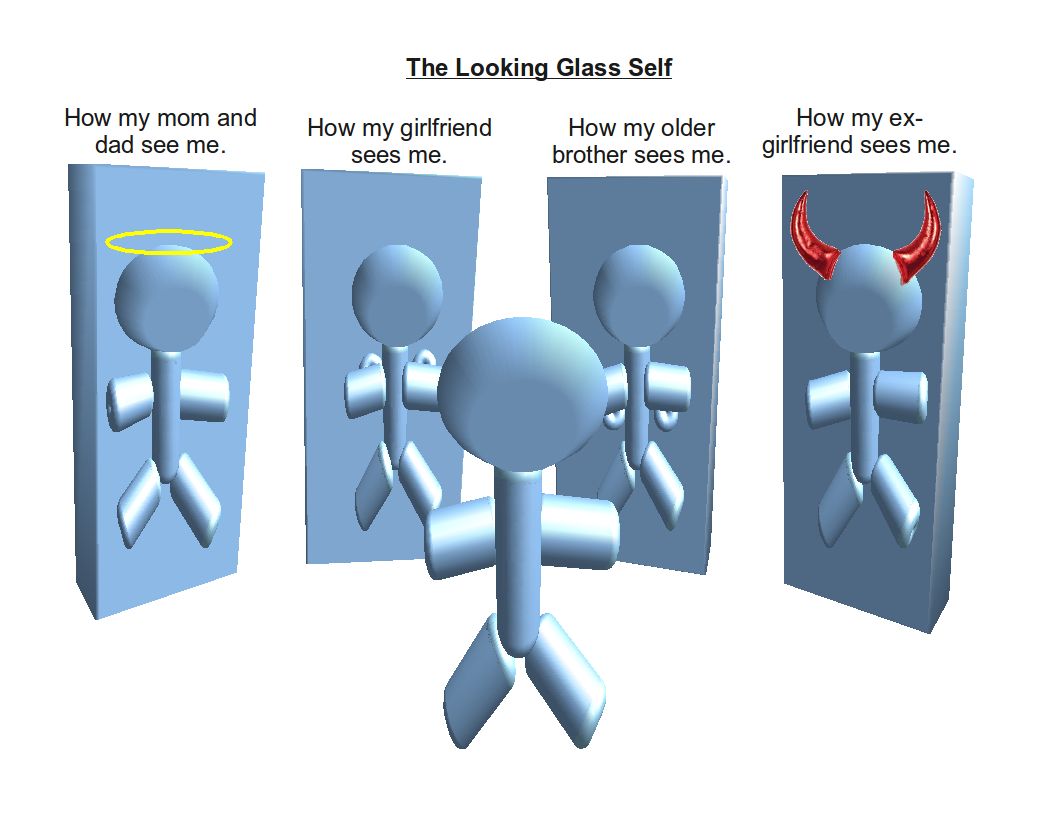
The self is social, not inborn
The self is your sense of who you are — a distinct identity, separate from others, that you can reflect on. It feels like the most private thing you own, but sociologists in the symbolic-interactionist tradition argue that it is entirely social in origin. You cannot develop a self alone; the self is built out of interaction, out of seeing yourself through the eyes of other people. Two early American sociologists worked out how this happens, and their ideas remain the backbone of how we understand identity.
Cooley's looking-glass self
Charles Horton Cooley proposed that we develop a self by imagining ourselves as others see us — a process he called the looking-glass self. It unfolds in three steps: first, we imagine how we appear to another person; second, we imagine that person's judgment of that appearance; and third, we develop a self-feeling — pride or shame — based on that imagined judgment. The crucial and often-missed point is that we react not to what others actually think, but to what we imagine they think, which can be badly mistaken. A student who is certain a professor finds her foolish may carry real shame built entirely on a misreading. As Cooley put it, we are, in a sense, what we think others think we are.
Mead's stages and the “I” and “Me”
George Herbert Mead, the founder of the interactionist view of the self, argued that the self emerges through role-taking — learning to put ourselves in others' positions — and that children do this in a predictable sequence. In the preparatory stage (roughly birth to age two) they simply imitate the people around them without grasping the meaning. In the play stage they take the role of one significant other at a time — playing “mommy” or “doctor,” trying on a single perspective. In the game stage they can hold the roles of many others at once and see how those roles fit together, the way a shortstop must anticipate every player on the field. From this final stage emerges the generalized other: the internalized attitudes and expectations of society as a whole, the imagined community whose standards we measure ourselves against. Mead also split the self into two phases — the “I,” the spontaneous, creative, unsocialized part that acts, and the “Me,” the socialized part that has internalized society's expectations and judges the “I.” Every act is a conversation between them.
| Mead's stage | Typical age | Key ability | Illustration |
|---|---|---|---|
| Preparatory | Birth–2 | Imitation without understanding | Babbling into a toy phone because a parent does |
| Play | ~2–6 | Takes the role of one significant other at a time | “Playing house” as the parent |
| Game | ~7 and up | Takes the roles of many others at once; grasps rules | Fielding a ball while tracking every teammate |
| Generalized other | Emerges from the game stage | Internalizes society's overall expectations | “What would people think?” |
- The self is not inborn; it is produced through social interaction.
- Cooley's looking-glass self has three steps: imagine how we appear, imagine the judgment, feel pride or shame.
- Mead's stages — preparatory, play, game — move the child from imitation to taking many roles at once, yielding the generalized other.
- The “I” is the spontaneous self; the “Me” is the socialized self that has internalized others' expectations.
Section 3Agents of socialization

Family: the primary agent
The people and groups that teach us are called agents of socialization, and the first and most powerful is the family. Long before we can choose, our family gives us a language, a first set of norms and values, a religion or its absence, and — whether anyone intends it — a position in the social structure: a social class, a race and ethnicity, a set of gendered expectations. Sociologist Melvin Kohn found that class shapes what parents prize: working-class parents, whose own jobs reward following orders, tended to stress obedience and conformity in their children, while middle-class parents, whose jobs reward initiative, stressed self-direction and curiosity. In this quiet way, families tend to reproduce the class position of the children they raise — a point conflict theorists press hard.
School and the hidden curriculum
School has an obvious manifest function — teaching reading, arithmetic, history — but sociologists are just as interested in its latent functions, the lessons no one lists on the syllabus. This hidden curriculum teaches punctuality, obedience to authority, standing in line, competition, and respect for rules — exactly the dispositions a worker will later need. Conflict theorists Samuel Bowles and Herbert Gintis argued that schooling corresponds to the workplace, sorting children and training them to accept hierarchy, so that schools help reproduce inequality across generations. In Mead's terms, the classroom is also where a child first meets the generalized other at full scale: an impersonal set of rules that applies to everyone alike.
Peers and the media
A peer group is made of people roughly equal in age and status, and its power surges in adolescence. Unlike family and school, peers are not authorities; among equals a young person learns to negotiate, to lead and follow, to build an identity partly independent of adults — and sometimes to adopt norms adults would not sanction. Finally, the mass media — and now social media above all — have become a pervasive agent, transmitting norms, ideals of beauty and success, gender scripts, stereotypes, and the habits of consumer culture to audiences of every age, for many hours a day. Religion, the workplace, and the state socialize us too, but family, school, peers, and media do the heaviest lifting.
| Agent | When it dominates | What it chiefly teaches | Note |
|---|---|---|---|
| Family | Infancy & childhood | Language, first norms and values, class and identity | Primary agent; most enduring influence |
| School | Childhood–adolescence | Academics plus the hidden curriculum: punctuality, obedience, competition | Manifest and latent functions |
| Peer group | Adolescence | Autonomy, negotiation, youth culture | Members are equals, not authorities |
| Mass & social media | All ages, and rising | Norms, ideals, stereotypes, consumer values | Pervasive and screen-based |
- Agents of socialization are the groups and institutions that teach us the culture.
- The family is the primary agent, transmitting language, values, and social position.
- Schools carry a hidden curriculum (obedience, competition) alongside academics; conflict theorists see this as reproducing inequality.
- Peer groups socialize among equals; media now reach every age with norms, ideals, and stereotypes.
Section 4Socialization over the life course
A process that never ends
It is tempting to think of socialization as something that happens to children and then stops. It does not. Socialization is lifelong, because we keep entering new groups and taking on new roles — student, employee, spouse, parent, retiree — and each requires fresh learning. Sociologists organize this with the idea of the life course: the sequence of socially defined stages people pass through from birth to death. The key sociological insight is that these stages are not simply biological facts but social constructions that vary across cultures and history. The historian Philippe Ariès argued that childhood as we know it — a protected, playful, separate phase — is a fairly modern invention; for much of history, children were treated as small adults. Adolescence as a recognized stage emerged only with industrial society, which delayed the entry into adult work.
Anticipatory socialization and role transitions
Much of adult socialization is anticipatory — a term from Robert Merton for learning the norms of a role we expect to occupy before we actually hold it. A student who begins dressing and speaking “professionally,” or a soon-to-be parent who reads every book on the subject, is rehearsing a future self. Cultures also mark major transitions with a rite of passage. The anthropologist Arnold van Gennep showed these rituals share a three-part shape: separation from an old status, a transition or in-between phase, and incorporation into the new status. A graduation, a wedding, a retirement party, a religious confirmation — each publicly moves a person from one socially recognized role into the next, and hands them the expectations that go with it.
| Type of socialization | What it is | Example |
|---|---|---|
| Primary socialization | The basic, foundational learning of early childhood | A toddler learning to say “please” and share |
| Secondary socialization | Later learning of the norms of specific settings and roles | Absorbing the unwritten rules of a first job |
| Anticipatory socialization | Rehearsing a role before actually occupying it | A student “acting professional” before graduating |
| Resocialization | Shedding old norms and adopting sharply new ones | Basic training in the military (see Section 5) |
- Socialization is lifelong; adults continually learn the norms of new roles.
- The life course and its stages (childhood, adolescence, adulthood, old age) are socially constructed and vary by time and place.
- Anticipatory socialization (Merton) is rehearsing a role before holding it.
- A rite of passage ritually moves a person between statuses through separation, transition, and incorporation.
Section 5Resocialization and total institutions
Resocialization: unmaking and remaking a self
Sometimes society does not merely add to a person's socialization but tries to replace it. Resocialization is the deliberate process of shedding one set of norms, values, and behaviors and adopting a sharply different set in their place. It can be voluntary — entering a monastery, enlisting in the military, joining a demanding new profession — or involuntary, as in a prison or a psychiatric hospital. What sets resocialization apart from ordinary learning is its intensity and its aim: not to build on the old self, but to break it down and construct a new one in its place.
Goffman's total institution
The most powerful resocialization happens inside what Erving Goffman, in his 1961 book Asylums, called a total institution: a place where a large number of people are cut off from the wider society for an extended period and lead an enclosed, formally administered life under a single authority. Prisons, military boot camps, psychiatric hospitals, monasteries, boarding schools, and some cults all qualify. Goffman noted their shared features: all spheres of life — sleep, work, play — occur in one place under one authority; each activity is carried out in the company of others treated exactly alike; the day is tightly scheduled from above; and the whole regime is bent toward the institution's official goals rather than the individual's.
Mortification and rebuilding
Resocialization in a total institution typically runs in two phases. First comes the mortification of the self — Goffman's term for a systematic stripping away of the old identity. The new arrival surrenders personal possessions and clothes for a uniform, may be assigned a number, submits to a standardized haircut, and loses control over the ordinary details of daily life. Sociologist Harold Garfinkel called the public ceremonies that lower a person's status degradation ceremonies. Second comes the rebuilding: through a tightly controlled system of rewards and punishments, the institution rewards behavior that conforms to the new identity and punishes what remains of the old, until the recruit becomes a soldier, the novice becomes a monk, and the person becomes an inmate. The results are never guaranteed — some resist, and the imprint can fade or, conversely, leave people so “institutionalized” they struggle to live outside — but the design is unmistakable.
| Dimension of life | In everyday society | In a total institution |
|---|---|---|
| Where you sleep, work, play | Different places, different authorities | One place, one authority |
| Daily schedule | Largely self-directed | Tightly imposed and uniform |
| Identity markers | Personal clothes, name, possessions | Uniform, number, standardized |
| Contact with the outside | Free | Restricted or barred |
- Resocialization discards an old set of norms and installs a new one; it can be voluntary or involuntary.
- A total institution (Goffman) encloses people under one authority, controlling all of daily life toward the institution's goals.
- Resocialization runs in two phases: mortification of the self (stripping the old identity, via degradation ceremonies) then rebuilding through rewards and punishments.
- The process confirms the chapter's theme: the self is a social achievement, capable of being remade.
The chapter in one breath
- Socialization is the lifelong learning of a society's culture — the process that turns a biological infant into a social person.
- The nature–nurture question resolves into both; cases of isolation (Anna, Isabelle, Genie) show that without social contact, no human self develops.
- The self is social in origin: Cooley's looking-glass self and Mead's preparatory–play–game stages explain how it forms through role-taking.
- The “I” is the spontaneous self and the “Me” the socialized self; the generalized other is society's internalized expectations.
- Agents of socialization — family, school (with its hidden curriculum), peers, and media — do the shaping, and often reproduce inequality.
- Socialization is lifelong: the life course is socially constructed, and anticipatory socialization rehearses future roles.
- Resocialization in a total institution (Goffman) unmakes and remakes the self through mortification and rebuilding.
- The three paradigms read socialization as social order (Durkheim), reproduced inequality (Marx), and the making of the self (Mead and Cooley).
ReferenceWords worth knowing
A quick reference for the terms in this chapter — skim it now, or circle back whenever a word trips you up.
- Agents of socialization
- The groups and institutions — family, school, peers, media, and others — that teach us the culture.
- Anticipatory socialization
- Merton's term for learning the norms of a role before one actually occupies it.
- Degradation ceremony
- Garfinkel's term for a public ritual that lowers a person's social status, often opening resocialization.
- Feral child
- A child raised in isolation from normal human contact, who fails to develop a full social self and language.
- Game stage
- Mead's third stage, in which a child can take the roles of many others at once and grasp shared rules.
- Generalized other
- The internalized attitudes and expectations of society as a whole, against which we judge ourselves.
- Hidden curriculum
- The unstated lessons of school — punctuality, obedience, competition — taught alongside academics.
- “I” and “Me”
- Mead's two phases of the self: the spontaneous, acting “I” and the socialized, self-judging “Me.”
- Life course
- The socially defined sequence of stages a person passes through from birth to death.
- Looking-glass self
- Cooley's idea that we form a self by imagining how we appear to others and how they judge us.
- Mortification of the self
- Goffman's term for the systematic stripping away of a person's old identity in a total institution.
- Nature versus nurture
- The debate over how far behavior is shaped by biology versus by social environment; resolved as both.
- Peer group
- A group of people who are roughly equal in age and social status, influential especially in adolescence.
- Play stage
- Mead's second stage, in which a child takes the role of one significant other at a time.
- Preparatory stage
- Mead's first stage, in which a child merely imitates others without understanding the meaning.
- Resocialization
- The deliberate shedding of old norms and behaviors and the adoption of sharply new ones.
- Rite of passage
- A ritual (van Gennep) that moves a person between statuses through separation, transition, and incorporation.
- Role-taking
- Putting oneself in another's position to see the world, and oneself, from their point of view.
- Self
- A person's distinct, reflective sense of identity, developed through social interaction.
- Significant other
- A specific person, such as a parent, whose viewpoint strongly shapes a child's developing self.
- Socialization
- The lifelong process of learning the culture, norms, values, and skills of one's society.
- Total institution
- Goffman's term for an enclosed setting where an authority controls all of daily life, e.g., a prison or boot camp.
Check yourself
Groups & Organizations
You are never just an individual. From the family that raised you to the company that pays you, from the friend group that knows your secrets to the motor-vehicle office that knows your license number, your life runs through groups — and the larger, more deliberate ones we call organizations. Sociology asks a set of stubborn questions about them: why does a group of two feel so different from a group of three? Why will ordinary, decent people go along with a group they know is wrong, or obey an authority they privately doubt? And why does so much of modern life — work, school, government, even lunch — feel like it runs on the same impersonal, rule-bound machinery? This chapter builds the vocabulary to answer all three.
By the end of this chapter you can
- Distinguish a social group from an aggregate and a category.
- Contrast primary and secondary groups, and explain in-groups, out-groups, and reference groups.
- Explain how group size changes group life, using Simmel's dyad and triad.
- Describe instrumental versus expressive leadership and the three classic leadership styles.
- Summarize what the Asch and Milgram experiments revealed about conformity and obedience.
- Classify formal organizations as utilitarian, normative, or coercive (Etzioni).
- Lay out Weber's ideal bureaucracy and connect it to rationalization and Ritzer's McDonaldization.
- Apply the three sociological paradigms to groups and organizations.
Section 1Types of groups
What makes a group a group
Sociologists are fussy about the word group, because in everyday speech we use it for things that are not groups at all. A social group is two or more people who identify with one another and interact on some regular basis — a family, a study team, a book club, a shift of coworkers. What matters is the shared sense of belonging and the ongoing interaction, not the number of bodies.
Contrast that with two look-alikes. An aggregate is a set of people who happen to be in the same place at the same time but share no lasting connection — strangers waiting for the same bus, a crowd at a stoplight. A category is a set of people who share a trait but need never meet or interact — all left-handed people, all twenty-year-olds, everyone earning minimum wage. Aggregates and categories can become groups (the bus riders start a neighborhood carpool; the minimum-wage workers unionize), but until identification and interaction appear, they are only potential groups.
Primary and secondary groups
The most important distinction among groups comes from Charles Horton Cooley, who coined the term primary group in 1909. A primary group is small, long-lasting, and emotionally intense; its members relate to one another as whole people and value the relationship for its own sake. Family and close friends are the textbook cases. Cooley called these groups “primary” because they come first in our lives and are the nursery of the self — it is inside them that we first learn who we are, an idea that connects directly to his looking-glass self.
A secondary group is the opposite in almost every respect: larger, more impersonal, often temporary, and organized around a shared goal rather than shared feeling. Your classmates this term, the other customers in a checkout line, the committee planning an event — these are secondary groups. Members are means to an end, valued for what they do (the role they fill) rather than who they are. The two types are ideal endpoints, not sealed boxes: a secondary group can warm into a primary one, as when coworkers become lifelong friends, and a primary group can chill into a secondary one, as when relatives drift into people you see only at holidays.
| Feature | Primary group | Secondary group |
|---|---|---|
| Size | Small | Often large |
| Relationships | Personal, whole-person, enduring | Impersonal, role-based, often temporary |
| Orientation | Expressive — the bond is the point | Instrumental — a goal is the point |
| Emotional tone | Warm, intimate | Cool, businesslike |
| Examples | Family, close friends | Coworkers, classmates, a committee |
In-groups, out-groups, and reference groups
Groups do not just include — they exclude, and the excluding is sociologically loaded. William Graham Sumner, in Folkways (1906), named the in-group (the “us” we belong to and feel loyalty toward) and the out-group (the “them” we feel apart from, or against). The boundary between them tends to produce ethnocentrism — judging other groups by the standards of your own and finding them wanting. In-group/out-group thinking is the quiet engine behind school cliques, sports rivalries, hazing, and, at its ugliest, prejudice and discrimination.
A reference group is different again: it is any group we use as a standard to measure and judge ourselves, whether or not we belong to it. A teenager dressing like the popular crowd, a resident physician modeling herself on the attending she admires, a family “keeping up with the Joneses” — all are using reference groups. Robert K. Merton developed reference-group theory and paired it with anticipatory socialization: rehearsing the attitudes and behaviors of a group you hope to join before you actually join it. Reference groups explain why we can feel poor in a rich neighborhood and rich in a poor one; satisfaction depends less on what we have than on whom we compare ourselves to.
- A social group requires identification and interaction; an aggregate (shared place) and a category (shared trait) are not yet groups.
- Primary groups (Cooley) are small, intimate, and expressive; secondary groups are large, impersonal, and instrumental.
- In-groups/out-groups (Sumner) fuel loyalty and ethnocentrism; reference groups (Merton) are the yardsticks we judge ourselves against.
Section 2Group size and leadership
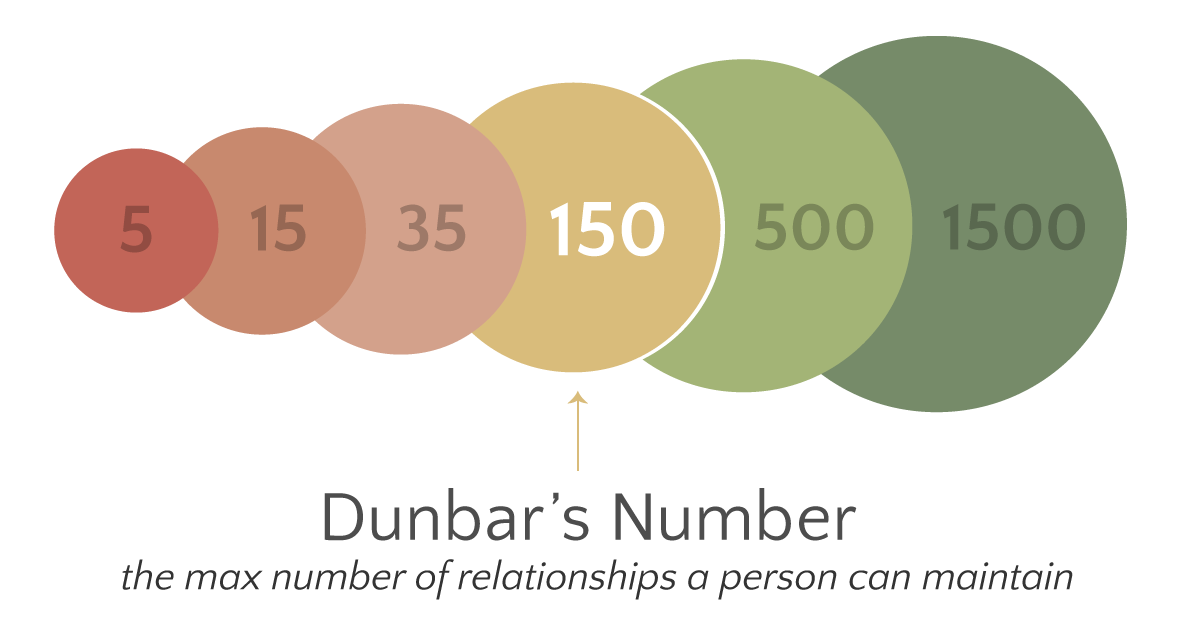
Why two is not just one more than one
The German sociologist Georg Simmel made a startling observation: the single most important thing about a group may simply be how many people are in it. He began with the smallest possible group, the dyad — a group of two. A dyad is uniquely intimate: with only one other person, each member gets the other's full attention, and there is nowhere to hide and no one to hide behind. But that intimacy comes at a price. A dyad is also the most unstable group there is, because it depends entirely on both members. If either one walks away, the group does not shrink — it vanishes. Marriages, best-friendships, and business partnerships all carry this built-in fragility.
Add a third person and the group's whole character changes — this is the triad. A triad is far more stable, because if two members quarrel the third can mediate and hold things together. But the third person also introduces politics that a dyad simply cannot have: two members can form a coalition against the one (two-against-one), and a clever third can play the other two off against each other to gain from their conflict, a move Simmel called tertius gaudens, “the third who enjoys.” A secret shared between two people is fundamentally different once a third knows it. This is why “let's keep this between us” means something so specific.
The trade-off of growing larger
Simmel's insight generalizes. As a group grows, it gains stability and diversity of skills and viewpoints, but it loses intimacy: the number of possible relationships explodes far faster than the number of members, so no one can maintain a close bond with everyone. Beyond a certain size, groups survive only by becoming formal — adopting rules, titles, and procedures to do the coordinating that personal ties once did. Anthropologist Robin Dunbar put a rough number on the ceiling of genuinely personal relationships a human can juggle — around 150, “Dunbar's number” — which is one reason organizations larger than a village need paperwork instead of memory.
Leadership: task and heart, and three styles
Every group develops leadership, and sociologists distinguish two kinds by their function. An instrumental leader focuses on the group's goal — setting tasks, keeping score, driving toward the finish. An expressive leader focuses on the group's emotional life — easing tension, boosting morale, keeping members together. The same person can do both, but the roles often split, which is why a team may have a hard-driving captain and a beloved peacemaker.
Leaders also differ in style. The psychologist Kurt Lewin and his colleagues, studying groups of boys in the 1930s, identified three that sociologists still use. An authoritarian (autocratic) leader gives orders and makes decisions alone; a democratic leader guides the group toward decisions it makes together; a laissez-faire leader stands back and lets the group run itself. None is best for all situations — the point is the fit between style and circumstance.
| Style | How decisions are made | Works best when | Typical downside |
|---|---|---|---|
| Authoritarian | Leader decides and directs | Speed and clarity are urgent (a crisis, a fire) | Resentment; low creativity and buy-in |
| Democratic | Group decides with the leader's guidance | Buy-in and good ideas matter more than speed | Slower; can stall without a decision |
| Laissez-faire | Leader steps back; members self-direct | Members are skilled, motivated experts | Drift and confusion if the group lacks focus |
- A dyad (two) is the most intimate and the most fragile group; a triad (three) is more stable but invites coalitions and mediation (Simmel).
- Growing larger buys stability and diversity but costs intimacy and forces formalization.
- Leaders are instrumental (task) or expressive (morale); the three styles are authoritarian, democratic, and laissez-faire (Lewin).
Section 3Conformity and obedience
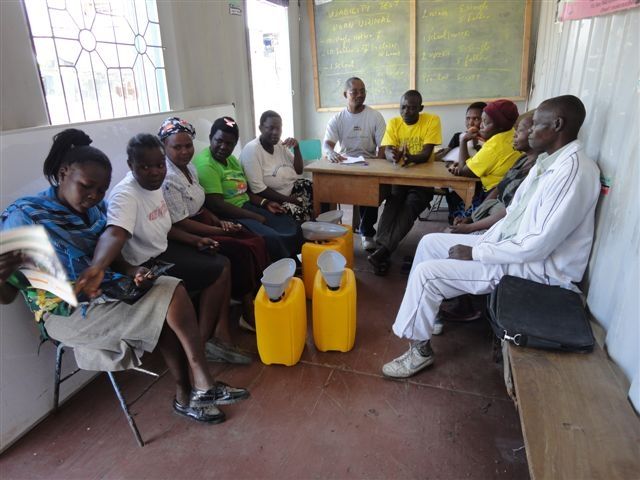
Asch: bending to the group
Conformity is changing your behavior or opinion to match a group's. In the early 1950s the psychologist Solomon Asch ran an experiment now famous across the social sciences. He seated a single real subject among several confederates and asked the group a laughably easy question: which of three lines matches a reference line in length? Alone, people answered correctly almost every time. But when the confederates all confidently gave the same wrong answer out loud first, about a third of subjects' responses conformed to the obvious error, and roughly three-quarters of subjects went along with the group at least once. Pressed afterward, many said they knew the group was wrong but could not bear to be the lone dissenter.
Asch's result is unsettling because the task was unambiguous. This was not a hard judgment call; the subjects could see the truth with their own eyes and still yielded. The experiment also revealed the antidote: add even a single confederate who breaks with the majority, and conformity collapses. One visible ally makes it far easier to stand your ground — a finding with obvious force for whistleblowers, juries, and anyone who has ever been the only one in the room to object.
Milgram: obeying the authority
If Asch showed how we bend to peers, Stanley Milgram showed how we bend to authority, and his findings are more disturbing still. At Yale in the early 1960s, Milgram told volunteers they were in a “learning” study. Playing the role of “teacher,” each subject was instructed by a lab-coated experimenter to deliver escalating electric shocks to a “learner” (an actor, unharmed) whenever he answered wrong — up to a switch marked 450 volts and “XXX.” The learner cried out, begged to stop, and eventually fell silent. When subjects hesitated, the experimenter simply said, calmly, “The experiment requires that you continue.” Roughly 65 percent obeyed all the way to the maximum shock.
The volunteers were not monsters; they sweated, protested, and pleaded to stop — and most kept flipping switches anyway. Milgram argued that under legitimate authority people can enter an agentic state, seeing themselves as mere instruments of someone else's will and handing off responsibility for the outcome. His experiments — ethically controversial precisely because they were so revealing — became the touchstone for how ordinary people carry out cruelty inside hierarchies, and part of why modern research now requires strict ethical review. A related danger appears when a tight group prizes agreement over accuracy: Irving Janis called it groupthink, and it explains how smart, well-meaning teams talk themselves into disastrous decisions no member would have made alone.
| Asch (1951) | Milgram (1961–63) | |
|---|---|---|
| Pressure from | Peers (an equal group) | Authority (an expert in charge) |
| The task | Match a line to its equal — obviously easy | Shock a “learner” on command |
| Key finding | ~1/3 of answers conformed to a clear error | ~65% obeyed to the maximum “450 volts” |
| What breaks it | One ally who dissents | Weaker or absent authority; a defiant peer |
| Lesson | We conform to belong | We obey to defer |
- Asch showed strong conformity to peers even on an obviously correct task; a single dissenting ally breaks the spell.
- Milgram showed high obedience to authority — about 65% delivered the maximum shock — via an “agentic state” that offloads responsibility.
- Behavior is powerfully shaped by the situation; groupthink (Janis) is the group-level cousin of these pressures.
Section 4Formal organizations
From group to organization
When a secondary group grows large and is deliberately built to pursue specific goals, it becomes a formal organization: a large, secondary group organized to achieve its aims efficiently, with explicit rules, roles, and usually a chain of command. Corporations, universities, hospitals, armies, churches, and government agencies are all formal organizations. They are one of the defining features of modern life — a few centuries ago most people lived and died inside primary groups, whereas today we are born in an organization (the hospital), schooled in one, employed by one, and buried by one.
Etzioni's three types: why we join
The sociologist Amitai Etzioni classified formal organizations by the simplest sociological question you can ask: why do members participate, and how does the organization secure their compliance? His answer produced three types. A utilitarian organization pays you — you join for a material reward, chiefly money. Businesses and corporations are utilitarian; so, arguably, is the college you attend for the credential. A normative organization (also called voluntary) draws you with a shared cause or moral purpose rather than a paycheck — a charity, a church, a political party, a volunteer fire company, a professional association. People join to pursue goals they find worthwhile. A coercive organization holds members against their will as a form of punishment or treatment — prisons and some psychiatric hospitals. Membership is involuntary, and control is maintained by force.
The same person can belong to all three at once — utilitarian at work, normative at a place of worship, and, in an unlucky life, coercive in a jail. And an organization can shift type: a normative volunteer group that begins paying its organizers takes on a utilitarian character. The typology matters because it predicts so much else — how tightly members are watched, how much loyalty they feel, how they resist, and how the organization is likely to change.
| Type | Why members join | Basis of control | Examples |
|---|---|---|---|
| Utilitarian | Material reward (pay, credential) | Remunerative — money | Corporations, businesses |
| Normative | Shared goal or moral cause | Normative — values, belonging | Charities, churches, parties, clubs |
| Coercive | Involuntary — held for punishment or treatment | Coercive — force | Prisons, some psychiatric hospitals |
Coercive organizations often function as what Erving Goffman called total institutions — places that cut members off from the outside world and take charge of every part of their lives under a single authority. Goffman argued that such settings deliberately strip away the old self (uniforms replace clothes, numbers replace names, schedules replace choices) and rebuild it, a brutal form of resocialization. The same machinery appears, more gently, in boot camps and some monasteries.
Three lenses on organizations
The discipline's three great paradigms each read organizations differently, and each catches something the others miss.
| Paradigm | How it sees formal organizations |
|---|---|
| Structural functionalism | Rational tools that coordinate specialized roles to meet society's needs; bureaucracy efficiently delivers goods, services, and order — though it can develop dysfunctions like red tape (Merton). |
| Conflict theory | Machinery that concentrates power and wealth in a few hands; organizations discipline workers and citizens, and even democratic ones drift toward rule by elites — Michels' iron law of oligarchy, echoed in Mills' “power elite.” |
| Symbolic interactionism | Lived through everyday interaction and informal culture; real behavior follows unwritten norms and face-to-face relationships as much as the official org chart. |
- A formal organization is a large secondary group deliberately built to pursue goals efficiently.
- Etzioni's three types — utilitarian (pay), normative (cause), coercive (force) — sort organizations by why members comply.
- Coercive settings are often total institutions (Goffman) that resocialize by stripping and rebuilding the self.
- Functionalism sees coordination, conflict theory sees power (Michels, Mills), interactionism sees informal culture.
Section 5Bureaucracy and McDonaldization

Weber's ideal bureaucracy
The characteristic organizational form of the modern world is the bureaucracy — a large formal organization run by clear rules and a rational hierarchy rather than by personal ties or tradition. Max Weber built an ideal type of it: not a compliment or a criticism, but a pure model listing the features a fully bureaucratic organization would have. He identified six. Weber saw bureaucracy resting on rational-legal authority — obedience to impersonal rules and offices, not to a beloved chief (charisma) or an inherited throne (tradition).
| Weber's feature | What it means |
|---|---|
| Division of labor | Work is split into specialized offices, each with defined duties |
| Hierarchy of offices | Positions are ranked, each supervised by the one above — a clear chain of command |
| Written rules | Explicit regulations govern conduct and decisions, so the organization runs the same way regardless of who staffs it |
| Impersonality | Rules apply to everyone alike; officials serve without fear or favor, treating people as cases, not friends |
| Technical competence | People are hired and promoted on qualifications and merit, not on family or connections |
| Formal records | Everything is documented in writing — the “files” that give the organization a memory |
Weber thought bureaucracy was, on its own terms, the most efficient way ever devised to organize large numbers of people — and that this was precisely the problem. He feared that rational efficiency would spread until it caged the human spirit in what he called an iron cage (the “shell as hard as steel”) of impersonal calculation, draining life of magic, meaning, and warmth. Later sociologists cataloged bureaucracy's failures: Robert Merton described bureaucratic ritualism, in which officials cling to rules so rigidly that following the rule replaces achieving the goal (“I'm sorry, that's our policy”). Robert Michels added the iron law of oligarchy — that any large organization, however democratic in principle, tends to concentrate real power in a small, self-perpetuating leadership. Red tape, inertia, and alienation are not accidents of bad management; they are bureaucracy's own shadow.
McDonaldization: Weber for the twenty-first century
The sociologist George Ritzer updated Weber for a fast-food age with a concept he named McDonaldization: the process by which the principles of the fast-food restaurant come to dominate more and more of society, from higher education to healthcare to dating apps. Ritzer argued that rationalization now runs on four dimensions, all visible under the golden arches and now nearly everywhere else.
| Dimension | What it means | Everyday example |
|---|---|---|
| Efficiency | The fastest route from need to fulfillment | Drive-thru; self-checkout; “one-click” buying |
| Calculability | Counting and measuring — quantity stands in for quality | “Billions served”; portion sizes; credit hours; star ratings |
| Predictability | The same product and experience everywhere, every time | A Big Mac tastes identical in Tokyo or Toledo |
| Control | People (workers and customers) managed by rules and nonhuman technology; skills are removed | Scripted service; automated fryers; timed tasks |
Ritzer's sharpest point is that these rational systems routinely produce irrational outcomes — the irrationality of rationality. The efficient drive-thru breeds long lines and unhealthy food; the predictable chain flattens local character; the tightly controlled job deskills and dehumanizes the worker who does it. This is Weber's iron cage in a paper wrapper: a world made maximally efficient, calculable, and predictable can become, at the same time, joyless and absurd. Recognizing McDonaldization is not a demand to reject every rational system — it is a way to notice what we trade away when convenience becomes the only value we count.
- Bureaucracy rests on Weber's six features — specialization, hierarchy, written rules, impersonality, merit, and records — and on rational-legal authority.
- Its shadow side includes the iron cage, Merton's ritualism, and Michels' iron law of oligarchy.
- Ritzer's McDonaldization extends rationalization through efficiency, calculability, predictability, and control — and warns of the irrationality of rationality.
The chapter in one breath
- A social group needs identification and interaction; an aggregate and a category are not yet groups.
- Primary groups (Cooley) are intimate and expressive; secondary groups are impersonal and instrumental; we also live among in-groups, out-groups, and reference groups (Sumner, Merton).
- Group size is destiny: Simmel's dyad is intimate but fragile, the triad more stable but political; bigger groups trade intimacy for stability and must formalize.
- Leaders are instrumental or expressive, and lead in authoritarian, democratic, or laissez-faire styles (Lewin).
- Asch exposed conformity to peers and Milgram obedience to authority — both proving the power of the situation over the individual.
- Formal organizations come in three types — utilitarian, normative, and coercive (Etzioni) — and coercive ones often act as total institutions (Goffman).
- Weber's bureaucracy is efficient but risks the iron cage; Ritzer's McDonaldization spreads that rationalization across modern life, dysfunctions and all.
ReferenceWords worth knowing
A quick reference for the terms in this chapter — skim it now, or circle back whenever a word trips you up.
- Aggregate
- People who share a physical space but have no lasting interaction or sense of belonging, e.g., strangers at a bus stop.
- Anticipatory socialization
- Rehearsing the attitudes and behaviors of a group you hope to join before you actually belong to it (Merton).
- Bureaucracy
- A large formal organization run by rational rules and a hierarchy of offices rather than by personal ties or tradition.
- Category
- People who share a trait (age, income, handedness) but need never meet or interact.
- Coercive organization
- A formal organization whose members are held involuntarily for punishment or treatment, e.g., prisons (Etzioni).
- Conformity
- Adjusting one's behavior or opinion to align with a group's, even against one's own judgment.
- Dyad
- A group of two — the most intimate group and the most unstable, since either member's exit dissolves it (Simmel).
- Ethnocentrism
- Judging other groups by the standards of one's own in-group and finding them inferior.
- Formal organization
- A large secondary group deliberately organized to pursue specific goals efficiently.
- In-group / out-group
- The group one belongs to and feels loyal toward (“us”) versus a group one feels apart from (“them”) (Sumner).
- Instrumental / expressive leadership
- Leadership focused on the group's task and results (instrumental) versus its emotional life, morale, and cohesion (expressive).
- Iron law of oligarchy
- Michels' claim that all large organizations, however democratic, tend toward rule by a small elite.
- McDonaldization
- Ritzer's term for the spread of fast-food principles — efficiency, calculability, predictability, control — across society.
- Normative organization
- A voluntary organization people join to pursue a shared goal or moral cause, e.g., a charity or church (Etzioni).
- Obedience
- Complying with the direct commands of an authority figure, as in Milgram's experiments.
- Primary group
- A small, enduring, emotionally intimate group valued for its own sake, e.g., family and close friends (Cooley).
- Rationalization
- Weber's term for the historical shift toward organizing life by efficiency, calculation, and impersonal rules.
- Reference group
- A group used as a standard for evaluating oneself, whether or not one belongs to it (Merton).
- Secondary group
- A large, impersonal, goal-oriented group whose members relate through roles, e.g., coworkers and classmates.
- Total institution
- A setting that isolates members and controls all of life under one authority, resocializing them, e.g., a prison (Goffman).
- Triad
- A group of three — more stable than a dyad, but open to coalitions and mediation by a third party (Simmel).
- Utilitarian organization
- A formal organization people join for a material reward such as pay, e.g., a business (Etzioni).
Check yourself
Deviance, Crime & Social Control
Every group draws a line between what is acceptable and what is not — and then spends enormous energy patrolling that line. Deviance is the violation of a social norm; crime is the narrower category of acts a government has made illegal; and social control is the whole machinery, from a raised eyebrow to a prison sentence, that keeps most people most of the time inside the lines. The sociological surprise is that none of these categories is fixed by nature. What counts as deviant shifts across time, place, and situation, and it is decided not by the behavior alone but by how others react to it. This chapter asks the questions sociologists have argued over for a century: why does deviance exist, who gets to define it, how do we measure crime, and what happens to the people a society decides to punish.
By the end of this chapter you can
- Define deviance, social norms (folkways, mores, taboos), and social control, and explain why deviance is relative rather than inherent in an act.
- Distinguish informal from formal social control and positive from negative sanctions.
- Explain Durkheim's claim that deviance is normal and functional, and define anomie.
- Apply Merton's strain theory and its five modes of adaptation, and summarize subcultural explanations of deviance.
- Contrast the conflict and labeling accounts, and distinguish primary from secondary deviance.
- Identify the major types of crime and evaluate how the UCR/NIBRS, the NCVS, and self-report surveys measure it.
- Describe the three branches of the criminal justice system — police, courts, corrections — and the four justifications for punishment.
- Apply the three sociological paradigms to a single case of deviance and see how each reframes it.
Section 1What deviance is
Norms, and the many ways to break them
A social norm is a shared expectation about how people ought to behave in a given setting. Norms are not all equal in weight, and sociologists sort them by how seriously a group treats a violation. Folkways are everyday customs of politeness and routine — facing forward in an elevator, chewing with your mouth closed, waiting your turn in line. Breaking a folkway makes you rude or odd, not evil. Mores (pronounced "MOR-ays") carry a moral charge: honesty, fidelity, respect for the vulnerable. Violating a more brings real condemnation. Taboos are the most deeply held mores, so profoundly felt that the very thought of violating them provokes disgust — cannibalism, incest. Some norms are also written into law, backed by the coercive power of the state.
Deviance, then, is any behavior, belief, or condition that violates a social norm and draws a negative reaction. Notice how wide that is: deviance includes crime, but it also includes tattoos in a conservative workplace, a hermit's withdrawal from society, or a billionaire's eccentric habits. Deviance can even be positive or admired — the whistle-blower and the saint both break with what most people do. The sociological point is that deviance is defined by reaction, not by harm.
| Type of norm | What it governs | Reaction to violation | Example violation |
|---|---|---|---|
| Folkway | Everyday etiquette & custom | Mild — seen as rude or strange | Cutting in line; loud phone call in a quiet car |
| More | Core moral standards | Strong — seen as wrong or immoral | Lying to a friend; cheating on a partner |
| Taboo | The most sacred prohibitions | Revulsion & horror | Incest; cannibalism |
| Law | Norms codified by the state | Formal punishment | Theft; assault |
Deviance is relative, not inherent
No act is deviant in and of itself. The same behavior can be deviant in one setting and required in another, which is why sociologists say deviance is socially constructed. Killing is murder in a back alley and heroism on a battlefield. Public nudity is deviant on a city street and normal at a nude beach. Cannabis use is a crime in one state and a taxed retail product across the border. Even the passage of time redefines the line: interracial marriage, left-handedness, and same-sex relationships were all treated as deviant within living memory in places that now protect them. What makes an act deviant is not the act but the time, place, culture, and situation in which it occurs, and the audience that judges it.
Social control: keeping people in line
Social control is the set of mechanisms a society uses to encourage conformity and discourage deviance. It operates through sanctions — reactions that reward conforming behavior or punish deviant behavior. Sanctions can be positive (a smile, a promotion, a medal) or negative (a frown, a fine, a jail term). They can also be informal, applied in everyday interaction by peers and family, or formal, applied by institutions and officials empowered to enforce the rules. Most conformity is produced not by police but by the informal, internalized sense that certain things are simply "not done."
- Norms range from folkways (etiquette) to mores (morals) to taboos (the sacred) to laws (codified by the state).
- Deviance is any norm violation that draws a negative reaction; it is defined by reaction, not by harm, and can be positive as well as negative.
- Deviance is relative — the same act is deviant or normal depending on time, place, culture, and situation.
- Social control works through sanctions that are positive or negative and informal or formal; most conformity is informal and internalized.
Section 2The functionalist view of deviance
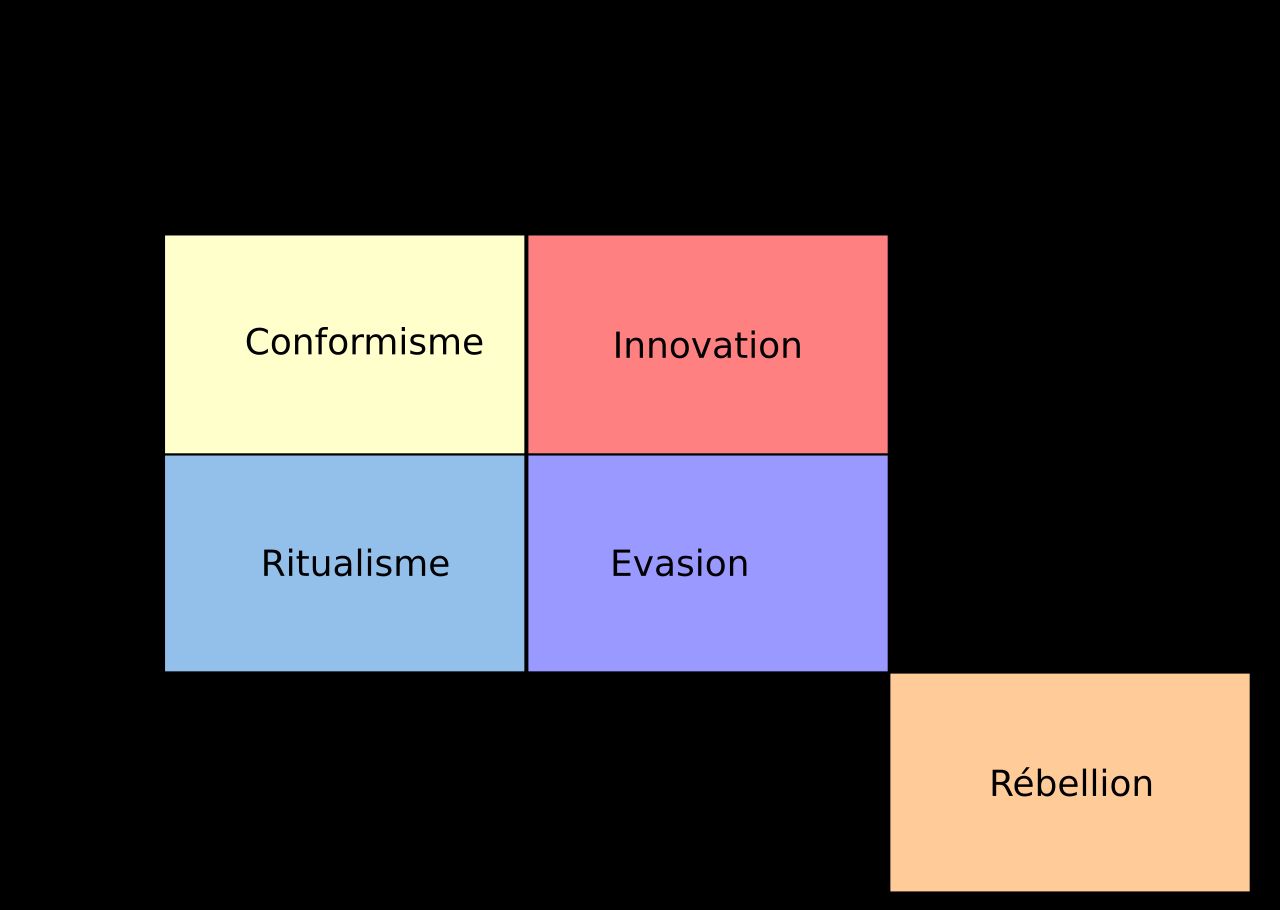
Durkheim: deviance is normal and useful
The founder of the functionalist tradition, Émile Durkheim, offered the most counterintuitive idea in this chapter: deviance is not a sickness in society but a normal, permanent, and even useful feature of every social order. In a famous thought experiment he imagined "a society of saints, a perfect cloister of exemplary individuals." Even there, he argued, ordinary faults invisible to us would be treated as scandalous crimes, because the group needs a boundary and will always find one to draw. Durkheim identified several functions that deviance performs: it affirms cultural values and norms (we learn what is right partly by seeing what is punished), it clarifies moral boundaries, it promotes social cohesion as people unite in reaction against the offender, and it can encourage social change, since today's deviant may be tomorrow's reformer.
Durkheim also gave us anomie — a condition of normlessness in which the rules that ordinarily guide behavior weaken or break down, typically during rapid social change. When old expectations collapse faster than new ones form, people lose their moral compass, and deviance rises. Anomie became the seed of the most influential functionalist theory of deviance.
Merton's strain theory
Robert K. Merton took Durkheim's anomie and rooted it in the structure of society. His strain theory begins with an observation about culture: a society such as the United States loudly promotes certain cultural goals (wealth, success, the "American Dream") while distributing the legitimate means to reach them — good schools, decent jobs, connections — very unequally. The gap between the goals everyone is told to want and the means available to reach them produces strain. People adapt to that strain in five ways, and only the first is fully conforming.
| Adaptation | Cultural goals | Legitimate means | Example |
|---|---|---|---|
| Conformity | Accept (+) | Accept (+) | Works hard through school and a job to get ahead |
| Innovation | Accept (+) | Reject (–) | Wants wealth but pursues it illegally — theft, fraud, drug dealing |
| Ritualism | Reject (–) | Accept (+) | Abandons the dream but rigidly follows the rules — the burned-out bureaucrat |
| Retreatism | Reject (–) | Reject (–) | Drops out of the whole game — some addiction and chronic homelessness |
| Rebellion | Replace | Replace | Rejects both goals and means and works to build a new system |
Strain theory's great strength is that it locates the source of much deviance not in bad individuals but in a social structure that dangles universal goals while denying many people the means to reach them. It explains why property crime concentrates where legitimate opportunity is scarce — innovation is the predictable response of someone who has fully absorbed the goal of success but has been shut out of the ladder.
Subcultures and differential opportunity
Later functionalists asked where people learn deviant adaptations, and answered: in subcultures — groups whose values and norms differ from the mainstream. Albert Cohen argued that working-class boys, judged by a "middle-class measuring rod" they cannot meet, experience status frustration and band together to invert those standards, prizing exactly what the school condemns. Richard Cloward and Lloyd Ohlin added differential opportunity theory: just as legitimate opportunity is unequally distributed, so is illegitimate opportunity. Whether a strained neighborhood produces organized criminal enterprise, violent conflict, or drug-focused retreat depends on which illegitimate paths are actually available there. Deviance, in this view, is learned in groups — a bridge to the interactionist theories of the next section.
- Durkheim: deviance is normal and performs functions — affirming norms, clarifying boundaries, building cohesion, and enabling change; anomie is normlessness.
- Merton's strain theory: deviance flows from the gap between cultural goals and legitimate means.
- The five adaptations are conformity, innovation, ritualism, retreatism, rebellion.
- Subcultural theories (Cohen; Cloward & Ohlin) show deviance is learned in groups and shaped by unequal illegitimate opportunity.
Section 3Conflict and labeling
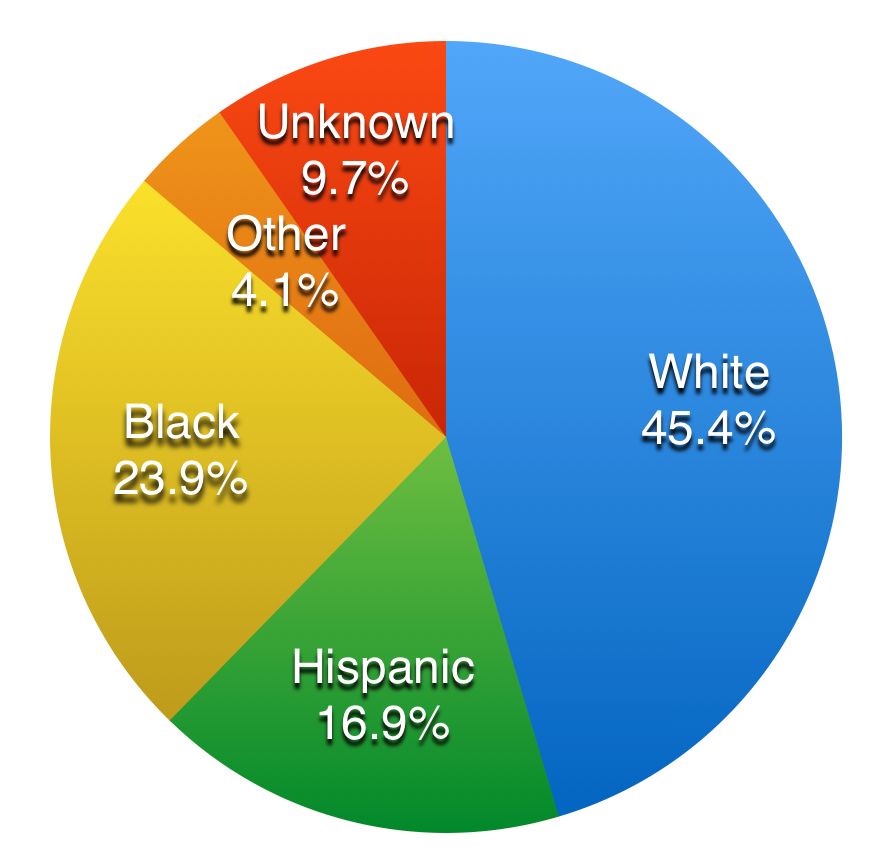
Conflict theory: deviance and power
Where functionalists ask what deviance does for society, conflict theorists ask a sharper question: who benefits from defining it? Drawing on Karl Marx, the conflict paradigm holds that the norms and laws a society enforces are not a neutral consensus but reflect the interests of its most powerful groups. Those with wealth and power shape what gets written into law, whose behavior gets watched, and whose gets excused. The result is a system that comes down hard on the "street crime" of the poor — theft, drugs, disorder — while treating the far costlier "suite crime" of the powerful — wage theft, financial fraud, environmental harm — with fines and settlements. A hungry person who shoplifts is arrested; an executive whose fraud costs thousands their savings may never see a cell. Conflict theory also underwrites feminist analyses of how deviance is gendered and critical-race analyses of how enforcement is racialized.
Labeling theory: deviance is a social response
Labeling theory, an offshoot of symbolic interactionism, makes the most radical move of all: it says deviance is not a quality of the act but a consequence of the label. In Howard Becker's formulation, social groups create deviance by making rules whose violation constitutes deviance, and then applying those rules to particular people. The same act — smoking cannabis, a teenage fight — may be ignored in one person and prosecuted in another; what differs is the reaction. Erving Goffman analyzed the stigma that attaches to a spoiled identity, and how a deviant label can become a master status — the one trait through which everything else about a person is now seen. "Ex-convict" or "addict" can eclipse every other identity a person holds.
The theory's key distinction comes from Edwin Lemert. Primary deviance is an initial rule-breaking act that provokes little reaction and no change in self-concept — nearly everyone commits some. Secondary deviance begins when society reacts, applies a label, and the person reorganizes their identity and behavior around that label. The labeled shoplifter, treated as a thief and shut out of legitimate opportunity, may come to see themselves as a thief and offend again. The reaction, not the original act, produces the durable deviant career — a self-fulfilling prophecy.
| Question | Functionalism | Conflict theory | Symbolic interactionism / labeling |
|---|---|---|---|
| Level of analysis | Macro | Macro | Micro |
| What is deviance? | A normal feature that helps society function | A definition imposed by the powerful | A label produced by social reaction |
| Why does it exist? | Structural strain; it serves functions | Inequality; laws protect elite interests | People learn and are labeled into it |
| Key thinkers | Durkheim, Merton | Marx and successors | Becker, Lemert, Goffman |
| Reform implies | Restore norms & opportunity | Redistribute power | Reduce labeling & stigma |
- Conflict theory (from Marx) argues laws and enforcement reflect the interests of the powerful; "street crime" is punished, "suite crime" excused.
- Labeling theory (Becker) holds deviance is created by the social reaction, not by the act itself.
- Primary deviance provokes little reaction; secondary deviance follows labeling and reorganizes identity around the label.
- A deviant label can become a master status and a self-fulfilling prophecy.
Section 4Crime and how we count it
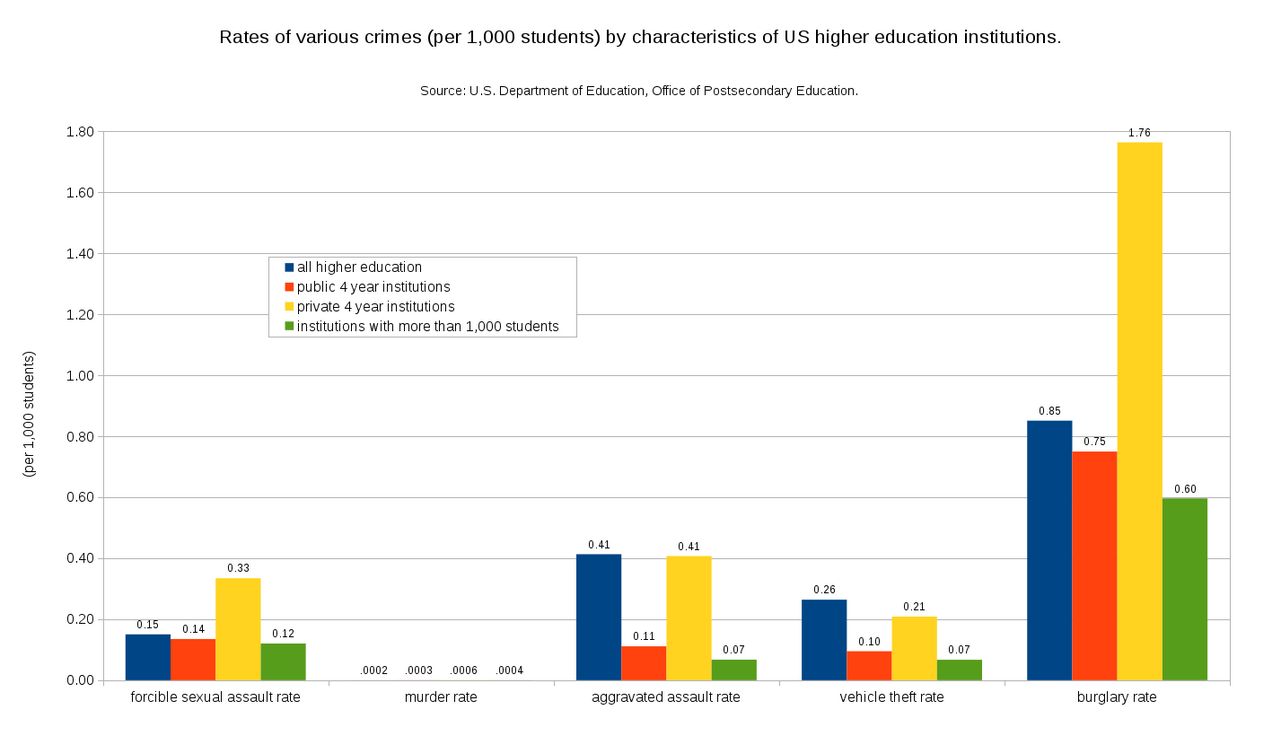
The many kinds of crime
Crime is the subset of deviance that violates a law and is subject to formal punishment by the state. It is far from uniform. Violent crime uses force or its threat against a person — homicide, assault, robbery, rape. Property crime takes or destroys property without force against a victim — burglary, larceny, motor-vehicle theft, arson. White-collar crime, a term coined by Edwin Sutherland, is committed by respectable people of high status in the course of their occupations — embezzlement, insider trading, tax evasion, fraud. Though it rarely fills the evening news, it drains far more money from society than all street crime combined. Corporate crime extends this to illegal acts by companies themselves. Organized crime is the ongoing business of supplying illegal goods and services. And consensual or "victimless" crimes — some drug use, gambling, sex work — involve willing participants and no direct complainant, which is exactly why they are so hard to police and so contested to define.
| Category | What it involves | Examples |
|---|---|---|
| Violent crime | Force or threat against a person | Homicide, assault, robbery |
| Property crime | Taking/destroying property, no force on a victim | Burglary, larceny-theft, arson |
| White-collar crime | Committed by high-status people at work | Fraud, embezzlement, insider trading |
| Corporate crime | Illegal acts by organizations | Price-fixing, pollution, unsafe products |
| Organized crime | Ongoing supply of illegal goods/services | Trafficking, extortion rackets |
| Consensual (victimless) crime | Willing participants, no direct complainant | Some drug use, gambling, sex work |
Measuring crime — and the dark figure
Everything we claim to know about crime rates depends on how crime is measured, and no single measure is complete. The Uniform Crime Reports (UCR) — now being replaced by the more detailed NIBRS — compile offenses reported to and recorded by police. They are national and long-running, but they miss everything never reported and everything police choose not to record. The National Crime Victimization Survey (NCVS) instead asks a large sample of households whether they have been victimized, capturing much crime that never reached the police — but it relies on memory and omits homicide (the victim cannot answer) and crimes against businesses. Self-report surveys ask people to confess their own offending anonymously, which is invaluable for hidden and juvenile deviance but depends on honesty. The gap between all the crime that happens and the crime that shows up in official statistics is called the dark figure of crime, and for some offenses — sexual assault, domestic violence, corporate wrongdoing — it is enormous.
- Crime is deviance that breaks a law; major types include violent, property, white-collar, corporate, organized, and consensual crime.
- White-collar crime (Sutherland) costs far more than street crime yet is punished far more lightly.
- The three main measures are the UCR/NIBRS (police reports), the NCVS (victim survey), and self-report surveys — each with distinct blind spots.
- The dark figure of crime is the large share of offenses that never enter official statistics.
Section 5The criminal justice system
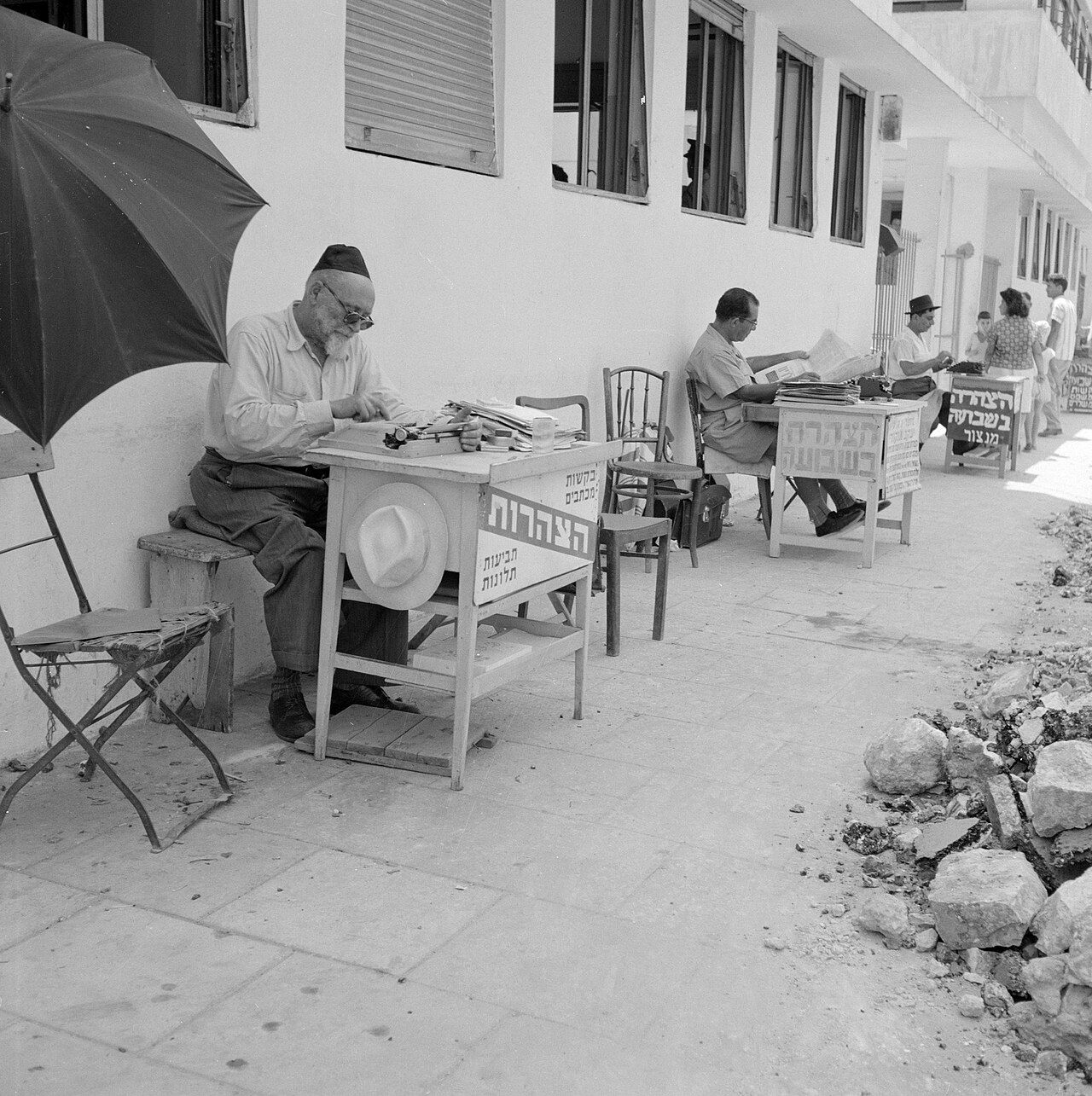
Police: the gatekeepers
The criminal justice system is the formal apparatus a society uses to enforce its laws, and it has three interlocking branches. The first is the police. Because officers cannot act on every violation they encounter, their defining feature is discretion — the power to decide whom to stop, question, cite, or arrest, and whom to let go. That discretion makes police the gatekeepers of the whole system: a person only becomes a "criminal case" if an officer decides to make one. Where and how that discretion falls — which neighborhoods are patrolled, which behaviors are treated as suspicious — shapes everything downstream, which is why conflict and labeling theorists watch policing so closely.
Courts: adjudication and the bargain
Once charged, a case moves to the courts, built in principle on an adversarial contest between prosecution and defense before a neutral judge, with the accused protected by due process — the presumption of innocence, the right to counsel, the right to a jury. In practice, the dramatic trial is the exception. The overwhelming majority of criminal convictions are obtained through plea bargaining, in which the accused pleads guilty, usually to a reduced charge, in exchange for a lighter sentence. Plea bargaining keeps a crowded system moving, but critics note it pressures even innocent defendants to plead, and it shifts real power from judges and juries to prosecutors.
Corrections: what punishment is for
The third branch, corrections, carries out the sentence — through incarceration, community supervision on probation or parole, fines, or, in some jurisdictions, death. Sociologists organize the debate over corrections around four competing justifications for punishment. Retribution punishes because the offender deserves it. Deterrence punishes to discourage future crime, whether by the individual (specific deterrence) or by society watching (general deterrence). Incapacitation simply removes the offender's ability to reoffend by confining them. Rehabilitation aims to reform the offender so they can return as a law-abiding member of society. These goals often pull in different directions, and which one dominates shapes an entire penal culture. The United States now incarcerates one of the largest shares of its population of any nation — a phenomenon called mass incarceration — and high rates of recidivism, the tendency of released offenders to reoffend, raise a hard question about whether prisons rehabilitate or merely warehouse and label.
| Justification | Logic of punishment | Aimed at |
|---|---|---|
| Retribution | The offender deserves to suffer for the wrong | The past act |
| Deterrence | Punishment discourages future offending | The offender and the watching public |
| Incapacitation | Confinement removes the ability to reoffend | Public safety now |
| Rehabilitation | Treatment reforms the offender to return safely | The offender's future |
- The criminal justice system has three branches: police, courts, and corrections.
- Police discretion makes officers the system's gatekeepers; most convictions come from plea bargaining, not trials.
- Punishment is justified in four ways: retribution, deterrence, incapacitation, rehabilitation.
- Mass incarceration and high recidivism raise whether prisons rehabilitate or simply confine and label.
The chapter in one breath
- Deviance is a norm violation that draws a negative reaction; it is relative and defined by reaction, not by harm.
- Norms run from folkways to mores to taboos to laws, and social control enforces them through positive/negative, informal/formal sanctions.
- Durkheim showed deviance is normal and functional; Merton's strain theory ties it to the gap between cultural goals and legitimate means, with five modes of adaptation.
- Conflict theory (Marx) says the powerful define deviance to protect their interests; labeling theory (Becker, Lemert) says the social reaction creates it, turning primary into secondary deviance.
- Crime is illegal deviance — violent, property, white-collar, corporate, organized, and consensual — and white-collar crime costs the most while being punished least.
- We measure crime with the UCR/NIBRS, the NCVS, and self-report surveys, each blind to a different dark figure.
- The criminal justice system runs on discretion through police, courts, and corrections, and punishment is justified by retribution, deterrence, incapacitation, and rehabilitation.
ReferenceWords worth knowing
A quick reference for the terms in this chapter — skim it now, or circle back whenever a word trips you up.
- Anomie
- A condition of normlessness in which the guiding rules of society weaken or break down, often during rapid change; Durkheim's concept, central to strain theory.
- Conflict theory
- The paradigm, rooted in Marx, that laws and social control reflect the interests of the powerful and are applied unequally across social classes.
- Corrections
- The branch of the justice system that carries out sentences through incarceration, probation, parole, fines, or execution.
- Crime
- Deviance that violates a codified law and is subject to formal punishment by the state.
- Deterrence
- A justification for punishment that aims to discourage future offending, whether by the individual (specific) or by the watching public (general).
- Deviance
- Any behavior, belief, or condition that violates a social norm and provokes a negative reaction.
- Folkways
- Everyday customs and etiquette whose violation is mildly sanctioned as rude or strange rather than immoral.
- Formal social control
- Control exercised by institutions and officials empowered to enforce rules — police, courts, schools — as opposed to informal, everyday control.
- Labeling theory
- The interactionist view that deviance is produced by the social reaction to an act — the label — rather than by the act itself.
- Master status
- A status so dominant it overrides all others in how a person is seen; a deviant label such as "ex-convict" can become one.
- Mores
- Norms with strong moral significance; violating them brings serious condemnation.
- Primary deviance
- An initial norm violation that provokes little reaction and does not alter the person's self-concept.
- Recidivism
- The tendency of a previously punished offender to reoffend; a key measure of whether corrections rehabilitate.
- Sanction
- A reaction that rewards conformity or punishes deviance; sanctions may be positive or negative, informal or formal.
- Secondary deviance
- Deviance that follows labeling, when a person reorganizes identity and behavior around the deviant label.
- Social control
- The mechanisms a society uses to encourage conformity and discourage deviance.
- Social norm
- A shared expectation about how people ought to behave in a given setting.
- Stigma
- A powerfully negative label or "spoiled identity" that discredits a person in the eyes of others; analyzed by Goffman.
- Strain theory
- Merton's theory that deviance arises from the gap between culturally approved goals and the legitimate means available to reach them.
- Subculture
- A group whose values, norms, and lifestyle differ from those of the dominant culture; a common site for learning deviance.
- Uniform Crime Reports (UCR)
- The FBI's long-running compilation of crimes reported to and recorded by police, now transitioning to the more detailed NIBRS.
- White-collar crime
- Crime committed by respectable, high-status people in the course of their occupations; a term coined by Edwin Sutherland.
Check yourself
Social Class & Stratification
Every society sorts its members into layers, and where you land shapes almost everything — your health, your schooling, your work, even how long you live. Sociologists call this ranking social stratification, and unlike the differences between individuals, it is a feature of society itself: durable, patterned, and passed from one generation to the next. This chapter asks how societies build these hierarchies, why they persist, and how the great theorists explained them. It then brings the questions home — what a social class is, how we measure poverty and identify who bears it, and whether the American Dream of rising through effort matches the evidence. Class is often invisible to the people who benefit from it; the work of this chapter is to make it visible.
By the end of this chapter you can
- Define social stratification and distinguish closed (caste) from open (class) systems.
- Compare the estate, caste, and class systems and the role of ascribed versus achieved status.
- Explain and critique the Davis–Moore thesis from the functionalist paradigm.
- Summarize Marx's account of class, exploitation, and class consciousness.
- Contrast Weber's three dimensions of stratification — class, status, and power.
- Describe the U.S. class structure and the markers of class: income, wealth, and cultural capital.
- Distinguish absolute from relative poverty and identify who is most likely to be poor.
- Classify the types of social mobility and weigh the American Dream against the evidence.
Section 1Systems of stratification
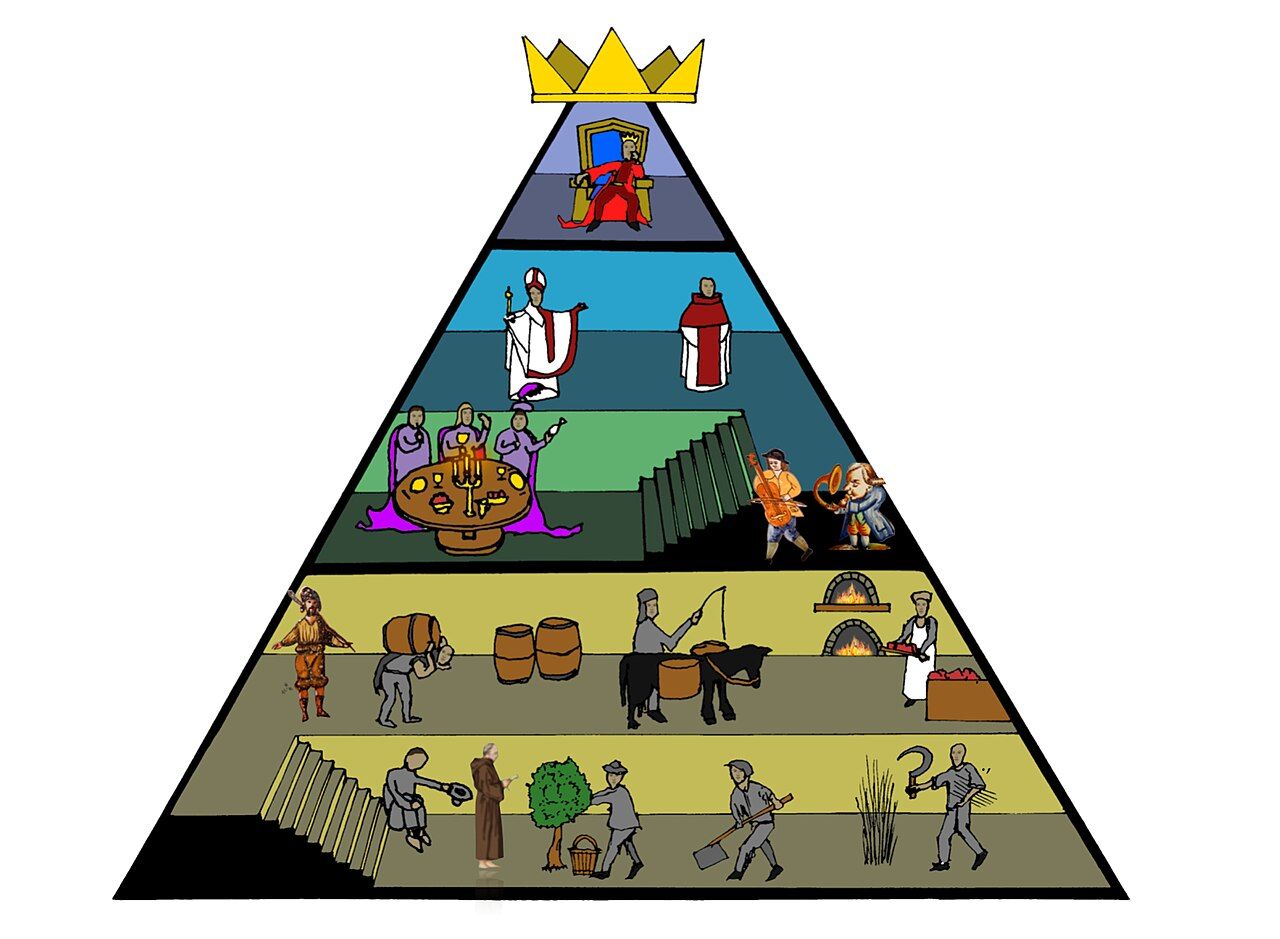
What stratification is — and isn't
Social stratification is the ranking of whole categories of people into a hierarchy of layers, or strata, that receive unequal shares of a society's resources, power, and prestige. Four ideas make it a social fact rather than a personal one. First, stratification is a trait of society, not of individuals: a talented child born into a poor family and an ordinary child born into a rich one do not, on average, end up in the same place, because the layering exists before either of them is born. Second, it persists across generations — parents pass their position, and its advantages, to their children. Third, it is universal but variable: every known society ranks its members, yet what gets rewarded and how steeply differs enormously from one society to the next. Fourth, it rests not only on force but on belief — every stratification system is supported by an ideology that makes the arrangement seem natural, fair, or inevitable.
Sociologists sort stratification systems along a spectrum from closed to open. Closed systems allow little or no movement between strata and rest on ascribed status — a position assigned at birth, over which the person has no control. Open systems permit movement and give real weight to achieved status — a position earned through a person's own effort and choices. No real society sits at either pure extreme, but the distinction organizes the whole field.
Closed systems: slavery, estate, and caste
Three historical systems sit near the closed end. Slavery — the ownership of some people by others — is the most extreme, treating human beings as property. The estate system of medieval Europe divided society into legally defined orders: a nobility that owned the land, a clergy that owned the moral authority, and a vast commoner class of peasants and, later, townspeople who worked it. Rank was hereditary and enshrined in law.
The purest surviving example of a closed system is the caste system, in which a person's lifelong position is fixed by birth. India's traditional system is organized around ranked categories — the classical varnas of Brahmins (priests and scholars), Kshatriyas (warriors and rulers), Vaishyas (merchants), and Shudras (laborers), with the Dalit communities historically placed outside and below the scheme and long stigmatized as “untouchable.” Caste systems share a recognizable machinery: status is ascribed and permanent, marriage is endogamous (you must marry within your caste), occupation is often inherited, and the whole arrangement is sustained by powerful cultural and, historically, religious beliefs. Apartheid-era South Africa operated a racial caste system by law, and many scholars read the American system of racial segregation in the same terms. Modern India has outlawed caste discrimination, yet caste continues to shape marriage, opportunity, and everyday life — a reminder of how durably these arrangements outlive the laws that once enforced them.
Open systems: class
A class system ranks people by a combination of birth and individual achievement. Its boundaries are blurred rather than legally fixed, its categories shade into one another, and — crucially — it permits social mobility, movement up or down between strata within a lifetime or across generations. Because class systems reward achieved status, they are bound up with the ideology of meritocracy: the belief that social position reflects personal merit — talent plus effort. Meritocracy is a powerful and motivating idea, but it is also, in part, a story a society tells itself, and later sections weigh how much of it the evidence actually supports.
| Feature | Caste (closed) | Class (open) |
|---|---|---|
| Basis of position | Ascribed — fixed at birth | Ascribed and achieved |
| Mobility | Essentially none | Possible, up or down |
| Boundaries | Sharp, legally/ritually enforced | Blurred, informal |
| Marriage | Endogamous (within caste) | Largely open, though class tends to marry class |
| Occupation | Often inherited, assigned | Chosen (in principle) |
| Supporting ideology | Tradition, religion, purity | Meritocracy |
- Social stratification is a society-wide ranking of categories of people; it persists across generations and is upheld by belief.
- Closed systems (slavery, estate, caste) rest on ascribed status and permit little mobility; open (class) systems add achieved status and allow movement.
- A caste system fixes lifelong rank at birth, enforces endogamy, and is sustained by tradition and religion.
- A class system blends birth and achievement, has blurred boundaries, and is justified by the ideology of meritocracy.
Section 2Explaining stratification
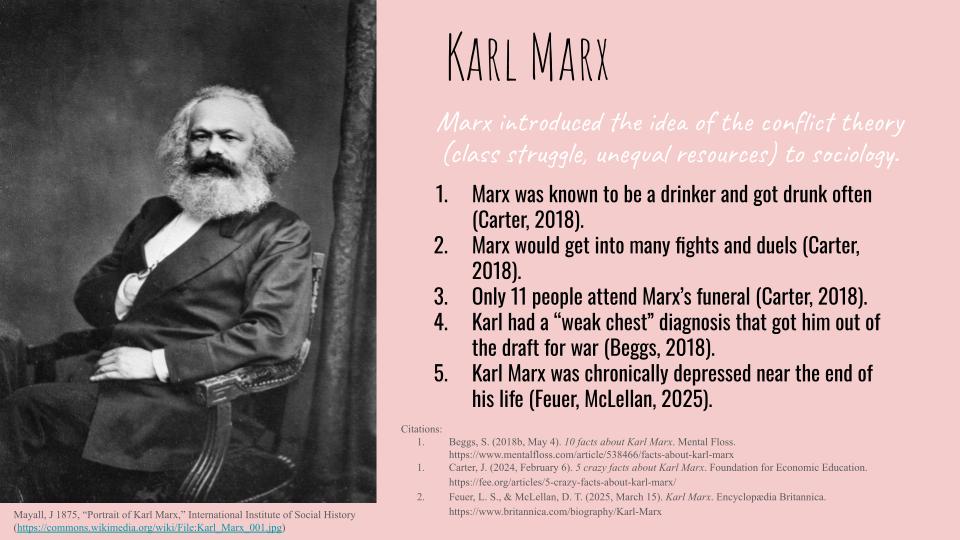
The functionalist answer: the Davis–Moore thesis
Why does every society have stratification? The functionalist reply, stated most sharply by Kingsley Davis and Wilbert Moore in 1945, is that inequality is useful — even necessary. Their argument, the Davis–Moore thesis, runs like this: a society has some positions that are more important and harder to fill than others (a surgeon's job matters more, and is harder to train for, than a cashier's). To motivate the most capable people to endure the long, costly training those positions demand, society must attach greater rewards — money, prestige, power — to them. Unequal rewards, on this view, are a device for getting the right people into the right jobs. Stratification is thus a functional necessity, and the greater the functional importance of a position, the greater its reward.
The critique, pressed by Melvin Tumin, is that the thesis assumes a fair race that ascription makes impossible. How do we measure a job's importance — and why do some plainly essential jobs (sanitation, childcare, farm labor) pay so little while others of doubtful social value pay so much? More damning, stratification does not sift the ablest people to the top; it lets the already-advantaged hoard opportunity, blocking talented people born low and cushioning mediocre people born high. Far from placing the best people in key roles, inequality can reproduce itself, wasting talent and calling the result “merit.”
The conflict answer: Marx
Karl Marx saw stratification not as society's useful glue but as the visible scar of exploitation. For Marx, class in industrial capitalism is defined by one thing: your relationship to the means of production — the factories, land, and capital used to produce wealth. Two great classes result. The bourgeoisie (capitalists) own the means of production; the proletariat (workers) own only their labor, which they must sell to survive. Profit, Marx argued, comes from surplus value: owners pay workers less than the value their labor creates and pocket the difference. Stratification, then, is exploitation dressed up as economics.
Why don't workers revolt? Because, Marx said, they are held in false consciousness — a distorted view of their situation that leads them to accept and even defend a system working against them, blaming themselves or their neighbors instead of the structure. The task of history, in his view, was for workers to develop class consciousness, recognize their shared exploitation, and act collectively to overturn the system. Marx predicted capitalism would deepen inequality until it collapsed into revolution. That specific prediction failed — wages rose, a middle class swelled, reforms softened the edges — but his central insight, that economic ownership structures power and that ideology hides it, remains one of sociology's most influential ideas.
Weber's multidimensional view: class, status, and power
Max Weber accepted much of Marx but thought a single economic axis was too crude. Stratification, he argued, has three distinct dimensions that usually cluster but can come apart. The first is class — a person's economic position and, with it, their life chances, the odds of obtaining the good things a society offers. The second is status (Weber's Stand) — social honor or prestige, the esteem attached to a person's style of life, which money cannot always buy. The third is power (which Weber discussed as party) — the capacity to get one's way over others, often through organized political influence.
The point of separating them is that they do not always line up. A tenured professor or a member of the clergy may enjoy high status on modest income; a lottery winner or an organized-crime boss may command wealth and power with little prestige; a mid-level bureaucrat may wield real power with unremarkable class and status. Weber's own three dimensions are class, status (Stand), and party or power; he did not use the phrase socioeconomic status. Later researchers, drawing on his multidimensional insight, built the composite measure now called socioeconomic status (SES), which typically combines income, education, and occupational prestige. That multidimensional idea underlies most modern measurement of class.
| Question | Functionalism (Davis–Moore) | Conflict (Marx) | Weber |
|---|---|---|---|
| What is stratification? | A functional necessity that rewards important roles | Exploitation rooted in ownership of the means of production | A layering along three axes at once |
| Why does it exist? | To motivate the ablest into the hardest, most vital jobs | Because owners extract surplus value from workers | Because class, status, and power are unequally held |
| Key concept | Functional importance; reward | Bourgeoisie vs. proletariat; false consciousness | Class, status, power; life chances |
| Is it good for society? | Yes — it places the right people in key roles | No — it enriches a few by impoverishing many | It simply is; the analyst describes, not judges |
| Main criticism | Ignores ascription; “importance” is arbitrary (Tumin) | Revolution never came; too economic | Harder to turn into a single measure |
- The Davis–Moore thesis (functionalism) holds that unequal rewards are necessary to fill important, hard-to-train positions; Tumin countered that ascription blocks the fair sorting it assumes.
- Marx (conflict) defined class by ownership of the means of production, located profit in surplus value, and saw false consciousness preventing revolt.
- Weber split stratification into three dimensions — class, status, and power — that cluster but can diverge.
- Life chances — the odds of getting society's rewards — are Weber's enduring bridge between class position and everyday outcomes.
Section 3Social class
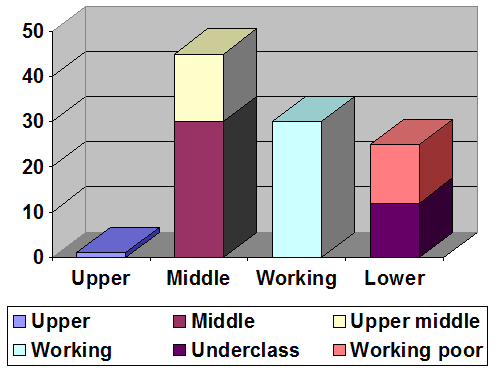
What a social class is
A social class is a large category of people who occupy a similar economic position and, as a result, share broadly similar life chances. Because the United States lacks the legal ranks of an estate or caste system, its classes have fuzzy edges, and sociologists draw the lines in different places. A widely used sociological map, the Gilbert–Kahl model, describes roughly six layers: a tiny capitalist (upper) class that lives on investments and inherited wealth; an upper-middle class of well-paid professionals and managers with advanced degrees; a middle class of semi-professionals, lower-level white-collar workers, and skilled craft workers; a working class in routine manual and clerical jobs with little autonomy; the working poor, employed but below or near the poverty line; and an underclass largely shut out of the regular labor market. The share of national resources each layer commands is wildly uneven — the top sliver holds a share of wealth out of all proportion to its numbers.
Income, wealth, and prestige
Class is measured with several markers, and confusing two of them — income and wealth — is one of the most common mistakes in thinking about inequality. Income is the money a household receives over a period of time: wages, salary, interest, government benefits. Wealth (or net worth) is the total value of everything a household owns — home, savings, stocks, businesses — minus its debts. Wealth is far more concentrated than income, because it compounds and is inherited: the gap in accumulated wealth between the top and bottom is many times wider than the gap in yearly income. Two other markers complete the picture: occupational prestige, the respect a job commands (surveys reliably rank physicians and professors high, and manual and service jobs low), and educational attainment, which both signals and shapes class. Combined, these markers give a person's socioeconomic status (SES).
Cultural capital and the markers of taste
Class is more than a bank balance; it is also a way of moving through the world. The sociologist Pierre Bourdieu called the non-financial resources of class cultural capital — the tastes, manners, vocabulary, credentials, and know-how that a person absorbs, mostly from family, and that pay off in schools, workplaces, and social life. A child raised among books, museum trips, and confident dealings with authority arrives at school already fluent in its unspoken code; the school then rewards that fluency as if it were raw talent, quietly converting inherited advantage into “merit.” Status symbols — the neighborhood, the car, the college sweatshirt, the accent — broadcast class position, and much of what looks like personal preference is in fact a marker of the stratum one was raised in. This is why class can be so hard to see and so hard to escape: it is stitched into everyday habits long before anyone earns a paycheck.
| Class (Gilbert–Kahl) | Roughly | Typical work & resources |
|---|---|---|
| Capitalist / upper | ~1% | Live on investments & inherited wealth; top prestige universities; outsized political influence |
| Upper-middle | ~14% | Professionals & managers; advanced degrees; comfortable income and growing wealth |
| Middle | ~30% | Semi-professionals, lower white-collar & skilled trades; some college; modest security |
| Working class | ~30% | Routine manual/clerical jobs; little autonomy; vulnerable to layoffs |
| Working poor | ~13% | Employed but low-wage; below or near the poverty line; little to no wealth |
| Underclass | ~12% | Largely outside the regular labor market; reliant on assistance |
- A social class groups people of similar economic position and life chances; U.S. models commonly name about six blurred layers.
- Income (money received over time) differs from wealth (net worth); wealth is more concentrated and more inherited.
- Occupational prestige and education round out class; together the markers form a person's socioeconomic status.
- Cultural capital (Bourdieu) — tastes, manners, and know-how — transmits class advantage and gets rewarded as if it were merit.
Section 4Poverty
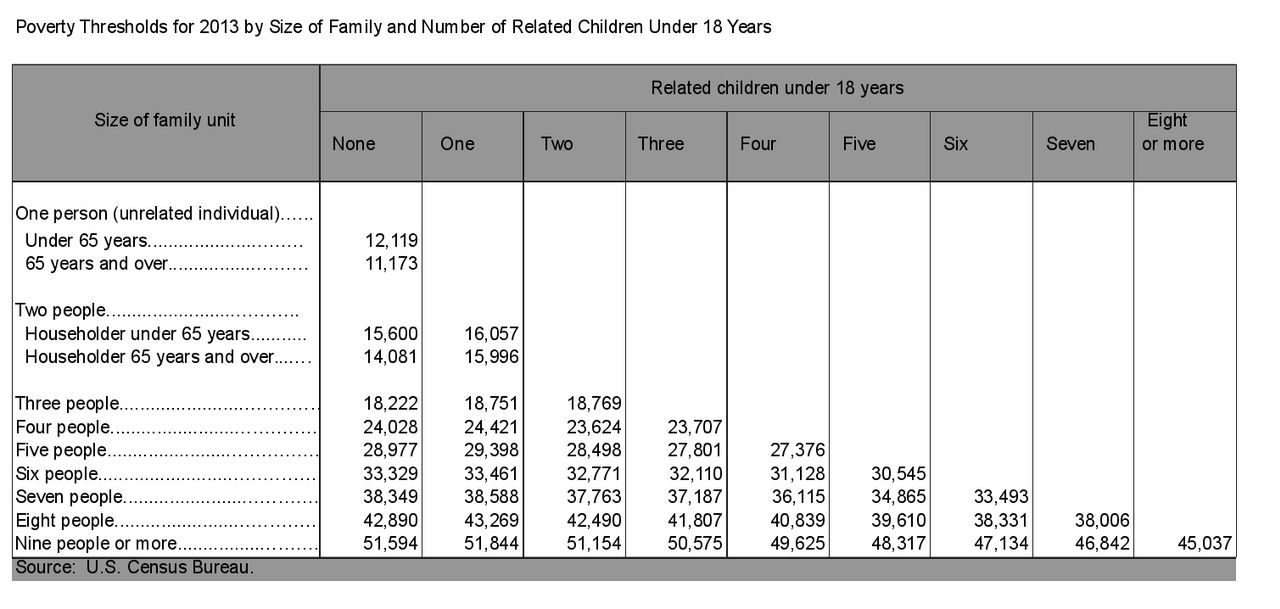
Measuring poverty: absolute and relative
Poverty comes in two conceptual flavors, and the difference decides who gets counted. Absolute poverty is a lack of the resources needed to survive — enough food, safe water, shelter, basic health care. It is a fixed standard: below this line, life and health are at risk. Relative poverty is a lack of the resources needed to live at the standard considered normal for one's own society. It is a moving line: a family with a roof and food may still be poor relative to a wealthy society if it cannot afford what that society treats as ordinary participation. Absolute poverty asks whether you can survive; relative poverty asks whether you can belong.
The official U.S. measure is essentially absolute. In the 1960s, economist Mollie Orshansky built the poverty line (the poverty threshold) from the cost of a minimum food budget multiplied by three — a rough figure, adjusted only for inflation and household size ever since. A household whose pre-tax cash income falls below its threshold is officially poor, and the share of people below it is the poverty rate. Critics on all sides fault the measure: it ignores taxes, non-cash benefits like food assistance and housing vouchers, and huge regional differences in the cost of living. To address these gaps, the Census Bureau also publishes a Supplemental Poverty Measure (SPM) that folds in benefits, taxes, and local costs — often changing the picture of who counts as poor.
Who is poor?
Poverty is not spread evenly; it concentrates in predictable ways. Children are among the poorest age groups, and childhood poverty leaves long shadows on health and schooling. Poverty is also increasingly female: the feminization of poverty describes the rising share of the poor who live in households headed by women, driven by the wage gap, the costs of unpaid caregiving, and single parenthood. Racial and ethnic minorities face poverty rates well above the national average, the accumulated residue of historical exclusion from wealth-building. And poverty has a geography — concentrated in some rural regions and in segregated urban neighborhoods where disadvantage compounds. One group deserves special notice: the working poor, people who hold jobs, sometimes more than one, yet still fall below the line because wages are too low or hours too few.
Explaining poverty: the person or the structure?
Two broad explanations compete. The first blames individuals or their culture. Oscar Lewis's culture of poverty thesis argued that persistent poverty breeds values — fatalism, short time horizons — that get passed down and trap the next generation. The second blames structure: poverty is produced by how a society is organized — by low-wage labor markets, unequal schools, discrimination, and economic shifts that erase whole categories of jobs. The two explanations point to very different remedies: fix the person, or fix the system. Most sociological evidence favors structural accounts — poverty rates rise and fall with the economy and with policy far faster than any culture could change — while cautioning that blaming the poor for their poverty is itself a form of the false consciousness Marx described, one that conveniently excuses the arrangement that produces it.
| Absolute poverty | Relative poverty | |
|---|---|---|
| The question | Can you survive? | Can you take part in normal life? |
| The standard | Fixed (basic necessities) | Moving (society's median) |
| Typical use | Global development, the official U.S. line | Comparing inequality within rich nations |
| Can it ever reach zero? | In principle, yes | Almost never — the line rises with society |
- Absolute poverty is lacking the means to survive; relative poverty is falling below one's society's normal standard.
- The U.S. poverty line (Orshansky) is a food budget × 3, adjusted for inflation; the SPM adds benefits, taxes, and local costs.
- Poverty falls hardest on children, female-headed households (the feminization of poverty), racial minorities, and the working poor.
- Structural explanations of poverty (labor markets, discrimination, policy) hold up better than individual/culture-of-poverty accounts.
Section 5Social mobility
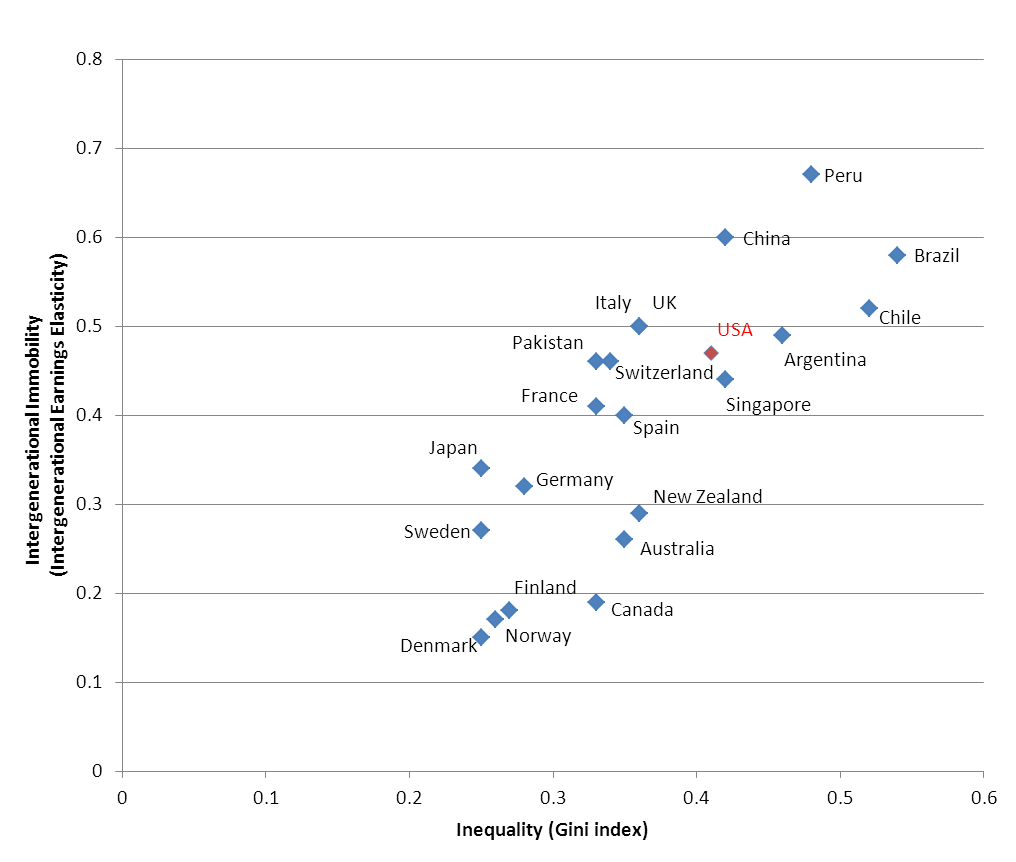
The types of mobility
Social mobility is movement between positions in a stratification system, and sociologists slice it several ways. The most important cut is by time frame. Intergenerational mobility compares a person's position to that of their parents — the daughter of factory workers who becomes a physician. Intragenerational mobility tracks a single person's movement across their own working life — the mailroom clerk who retires as a manager. Mobility also has a direction: vertical mobility moves a person up or down the hierarchy, while horizontal mobility shifts them between positions at roughly the same level (a nurse who becomes a paralegal). Finally, mobility can be structural — whole groups rise or fall because the economy itself changed, as when industrialization lifted millions into new middle-class jobs or when the loss of manufacturing pushed communities down — as opposed to exchange mobility, where individuals swap places while the overall shape of the ladder stays the same. Structural mobility is a reminder that a person's rise or fall is often the tide of history, not just the strength of their swimming.
The American Dream and the evidence
The American Dream — the belief that anyone who works hard can rise — is a story about upward, intergenerational, largely structural mobility, and for much of the twentieth century a growing economy made it broadly true. The recent evidence is more sobering. Researchers measure how tightly a child's adult income is tied to their parents' (a bond called intergenerational elasticity), and in the United States that bond is strong: where you start explains a great deal about where you finish. Comparative studies place the U.S. below several other wealthy nations, such as Canada and the Nordic countries, on the odds that a child born poor will reach the top. The pattern is captured by the “Great Gatsby Curve,” which shows that more unequal societies tend to have less mobility, not more. Studies of “absolute” mobility add a further worry: the share of children who grow up to earn more than their parents did has fallen sharply for cohorts born in the later twentieth century.
What drives who moves? The strongest lever is education, especially a four-year degree — but access to good schooling is itself patterned by class, so education both opens the door and guards it. Family wealth, neighborhood, health, and plain luck matter too. The upshot is not that mobility is a myth — people do rise and fall every generation — but that it is more limited, and more shaped by the accident of birth, than the Dream implies. The two ends of the ladder are especially sticky: children born at the very top and the very bottom are the most likely to stay put.
| Type of mobility | What it compares | Example |
|---|---|---|
| Intergenerational | You vs. your parents | Child of laborers becomes a physician |
| Intragenerational | You over your own career | Clerk retires as a manager |
| Vertical | Up or down the hierarchy | A promotion — or a layoff into poverty |
| Horizontal | Sideways, same level | Nurse becomes a paralegal |
| Structural | Whole groups, economy-driven | Industrialization lifts millions into new jobs |
- Social mobility is movement in the stratification system; it can be intergenerational or intragenerational, vertical or horizontal.
- Structural mobility moves whole groups because the economy changed; exchange mobility swaps individuals while the ladder's shape holds.
- The U.S. shows relatively low intergenerational mobility for a rich nation, and absolute upward mobility has declined for recent cohorts.
- Education is the strongest lever of mobility, but access to it is patterned by class — and the top and bottom rungs are the stickiest.
The chapter in one breath
- Social stratification ranks whole categories of people; it is a trait of society, persists across generations, and is upheld by belief.
- Systems run from closed (caste, resting on ascribed status, little mobility) to open (class, adding achieved status and justified by meritocracy).
- The Davis–Moore thesis calls inequality a functional necessity; Tumin answers that ascription blocks the fair sorting it assumes.
- Marx located class in ownership of the means of production and profit in surplus value; Weber split stratification into class, status, and power.
- The U.S. class structure has about six blurred layers; income differs from the more concentrated wealth, and cultural capital transmits advantage as “merit.”
- Absolute poverty is about survival, relative poverty about belonging; the official line falls hardest on children, women, minorities, and the working poor.
- Social mobility comes in several types; U.S. intergenerational mobility is relatively low, and the American Dream is real but more limited than it claims.
ReferenceWords worth knowing
A quick reference for the terms in this chapter — skim it now, or circle back whenever a word trips you up.
- Absolute poverty
- A lack of the resources needed to survive — adequate food, water, shelter, and health care; a fixed standard.
- Achieved status
- A social position earned through a person's own effort, talent, or choices.
- Ascribed status
- A social position assigned at birth or involuntarily, over which the individual has no control.
- Bourgeoisie
- In Marx's theory, the capitalist class that owns the means of production.
- Caste system
- A closed stratification system in which lifelong position is fixed by birth and marriage is endogamous.
- Class consciousness
- Workers' awareness of their shared exploitation and common interests as a class (Marx).
- Class system
- An open stratification system based on both birth and achievement, permitting social mobility.
- Cultural capital
- The tastes, manners, knowledge, and credentials, transmitted mainly by family, that yield advantage in schools and society (Bourdieu).
- Davis–Moore thesis
- The functionalist claim that stratification is necessary because unequal rewards motivate people to fill important, hard-to-train positions.
- False consciousness
- A distorted understanding that leads the disadvantaged to accept, or defend, a system that works against them (Marx).
- Feminization of poverty
- The trend by which women, especially heads of single-parent households, make up a growing share of the poor.
- Income
- The money a household receives over a period of time, such as wages, interest, and benefits.
- Intergenerational mobility
- A change in social position between one generation and the next (parents to children).
- Life chances
- Weber's term for the odds that a person will obtain the good things a society offers, given their class position.
- Meritocracy
- A system, or the belief in one, in which social position reflects personal merit — talent plus effort.
- Poverty line (threshold)
- The official income level below which a household is counted as poor; in the U.S., built from a minimum food budget.
- Proletariat
- In Marx's theory, the working class that owns no means of production and must sell its labor.
- Relative poverty
- A lack of the resources needed to live at the standard considered normal for one's own society; a moving standard.
- Social mobility
- Movement of individuals or groups between positions in a stratification system.
- Social stratification
- A society's ranking of categories of people into a hierarchy of layers with unequal resources, power, and prestige.
- Structural mobility
- Mobility of whole groups caused by changes in the economy or society rather than individual effort.
- Wealth
- The total value of everything a household owns (net worth) minus its debts; more concentrated than income.
Check yourself
Global Inequality
A child born today in Norway can expect more than eighty years of life, near-universal schooling, and clean water from a tap. A child born the same day in Niger faces a one-in-ten chance of dying before age five and may never see the inside of a classroom. Neither child chose where to be born, yet that single accident will shape their lives more powerfully than talent, effort, or ambition ever could. This chapter is about the largest and most consequential form of inequality on earth — the gulf between nations — how sociologists measure it, how they explain it, what it does to human bodies and lives, why it falls hardest on women, and how a globalizing world is reshuffling the whole arrangement.
By the end of this chapter you can
- Define global stratification and distinguish high-, middle-, and low-income nations.
- Explain the common measures of national wealth and poverty — GNI per capita, the Gini coefficient, and the Human Development Index.
- Compare and contrast modernization theory and dependency theory, and locate each in the functionalist and conflict paradigms.
- Distinguish absolute from relative poverty and describe the lived reality of extreme poverty.
- Explain the feminization of poverty and the mechanisms that concentrate hardship among women.
- Analyze how globalization has changed inequality both between and within nations.
- Apply the three sociological paradigms — structural functionalism, conflict theory, and symbolic interactionism — to global inequality.
Section 1Global stratification — high-, middle-, and low-income nations
What global stratification means
Within any single country, sociologists study social stratification — the way a society ranks its members into layers of wealth, power, and prestige. Global stratification lifts that same lens to the level of the planet: it is the ranking of entire nations into layers, so that whole populations are advantaged or disadvantaged by the country they happen to inhabit. The scale of this ranking dwarfs anything inside a single society. The richest fifth of the world's people consume roughly three-quarters of the world's output, while the poorest fifth consume a tiny sliver. For most of human history the gap between the richest and poorest societies was modest — a peasant in 1700 lived much like a peasant anywhere. Industrialization changed that. Over two centuries the nations that industrialized first pulled dramatically ahead, opening a chasm that defines the modern world.
The income ladder
The most widely used map of global stratification is the World Bank's income classification, which sorts economies by gross national income (GNI) per capita — the total income of a country divided by its population. It marks four rungs. High-income nations are the industrialized and post-industrial economies — the United States, Germany, Japan, Norway — that hold the great majority of global wealth. Upper-middle-income nations, such as China, Brazil, and Mexico, are industrializing rapidly and growing a large middle class. Lower-middle-income nations, including India, Nigeria, and Bangladesh, have mixed economies with large agrarian sectors and swelling cities. Low-income nations — concentrated in sub-Saharan Africa and including Niger, the Democratic Republic of the Congo, and Somalia — remain largely agrarian, with high child mortality and short life expectancy. Older labels you will still hear — "First, Second, and Third World," or "developed and developing" — are fading, partly because they were coined during the Cold War and partly because they implied that poor nations were simply immature versions of rich ones.
| Income tier | GNI per person (approx.) | Examples | Typical profile |
|---|---|---|---|
| High-income | Above ~$14,000 | United States, Germany, Japan, Norway, Qatar | Industrial/post-industrial; life expectancy ~80; holds most global wealth |
| Upper-middle-income | ~$4,500–14,000 | China, Brazil, Mexico, South Africa | Rapidly industrializing; growing urban middle class |
| Lower-middle-income | ~$1,150–4,500 | India, Nigeria, Kenya, Bangladesh | Mixed economies; large agrarian sector; fast-growing cities |
| Low-income | Below ~$1,150 | Niger, DR Congo, Somalia, Mali | Largely agrarian; high child mortality; life expectancy ~55–62 |
Measuring the gap
GNI per capita is a blunt instrument — it is an average, and an average can hide a nation where a few billionaires sit atop widespread misery. Sociologists therefore reach for other tools. The Gini coefficient captures how evenly income is spread within a country, running from 0 (everyone equal) to 1 (one person holds everything). The Human Development Index (HDI), developed for the United Nations, blends income with life expectancy and education, on the reasoning that development means more than money — it means a long, healthy, informed life. Together these measures reveal a stubborn truth: national wealth and human well-being usually rise together, but not always, and the exceptions are where the most interesting sociology lives.
Where you are born outweighs almost anything you will ever do. The economist Branko Milanovic calls it the "birthplace lottery": roughly half of a person's income can be predicted from their country of citizenship alone, before we know a single thing about their effort, schooling, or intelligence. In a world that prizes merit, that is a sobering finding — global stratification hands out most of the prizes at birth.
- Global stratification ranks whole nations into layers of wealth and life chances.
- The World Bank sorts nations by GNI per capita into high-, upper-middle-, lower-middle-, and low-income tiers.
- The Gini coefficient measures inequality within a nation; the HDI blends income with health and education.
- Country of birth — the "birthplace lottery" — predicts life chances more powerfully than individual merit.
Section 2Explaining global inequality — modernization vs. dependency
Modernization theory: poverty from within
Why are some nations rich and others poor? The first major answer, modernization theory, grows out of the structural-functionalist tradition of Emile Durkheim and Talcott Parsons. It locates the cause of poverty inside poor nations themselves: in traditional values, weak technology, and a shortage of the cultural habits — saving, investing, valuing science — that let a society take off economically. Its most famous statement is W. W. Rostow's stages of economic growth (1960), which imagines every nation climbing the same ladder: (1) traditional society, (2) preconditions for take-off, (3) take-off, (4) the drive to maturity, and (5) the age of high mass consumption. On this view, rich nations simply climbed first, and poor nations can follow by adopting modern values, welcoming investment, and opening to trade. The policy that follows is optimistic: foreign aid, technology transfer, and education will pull the poor up the ladder.
Dependency theory: poverty from without
Critics found modernization theory not just wrong but insulting — it seemed to blame the poor for their own poverty while ignoring five centuries of history. Dependency theory, rooted in the conflict tradition of Karl Marx, flips the explanation outward. Poverty, it argues, is not an original condition that poor nations have failed to escape; it is a condition that was created by the rich. Through colonialism, powerful nations extracted the gold, rubber, sugar, and labor of the lands they conquered, wiring the global economy so that raw materials flow cheaply out of poor countries and finished goods flow expensively back in. The Latin American economist Raúl Prebisch showed how these terms of trade keep poor nations running to stand still, and Andre Gunder Frank coined the phrase "the development of underdevelopment" to capture the idea that some nations were made poor by the same process that made others rich. Immanuel Wallerstein's world-systems theory extends the argument, describing a single capitalist world-economy divided into a wealthy core, an exploited periphery, and a semi-periphery in between.
Weighing the two
Neither theory is a clean winner. Modernization theory struggles to explain why decades of aid have not lifted many nations, and why some resource-rich countries stay poor — but it rightly notes that internal factors like governance, corruption, and education genuinely matter, and that a few nations (South Korea, Taiwan) really did climb the ladder. Dependency theory brilliantly exposes the scars of colonialism — but it can underplay internal factors and struggles to explain the spectacular, home-grown growth of China and India. A careful sociologist holds both: history and exploitation set the starting positions, and internal choices shape what a nation does from there.
| Feature | Modernization theory | Dependency theory | World-systems theory |
|---|---|---|---|
| Root paradigm | Structural functionalism | Conflict (Marxist) | Conflict, on a global scale |
| Cause of poverty | Internal — traditional culture, weak technology | External — colonial extraction, unequal trade | A nation's position in one capitalist world-economy |
| Key thinkers | W. W. Rostow, Talcott Parsons | Andre Gunder Frank, Raúl Prebisch | Immanuel Wallerstein |
| Way out of poverty | Adopt modern values, invest, trade openly | Break dependency; fairer terms of trade | Very hard — the system resists escape |
| Main critique | Blames the poor; ignores colonialism | Underplays internal factors & real growth | Broad and hard to test |
Much of the world's poverty was manufactured, not inherited. When Belgium ruled the Congo, it built railways — not to move Congolese people, but to move Congolese rubber and copper to the coast. Colonial economies were engineered for extraction, and many of those channels still run in the same direction. Dependency theory's core insight is that you cannot understand a poor nation's present without reading its extracted past.
- Modernization theory (functionalist; Rostow, Parsons) blames poverty on internal traditional culture and prescribes modern values, aid, and trade.
- Dependency theory (conflict; Frank, Prebisch) blames poverty on external exploitation — colonialism and unequal trade.
- World-systems theory (Wallerstein) sees one capitalist economy split into core, periphery, and semi-periphery.
- The strongest account combines both: history sets starting positions, and internal choices shape the path from there.
Section 3The human cost — the lived reality of global poverty
Two kinds of poverty
Sociologists draw a sharp line between two poverties. Relative poverty means falling well below the standard of living of one's own society — a family in a wealthy nation that cannot afford what neighbors take for granted. Absolute poverty is the deprivation of the basics needed to survive: food, clean water, shelter, sanitation. The World Bank marks the line of extreme poverty at roughly $3.00 a day (in 2021 purchasing-power terms — the older $2.15 line, in 2017 prices, has been retired), and more than 800 million people — roughly one in ten human beings — live below it. This is not the poverty of doing without a smartphone; it is the poverty of doing without dinner.
What poverty does to a life
Absolute poverty is not merely uncomfortable — it is lethal, and it is lethal disproportionately to the young. A child in the poorest nations is many times more likely to die before age five than a child in the richest, felled by diseases — diarrhea, pneumonia, malaria — that are cheap to prevent and treat where money exists. Roughly one in eleven people worldwide is undernourished, and hunger in the first years of life stunts both bodies and brains permanently. Billions still lack safely managed drinking water and sanitation, so the simple act of fetching water — a task that falls mostly to women and girls — can consume hours that might have gone to school or paid work. Poverty, in short, is a thief of time, health, and futures long before it is anything else.
The persistence of bondage
The harshest edge of global poverty is that human beings are still bought and sold. Modern estimates count on the order of 50 million people in some form of modern slavery — forced labor, forced marriage, and debt bondage, in which a loan that can never be repaid chains a worker (and sometimes their children) to an employer. Tens of millions of children work instead of attending school, many in hazardous conditions. These are not relics of a distant century; they are features of the same global economy that fills store shelves in wealthy nations, and they thrive precisely where poverty leaves people with no other option.
| Indicator | What it measures | Roughly, in the world today |
|---|---|---|
| Extreme poverty | Living below ~$3.00 a day (2021 PPP) | More than 800 million people (~1 in 10) |
| Undernourishment | Chronic lack of adequate food | Hundreds of millions; ~1 in 11 hungry |
| Under-5 mortality | Deaths before the fifth birthday | Many times higher in low- than high-income nations |
| Safe water & sanitation | Access to clean water and toilets | Billions still lack safely managed services |
| Modern slavery | Forced labor, forced marriage, debt bondage | On the order of 50 million people |
Absolute poverty kills; relative poverty still wounds. It is tempting to say only extreme poverty "counts," but relative poverty in a rich nation is real deprivation too — the child who cannot afford the school trip, the family one paycheck from the street. The distinction matters not to rank suffering but to aim policy: absolute poverty demands food, medicine, and water now, while relative poverty demands a fairer share of a society that already has enough.
- Absolute poverty lacks the basics for survival; relative poverty falls below a society's own standard.
- The extreme poverty line is about $3.00/day (2021 PPP); more than 800 million people live below it.
- Poverty's cruelest toll falls on children through hunger, preventable disease, and lost schooling.
- Modern slavery and debt bondage still trap tens of millions inside the global economy.
Section 4Gender & global poverty — the feminization of poverty
Poverty has a gender
Poverty is not distributed evenly between the sexes. The sociologist Diana Pearce named the pattern in 1978: the feminization of poverty, the tendency for women and children to make up a growing and disproportionate share of the world's poor. Women perform a large majority of the world's unpaid labor and much of its most precarious paid labor, yet own only a small fraction of the world's property and earn far less than their share of its income. When a household is poor, the woman in it is usually poorer still, eating last and least, working longest, and holding the fewest assets to fall back on.
Why the burden falls on women
Several mechanisms lock the pattern in place. First is unpaid care work: cooking, cleaning, hauling water, and raising children fall overwhelmingly to women, invisible to the economy and uncounted in any wage. Arlie Hochschild called the paid job stacked on top of this unpaid one the "second shift." Second is the wage gap and the crowding of women into the low-paid informal sector — street vending, piecework, domestic service — with no contract and no protection. Third is unequal access to property and credit: in many nations women cannot easily own land or borrow money, so they cannot build the assets that lift a family out of poverty. Fourth is education: when a poor family can school only some of its children, it is usually the daughters who are kept home. Each mechanism reinforces the others across a lifetime.
Why investing in women pays
The pattern has a hopeful mirror image. Decades of development research find that resources placed in women's hands do more good: mothers tend to spend added income on their children's food, health, and schooling. Educating girls lowers child mortality and birth rates and raises earnings across a whole society. This insight drove the microcredit movement — Muhammad Yunus's Grameen Bank in Bangladesh lent tiny sums, mostly to women, to start small enterprises, and won a Nobel Peace Prize for it. Microcredit is no cure-all, and critics note that debt can trap as easily as it can free, but the underlying lesson stands: because poverty is feminized, the fastest route out of it usually runs through women.
| Domain | The gendered pattern | Consequence for women |
|---|---|---|
| Paid work | Crowded into informal, low-wage jobs | Little pay, no protection or pension |
| Unpaid work | Care and housework — the "second shift" | Long hours, invisible to the economy |
| Property & credit | Barred or limited from owning land or borrowing | No assets to build wealth or buffer shocks |
| Education | Girls pulled from school first when money is short | Fewer skills, lower lifetime earnings |
| Health | High maternal mortality where care is scarce | Death and disability in childbirth |
Give a dollar to the mother, not the household. Development economists learned this the hard way: aid handed to "families" often never reaches the women and children who need it most, while aid placed directly in women's hands reliably improves child nutrition and schooling. The feminization of poverty is a problem, but it is also a lever — because women are the world's poorest, lifting them lifts the most.
- The feminization of poverty (named by Diana Pearce, 1978) is women's growing, disproportionate share of the poor.
- Its engines are unpaid care work (Hochschild's "second shift"), the wage gap, the informal sector, and denied access to land, credit, and schooling.
- Resources placed in women's hands yield outsized gains in child health and education.
- Microcredit (Yunus, Grameen Bank) targets women, though debt can trap as well as free.
Section 5A changing world — globalization and its effects on inequality
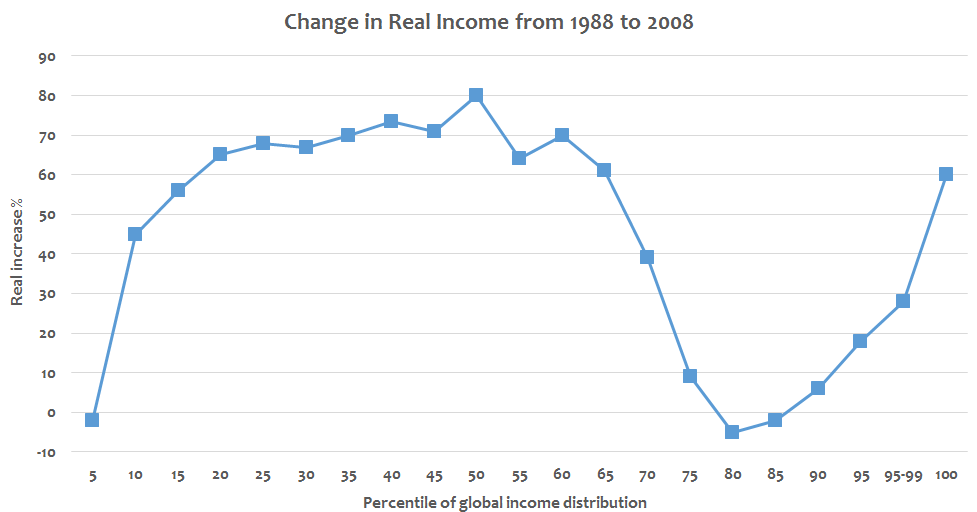
What globalization is
Globalization is the growing integration of the world's economies, cultures, and populations — the flow of goods, money, people, and ideas across borders at a scale and speed without precedent. Its economic engine is the transnational corporation, which designs a product in one country, manufactures it in a second, and sells it in a third, chasing the lowest costs across the planet. Supporters see globalization spreading prosperity; critics see it spreading exploitation. Both are partly right, and the truth is legible in a single, oddly shaped curve.
Winners, losers, and the elephant
Over the past generation something remarkable happened: extreme poverty fell faster than at any time in history, as China and India pulled hundreds of millions of people up. The gap between the average citizen of rich and poor nations narrowed. Yet within nations, inequality often widened at the same time. The economists Christoph Lakner and Branko Milanovic captured this in the famous "elephant curve": the emerging middle classes of Asia gained enormously (the elephant's rising back), and the global super-rich gained most of all (the raised trunk), while the working and middle classes of wealthy nations saw their incomes stagnate (the dip before the trunk). Globalization, in other words, did not simply raise or lower inequality — it rearranged it, creating new winners and new losers on every continent.
How the paradigms read the change
The three sociological paradigms interpret this rearrangement differently, and each catches something real. Structural functionalists, heirs to modernization theory, see globalization spreading technology and modern institutions, integrating poor nations into a productive whole. Conflict theorists, heirs to dependency theory, see a new engine of extraction: sweatshops, tax havens, and a "race to the bottom" in which corporations pit workers in different nations against one another. Symbolic interactionists zoom in on lived meaning — how a factory job reshapes a village woman's identity, how global brands rewrite what people in poor nations desire, how the very labels "developed" and "backward" frame whole populations. Add to this the digital divide — the gap between those with access to the internet and its opportunities and those without — and it is clear that globalization is not one thing happening to everyone but many things happening unevenly.
| Paradigm | How it sees global inequality | Reads globalization as |
|---|---|---|
| Structural functionalism | Nations at different stages of one shared climb | Modernization spreading — mostly a rising tide |
| Conflict theory | Exploitation of the powerless by powerful nations and firms | A new engine of extraction that widens gaps |
| Symbolic interactionism | Poverty and wealth as lived meanings and labels | A remaking of identities, desires, and consumption |
Globalization is neither savior nor villain — it is a choice about distribution. The technology that moved a factory to Bangladesh could have shared its gains with laid-off workers in Ohio, or with the women stitching shirts for a dollar a day; whether it did was a political decision, not an economic law. The elephant curve is not fate. It is the sum of choices about taxes, wages, trade rules, and rights — which means it could have been drawn, and could still be redrawn, differently.
- Globalization integrates the world's economies through trade, migration, technology, and transnational corporations.
- It narrowed inequality between nations (China, India) while often widening it within them — the "elephant curve."
- Functionalist, conflict, and interactionist paradigms each read globalization differently and each capture part of the truth.
- The digital divide is a new axis of global inequality, and distribution of globalization's gains is a political choice.
The chapter in one breath
- Global stratification ranks whole nations into high-, middle-, and low-income tiers, and the "birthplace lottery" makes country of birth the single biggest predictor of life chances.
- National wealth is measured by GNI per capita, inequality within nations by the Gini coefficient, and human well-being by the Human Development Index.
- Modernization theory (functionalist; Rostow) blames internal culture; dependency theory (conflict; Frank, Prebisch) and world-systems theory (Wallerstein) blame external exploitation and colonial history.
- Absolute poverty lacks survival basics — more than 800 million live under ~$3.00/day — and it kills children through hunger and preventable disease; relative poverty harms too.
- The feminization of poverty concentrates hardship among women through unpaid care, the wage gap, and denied land, credit, and schooling — yet investing in women yields the largest gains.
- Globalization narrowed inequality between nations while often widening it within them — the "elephant curve" of winners and losers.
- The three paradigms — functionalism, conflict, and symbolic interactionism — each illuminate a different face of global inequality.
ReferenceWords worth knowing
A quick reference for the terms in this chapter — skim it now, or circle back whenever a word trips you up.
- Absolute poverty
- Deprivation of the basic necessities for survival — food, clean water, shelter, sanitation.
- Colonialism
- The historical domination of one nation by another to extract its land, labor, and resources.
- Core nations
- In world-systems theory, the wealthy, industrialized nations at the center of the global economy.
- Dependency theory
- A conflict-based explanation holding that poor nations were made poor by exploitation from rich ones.
- Extreme poverty
- Living below the international poverty line (about $3.00 a day in 2021 purchasing-power terms; the earlier line was $2.15 in 2017 prices).
- Feminization of poverty
- The growing, disproportionate share of the world's poor made up of women and children.
- Gini coefficient
- A measure of income inequality within a nation, from 0 (perfect equality) to 1 (total concentration).
- Global North / Global South
- A shorthand contrast between wealthier (often northern) and poorer (often southern) nations.
- Global stratification
- The ranking of entire nations into layers of wealth, power, and life chances.
- Globalization
- The growing integration of the world's economies, cultures, and populations across borders.
- Gross national income (GNI) per capita
- A nation's total income divided by its population; the basis of income-tier classification.
- Human Development Index (HDI)
- A composite measure blending income, life expectancy, and education.
- Microcredit
- Small loans, often to women, to start enterprises and escape poverty; pioneered by the Grameen Bank.
- Modernization theory
- A functionalist explanation attributing poverty to internal traditional values and prescribing modern development.
- Neocolonialism
- Continued economic domination of former colonies through trade, debt, and corporations rather than direct rule.
- Peripheral nations
- In world-systems theory, poor nations exploited for cheap labor and raw materials.
- Relative poverty
- Falling well below the ordinary standard of living of one's own society.
- Rostow's stages of growth
- W. W. Rostow's five-stage model of a nation's climb from traditional society to mass consumption.
- Semi-peripheral nations
- In world-systems theory, industrializing nations between the core and the periphery.
- World-systems theory
- Wallerstein's model of a single capitalist world-economy split into core, semi-periphery, and periphery.
Check yourself
Race & Ethnicity
Ask a biologist to draw the boundary between one human race and the next and she cannot do it — there is more genetic variation inside any so-called race than between one and another. Yet race is one of the most powerful forces shaping a person's life: where they live, what they earn, how long they live, whether a traffic stop turns dangerous. Sociology holds both truths at once. Race is a social construction, an invention of human societies rather than a fact of nature — and precisely because societies treat it as real, it produces real consequences. This chapter examines how race and ethnicity are built, how prejudice hardens into discrimination, how the major paradigms explain group inequality, and the long spectrum of ways dominant and minority groups have lived together, from genocide at one end to pluralism at the other.
By the end of this chapter you can
- Explain what it means to call race a social construction and distinguish it from ethnicity.
- Define a minority group in sociological terms and explain why it is about power, not numbers.
- Distinguish prejudice, stereotypes, and discrimination, and use Merton's typology to relate attitude to action.
- Contrast individual and institutional racism.
- Apply the functionalist, conflict, and symbolic interactionist paradigms to race relations.
- Order the spectrum of intergroup relations from genocide through expulsion, segregation, assimilation, amalgamation, and pluralism.
- Describe major patterns among U.S. racial and ethnic groups, including the model minority myth and symbolic ethnicity.
- Explain intersectionality and why single-axis thinking misses how inequality is lived.
Section 1Race, ethnicity, and minority groups
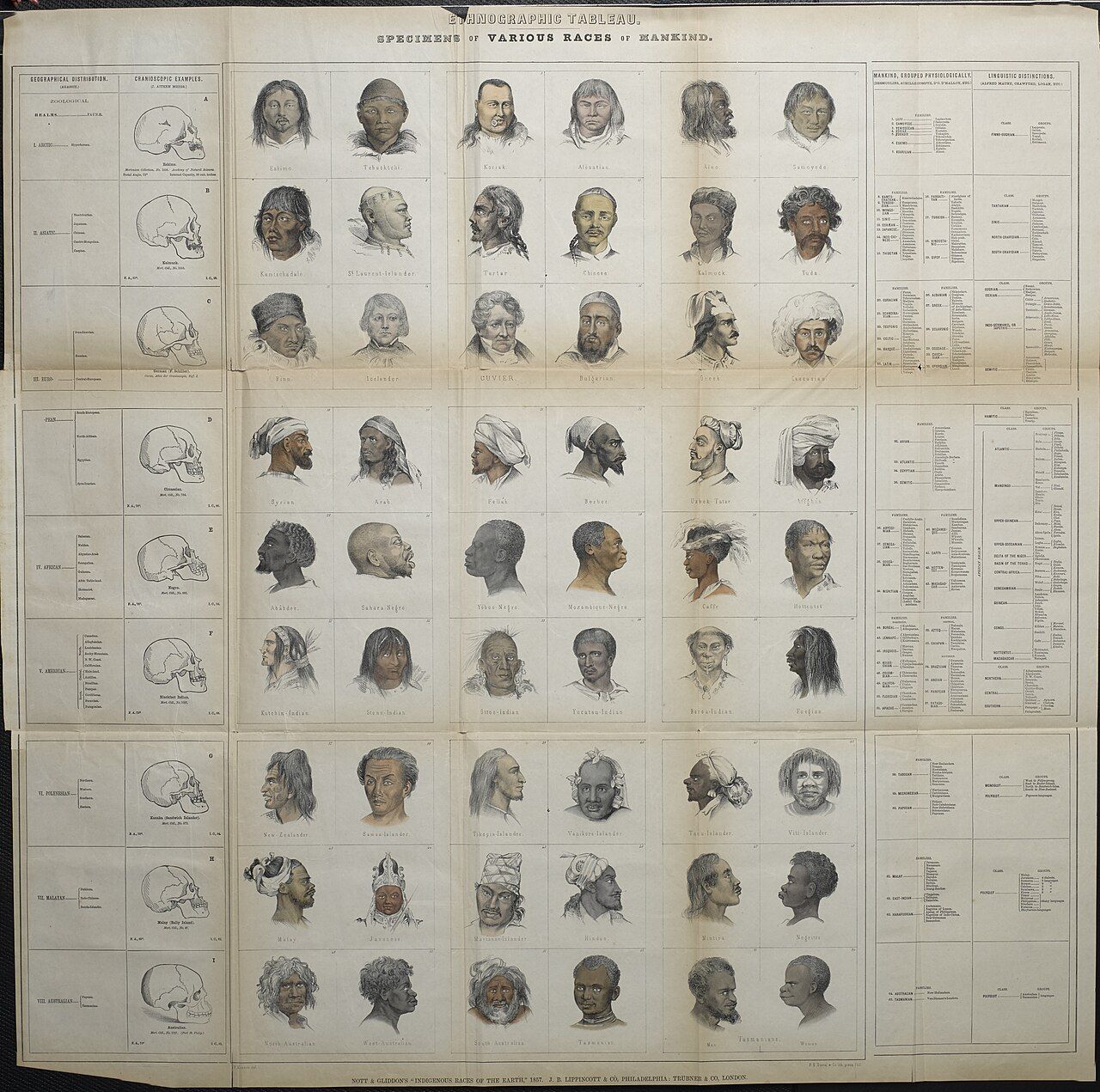
Race as a social construction
A race is a category of people who are treated as distinct because of physical characteristics — skin color, hair texture, facial features — that a society has decided to make socially significant. The key phrase is decided to make significant. Human beings vary continuously and the traits we sort by are superficial; geneticists find far more variation within any racial group than between groups, and no gene or set of genes marks the boundary of a race. Race, in other words, is a social construction: a real and consequential category, but one built by people, not discovered in nature.
Two kinds of evidence make the point. First, racial categories change across time and place. Groups treated a century ago in the United States as racially inferior and only conditionally white — the Irish, Italians, and Jews among them — saw the boundary of full “whiteness” gradually widen to include them. (They were classified as white on the census and were eligible to naturalize as “free white persons” throughout; what shifted was not their legal color but their standing within it. The naturalization cases that turned squarely on who counted as white — Ozawa and Thind in 1922–23 — were brought by Japanese and South Asian applicants, and both lost.) The U.S. Census has rewritten its own race questions in nearly every decade since 1790, adding, splitting, and deleting categories. A person classified as Black in the United States under the old “one-drop rule” might be classified as white or mixed in Brazil. If race were biological, it would not shift when you cross a border or turn a calendar page. Sociologists Michael Omi and Howard Winant call this ongoing process racial formation — the continual social and political work by which racial categories are created, inhabited, and transformed.
Ethnicity
Ethnicity refers to shared culture — language, religion, ancestry, national origin, food, and tradition — rather than perceived physical difference. Being Korean, Amish, Somali, or Italian-American is an ethnic identity. The line between race and ethnicity is not always clean (people often read culture off of appearance and vice versa), but the analytic distinction is worth holding: race is assigned largely on the basis of how a body is seen, while ethnicity is grounded in a way of life that can be practiced, emphasized, or set aside. That is why a single racial category can contain dozens of ethnicities — “Asian American” folds together Hmong, Filipino, Indian, and Japanese communities with little in common.
Minority groups
In everyday speech “minority” means smaller in number, but sociology defines it differently. Following Louis Wirth, a minority group is any group that is singled out for unequal treatment and that regards itself as an object of collective discrimination. What makes a group a minority is its lack of power, not its size. Black South Africans were the numerical majority under apartheid yet were the minority group; women are roughly half the population yet are treated as a minority in this sociological sense. The group that holds the power, prestige, and resources is the dominant group (sometimes loosely called the majority group). Minority groups typically share several features, summarized below.
| Feature of a minority group | What it means |
|---|---|
| Unequal treatment | Members have less power and receive less than their share of society's resources |
| Distinguishing traits | Physical or cultural traits the dominant group treats as marking the boundary |
| Ascribed status | Membership is usually assigned at birth, not chosen |
| Solidarity & identity | Shared experience of discrimination fosters a strong sense of group belonging |
| In-group marriage | Members tend to marry within the group, sometimes by choice, often by pressure |
- Race is a socially significant category based on perceived physical traits; it is a social construction, not a biological fact.
- Racial categories shift across time and place — evidence that society, not nature, draws the lines (racial formation).
- Ethnicity is shared culture; one racial category can hold many ethnicities.
- A minority group is defined by unequal treatment and lack of power, not by numbers.
Section 2Prejudice, discrimination, and racism
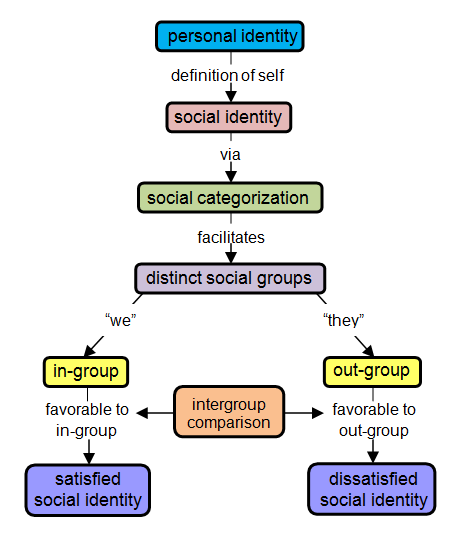
Prejudice and stereotypes
Prejudice is a prejudgment — an attitude, usually negative, held about the members of a group before you know anything about the individual in front of you. Because it lives in the head, prejudice is a matter of thought and feeling. Its raw material is the stereotype: an oversimplified, rigid generalization applied to every member of a group (“all X are lazy,” “all Y are good at math”). Stereotypes are sticky because they are cognitively cheap — they let us sort a complicated world quickly — and because they are learned early and reinforced everywhere, a saturation sociologists call the culture of prejudice. Note that a “positive” stereotype is still a stereotype: praising a group as naturally gifted still erases individuals and, as we will see, can be turned against them.
Discrimination
Where prejudice is an attitude, discrimination is an action — unequal treatment of people based on their group membership. The two often travel together, but not always, and Robert Merton mapped the four possible combinations. Someone can be prejudiced but not discriminate (a “timid bigot” held back by law or social pressure), or discriminate without being prejudiced (a “fair-weather liberal” who goes along with a discriminatory system for convenience). Recognizing that attitude and behavior can come apart matters, because it means you can reduce discrimination by changing rules and incentives even before you change hearts.
| Does not discriminate | Discriminates | |
|---|---|---|
| Not prejudiced | All-weather liberal — believes in equality and acts on it | Fair-weather liberal — goes along with discrimination for convenience |
| Prejudiced | Timid bigot — holds prejudice but is restrained by law or pressure | Active bigot — both believes in and practices unequal treatment |
Racism: individual and institutional
Racism is the belief that one race is inherently superior or inferior to another, together with the practices that flow from it. It operates at two levels. Individual racism is the prejudice and discrimination of one person against another. Institutional racism is discrimination built into the ordinary workings of a society's institutions — its banks, schools, courts, and housing markets — so that unequal outcomes are produced even when no single person intends them. The mid-century practice of redlining, in which lenders refused mortgages in Black neighborhoods, is a classic example: it locked wealth out of entire communities for generations and its effects persist in today's wealth gap. Scholars also describe colorblind racism, in which people disavow racial prejudice yet defend a status quo (“I don't see race”) that keeps existing inequalities in place.
- Prejudice is an attitude; a stereotype is its oversimplified content; discrimination is the action.
- Merton's typology shows attitude and action can come apart — you can discriminate without prejudice, or be prejudiced without discriminating.
- Individual racism is person-to-person; institutional racism is baked into how institutions operate.
- Redlining and colorblind racism show how unequal outcomes persist without overt intent.
Section 3Theories of race relations
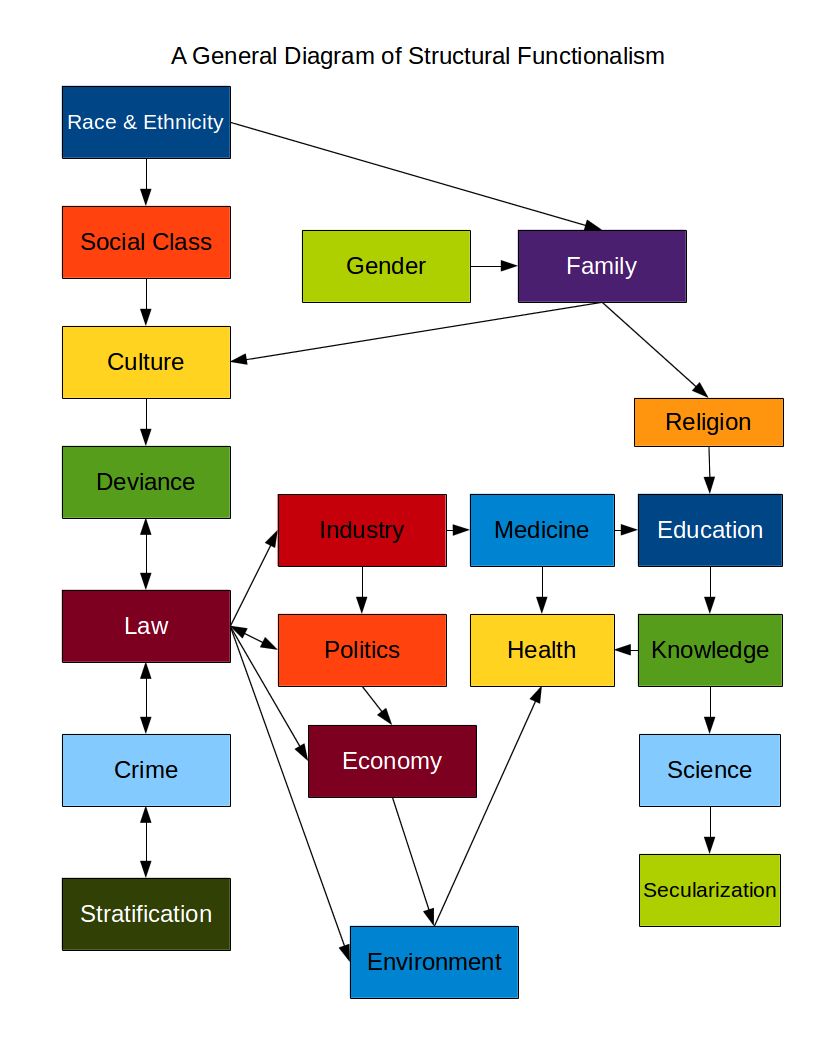
The functionalist lens
Structural functionalism asks what a social pattern does for the system as a whole. Applied to race, functionalists note that racial hierarchy, however unjust, can be functional for the dominant group: it supplies a low-wage labor pool, discourages workers from uniting across racial lines, and offers a psychological wage of superiority. But it is deeply dysfunctional for the society as a whole — it wastes the talents of excluded groups, breeds unrest, and fails Robert Merton's test of a healthy system by producing more strain than stability. In the functionalist reading, sustained discrimination is a form of social pathology that a well-integrated society will be pressured, over time, to resolve.
The conflict lens
Conflict theory, descended from Karl Marx, sees race relations as an arena of struggle over scarce resources and power. Racial divisions, in this view, are not accidents but tools: a dominant group uses them to justify exploitation and to keep subordinate groups — and potential rival workers — divided. The split labor market and scapegoat theories both belong here: elites benefit when a cheaper racialized workforce undercuts others, and dominant-group members frustrated by their own conditions are steered to blame a visible minority rather than the powerful. The pioneering sociologist W. E. B. Du Bois, whose concept of double consciousness named the split awareness of being both an American and a member of a despised group, anticipated much of this tradition; its contemporary heir is critical race theory.
The interactionist lens
Symbolic interactionism works at the level of everyday encounters and the meanings people attach to them. Race, for interactionists, is continually produced in interaction — in the labels we apply, the scripts we follow, and the way, as Charles Horton Cooley described with the looking-glass self, we come to see ourselves through others' eyes. This lens illuminates how children learn racial categories, how a stereotype can become a self-fulfilling prophecy, and how the role-taking George Herbert Mead described and the impression management Erving Goffman studied shape cross-racial encounters. It also grounds Gordon Allport's contact hypothesis: under the right conditions — equal status, common goals, cooperation, and institutional support — sustained contact between groups can erode prejudice.
| Paradigm | Level | How it explains race relations | Key idea |
|---|---|---|---|
| Functionalism | Macro | Racial hierarchy persists because it serves functions for the dominant group, but is dysfunctional for society as a whole | Function & dysfunction |
| Conflict theory | Macro | Dominant groups create and use race to control resources and divide workers; inequality is exploitation, not accident | Power & exploitation |
| Symbolic interactionism | Micro | Race is built and maintained in everyday interaction, labels, and self-concept; contact can reshape it | Meaning & interaction |
- Functionalism asks what racial hierarchy does for the system — functional for the dominant group, dysfunctional for society.
- Conflict theory (after Marx) treats race as a tool of exploitation and division; Du Bois and critical race theory extend it.
- Symbolic interactionism (drawing on Cooley, Mead, Goffman) shows race as produced in interaction; the contact hypothesis points to how prejudice can fall.
Section 4Intergroup relations: genocide to pluralism
A spectrum, not a switch
How dominant and minority groups live together is not a single condition but a range, running from the total destruction of a group at one end to genuine mutual respect at the other. Laying the possibilities on a spectrum makes the moral stakes visible and helps you locate any real society on the map.
| Pattern | What happens | Example |
|---|---|---|
| Genocide | Deliberate, systematic annihilation of a group | The Holocaust; Rwanda (1994); the Armenian genocide |
| Expulsion / population transfer | A group is forced to leave a territory | The Trail of Tears; forced relocation of Japanese Americans, 1942 |
| Segregation | Groups kept physically and socially separate | Jim Crow laws (de jure); today's residential segregation (de facto) |
| Assimilation | Minority absorbs the dominant culture, shedding its own | Pressure on immigrants to drop language and custom |
| Amalgamation | Groups blend into a new mixture (the “melting pot”) | Intermarriage producing a shared, mixed culture |
| Pluralism | Groups retain their cultures while sharing equally in society | The “salad bowl” ideal of multiculturalism |
The destructive end
Genocide — the deliberate extermination of a people — is the extreme case, and history offers too many: the Holocaust, the 1994 Rwandan genocide, the Armenian genocide, and the destruction of Indigenous peoples during colonization. Just short of it lies expulsion or population transfer, the forced removal of a group from its land, as in the Cherokee Trail of Tears or the wartime incarceration of Japanese Americans. Segregation keeps groups apart without removing them; it can be de jure (mandated by law, as under Jim Crow and apartheid) or de facto (produced in fact by housing, schooling, and income patterns even after the laws are gone).
The integrative end
Assimilation is the process by which a minority takes on the traits of the dominant culture — language, dress, values — often shedding its own along the way. The old “melting pot” image celebrated this, but assimilation is rarely neutral: it is usually the minority that is expected to change, and the price is frequently the loss of a heritage. Amalgamation goes further, blending groups through intermarriage into something genuinely new. Pluralism is the opposite of assimilation's demand: groups keep their distinct cultures and participate as equals, the “salad bowl” in which ingredients mix without dissolving. Switzerland's coexisting language communities are a frequently cited approximation, though no society reaches the ideal cleanly.
- Intergroup relations form a spectrum from genocide and expulsion through segregation to assimilation, amalgamation, and pluralism.
- Segregation may be de jure (by law) or de facto (in practice) — the second survives the first.
- Assimilation usually demands that the minority change; pluralism lets groups remain distinct while sharing equally.
Section 5Patterns among racial and ethnic groups
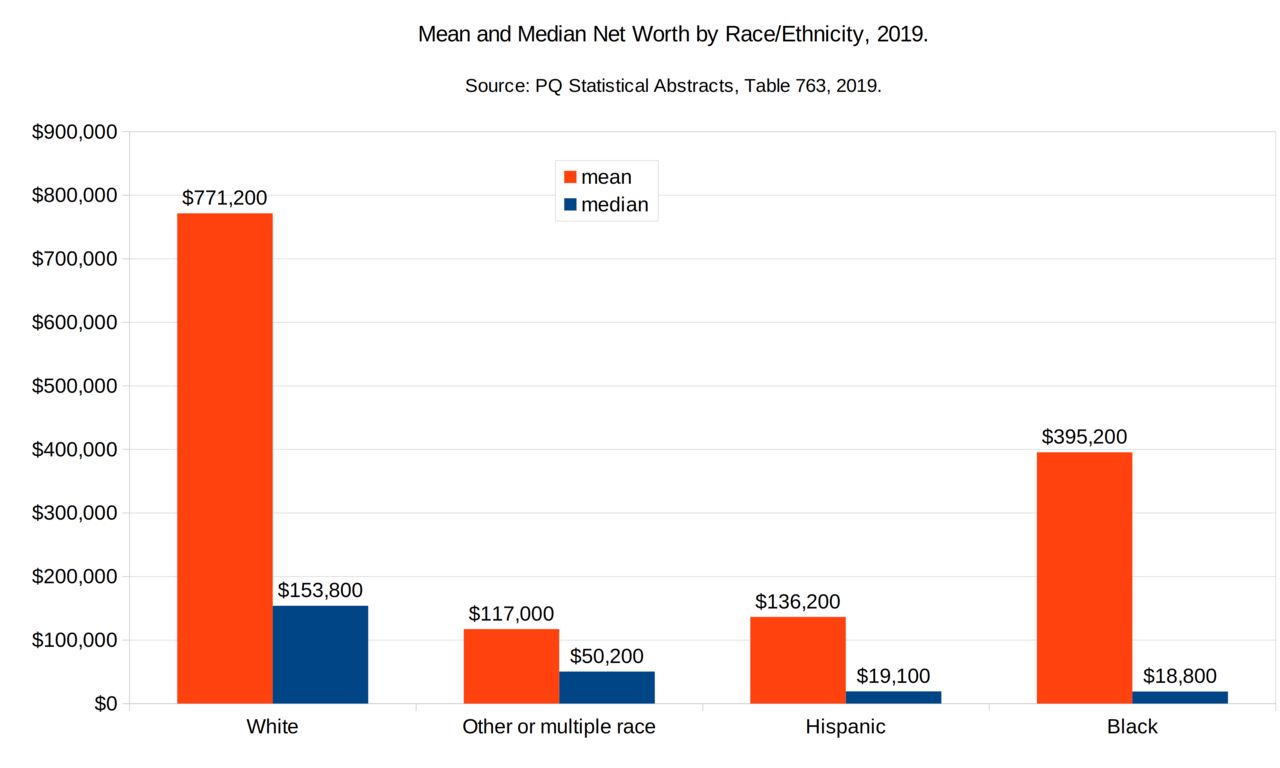
Different histories, patterned outcomes
Each major U.S. racial and ethnic group carries a distinct history, and those histories leave measurable patterns. African Americans, whose ancestors were enslaved and then subjected to a century of Jim Crow, moved north in the Great Migration and won formal equality through the civil rights movement, yet still face the nation's widest wealth gap and disproportionate contact with the criminal-justice system. Native Americans survived genocide, forced removal, and coerced assimilation in boarding schools, and now contend with the poverty and health disparities concentrated on many reservations. Hispanic and Latino Americans — the country's largest minority — are an ethnic category spanning every race and many national origins, from Mexican to Cuban to Salvadoran. Asian Americans are equally diverse, from Hmong refugees to Indian engineers, a range the aggregate statistics obscure.
The model minority myth — and its mirror image
The model minority myth casts Asian Americans as uniformly successful, hard-working, and problem-free. It is a stereotype in flattering dress, and it does real harm: it erases the poverty within many Asian communities, denies individuals their individuality, and — most insidiously — is wielded as a wedge, holding up one group to imply that other minorities have only themselves to blame. At the other end, Herbert Gans described symbolic ethnicity among later-generation white ethnics — an Irish-American or Italian-American identity worn lightly on holidays, real enough to celebrate but costless to set aside. The contrast is the point: a white ethnic can choose when ethnicity is relevant, while a racial minority is rarely granted that option.
Inequality is intersectional
The wealth gap in the figure above is only one thread. Racial disparities run through income, health, life expectancy, schooling, and incarceration, and they compound rather than sit in isolation. The legal scholar Kimberlé Crenshaw named this intersectionality: a person stands at the crossing of race, class, gender, and other statuses at once, so that a Black woman's experience is not simply “race plus gender” but a distinct position that single-axis analysis misses. To understand any group's outcomes, sociologists insist, you have to see the whole intersection, not one street at a time.
| Group | Historical experience | Sociological pattern |
|---|---|---|
| African Americans | Slavery, Jim Crow, Great Migration, civil rights movement | Widest wealth gap; disproportionate incarceration |
| Native Americans | Genocide, forced removal, boarding-school assimilation | Concentrated poverty; health disparities |
| Hispanic / Latino Americans | Conquest, immigration from many nations | Largest minority; a pan-ethnic, multiracial category |
| Asian Americans | Exclusion laws, internment, later skilled migration | Burdened by the model minority myth that hides diversity |
| White ethnics | European immigration, gradual “whitening” | Symbolic ethnicity — identity that can be chosen or shelved |
- Each U.S. racial and ethnic group carries a distinct history that shows up as measurable patterns in wealth, health, and incarceration.
- The model minority myth is a harmful stereotype that hides diversity and is used against other groups.
- Symbolic ethnicity (Gans) is an optional identity available to white ethnics but rarely to racial minorities.
- Intersectionality (Crenshaw) shows that race, class, and gender compound; single-axis analysis misses lived inequality.
The chapter in one breath
- Race is a social construction based on perceived physical traits; ethnicity is shared culture; both are drawn by societies, not nature.
- A minority group is defined by unequal treatment and lack of power, not by numbers; the dominant group holds the resources.
- Prejudice is an attitude and discrimination is an action; Merton's typology shows the two can come apart.
- Racism operates individually and, more durably, institutionally — as in redlining and colorblind racism.
- The three paradigms read race as function/dysfunction (functionalism), power and exploitation (conflict, after Marx and Du Bois), and meaning built in interaction (interactionism, after Cooley, Mead, and Goffman).
- Intergroup relations run a spectrum from genocide and expulsion through segregation to assimilation, amalgamation, and pluralism.
- U.S. groups carry distinct histories that produce patterned inequality; the model minority myth and symbolic ethnicity illustrate how race and ethnicity work differently.
- Intersectionality insists that race, class, and gender be understood together, not one axis at a time.
ReferenceWords worth knowing
A quick reference for the terms in this chapter — skim it now, or circle back whenever a word trips you up.
- Amalgamation
- The blending of two or more groups into a new, mixed culture and population, often through intermarriage — the “melting pot.”
- Assimilation
- The process by which a minority group takes on the culture of the dominant group, frequently shedding its own.
- Colorblind racism
- Disavowing racial prejudice while defending a status quo (“I don't see race”) that keeps existing inequalities in place.
- Contact hypothesis
- Gordon Allport's idea that, under conditions of equal status and cooperation, sustained contact between groups reduces prejudice.
- Discrimination
- Unequal treatment (action) of people based on their group membership.
- Dominant group
- The group that holds the most power, prestige, and resources; sometimes loosely called the majority group.
- Ethnicity
- Shared culture — language, religion, ancestry, and tradition — rather than perceived physical difference.
- Expulsion
- The forced removal of a group from a territory; population transfer.
- Genocide
- The deliberate, systematic annihilation of a racial, ethnic, or national group.
- Institutional racism
- Discrimination embedded in the ordinary workings of institutions, producing unequal outcomes even without individual intent.
- Intersectionality
- Kimberlé Crenshaw's concept that race, class, gender, and other statuses cross and compound in a person's life.
- Minority group
- A group singled out for unequal treatment that sees itself as an object of collective discrimination; defined by power, not numbers.
- Model minority
- A stereotype casting a group (often Asian Americans) as uniformly successful; it hides diversity and is used against other groups.
- Pluralism
- An arrangement in which groups keep their distinct cultures while sharing equally in society — the “salad bowl.”
- Prejudice
- A prejudgment — an attitude (usually negative) held about members of a group.
- Race
- A socially constructed category treating people as distinct on the basis of perceived, socially significant physical traits.
- Racial formation
- Omi and Winant's term for the ongoing social and political process that creates and transforms racial categories.
- Racism
- The belief that one race is inherently superior or inferior, together with the practices that follow from it.
- Scapegoat theory
- The idea that a dominant group frustrated in its goals redirects aggression onto a relatively powerless minority.
- Segregation
- The physical and social separation of groups; de jure when required by law, de facto when produced in practice.
- Stereotype
- An oversimplified, rigid generalization applied to all members of a group.
- Symbolic ethnicity
- Herbert Gans's term for an ethnic identity worn lightly and optionally, typical of later-generation white ethnics.
Check yourself
Gender & Sexuality
A form asks your “gender” when it really wants to know your sex — and in that small slip lives one of sociology’s biggest ideas. Your body is biological, but almost everything a society expects of that body — how you dress, who you love, what work you do, whether you cry — is learned, taught, and enforced. This chapter separates sex from gender, follows gender as it is drilled into us from the gender-reveal party onward, measures the stubborn gaps in pay and power that gender still produces, and turns the three great sociological paradigms loose on both gender and sexuality. By the end you will see that the most “natural” feeling categories in your life are also among the most socially built.
By the end of this chapter you can
- Distinguish sex from gender and explain what it means to call gender a social construction.
- Describe how gender is learned through the agents of socialization.
- Explain gender stratification in work, pay, and power using terms like the pay gap, occupational segregation, and the glass ceiling.
- Apply the functionalist, conflict, and symbolic-interactionist paradigms to gender.
- Summarize what feminist theory adds to the study of gender.
- Define sexual orientation and describe it as a continuum rather than a strict binary.
- Explain how sexual attitudes and social views of sexuality vary across cultures and change over time.
- Name the theorists behind each idea — Mead, Durkheim, Marx, Engels, Parsons, Cooley, Goffman — and place them correctly.
Section 1Sex and gender
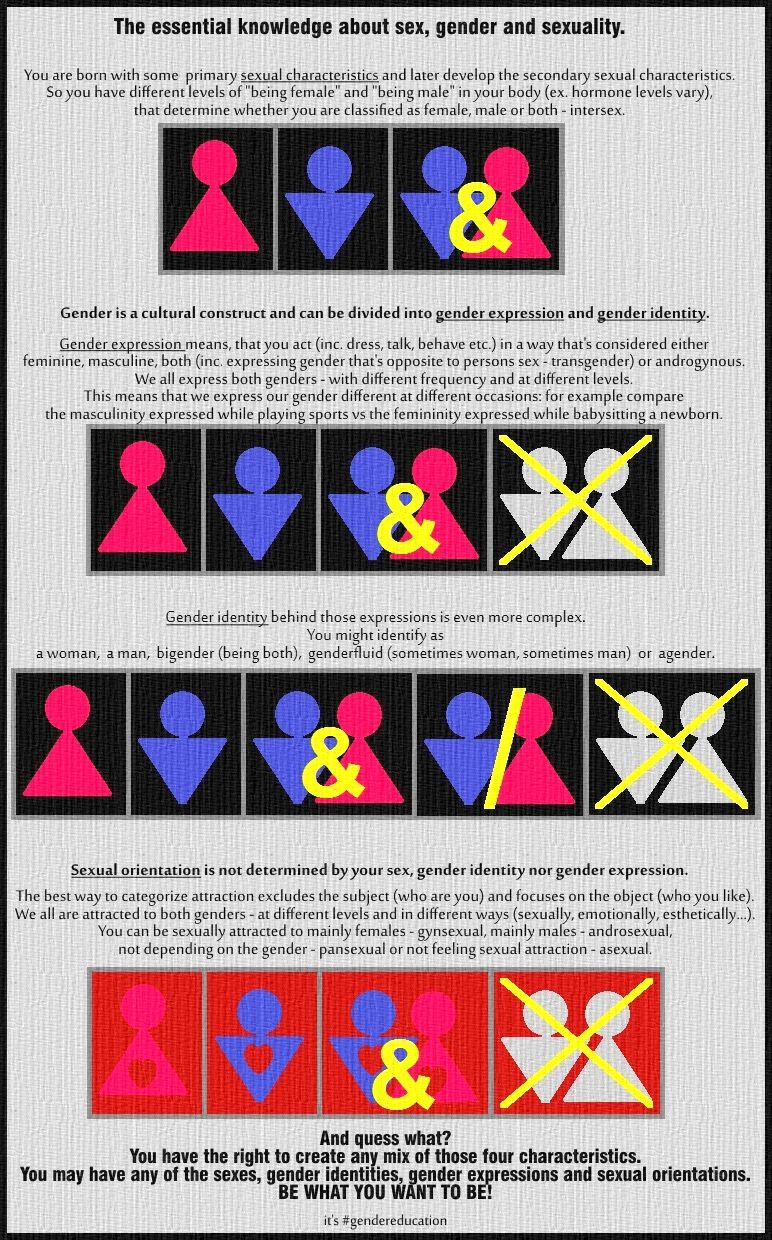
The distinction that starts it all
Everyday speech treats sex and gender as the same word. Sociologists insist on splitting them, because the split is where the whole discipline earns its keep. Sex is biological: the chromosomes (typically XX or XY), hormones, gonads, and anatomy a person is born with. Some people are intersex, born with reproductive or sexual anatomy that doesn’t fit the neat male/female boxes — a first hint that even biology is less tidy than we assume.
Gender, by contrast, is social and cultural: the roles, behaviors, expectations, and meanings a society layers on top of sex. “Masculine” and “feminine” are gender words, not sex words. Two further terms sharpen the picture. Gender identity is a person’s internal sense of their own gender — when it matches the sex assigned at birth we say cisgender, and when it differs, transgender. Gender expression is the outward presentation — clothing, voice, mannerisms — through which we signal gender to others.
Gender as a social construction
Here is the sociological punchline: if gender simply followed from biology, it would look the same in every society. It does not. What counts as manly in one culture is womanly in another. The anthropologist Margaret Mead, in her classic 1935 study of three New Guinea peoples, found the gentle Arapesh raising both sexes to be nurturing, the fierce Mundugumor raising both to be aggressive, and the Tchambuli reversing Western expectations — women were the brisk, practical providers and men the vain, emotional decorators. Temperaments we call “masculine” or “feminine,” she argued, are culturally patterned, not fixed by nature.
Cultures disagree even about how many genders there are. The hijra of South Asia, the Two-Spirit roles recognized by some Native American nations, and the muxe of Zapotec Mexico are long-standing third-gender categories. To say gender is socially constructed is to say it is built and maintained by human societies rather than dictated by chromosomes. Sociologists Candace West and Don Zimmerman captured this in the phrase “doing gender”: gender is less something you are than something you continually do, and are held accountable for doing, in everyday interaction.
| Sex | Gender | |
|---|---|---|
| Basis | Biology | Society & culture |
| Given by | Chromosomes, hormones, anatomy | Socialization, norms, interaction |
| Categories | Male, female, intersex | Man, woman, and others — varies by culture |
| Same everywhere? | Largely yes | No — differs widely across time and place |
| Example | XY chromosomes | The expectation that “men don’t cry” |
- Sex is biological (chromosomes, hormones, anatomy); gender is the social meaning built on top of it.
- Gender identity is one’s inner sense of gender (cisgender or transgender); gender expression is the outward presentation.
- Because gender varies across cultures — Mead’s New Guinea peoples, third-gender roles — it is a social construction, not a biological given.
- West and Zimmerman’s “doing gender” frames gender as an ongoing performance.
Section 2Gender socialization

The agents that teach gender
No baby is born preferring trucks to dolls. Gender socialization is the lifelong process by which we learn our society’s gender norms and come to experience them as our own preferences. It starts before birth — the gender-reveal party is a socialization ritual — and it never entirely stops. Sociologists trace the teaching to a familiar set of agents of socialization: the family, peers, schools, the mass media, and religion.
The family is first and most powerful. Three classic studies, often blurred together, show how early the labelling begins. Rubin, Provenzano, and Luria (1974) asked parents to describe their own newborns within a day of birth: daughters came out “delicate” and fine-featured, sons “strong” and better coordinated — though the babies did not differ in size or condition. Condry and Condry (1976) showed adults a videotape of one infant reacting to a jack-in-the-box; viewers told the baby was a boy read the reaction as “anger,” those told it was a girl read the same footage as “fear.” And in the “Baby X” experiments (Seavey, Katz, and Zalk, 1975), adults handed an infant in a gender-neutral outfit reached for a doll or a football depending on the label they had been given — description turning into treatment. Parents dress, name, praise, and assign chores along gender lines. Peers then police the boundaries (“that’s a girl toy”), schools deliver a hidden curriculum in which teachers call on boys more and steer students toward gendered subjects, media supply a steady stream of stereotyped heroes and helpers, and religion assigns gendered roles in doctrine and ritual.
The looking-glass self, gendered
How does an outside expectation become an inside identity? Two founders of American sociology give the answer. Charles Horton Cooley called the self a looking-glass self: we build our self-image out of how we imagine others see us. A girl told again and again that she is “so pretty” and a boy told he is “so strong” assemble gendered selves from those reflections. George Herbert Mead added that children learn by taking the role of the other in play — trying on the mother, the doctor, the soldier — and absorbing the gender scripts attached to each. Reward and punishment (social sanctions), imitation of role models, and the very structure of language do the rest.
| Agent | How it teaches gender | Everyday example |
|---|---|---|
| Family | Differential treatment, chores, modeling | Pink vs. blue; daughters assigned the dishes |
| Peers | Policing, inclusion and exclusion | “Boys don’t play with dolls” |
| Schools | Hidden curriculum, tracking | Boys nudged toward math and science |
| Media | Representation, repeated stereotypes | The rescuing hero, the rescued damsel |
| Religion | Doctrine and assigned ritual roles | Gender-restricted leadership |
- Gender socialization is the lifelong learning of gender norms, delivered by the agents of socialization.
- The family is the earliest and strongest agent; peers, schools (hidden curriculum), media, and religion reinforce it.
- Cooley’s looking-glass self and Mead’s role-taking explain how outside expectations become inner identity.
- Because the lessons feel like personal preference, they are easy to mistake for “human nature.”
Section 3Gender stratification
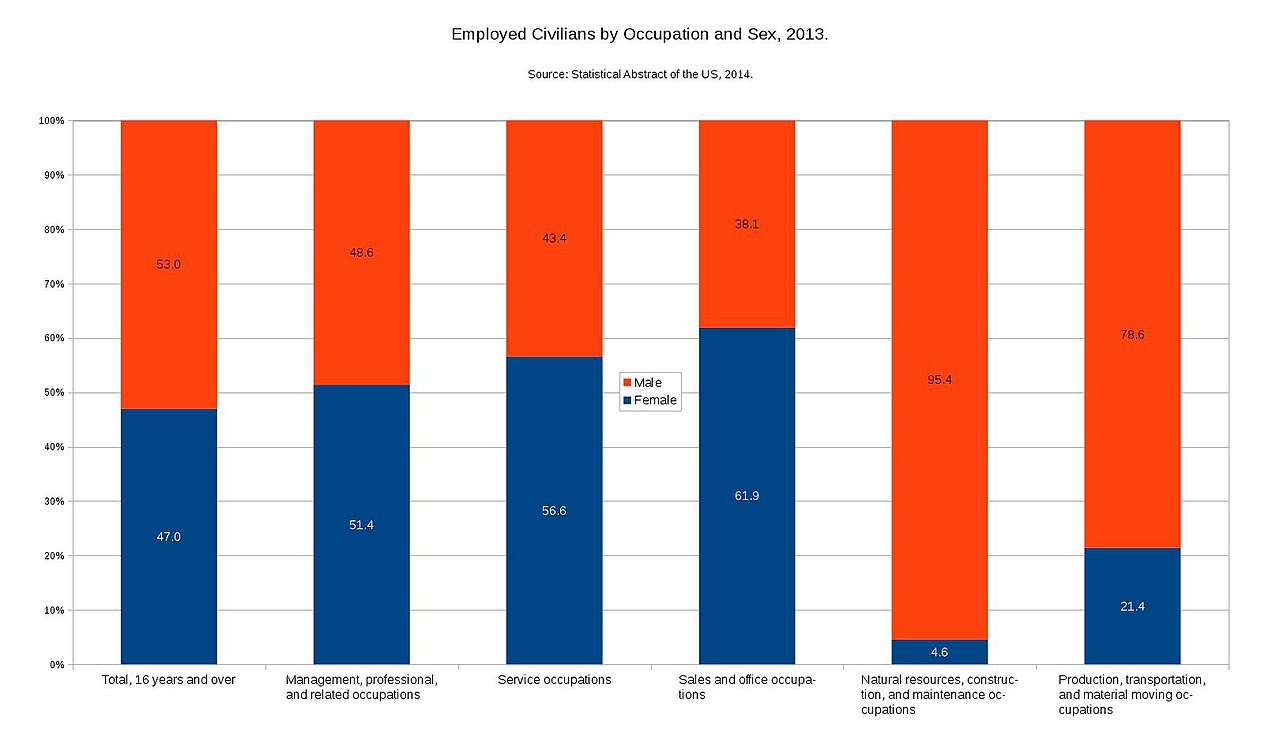
Work and the pay gap
Gender stratification is the unequal distribution of wealth, power, and privilege between men and women. Its most measured face is the gender pay gap: in the United States, women working full-time earn roughly 82 to 84 cents for every dollar earned by men, and the gap is wider for Black and Latina women. Part of the gap comes from occupational segregation. Horizontally, women are concentrated in lower-paid “pink-collar” fields — nursing, teaching, clerical work, caregiving — while men dominate higher-paid trades and management. Vertically, women who enter a field often hit the glass ceiling, an invisible barrier to the top. The mirror image is the glass escalator: men who enter female-dominated fields tend to ride upward into supervisory posts faster than their women colleagues.
Power, politics, and the double burden
Beyond the paycheck, gender stratification shows up in power. Women remain underrepresented in legislatures, corporate boards, and executive suites almost everywhere. Sociologists name the underlying system patriarchy — a social order in which men hold disproportionate authority. At home the inequality continues: Arlie Hochschild called it the second shift, the disproportionate share of housework and childcare that employed women perform after the paid workday ends. Globally, the feminization of poverty describes how women — especially single mothers and elderly women — are overrepresented among the poor.
Why does the gap persist? Two explanations compete. The human-capital account points to differences in experience, hours, and field choice. The discrimination account notes that even after those factors are controlled, a stubborn unexplained residual remains — and audit studies, in which identical résumés with male and female names draw different callbacks, keep exposing bias directly. Most sociologists conclude that both forces are at work, with discrimination doing more than the market likes to admit.
| Dimension | Sociological term | What it means |
|---|---|---|
| Kinds of jobs | Occupational segregation | Women and men cluster in different fields |
| Earnings | Gender pay gap | Women earn less per dollar than men |
| Advancement | Glass ceiling / glass escalator | Invisible barrier for women; fast track for men |
| Home | Second shift | Women’s unpaid domestic “double day” |
| Wealth | Feminization of poverty | Women overrepresented among the poor |
| Authority | Patriarchy | Men’s disproportionate social power |
- Gender stratification is the unequal distribution of wealth, power, and privilege by gender.
- The pay gap reflects occupational segregation, the glass ceiling, and outright discrimination — not choices alone.
- The second shift and the feminization of poverty extend inequality into the home and across the globe.
- Patriarchy names the system of men’s disproportionate power.
Section 4Theories of gender
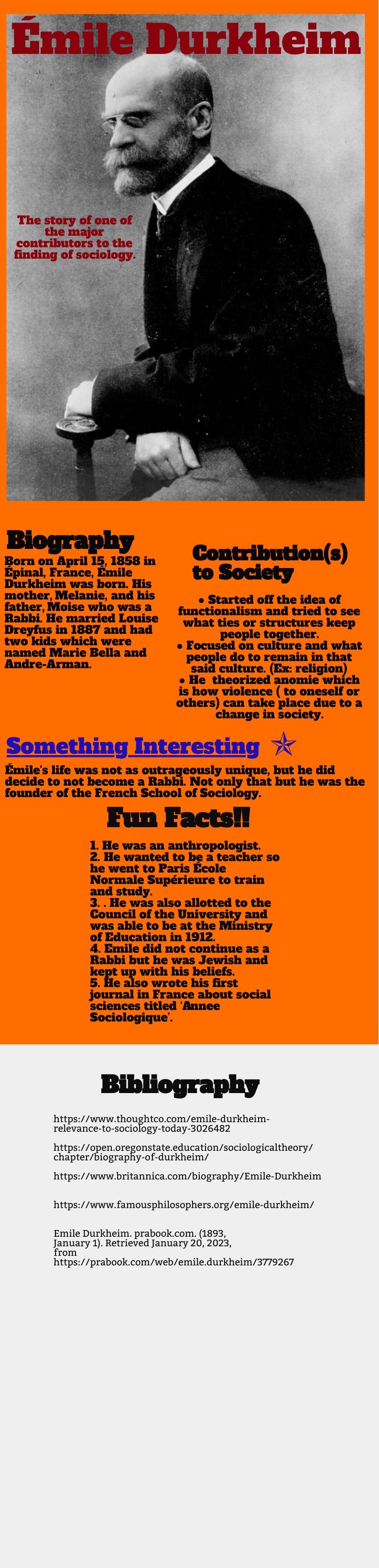
The functionalist view
Recall that functionalism, in the tradition of Comte and Durkheim, sees society as a system of interlocking parts that each serve a purpose. Applied to gender, Talcott Parsons and Robert Bales argued that the mid-century nuclear family ran smoothly because adults specialized: men filled instrumental roles (breadwinning, leadership, task focus) and women filled expressive roles (nurturing, emotional support, holding the family together). The two sets of roles were meant to be complementary, echoing Durkheim’s claim that a division of labor breeds social solidarity. The obvious critique — pressed hard by everyone who came after — is that this account mistakes one era’s middle-class arrangement for a universal law, and quietly justifies the inequality it describes.
The conflict view
Where functionalists see harmony, conflict theory sees a power struggle. Building on Marx, Friedrich Engels argued in The Origin of the Family, Private Property and the State that women’s subordination arose with private property: once men had wealth to pass on, they controlled women’s labor and sexuality to secure legitimate heirs. In this lens men are the dominant group and women the subordinate one, and patriarchy delivers men real material advantages — cheaper labor, unpaid care, social authority. Feminist theory extends the conflict frame; its slogan “the personal is political” insists that private inequalities are structured by public power.
The interactionist view
Symbolic interactionism zooms from society down to the sidewalk. Gender, in this view, is produced and reproduced in face-to-face encounters. West and Zimmerman’s “doing gender” belongs here: masculinity and femininity are ongoing accomplishments, not fixed traits. Erving Goffman, in Gender Advertisements, dissected the tiny rituals of gender display — who reaches for the door, whose body is posed as submissive in an ad — through which we broadcast gender. Cooley and George Herbert Mead supply the foundation: the self is social, assembled from interaction. The critique is the mirror of functionalism’s — brilliant on the how of daily life, weaker on the vast structures that frame it.
| Functionalism | Conflict theory | Symbolic interactionism | |
|---|---|---|---|
| Level of analysis | Macro | Macro | Micro |
| View of gender | Complementary roles that stabilize society | A system of inequality that benefits men | An identity performed in interaction |
| Key thinkers | Parsons & Bales; Durkheim | Engels, Marx, feminists | West & Zimmerman, Goffman, Mead |
| Guiding question | What function do gender roles serve? | Who benefits from gender inequality? | How is gender created in everyday life? |
| Main critique | Excuses inequality; ignores change | Underplays cooperation and agency | Neglects large-scale structures |
- Functionalists (Parsons & Bales, after Durkheim) see complementary instrumental and expressive roles — and are criticized for excusing inequality.
- Conflict theorists (Engels, after Marx; feminists) see gender as a power system that benefits men.
- Interactionists (West & Zimmerman, Goffman, Mead) see gender done in everyday encounters.
- Feminist theory is a family of lenses — liberal, socialist, radical — not one position.
Section 5Sexuality
Sexual attitudes and scripts
Sexuality — sexual attitudes, desires, and practices — feels intensely private, yet sociology shows it is thoroughly social. Every society supplies sexual scripts: culturally provided guidelines for who may do what, with whom, and when. Societies range from restrictive, permitting sex only within marriage and for reproduction, to permissive. Ira Reiss mapped how standards for premarital sex differ, and the historical trend in many countries is unmistakable: acceptance of premarital sex, cohabitation, and same-sex relationships has risen sharply across recent generations. What a society calls scandalous is a moving target, which is exactly why sociologists treat sexual morality as data rather than as a fixed fact.
Sexual orientation as a continuum
Sexual orientation is an enduring pattern of romantic or sexual attraction — heterosexual, homosexual (gay or lesbian), bisexual, or asexual. It is distinct from gender identity: whom you are attracted to is a different question from who you are. Alfred Kinsey’s mid-twentieth-century surveys reframed orientation with the Kinsey scale, a 0-to-6 continuum from exclusively heterosexual to exclusively homosexual. His central sociological point still holds: orientation is better modeled as a spectrum than as a strict either/or, and same-sex attraction and experience are far more common than public talk admitted.
Changing social views
Societies do not merely have orientations — they rank them. Heteronormativity is the built-in assumption that heterosexuality is the natural default; heterosexism and homophobia are the prejudice and hostility that stigmatize sexual minorities. Yet the social views themselves shift, sometimes fast. The American Psychiatric Association removed homosexuality from its list of mental disorders in 1973, and in 2015 the U.S. Supreme Court legalized same-sex marriage nationwide in Obergefell v. Hodges. Queer theory pushes further, questioning whether fixed sexual categories should be taken for granted at all. The three paradigms each take a turn: functionalists note that sexual norms channel reproduction and stabilize family life; conflict and feminist theorists ask who controls sexuality and expose the sexual double standard; interactionists study how meanings like “virginity” or “coming out” are socially constructed.
| Term | Meaning |
|---|---|
| Heterosexual | Attraction to a different sex or gender |
| Homosexual (gay/lesbian) | Attraction to the same sex or gender |
| Bisexual | Attraction to more than one sex or gender |
| Asexual | Little or no sexual attraction to others |
| Kinsey scale | A 0–6 continuum from exclusively hetero- to exclusively homosexual |
| Heteronormativity | The assumption that heterosexuality is the default |
- Sexuality is governed by cultural sexual scripts that range from restrictive to permissive and shift over time.
- Sexual orientation — hetero-, homo-, bi-, asexual — is a continuum (the Kinsey scale), distinct from gender identity.
- Heteronormativity, heterosexism, and homophobia stigmatize sexual minorities, but social views change (APA 1973; Obergefell 2015).
- Each paradigm reads sexuality differently — function, power, or everyday meaning.
The chapter in one breath
- Sex is biological; gender is the social meaning built on top of it, and because it varies across cultures it is a social construction.
- Gender socialization teaches those meanings through family, peers, schools, media, and religion, turning outside expectations into inner identity (Cooley, Mead).
- Gender stratification shows up as the pay gap, occupational segregation, the glass ceiling, the second shift, and patriarchy.
- Functionalists see complementary roles, conflict theorists see male power, interactionists see gender “done” in interaction.
- Feminist theory — liberal, socialist, radical — extends the conflict lens to insist the personal is political.
- Sexuality is guided by cultural sexual scripts; sexual orientation is a continuum (the Kinsey scale).
- Social views of sexuality — heteronormativity, homophobia — are real but changeable (APA 1973; Obergefell 2015).
ReferenceWords worth knowing
A quick reference for the terms in this chapter — skim it now, or circle back whenever a word trips you up.
- Asexual
- Experiencing little or no sexual attraction to others.
- Cisgender
- Having a gender identity that matches the sex assigned at birth.
- Conflict theory (of gender)
- The view that gender is a system of inequality that gives men power and advantage over women.
- Doing gender
- West and Zimmerman’s idea that gender is an ongoing performance accomplished in interaction, not a fixed trait.
- Expressive role
- In Parsons’s functionalism, the nurturing, emotional, cohesion-building role historically assigned to women.
- Feminist theory
- A family of perspectives (liberal, socialist, radical) analyzing and challenging gender inequality.
- Feminization of poverty
- The overrepresentation of women, especially single mothers and the elderly, among the poor.
- Gender
- The social and cultural roles, expectations, and meanings attached to being male or female.
- Gender identity
- A person’s internal sense of their own gender.
- Gender socialization
- The lifelong process of learning and internalizing a society’s gender norms.
- Gender stratification
- The unequal distribution of wealth, power, and privilege between men and women.
- Glass ceiling
- An invisible barrier that keeps women (and minorities) from reaching top positions.
- Heteronormativity
- The assumption that heterosexuality is the natural or default orientation.
- Instrumental role
- In Parsons’s functionalism, the breadwinning, task-focused, leadership role historically assigned to men.
- Intersex
- Born with sexual or reproductive anatomy that does not fit typical male or female definitions.
- Kinsey scale
- A 0–6 continuum representing sexual orientation from exclusively heterosexual to exclusively homosexual.
- Occupational segregation
- The concentration of women and men in different kinds of jobs.
- Patriarchy
- A social system in which men hold disproportionate power and authority.
- Sex
- The biological traits — chromosomes, hormones, anatomy — that distinguish males, females, and intersex people.
- Sexual orientation
- An enduring pattern of romantic or sexual attraction (heterosexual, homosexual, bisexual, asexual).
- Sexual script
- Culturally provided guidelines for sexual behavior — who does what, with whom, and when.
- Social construction of gender
- The idea that gender is built and maintained by society rather than dictated by biology.
- Transgender
- Having a gender identity that differs from the sex assigned at birth.
Check yourself
Marriage & Family
Family is the most personal institution you will ever belong to — and the most sociological. It feels like the private opposite of “society,” yet almost nothing about it is truly private: who counts as kin, who may marry whom, who does the dishes, and what happens when a marriage ends are all shaped by law, economy, religion, and custom. Every known human society organizes reproduction, child-rearing, and intimacy through some form of family, but the forms vary enormously across cultures and are changing quickly in our own. This chapter defines the family sociologically, examines marriage and mate selection, applies the three major theoretical paradigms, and looks squarely at divorce, violence, and the striking transformation of family life now underway.
By the end of this chapter you can
- Define family sociologically and distinguish it from a household.
- Identify major family forms and distinguish family of orientation from family of procreation, and nuclear from extended families.
- Describe patterns of marriage, descent, residence, and authority across societies.
- Explain cohabitation and the sociology of mate selection — endogamy, exogamy, homogamy, and propinquity.
- Apply the functionalist, conflict, and symbolic interactionist perspectives to family life.
- Analyze divorce, remarriage and blended families, and family violence as social patterns, not just private troubles.
- Describe how family life is changing — single-parent, same-sex, cohabiting, and multigenerational households — and why the family endures.
Section 1What is a family?
Family versus household
In everyday speech “family” and “household” blur together, but sociologists keep them apart because they answer different questions. A family is a socially recognized group — usually joined by blood, marriage, cohabitation, or adoption — whose members form an emotional bond and typically function as an economic unit. A household, by contrast, is simply all the people who occupy a single housing unit, whether or not they are related: three unrelated roommates are a household but not a family, while your grandmother across town is family but not part of your household. Governments count households because they are easy to see; sociologists study families because they are where so much social life actually happens.
Notice that the definition rests on social recognition, not biology alone. Adoption creates family without shared genes; a step-parent who raises a child is family in every sense that matters; and many cultures treat close friends, godparents, or clan members as kin. Because the boundary is drawn socially, it can be contested — which is exactly why debates over who counts as a “real” family (unmarried partners, same-sex couples, chosen families) are so heated. They are arguments about social recognition, and the sociological answer is that family is defined by the functions it performs, not by any single fixed form.
The many forms of family
Two distinctions organize most of the world's family types. The first is between your family of orientation — the family you are born or adopted into and socialized by — and your family of procreation, the one you form as an adult through partnership and child-rearing. The second is between the nuclear family (a couple and their dependent children living together) and the extended family, which adds grandparents, aunts, uncles, or cousins into a larger cooperating unit. The isolated nuclear household feels “normal” to many Westerners, but across human history and much of the world today the multigenerational extended family has been the dominant and often the more resilient arrangement.
Beyond these lie a growing roster of recognized forms: single-parent families, cohabiting-couple families, same-sex-couple families, blended or stepfamilies, and childfree couples. Each is a genuine family, and each rearranges the same basic tasks — care, economic support, socialization — in a different way.
Kinship: descent, residence, and authority
Kinship is the web of culturally recognized ties of blood, marriage, and adoption, and societies organize it along three axes. Descent traces lineage and inheritance: patrilineal systems reckon through the father's line, matrilineal through the mother's, and bilateral (common in North America and Europe) through both. Residence patterns say where a new couple lives — patrilocal (with the husband's kin), matrilocal (with the wife's), or neolocal (a new home of their own). Authority describes who holds formal power: a patriarchy vests it in men, a matriarchy (rare and disputed) in women, and an egalitarian family shares it. Most industrial societies trend bilateral, neolocal, and at least formally egalitarian — a pattern that fits an economy in which couples move for work and both partners earn.
| Family form | What it is | Where it's common |
|---|---|---|
| Nuclear | Couple plus their dependent children in one home | Idealized in industrial societies |
| Extended | Adds grandparents and other kin into a cooperating unit | Much of the world; historically dominant |
| Single-parent | One parent raising children | Rising sharply in recent decades |
| Blended (step) | Remarriage joins parents and children from prior unions | Common after divorce/remarriage |
| Cohabiting | Unmarried partners sharing a household | Fast-growing across age groups |
| Same-sex | Two partners of the same sex, with or without children | Legally recognized in a growing number of nations |
- A family is a socially recognized kin/emotional/economic group; a household is whoever shares a dwelling.
- Family of orientation (born into) differs from family of procreation (formed as an adult); nuclear differs from extended.
- Kinship is organized by descent (patrilineal/matrilineal/bilateral), residence (patrilocal/matrilocal/neolocal), and authority (patriarchal/egalitarian).
- Family is defined by its functions, which is why its forms can vary and change.
Section 2Marriage & partnering

Marriage patterns across societies
Marriage is a socially and legally recognized union that establishes rights and obligations between partners and, usually, between them and any children. Its most visible variable is the number of spouses permitted. Monogamy — one spouse at a time — is the legal norm in most industrial nations; because divorce and remarriage are common, sociologists often describe the actual practice as serial monogamy, a sequence of exclusive unions over a lifetime. Polygamy (more than one spouse) takes two forms: polygyny, one husband with multiple wives, is by far the more common cross-culturally, while polyandry, one wife with multiple husbands, is rare and usually tied to specific ecological or economic pressures. Even where polygyny is permitted, most such marriages are in practice monogamous, because supporting several spouses requires wealth.
Societies also regulate whom one may marry. Endogamy is the norm or rule that people marry within a defined group — their religion, ethnicity, or social class — while exogamy requires marrying outside a group, most universally the incest taboo that forbids marriage within the immediate family. These rules are not quaint relics; they still steer marriage markets today, mostly informally, through the people families and communities encourage us to meet.
Cohabitation and the retreat from marriage
Fewer people are marrying, and those who do are marrying later. In the space they leave, cohabitation — unmarried partners sharing a household — has surged from a stigmatized arrangement to a mainstream stage of life, functioning variously as a prelude to marriage, a trial run, or a long-term alternative to it. The sociologist Andrew Cherlin coined the phrase “incomplete institution” in 1978 for remarriage and stepfamilies, and sociologists have since extended the same logic to cohabitation: it lacks the clear, shared norms that surround marriage — there is no script for how to introduce a live-in partner, no ceremony, and often no legal protection — which can leave partners improvising rules that marriage would have supplied. The rise of cohabitation is not simply about looser morals; it tracks economic insecurity, higher education, and the growing expectation that a marriage be an emotional and financial partnership of near-equals.
How we actually “choose” a mate
We tell ourselves that love strikes at random, yet mate selection is one of the most patterned behaviors sociologists study. Propinquity — simple physical and social proximity — means we tend to partner with people we repeatedly encounter at school, work, worship, or online in curated pools. Homogamy, the tendency to marry someone similar to ourselves in age, education, social class, race, and religion, is so strong that “opposites attract” is largely a myth: statistically, like marries like. Exchange theorists add that partners implicitly weigh what each brings to the union — income, status, attractiveness, warmth — and settle where the perceived exchange feels fair. None of this means love is an illusion; it means the pool from which we fall in love has already been narrowed by social structure long before we feel the spark.
| Principle | What it means | Everyday example |
|---|---|---|
| Propinquity | We pair with those we are near, physically or socially | Meeting a partner at work or on a campus |
| Homogamy | We marry people like us in key traits | Similar education, religion, or class background |
| Endogamy | Norms nudge marriage within a group | Family encouragement to marry within a faith |
| Exogamy | Rules require marrying outside a group | The near-universal incest taboo |
| Exchange | Partners weigh what each contributes | Perceived fairness of the “deal” two people strike |
- Monogamy (often serial in practice) is the industrial norm; polygyny is the most common form of polygamy cross-culturally.
- Endogamy pushes marriage within a group; exogamy pushes it outside, including the universal incest taboo.
- Cohabitation is now mainstream but has unclear norms — sociologists apply to it Cherlin’s “incomplete institution,” a phrase he coined in 1978 for remarriage.
- Propinquity and homogamy pattern mate selection: like tends to marry like.
Section 3Theoretical views of family
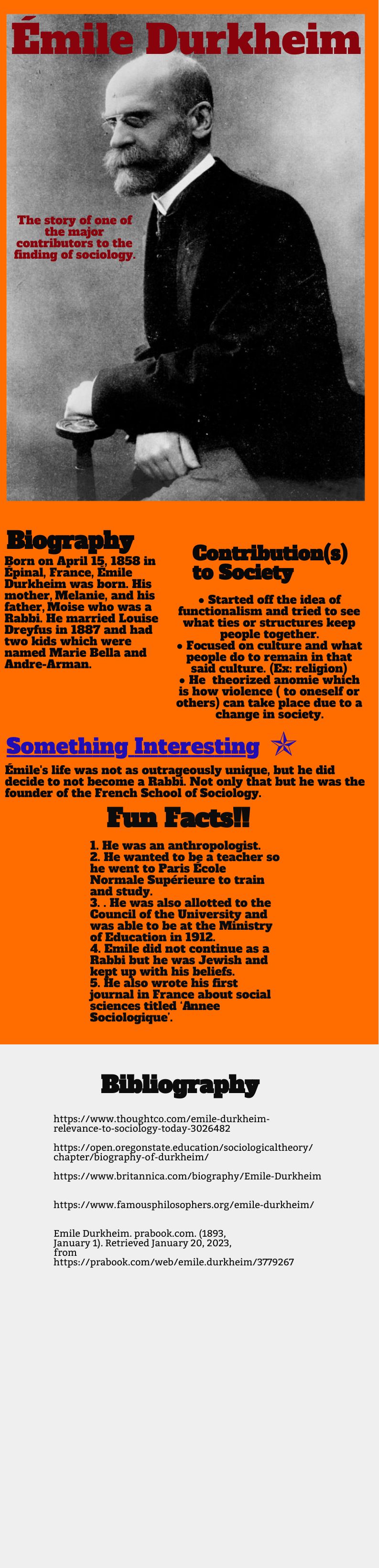
The functionalist view: what family does for society
Functionalism asks what a persistent institution contributes to social stability, and by that test the family is indispensable. Building on Émile Durkheim's concern with social integration — he showed that married people are, on average, better buffered against isolation and anomie than the unattached — the anthropologist George Murdock argued that the family universally performs four functions: regulating sexual activity, reproduction, economic cooperation, and the socialization of children. Talcott Parsons narrowed the list for the modern nuclear family to two irreducible tasks: the primary socialization of children into society's norms and the stabilization of adult personalities — the family as an emotional refuge from an impersonal economy. Parsons also (controversially) described a division into instrumental and expressive roles. Critics note this reads a mid-century, middle-class American arrangement as if it were a functional necessity — a reminder that functionalism can mistake the familiar for the inevitable.
The conflict view: family as an engine of inequality
Conflict theory, rooted in Karl Marx, turns the question around: whom does the family's structure benefit, and at whose expense? Marx's collaborator Friedrich Engels argued in The Origin of the Family, Private Property and the State that the monogamous nuclear family arose to secure private property — men needed legitimate heirs to inherit wealth, which required controlling women's reproduction and subordinating them within the household. From this angle the family is a mechanism for transmitting class advantage across generations: wealthy families pass on capital, connections, and cultural capital, reproducing the stratification system chapter after chapter. Feminist conflict theorists extend the point to gender, highlighting the unpaid domestic labor — cooking, cleaning, caregiving — that disproportionately falls to women and quietly subsidizes the whole economy. Where functionalists see harmony, conflict theorists see power.
The interactionist view: family as everyday meaning-making
Symbolic interactionism zooms all the way in to the daily interactions through which a family is actually lived. Ernest Burgess captured it in his phrase that the family is “a unity of interacting personalities” — not a fixed structure but something continually created and re-created through communication. Charles Horton Cooley called the family the original primary group, the intimate circle in which, through the looking-glass self, we first come to see ourselves through others' eyes. George Herbert Mead showed how children develop a self by taking the role of parents and siblings in play, and Erving Goffman's dramaturgy reveals how family members perform roles — the “good son,” the “devoted spouse” — managing impressions front-stage and relaxing back-stage. For interactionists, whether an arrangement even counts as a “marriage” or who does the housework is settled not by law but by the meanings partners negotiate day to day.
| Paradigm | Core question | View of the family | Key figures |
|---|---|---|---|
| Functionalism | What does family do for social stability? | A vital institution performing socialization, regulation, economic and emotional support | Durkheim, Murdock, Parsons |
| Conflict | Who benefits and who is exploited? | A means of transmitting property, class, and gender inequality | Marx, Engels, feminist theorists |
| Symbolic interactionism | How is family meaning built in interaction? | A unity of interacting personalities defined by negotiated meanings and performed roles | Cooley, Mead, Goffman, Burgess |
- Functionalists (Durkheim, Murdock, Parsons) stress the family's contributions: socialization, regulation, economic and emotional support.
- Conflict theorists (Marx, Engels, feminists) see the family transmitting class and gender inequality — property, inheritance, unpaid domestic labor.
- Interactionists (Cooley, Mead, Goffman, Burgess) study family as meaning made in daily interaction — the primary group and performed roles.
- Each paradigm illuminates a different scale; together they give a fuller picture.
Section 4Family challenges
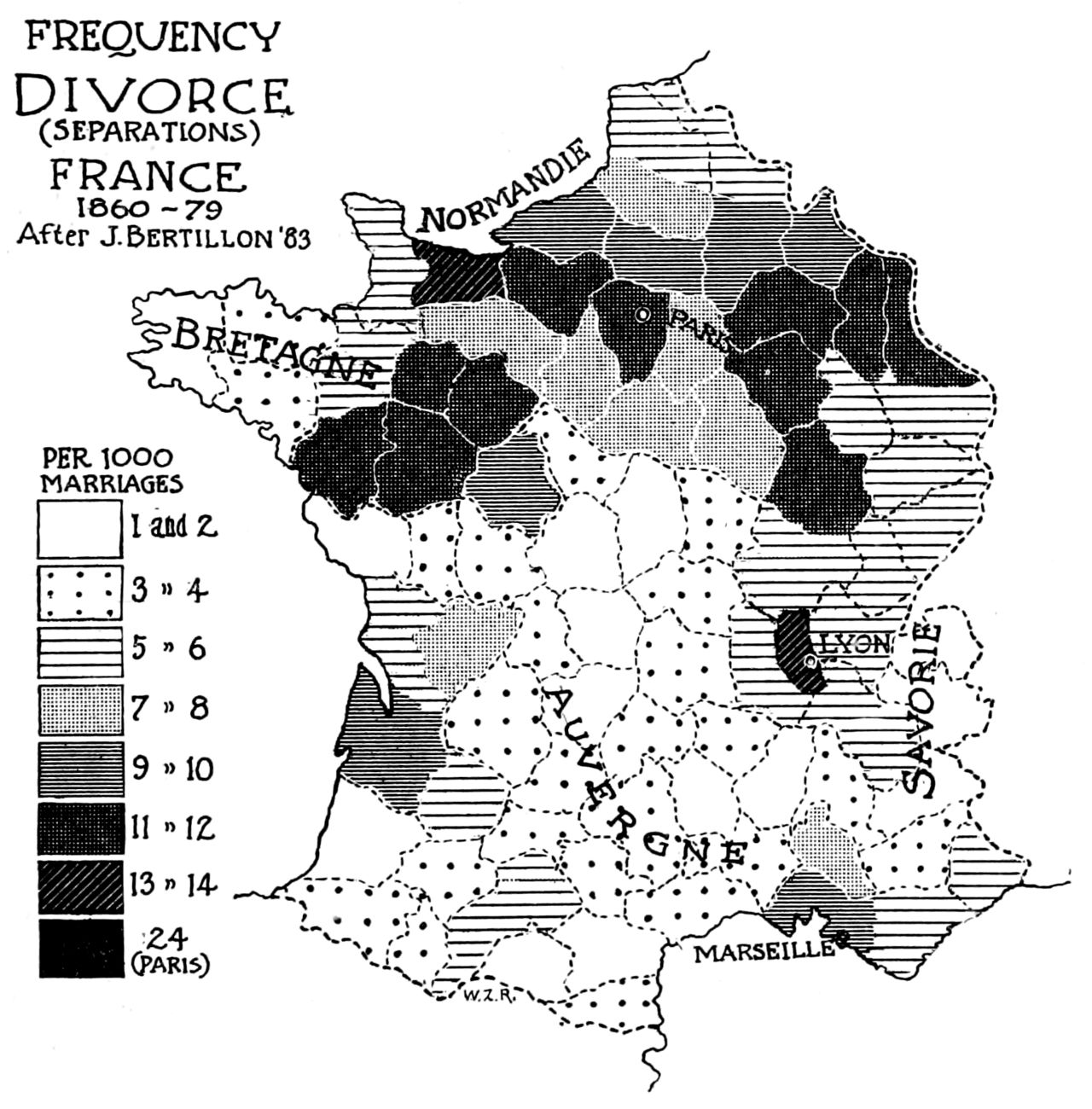
Divorce: private grief, social pattern
Divorce feels like the most individual of failures, yet its rates rise and fall with law, economy, and culture in ways no single couple controls. In the United States the divorce rate climbed steeply through the 1960s and 1970s — propelled in part by the spread of no-fault divorce, which let couples end a marriage without proving wrongdoing — and has since drifted downward, partly because fewer, and more selectively, people marry in the first place. Sociologists measure it carefully: the crude rate (divorces per 1,000 people) is easy to misread, so the refined divorce rate (divorces per 1,000 married women) gives a truer picture. Reliable predictors of divorce include marrying very young, low income and education, cohabiting with several partners before marriage, and having grown up with divorced parents — the last a modest but real intergenerational transmission.
The effects on children are real but frequently oversimplified. Decades of research suggest that it is persistent conflict, more than divorce itself, that harms children most; a low-conflict split can be less damaging than a high-conflict marriage that stays intact. That finding reframes divorce from a simple verdict — good or bad for kids — into a question about how conflict and disruption are managed.
Remarriage and blended families
Most divorced people remarry, and many form blended families (stepfamilies) that fold together children and parents from prior unions. Here Cherlin's “incomplete institution” idea returns to the case it was written for: his 1978 analysis was of remarriage, and its point was that our culture offers no clear norms — and barely any vocabulary — for step-relationships. What does a stepfather owe a teenage stepdaughter? What should stepsiblings call each other's grandparents? Because the roles are underdefined, blended families must negotiate from scratch the expectations that first marriages inherit ready-made — which is part of why remarriages, on average, dissolve somewhat more often than first marriages. Yet many blended families thrive precisely by inventing their own workable norms.
Family violence
The same institution that provides intimacy and refuge can also conceal harm. Family violence spans intimate-partner violence, child abuse and neglect, and elder abuse, and it shares a grim logic across those forms: it flourishes in private, exploits dependency, and is powerfully underreported because victims may love, rely on, or fear the person harming them. Sociologists resist framing it as isolated pathology; they trace patterns of power and control, note how economic stress and social isolation raise risk, and document a cycle in which children who witness violence are more likely to experience or perpetrate it later. Treating family violence as a social problem — addressed through law, shelters, screening, and support — rather than a purely private matter is one of the clearest cases of C. Wright Mills's distinction between a personal trouble and a public issue.
| Form of family violence | Who is harmed | Why it stays hidden |
|---|---|---|
| Intimate-partner violence | A current or former spouse or partner | Fear, financial dependence, shame, love for the abuser |
| Child abuse & neglect | Dependent children | Children cannot easily report; harm is normalized as discipline |
| Elder abuse | Older, often dependent adults | Isolation, frailty, reliance on the caregiver who harms them |
- Divorce rates track law and economy; the refined divorce rate is more accurate than the crude rate, and conflict harms children more than divorce itself.
- Most divorced people remarry into blended families, which must improvise norms our culture doesn't supply.
- Family violence — partner, child, and elder abuse — is patterned, underreported, and best understood as a public issue, not private pathology.
Section 5Families in transition
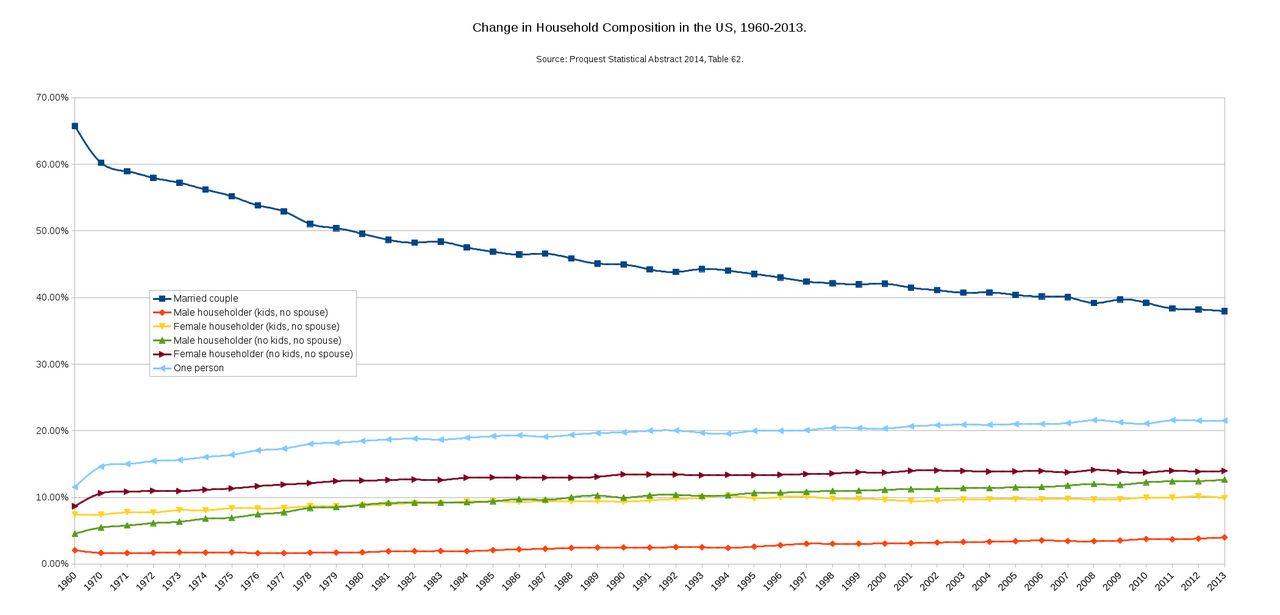
The changing shape of the household
The mid-twentieth-century image of the “typical” family — a breadwinner father, a homemaker mother, and their children in a single-family home — describes a shrinking minority of households today. Married-couple-with-children households have fallen as a share of the total, while people living alone, single-parent families, cohabiting couples, and multigenerational homes have all risen. This is not the collapse of the family so much as its diversification: the same enduring needs for care, support, and belonging are now met through a wider variety of arrangements. Demographers describe part of this shift as a second demographic transition, in which delayed marriage, delayed and reduced childbearing, and rising cohabitation accompany greater individual autonomy and gender equality.
New and newly visible family forms
Several trends stand out. Marriage is being delayed: the median age at first marriage has climbed as young adults finish schooling and establish careers first. Dual-earner families are now the norm, which has forced a renegotiation of housework — though the sociologist Arlie Hochschild's research on the “second shift” found that employed women still tend to do more unpaid domestic and emotional labor at home than their male partners, a stubborn inequality inside the modern egalitarian ideal. Same-sex families have moved from invisibility to legal recognition in a growing number of countries, including nationwide marriage rights in the United States since 2015. And a rising share of adults are childfree by choice or living alone, arrangements once treated as deviant and now increasingly ordinary.
Why the family endures
Given divorce, violence, and dizzying change, it is tempting to conclude that the family is failing. The sociological evidence points the other way. No society has ever done without some family form, because the tasks the family performs — raising the next generation, organizing care, anchoring identity — still must be done, and no other institution does them as well. What is dying is not the family but a single historically specific version of it. The family is not disappearing; it is doing what durable institutions do — adapting its form to a changed economy and culture while continuing to perform its oldest functions.
| Trend | Mid-20th century | Today |
|---|---|---|
| Age at first marriage | Early twenties | Later — often late twenties or beyond |
| Married-couple-with-children homes | Dominant household type | One form among many |
| Cohabitation before marriage | Rare and stigmatized | Common and mainstream |
| Women's paid employment | Minority of married mothers | Dual-earner is the norm |
| Same-sex families | Largely invisible, unrecognized | Increasingly recognized in law |
- The breadwinner–homemaker nuclear family is now a minority of households; family forms have diversified, not vanished.
- Marriage and childbearing are delayed; dual-earner families are the norm, yet the “second shift” leaves women doing more home labor.
- Same-sex families have gained legal recognition; living alone and being childfree are increasingly ordinary.
- The family endures because its core functions still must be performed; its form adapts to a changed economy and culture.
The chapter in one breath
- A family is a socially recognized kin, emotional, and economic group; a household is whoever shares a dwelling — and family is defined by function, not form.
- Forms range from nuclear to extended, with a growing roster of single-parent, cohabiting, blended, and same-sex families; kinship is organized by descent, residence, and authority.
- Marriage patterns include monogamy (often serial) and polygamy (mostly polygyny), bounded by endogamy and exogamy.
- Cohabitation is now mainstream but norm-poor; mate selection is patterned by propinquity and homogamy — like marries like.
- Functionalists stress the family's functions, conflict theorists its transmission of inequality, and interactionists its negotiated everyday meanings.
- Divorce tracks law and economy (conflict harms children more than divorce itself); most people remarry into blended families; family violence is a patterned public issue.
- Family life is diversifying — delayed marriage, dual earners, the second shift, same-sex recognition — yet the institution endures because its work still must be done.
ReferenceWords worth knowing
A quick reference for the terms in this chapter — skim it now, or circle back whenever a word trips you up.
- Bilateral descent
- Tracing kinship and inheritance through both the mother's and the father's lines; common in North America and Europe.
- Blended family (stepfamily)
- A family formed when remarriage joins parents and children from previous unions.
- Cohabitation
- An arrangement in which an unmarried couple shares a household and an intimate relationship.
- Egalitarian family
- A family in which authority and decision-making are shared roughly equally between partners.
- Endogamy
- A norm or rule encouraging marriage within one's own social group (religion, class, ethnicity).
- Exogamy
- A norm or rule requiring marriage outside a defined group; the incest taboo is its most universal form.
- Extended family
- A family unit that includes relatives beyond the nuclear core, such as grandparents, aunts, uncles, or cousins.
- Family
- A socially recognized group, usually joined by blood, marriage, cohabitation, or adoption, that forms an emotional bond and economic unit.
- Family of orientation
- The family into which a person is born or adopted and by which they are first socialized.
- Family of procreation
- The family a person forms as an adult through partnership and the raising of children.
- Homogamy
- The tendency to marry someone similar to oneself in traits such as age, education, class, race, or religion.
- Household
- All the people, related or not, who occupy a single housing unit.
- Kinship
- The culturally recognized web of ties among people based on blood, marriage, and adoption.
- Marriage
- A socially and legally recognized union that establishes rights and obligations between partners and toward children.
- Matrilineal descent
- Tracing kinship and inheritance through the mother's line.
- Monogamy
- Marriage to one spouse at a time; serial monogamy is a sequence of such unions over a lifetime.
- Neolocal residence
- A pattern in which a newly married couple establishes a household of their own, apart from either partner's kin.
- Nuclear family
- A family consisting of a couple and their dependent children sharing a household.
- Patriarchy
- A family or social system in which men hold predominant authority and power.
- Polygamy
- Marriage to more than one spouse at a time; polygyny (multiple wives) and polyandry (multiple husbands) are its two forms.
- Propinquity
- Physical and social proximity, which channels whom people meet and ultimately partner with.
- Serial monogamy
- A pattern of marrying, divorcing, and remarrying so that a person has one spouse at a time across several unions.
Check yourself
Social Institutions
Some patterns are so deep in a society that we barely notice they are patterns at all. Every society, no matter how it differs in language or landscape, builds up a set of durable arrangements to answer the same handful of unavoidable questions: How do we pass knowledge to the next generation? What do we hold sacred? How do we produce and distribute what we need? Who gets to give orders, and why do the rest of us obey? Who cares for us when our bodies fail? These arrangements — education, religion, the economy, government, and medicine — are the social institutions of this chapter, and learning to see them as human creations rather than facts of nature is one of the most powerful moves in all of sociology.
By the end of this chapter you can
- Define a social institution and explain why every society develops the same core institutions.
- Distinguish the manifest and latent functions of education and describe the hidden curriculum and tracking.
- Summarize Durkheim's theory of religion and contrast the ecclesia, church, sect, and cult, and explain secularization.
- Compare capitalism, socialism, and mixed economies, and describe how the world of work has changed.
- State Weber's three types of authority and distinguish power from legitimate authority.
- Explain the social construction of health, the concept of medicalization, and Parsons's sick role.
- Apply the functionalist, conflict, and symbolic-interactionist paradigms to each of these institutions.
Section 1Education

What schools are for
Education is the social institution through which a society transmits knowledge, skills, values, and norms to its members. In small pre-industrial societies this happened informally, at a parent's side; in modern societies it has been handed to a specialized, formal institution — the school — that most children are legally required to attend. Sociologists find it useful to separate a school's intended, openly acknowledged purposes from its unintended, unrecognized ones, a distinction Robert Merton gave us as manifest versus latent functions. The manifest functions of schooling are the obvious ones: teaching literacy and numeracy, training a workforce, and passing on the culture. The latent functions are the quieter by-products — schools supervise children while parents work, they bring young people together and become marriage markets and friendship networks, and they can incubate social change when students encounter ideas their parents never met.
A functionalist reads all of this approvingly: Émile Durkheim argued that schools are engines of socialization and social integration, teaching a shared moral culture that binds diverse individuals into one society. A conflict theorist is more suspicious, asking whose culture is being transmitted and who benefits — and answering, following Marx, that schools mostly reproduce the existing class order while calling it merit. A symbolic interactionist zooms all the way in to the classroom itself, to the daily face-to-face expectations between teacher and student that quietly shape who succeeds.
| Paradigm | What education really does | Key idea |
|---|---|---|
| Functionalist | Socializes the young, transmits culture, sorts talent, integrates society | Manifest & latent functions (Durkheim, Merton) |
| Conflict | Reproduces class inequality while disguising it as fair competition | Social reproduction, cultural capital (Marx, Bourdieu) |
| Symbolic interactionist | Labels students and turns teacher expectations into outcomes | Self-fulfilling prophecy, labeling |
The hidden curriculum
Alongside the official syllabus of math and history runs a second, unwritten one. The hidden curriculum is the set of lessons in norms, values, and dispositions that schools teach without ever announcing them: sit still, raise your hand, be punctual, wait your turn, compete for grades, respect the authority of whoever is at the front of the room. None of this appears on a report card, yet it may be the most consequential thing schooling does, because it trains children in exactly the habits an employer will later reward. Conflict theorists argue this is no accident. Schooling instills obedience and acceptance of hierarchy, so that when students become workers they slot into a stratified economy without protest — the hidden curriculum quietly manufactures consent to the way things are.
Tracking
Tracking (called streaming in many countries) is the practice of sorting students into different instructional groups — “honors” versus “remedial,” college-preparatory versus vocational — on the basis of measured ability. Defenders say it lets teaching meet each student where they are. Critics point out that placement correlates strongly with social class and race rather than raw talent, that lower tracks receive thinner curricula and lower expectations, and that a track assigned at age ten can harden into a life path. Because students tend to become what they are told they are, tracking often functions as a self-fulfilling prophecy, and it is one of the clearest mechanisms by which a system that promises mobility ends up reproducing the stratification it inherited.
- Education transmits knowledge and culture; its purposes split into manifest and latent functions (Merton).
- The hidden curriculum teaches punctuality, obedience, and competition — the dispositions the workforce rewards.
- Tracking sorts students by supposed ability but tends to reproduce class and race inequality.
- Teacher expectations can become self-fulfilling prophecies, shaping the very outcomes they predict.
Section 2Religion

Durkheim and the sacred
To a sociologist, religion is not a question of whether any god exists — that is a question for theology — but of what religion does in social life. Émile Durkheim built the classic answer in The Elementary Forms of Religious Life. Every religion, he observed, divides the world into two categories: the sacred (things set apart, forbidden, treated with awe — a cross, a river, a scripture) and the profane (the ordinary, everyday, mundane). What makes something sacred is not any property of the object itself but the collective attitude a community takes toward it. When believers gather to perform rituals around the sacred, Durkheim argued, they generate a shared emotional energy he called collective effervescence — and in that surge of belonging, the group is really experiencing the power of society itself. His startling conclusion: in worshipping the sacred, a society is, in a sense, worshipping itself, and religion's deepest function is to bind people into a moral community.
Durkheim's is a functionalist account, stressing cohesion, social control, and a sense of meaning and purpose. Other founders saw different things. Karl Marx, from the conflict tradition, called religion “the opium of the people” — a comfort that dulls the pain of exploitation and legitimates inequality by promising rewards in the next life rather than justice in this one. Max Weber, in The Protestant Ethic and the Spirit of Capitalism, argued the reverse of Marx: that religious ideas can drive economic change, tracing how a Calvinist ethic of disciplined, thrifty work helped midwife modern capitalism.
Types of religious organization
Religions organize themselves in recognizably different social forms, arranged here roughly from most to least integrated into the surrounding society. An ecclesia is a state religion to which nearly everyone in a society automatically belongs. A church (or denomination) is a large, well-established, respectable body that accommodates itself to the wider world and coexists with other faiths. A sect is a smaller, more fervent group that has broken away in protest, demanding stricter commitment and holding itself apart from a society it finds too worldly. A cult — scholars increasingly prefer the neutral term new religious movement — is a new, unconventional faith organized around novel beliefs or a charismatic founder, often at the margins of the mainstream.
| Form | Size & standing | Relationship to society |
|---|---|---|
| Ecclesia | Society-wide, official | Fused with the state; membership by birth |
| Church / denomination | Large, established, respectable | Accommodates the wider world; tolerates rivals |
| Sect | Smaller, intense, breakaway | Rejects and withdraws from mainstream society |
| Cult / new religious movement | Small, new, unconventional | Novel beliefs, often around a charismatic leader |
Secularization — and its limits
For much of the twentieth century, sociologists expected secularization — the long decline in the social influence of religion — to march steadily forward as societies modernized. In many wealthy nations, formal religious participation has indeed fallen, and institutions once governed by the church (schools, hospitals, courts, welfare) have passed into secular hands. Yet the confident prediction that religion would simply fade has not held up. Across much of the world religion is vigorous, and even in secularizing societies the picture is less decline than reorganization: the rise of fundamentalist movements reasserting tradition, and a “religious economy” view suggesting that where many faiths compete freely for members, religious energy can actually intensify rather than wither.
- Durkheim defined religion around the sacred vs the profane; ritual generates collective effervescence and binds society.
- Marx saw religion legitimating inequality (“opium”); Weber saw it driving change (the Protestant ethic).
- Religious organizations range across ecclesia, church/denomination, sect, and cult, and groups migrate between them.
- Secularization is real in some societies but uneven; religion persists, revives, and reorganizes.
Section 3The economy & work
Economic systems
The economy is the institution that organizes the production, distribution, and consumption of goods and services. Societies answer the basic economic questions — what to produce, how, and for whom — through different systems, and the two ideal types anchor a long argument. Under capitalism, the means of production are privately owned, goods are exchanged in a competitive market, and the engine is private profit; Adam Smith famously argued that individuals pursuing their own gain are led “by an invisible hand” to promote an end that was no part of their intention — the benefit of society as a whole. Under socialism, the means of production are owned collectively (often through the state), and the economy is directed by central planning toward meeting collective need rather than private profit. Karl Marx supplied capitalism's sharpest critique: he argued that owners extract surplus value from workers — paying them less than the worth of what they produce — making exploitation the hidden motor of profit, and predicting that the resulting class conflict would eventually overturn the system.
In reality no large economy is purely one or the other. Nearly every modern society runs a mixed economy, combining private markets with public provision — regulation, taxation, and a welfare state that supplies education, pensions, and health care alongside the market.
| System | Who owns production | How resources are allocated | Primary goal |
|---|---|---|---|
| Capitalism | Private individuals & firms | Competitive markets, supply & demand | Private profit |
| Socialism | The community / the state | Central planning | Meeting collective need |
| Mixed economy | Both private and public | Markets plus regulation & a welfare state | Growth and social protection |
The changing world of work
The kind of work a society does has been transformed twice over. Most human history was spent in the primary sector — agriculture and extraction, drawing raw materials from the earth. The Industrial Revolution shifted the center of gravity to the secondary sector, manufacturing goods in factories like the one above. The wealthy societies of today have moved again, into a post-industrial or tertiary sector economy built on services, information, and knowledge — a transition the sociologist Daniel Bell named and analyzed. With that shift came deindustrialization (the loss of stable factory jobs to automation and to lower-wage countries) and the growth of a gig economy of short-term, app-mediated, contract work that offers flexibility but strips away the security, benefits, and predictability of the mid-century job.
Sociology insists that work is never merely a paycheck. Marx's concept of alienation captures what can go wrong: when workers have no ownership of what they make, no control over how they make it, and no connection to the final product, labor becomes estranged and hollow rather than fulfilling. Whether the next wave of automation and platform work deepens that alienation or relieves it is one of the defining questions of the contemporary economy.
- The economy organizes production and distribution; capitalism (private, market, profit) and socialism (collective, planned, need) are the ideal types.
- Marx located profit in surplus value extracted from workers; most societies are in fact mixed economies.
- Work has shifted from the primary to the secondary to the post-industrial / tertiary sector, bringing deindustrialization and the gig economy.
- Alienation describes labor stripped of ownership, control, and meaning.
Section 4Government & power
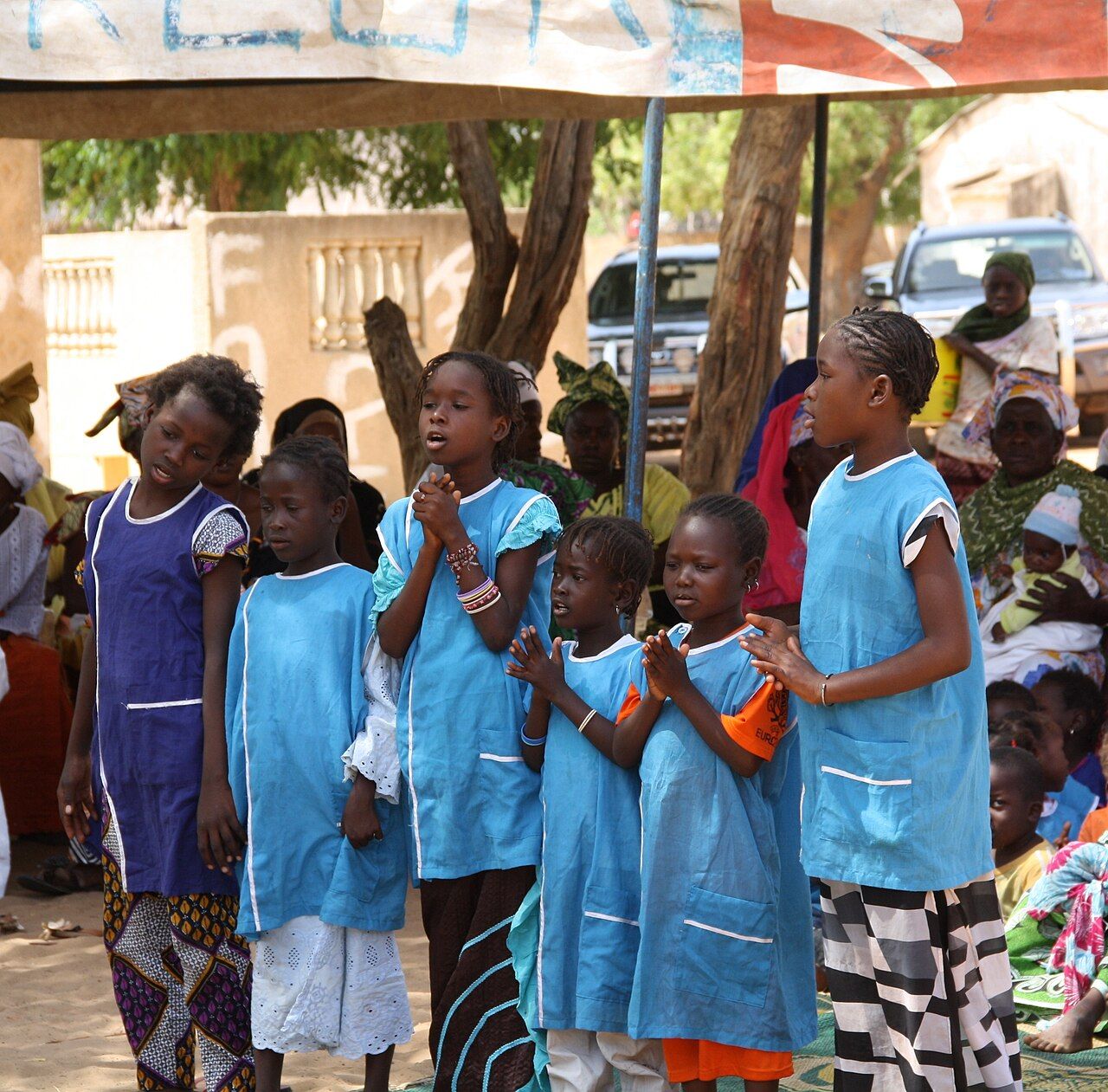
Power and its legitimacy
Max Weber gave sociology its working definition of power: the ability to achieve one's goals and impose one's will on others even against their resistance. Power comes in two very different flavors. Raw coercion — power backed only by force or the threat of it — is unstable and expensive, because people obey only as long as the gun is pointed at them. Far more durable is authority: power that people accept as legitimate and rightful, so that they obey willingly. The central puzzle of government is therefore not how rulers seize power but how they get the ruled to grant them authority — and Weber's answer was that legitimacy comes in three distinct types.
Weber's three types of authority
Traditional authority rests on long-established custom and the sanctity of “the way things have always been done.” A hereditary monarch or tribal chief commands obedience because their family always has; the legitimacy is inherited, not earned. Charismatic authority flows from the extraordinary personal qualities of an individual — a prophet, a revolutionary, a movement leader whose followers are devoted to the person themselves. It is the most volatile type, because it lives and dies with one human being; Weber described how a movement must accomplish the routinization of charisma, converting a founder's personal magnetism into stable offices and rules, or it dies with them. Rational-legal authority is vested not in persons but in a system of impersonal rules and offices: we obey the law and the officeholder, not the individual, and power passes peacefully when one officeholder replaces another. This is the characteristic authority of the modern state, and its natural home is bureaucracy.
| Type of authority | Source of legitimacy | Example | Weak point |
|---|---|---|---|
| Traditional | Custom, heredity, “always done this way” | Kings, queens, tribal chiefs | Struggles to justify change |
| Charismatic | Extraordinary qualities of one person | Prophets, revolutionaries, movement leaders | Dies with the leader unless routinized |
| Rational-legal | Impersonal rules, laws, and offices | Modern states, elected officials, bureaucracies | Can feel cold, rigid, dehumanizing |
Who really holds power?
Weber told us how authority is legitimated; sociologists still argue about where power actually concentrates. C. Wright Mills advanced the influential power elite thesis: that real power in a large society is held by a small, interlocking circle at the top of its political, economic, and military institutions, whose members share backgrounds and interests and make the decisions that matter — leaving ordinary democratic participation more limited than it appears. Against this, pluralists argue that power is dispersed among many competing interest groups, none able to dominate, so that outcomes emerge from bargaining. Which picture is closer to the truth remains a central question of political sociology.
- Power (Weber) is achieving one's will despite resistance; authority is power accepted as legitimate.
- Weber named three types of authority: traditional, charismatic, and rational-legal.
- Charisma must undergo routinization to survive its leader; the modern state rests on rational-legal authority and bureaucracy.
- C. Wright Mills's power elite thesis holds that a small interlocking group dominates; pluralists disagree.
Section 5Health & medicine
Health is more than biology
It is tempting to think of health and illness as purely biological facts, but sociologists study the social construction of health — the way a society decides what counts as sickness, who counts as sick, and how the sick should be treated. What a culture labels a disease varies dramatically across time and place: conditions once seen as sin, weakness, or spirit possession are now diagnoses, and behaviors once considered ordinary have been redefined as medical problems. That last process has a name: medicalization, a concept introduced by Irving Zola in 1972 and developed most influentially by Peter Conrad, for the trend of bringing more and more of life — childbirth, aging, shyness, sadness, restlessness, addiction — under the authority of medicine. Medicalization can help people by opening the door to treatment, but it also expands the reach of medical control over everyday life and turns social questions into individual clinical ones.
Sociologists also document that health itself is unequally distributed along social lines. There is a durable social gradient: the lower a person's social class, the worse their health and the shorter their life expectancy tend to be — a pattern that no amount of individual willpower explains and that points instead to the social causes of disease.
The sick role
The functionalist Talcott Parsons gave the classic account of what it means, socially, to be ill. Being sick, he argued, is not just a physical state but a temporary social role — the sick role — that comes with a bargain of rights and obligations. The sick person earns two rights: they are excused from their normal duties (a doctor's note releases you from work or class), and they are not held personally responsible for their condition. In exchange, they take on two obligations: they must genuinely want to get well and regard being sick as undesirable, and they must seek competent help — a physician — and cooperate with treatment. In this view, illness is a form of deviance that medicine is licensed to manage, which makes the medical profession an agent of social control, deciding who is legitimately excused and returning them to their duties.
The sick-role model has been sharply criticized. It fits an acute, curable illness like the flu but describes chronic and disabling conditions poorly, since those can never simply be “gotten over.” It assumes a cooperative doctor–patient relationship and glosses over the power imbalance within it, and it ignores how unequally people can access the medical help the model requires them to seek.
| Paradigm | How it views health & medicine | Key idea |
|---|---|---|
| Functionalist | Illness disrupts society; medicine restores people to their roles | The sick role; medicine as social control (Parsons) |
| Conflict | Health and care are distributed by power and profit; medicine expands its authority | Health inequality, medicalization critique |
| Symbolic interactionist | Illness meanings are socially constructed and negotiated; the sick can be stigmatized | Social construction of illness, stigma (Goffman) |
- The social construction of health means societies decide what counts as illness; medicalization expands medicine's reach over everyday life.
- Health follows a social gradient: lower class, worse health — disease has social causes.
- Parsons's sick role grants rights (excused, not blamed) in exchange for obligations (want to recover, seek and follow treatment).
- Medicine acts as an agent of social control; the sick-role model fits acute better than chronic illness.
The chapter in one breath
- Social institutions are the durable arrangements every society builds to meet shared needs — education, religion, the economy, government, and medicine.
- Education serves manifest and latent functions, teaches a hidden curriculum of obedience and competition, and tracks students in ways that reproduce inequality.
- Durkheim saw religion binding society through the sacred and collective ritual; organizations range from ecclesia to cult, and secularization is real but uneven.
- The economy runs on capitalism, socialism, or a mixed blend; work has moved from farm to factory to service, bringing the gig economy and alienation.
- Weber distinguished power from legitimate authority, which comes in traditional, charismatic, and rational-legal forms; Mills warned of a power elite.
- Health is socially constructed and medicalized; Parsons's sick role frames illness as a social role of rights and obligations, and medicine as social control.
- The functionalist, conflict, and symbolic-interactionist paradigms each throw a different light on every one of these institutions.
ReferenceWords worth knowing
A quick reference for the terms in this chapter — skim it now, or circle back whenever a word trips you up.
- Alienation
- Marx's term for the estrangement workers feel when they have no ownership of, control over, or connection to what they produce.
- Authority
- Power that people accept as legitimate and rightful, so that they obey willingly rather than by compulsion.
- Bureaucracy
- A large, formal organization run by impersonal rules and offices; the characteristic home of rational-legal authority.
- Capitalism
- An economic system based on private ownership of production, competitive markets, and the pursuit of profit.
- Charismatic authority
- Legitimacy grounded in the extraordinary personal qualities of an individual leader.
- Cult (new religious movement)
- A small, new, unconventional religious group, often organized around novel beliefs or a charismatic founder.
- Ecclesia
- A religion so dominant it is fused with the state, with membership essentially by birth.
- Gig economy
- A labor market of short-term, contract, and app-mediated work in place of stable, long-term employment.
- Hidden curriculum
- The unofficial lessons in norms and values — punctuality, obedience, competition — that schools teach without announcing them.
- Manifest & latent functions
- Merton's distinction between an institution's intended, recognized effects and its unintended, unrecognized ones.
- Medicalization
- The process by which non-medical aspects of life come to be defined and treated as medical conditions.
- Power
- Weber's term for the ability to achieve one's goals and impose one's will despite the resistance of others.
- Profane
- In Durkheim's scheme, the ordinary, everyday, mundane world, set against the sacred.
- Rational-legal authority
- Legitimacy vested in impersonal rules, laws, and offices rather than in persons; the basis of the modern state.
- Sacred
- Things a community sets apart and treats with awe or reverence; for Durkheim, the core of religion.
- Sect
- A smaller, more fervent religious group that has broken away from an established church and rejects the wider society.
- Secularization
- The long-term decline in the social influence and authority of religion, uneven across societies.
- Sick role
- Parsons's concept of illness as a temporary social role carrying rights (excused, not blamed) and obligations (seek help, want to recover).
- Social institution
- A durable, patterned set of arrangements through which a society meets a basic recurring need.
- Socialism
- An economic system based on collective or state ownership of production and planning to meet social need.
- Tracking
- Sorting students into different instructional groups by measured ability, often reproducing existing inequality.
- Traditional authority
- Legitimacy grounded in long-standing custom and heredity, as with a monarch or chief.
Check yourself
Social Change & Movements
Societies never sit still. The language you speak, the work you do, the family you were born into, and the rights you take for granted all look different than they did a century ago — and they will look different again. This chapter is about social change: how it happens, who drives it, and how sociologists explain it. We start with the crowd in the street and the rumor that races through a town, move to the organized movements that deliberately try to reshape the world, and end with the two great engines of modern change — modernization and globalization — that are remaking every society on Earth at once.
By the end of this chapter you can
- Define collective behavior and distinguish casual, conventional, expressive, and acting crowds, along with mobs and mass behavior.
- Compare the contagion, convergence, and emergent-norm explanations of why crowds act as they do.
- Define a social movement and classify movements using Aberle’s four types.
- Trace the four stages a movement typically passes through, from emergence to decline.
- Contrast relative-deprivation, resource-mobilization, framing, and new-social-movement theories.
- Explain how technology, population, and the environment drive change, and apply Ogburn’s idea of cultural lag.
- Summarize modernization theory and the conflict-based critiques offered by dependency and world-systems theory.
- Identify the causes and consequences of globalization and read it through the three sociological paradigms.
Section 1Collective behavior: crowds, mobs, and mass behavior

What collective behavior is
Most of social life is institutional — patterned, expected, governed by clear norms. You know how to behave in a classroom, a checkout line, or a funeral because the script is already written. Collective behavior is what happens outside that script: relatively spontaneous, short-lived, loosely structured action by a group responding to a common influence or situation. Robert E. Park of the Chicago School gave the field its name in 1921; Herbert Blumer, building on Park, gave it its core framework — the idea that in these moments people improvise new ways of acting together before any settled institution tells them how. A stadium doing the wave, a town swept by a rumor, shoppers stampeding a doorbuster sale, and a neighborhood pouring into the street after a verdict are all collective behavior, even though they look nothing alike.
Kinds of crowds — and the myth of the mad mob
A crowd is simply a temporary gathering of people in close enough proximity to influence one another. Blumer sorted crowds into four kinds. A casual crowd is a loose collection of people who happen to share a space — onlookers around a street performer — with little in common. A conventional crowd gathers for a scheduled, structured purpose, like a lecture audience or churchgoers. An expressive crowd forms around emotional release, such as a concert or a religious revival. An acting crowd is focused on a specific, often intense goal and is capable of aggression. When an acting crowd turns violent and destructive toward a target, we call it a mob; a riot is a more diffuse, longer-lasting eruption of violence with no single focus.
It is tempting to imagine crowds as mindless herds, and the earliest theorist of crowds, Gustave Le Bon, said exactly that. Modern research disagrees. The sociologist Clark McPhail studied thousands of real gatherings and found that people in crowds mostly retain their judgment, cluster with the friends and family they arrived with, and act with more purpose than the “mad mob” image allows. Crowds are not people losing their minds; they are people making new rules on the fly.
Three ways to explain the crowd
Why does a crowd sometimes act as one? Three classic theories compete. Contagion theory (Le Bon) claims the anonymity and emotional intensity of a crowd spread feeling from person to person like a fever, overriding individual restraint. Convergence theory flips the arrow: the crowd does not create the behavior, it gathers people who already shared the impulse, so a violent crowd reflects the tendencies its members brought with them. Emergent-norm theory, developed by Ralph Turner and Lewis Killian, offers a middle path grounded in symbolic interactionism: crowds face ambiguous, unscripted situations, and through interaction they improvise a shared norm that then guides everyone present. This is why two crowds facing the same event can behave completely differently.
| Theory | Where the behavior comes from | Key figure | Weakness |
|---|---|---|---|
| Contagion | Spreads through the crowd; anonymity dissolves self-control | Le Bon | Treats crowds as mindless; overstated by research |
| Convergence | Brought in by the individuals who chose to gather | Allport | Can’t explain behavior members never intended |
| Emergent-norm | Improvised on the spot through interaction | Turner & Killian | Hard to observe the norm forming in real time |
Behavior at a distance: mass behavior
Not all collective behavior needs bodies in one place. Mass behavior is collective behavior among people spread over a wide area who never meet but respond to the same influence. It includes rumor (unverified information passed person to person), fads and fashions, panics and mass hysteria, public opinion, and disaster behavior. Social media has supercharged mass behavior: a rumor that once took weeks to cross a county now circles the planet in minutes, and a fad can consume millions of strangers who share nothing but a feed. Sociologists study these not as trivia but as early tremors — the diffuse, disorganized stirrings from which organized social movements often crystallize.
- Collective behavior is spontaneous, loosely structured group action outside normal institutional scripts.
- Crowds are casual, conventional, expressive, or acting; a violent acting crowd is a mob, a diffuse eruption a riot.
- Contagion, convergence, and emergent-norm theories explain crowd action; emergent-norm best fits the evidence.
- Mass behavior (rumor, fads, panics, public opinion) is collective behavior spread across distance, now accelerated by social media.
Section 2Social movements: types, stages, and theories
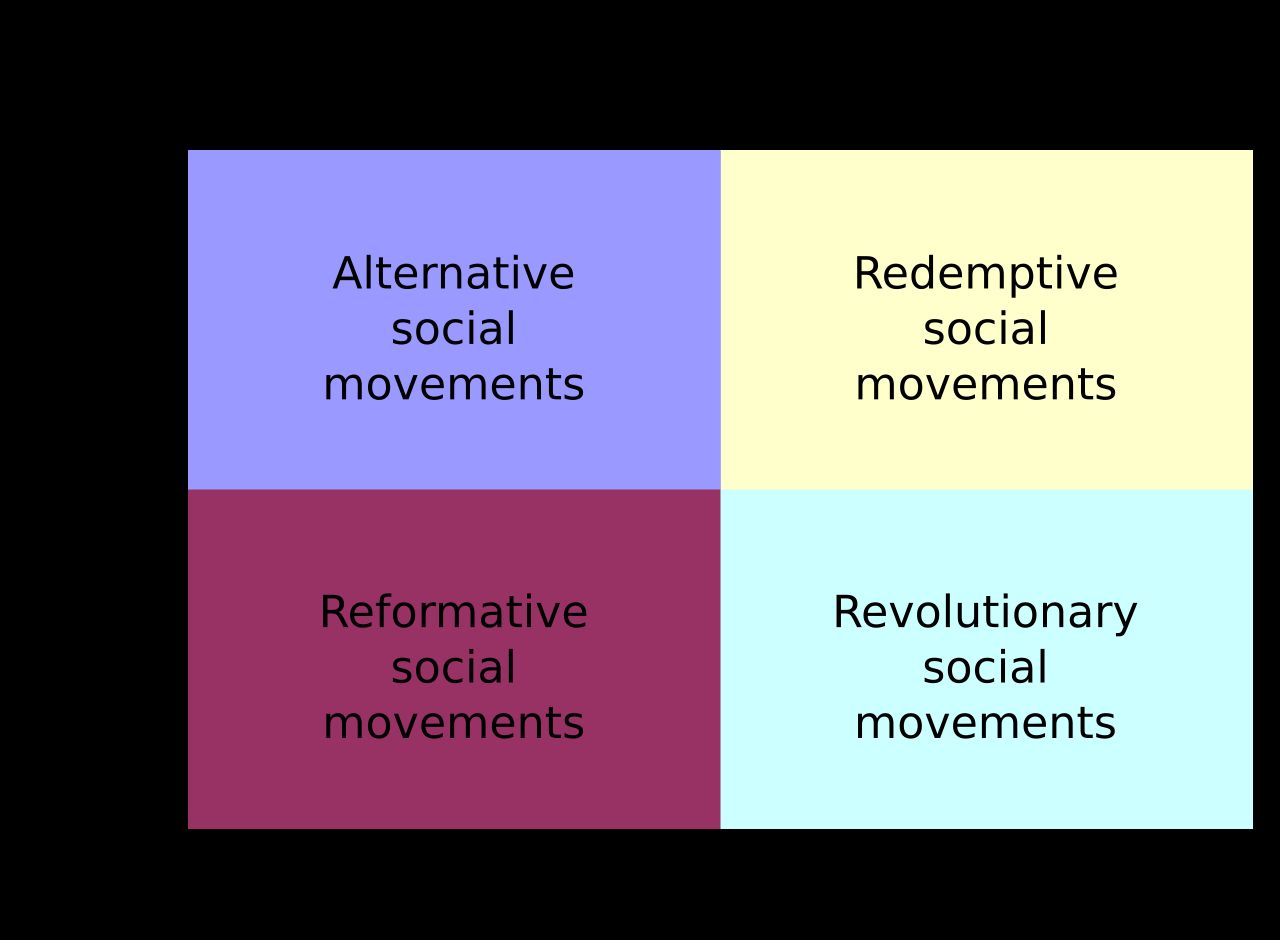
From crowd to campaign
A crowd disperses by nightfall; a social movement does not. A social movement is an organized, sustained, collective effort by a large number of people to promote or resist social change. Where collective behavior is spontaneous and fleeting, movements have leaders, goals, an organizational core, and staying power measured in years or decades. The abolition of slavery, women’s suffrage, the labor and civil-rights movements, environmentalism, and the many movements resisting each of these were all deliberate campaigns, not passing crowds. Movements are the single most important way that ordinary people — those without armies or fortunes — force change onto societies that would otherwise leave them out.
Four types of movements
The anthropologist David Aberle classified movements along two questions: how much change do they seek (limited or total), and whom do they target (specific individuals or entire structures). The result is four types. Alterative movements seek limited change in specific individuals — a campaign to get people to drive sober. Redemptive movements seek total change in specific individuals — a religious revival aiming to transform believers completely. Reformative movements seek limited change across a whole society — marriage-equality or clean-air campaigns that alter law without overturning the system. Revolutionary movements seek total change across society — to replace the existing order entirely. Sociologists add other labels, such as resistance (or reactionary) movements that fight to reverse change others have won.
| Type | How much change | Who is targeted | Example |
|---|---|---|---|
| Alterative | Limited | Specific individuals | Anti–drunk-driving campaigns |
| Redemptive | Total | Specific individuals | A religious revival movement |
| Reformative | Limited | Whole society | Environmental or voting-rights reform |
| Revolutionary | Total | Whole society | Movements to replace the political order |
The stages a movement lives through
Movements are not born whole; they mature and age. Drawing on Herbert Blumer and later Charles Tilly, sociologists describe four stages. In emergence (or incipiency), widespread discontent finds no organized outlet yet — people sense that something is wrong. In coalescence, that discontent organizes: leaders emerge, strategy forms, and the movement stages its first public actions and defines its demands. In bureaucratization, the movement builds formal organizations, paid staff, and routines so it can survive beyond its founding excitement. Finally comes decline, which is not necessarily failure: a movement can decline because it succeeded (its goals became law), because it failed, because it was repressed, because it was co-opted by the establishment, or because it went mainstream and its ideas became ordinary common sense.
Four theories of why movements arise and win
Why do movements form, and why do some succeed? Relative-deprivation theory (developed by Ted Gurr and others) argues that movements grow not from absolute misery but from a felt gap between what people believe they deserve and what they actually have — deprivation is relative to expectation, which is why rising conditions can spark revolt. Resource-mobilization theory (John McCarthy and Mayer Zald) shifted attention from grievance to capacity: grievances are everywhere, but movements succeed only when they can mobilize money, members, leadership, media, and organization. Framing theory (David Snow and Robert Benford, extending Erving Goffman’s frame analysis) stresses meaning — movements must package their message so that potential recruits see a problem, assign blame, and believe action can help. New-social-movement theory explains the identity- and quality-of-life movements of recent decades — environmental, LGBTQ, peace, and consumer movements — which pursue recognition and values more than the bread-and-butter economic demands of the old labor movement.
The three paradigms frame the whole subject differently. Structural functionalism sees movements as a society’s response to strain or dysfunction, a pressure valve that restores balance. Conflict theory, following Karl Marx, sees them as the visible edge of struggles over power and resources between dominant and subordinate groups. Symbolic interactionism zooms in on framing and identity — how activists construct shared meanings that turn private complaints into public causes.
- A social movement is organized, sustained, and collective — the opposite of a fleeting crowd.
- Aberle’s four types (alterative, redemptive, reformative, revolutionary) sort movements by amount and target of change.
- Movements pass through emergence, coalescence, bureaucratization, and decline — and decline can mean success.
- Relative deprivation, resource mobilization, framing, and new-social-movement theory each explain a different piece of why movements rise and win.
Section 3Sources of change: technology, population, and the environment
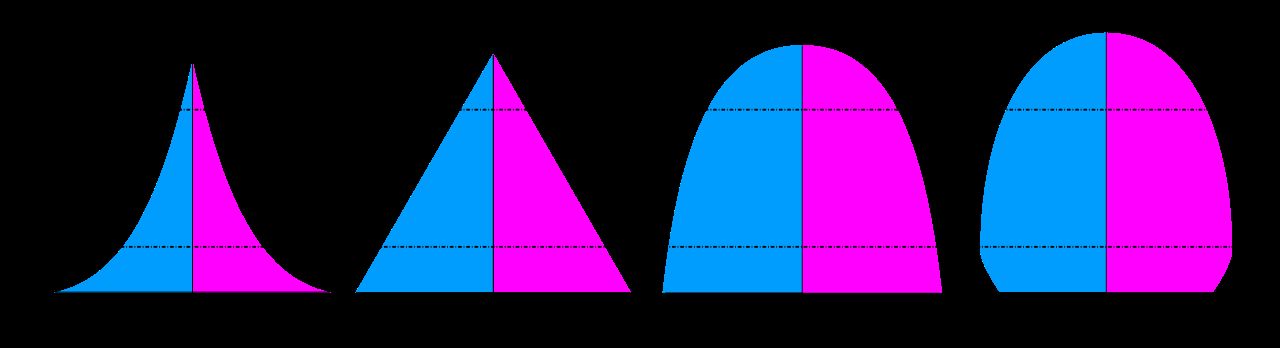
Technology and cultural lag
Movements are one source of change, but three deeper forces reshape every society whether anyone campaigns for it or not. The first is technology. Change spreads through discovery (finding something that already existed), invention (combining knowledge into something new), and diffusion (the spread of an idea or object from one group to another). Technology rarely changes just one thing: the automobile did not only move people faster, it created suburbs, teenagers with independence, and a new geography of work and dating. The sociologist William F. Ogburn named the friction this creates cultural lag — the tendency of material culture (tools, machines) to change faster than non-material culture (laws, norms, ethics), which struggles to catch up. We invent gene editing and facial-recognition systems in a few years but spend decades arguing over the rules for using them. That gap is cultural lag.
Population as an engine of change
The second force is demography — the study of population size and structure, driven by fertility (births), mortality (deaths), and migration (movement). Populations reshape societies as they grow, shrink, and age. The central sociological model here is the demographic transition: as societies industrialize, they move from a stage of high birth and high death rates (slow growth) to one where death rates fall but births stay high (rapid growth), and finally to low birth and low death rates (slow growth again, now with an aging population). Thomas Malthus famously predicted that population would outrun food and end in catastrophe; he underestimated how much technology could raise food production and how much falling fertility would slow growth. Today the sociological worries run the other way, too — toward aging societies with too few workers to support their elders.
| Source of change | Mechanism | Key concept | Everyday example |
|---|---|---|---|
| Technology | Discovery, invention, diffusion | Cultural lag (Ogburn) | Smartphones reshaping attention and work |
| Population | Fertility, mortality, migration | Demographic transition | Aging societies straining pensions |
| Environment | Disasters, depletion, climate | Society–environment feedback | Drought driving migration |
The environment, both cause and consequence
The third force is the environment. Natural events — earthquakes, floods, droughts, pandemics — have always redrawn societies, and environmental sociology studies the two-way street between the natural world and social life. The relationship runs both directions: the environment shapes society (a drought empties farms and fills cities), and society shapes the environment (industrial economies warm the planet). Climate change is the defining case, because it is simultaneously a product of human social organization — industrial capitalism, consumption, fossil-fueled growth — and a driver of future change through rising seas, migration, and conflict. Conflict theorists stress environmental inequality: the societies and communities that contribute least to pollution often suffer its harms first and worst, a pattern the environmental-justice movement was built to fight.
- Change spreads by discovery, invention, and diffusion; cultural lag is non-material culture lagging behind material culture.
- Demography (fertility, mortality, migration) reshapes societies; the demographic transition tracks the shift from high to low birth and death rates.
- Malthus overestimated catastrophe by underrating technology and falling fertility; aging is now a central concern.
- Society and the environment shape each other; climate change and environmental inequality are the era’s defining cases.
Section 4Modernization: theories of a changing society
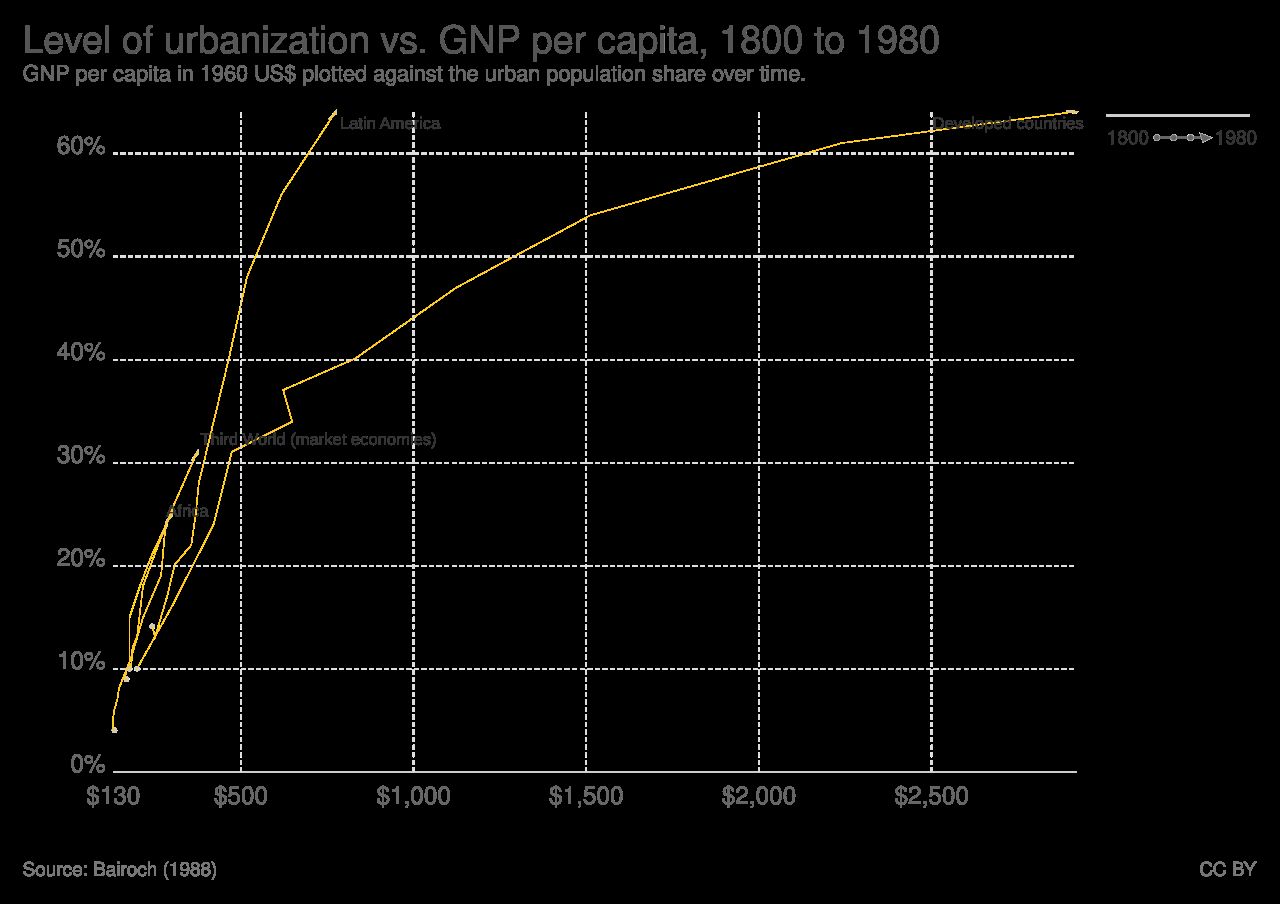
What modernization means
Modernization is the process by which a society moves from traditional, rural, agricultural forms of life toward industrial, urban, and bureaucratic ones. The founders of sociology were, in a sense, all trying to make sense of this one enormous shift as it swept nineteenth-century Europe. Ferdinand Tönnies described it as a move from Gemeinschaft — small communities bound by personal ties and tradition — to Gesellschaft, large impersonal societies bound by self-interest and contract. Émile Durkheim saw the same shift as a change in the basis of solidarity, from the mechanical solidarity of similar people in simple societies to the organic solidarity of interdependent specialists in complex ones — and warned that rapid change could produce anomie, a breakdown of shared norms. Max Weber saw it as rationalization: the steady replacement of tradition and emotion by calculation, efficiency, and bureaucracy, which he feared would trap us in an “iron cage” of impersonal rules. Karl Marx saw the engine underneath it all as capitalism, driving relentless change while alienating workers from their labor.
Modernization theory and its critics
In the mid-twentieth century these ideas hardened into modernization theory, a functionalist account of why some nations are rich and others poor. Its best-known version, the economist W. W. Rostow’s “stages of economic growth,” pictured every society climbing the same ladder from traditional society to a final age of mass consumption, held back mainly by its own traditional values and lack of technology. The remedy, in this view, is to adopt modern technology, education, and market institutions. Critics from the conflict tradition attacked this as blaming the victim and ignoring history. Dependency theory (associated with Andre Gunder Frank) argued that poor nations are not simply “behind” but were actively underdeveloped by colonialism and by ongoing economic dependence on rich nations. Immanuel Wallerstein’s world-systems theory extended this into a global map of a single capitalist economy divided into a wealthy core, an exploited periphery, and a semi-periphery in between — with wealth flowing from periphery to core by design, not by accident.
| Perspective | Paradigm | Why some nations stay poor | Key figure |
|---|---|---|---|
| Modernization theory | Functionalist | They lag in technology and modern values; they must catch up | Rostow |
| Dependency theory | Conflict | Rich nations underdeveloped them and keep them dependent | Frank |
| World-systems theory | Conflict | One global economy funnels wealth from periphery to core | Wallerstein |
Is modernization one road or many?
The deepest quarrel is whether modernization has a single destination. Modernization theory implies one road that all societies eventually travel — toward a Western-style industrial democracy. Its critics answer that there are multiple modernities: societies can industrialize while keeping distinct religious, family, and political traditions, and “modern” need not mean “Western.” Weber himself was ambivalent, admiring the efficiency of rationalization while mourning what he called the disenchantment of the world — the draining away of mystery, meaning, and the sacred as calculation takes over. Modernization, in the sociological view, is neither pure progress nor pure loss. It trades the warmth and constraint of the small community for the freedom and loneliness of the large society.
- Modernization is the shift from traditional, rural, agrarian life to industrial, urban, bureaucratic life.
- The founders read it as Tönnies’ Gemeinschaft→Gesellschaft, Durkheim’s mechanical→organic solidarity, and Weber’s rationalization and disenchantment.
- Modernization theory (functionalist, Rostow) sees poverty as lagging behind; dependency and world-systems theory (conflict) see it as produced by exploitation.
- The core debate is whether modernization has one destination or multiple modernities.
Section 5Globalization: causes and consequences of a connected world
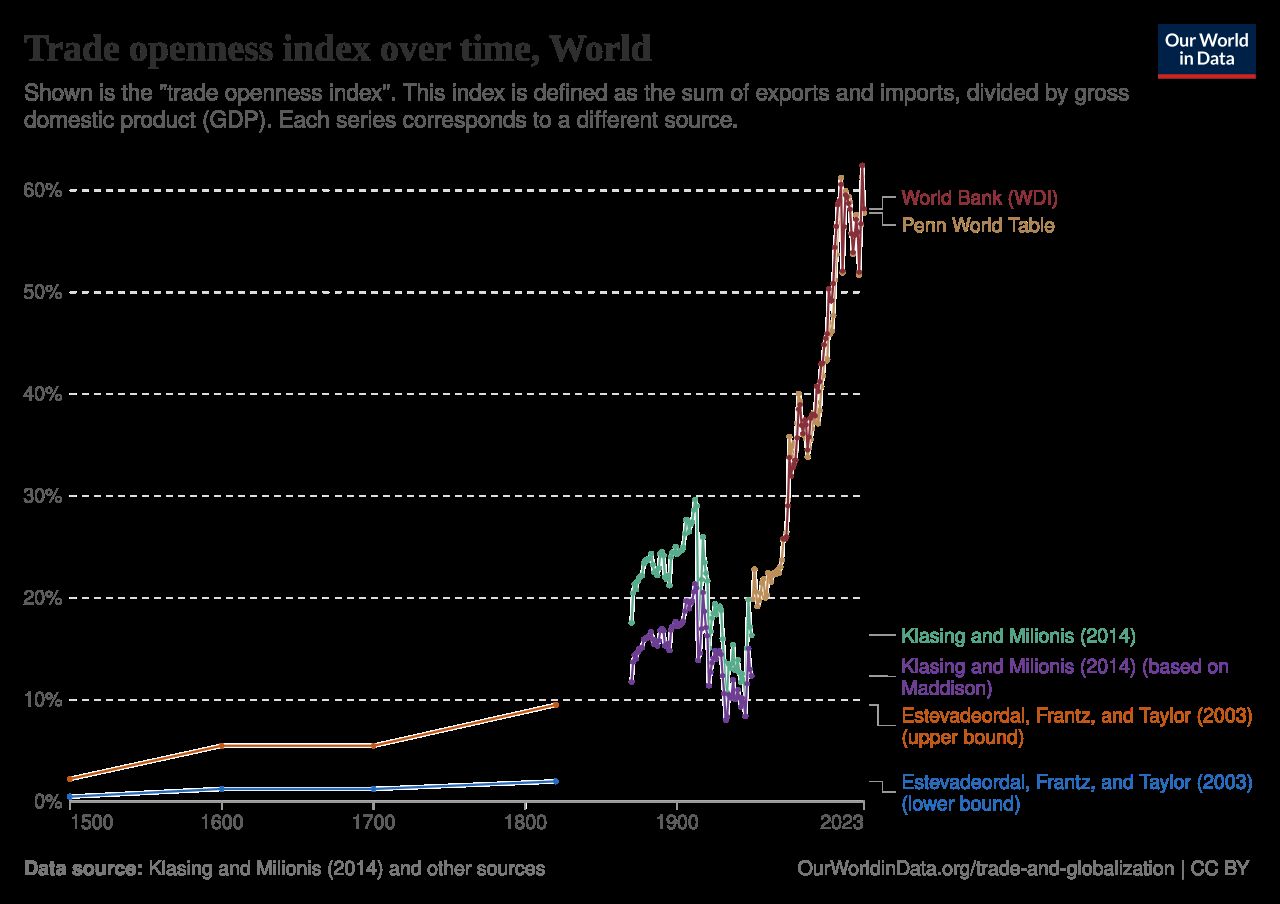
What globalization is, and what caused it
If modernization asks how a single society changes, globalization asks how societies grow into one another. Globalization is the increasing economic, political, and cultural interconnection and interdependence of the world’s societies — the process by which events, goods, ideas, and people move across national borders with ever less friction. It is not brand new; trade routes have linked distant peoples for millennia. But its recent acceleration has clear causes. Technology — container shipping, jet travel, satellites, and above all the internet — collapsed the cost of moving goods and information. Economic forces — the expansion of capitalism, trade liberalization, and transnational corporations that organize production across dozens of countries — stitched national economies into a single global market. And political arrangements, from trade agreements to international bodies, built the rules that let all of this flow.
The consequences: integration or exploitation?
Whether globalization is good news depends heavily on which paradigm you bring to it. To a functionalist, growing interconnection is broadly integrative and efficient: a global division of labor lets each region do what it does best, spreads technology and prosperity, and knits nations together in webs of mutual dependence that make cooperation rational. To a conflict theorist, the same system looks like exploitation scaled up to the planet — Wallerstein’s core nations and their corporations profiting from cheap labor and raw materials in the periphery, widening the gap between a global rich and a global poor even as some averages rise. Cultural sociologists debate whether globalization produces cultural homogenization — captured by George Ritzer’s McDonaldization, the spread of standardized, efficient, calculable models around the world — or instead a hybrid mixing, sometimes called glocalization, in which global forms are reworked to fit local meanings.
| Paradigm | How it sees globalization | What it emphasizes |
|---|---|---|
| Structural functionalism | Integrative and efficient | Global division of labor, interdependence, spread of technology |
| Conflict theory | Exploitative and unequal | Core vs. periphery, corporate power, widening global inequality |
| Symbolic interactionism | Transformative of everyday life | Shifting identities, mixed cultures, new forms of interaction |
The nation-state and the interactionist view
Globalization also strains the nation-state. When capital, information, and pollution cross borders freely but governments stop at them, national leaders lose some of their grip — a factory can relocate to a cheaper country overnight, and a financial panic or a virus can arrive uninvited. This has fed both new forms of global governance (international organizations, treaties, and transnational activist networks) and a fierce backlash of nationalism and protectionism. At the smallest scale, the symbolic-interactionist lens notices how globalization quietly rewrites daily life: the clothes you wear were designed on one continent and sewn on another, your friendships and identities form across time zones on your phone, and the food, music, and slang you treat as ordinary are the mingled products of a connected world. Globalization is not only a matter of trade balances; it is remaking the texture of ordinary interaction.
- Globalization is the deepening economic, political, and cultural interconnection of the world’s societies.
- Its causes are technological (internet, shipping, travel), economic (capitalism, trade, transnational corporations), and political (trade rules and institutions).
- Functionalists read it as integrative; conflict theorists as exploitative (core vs. periphery); interactionists as reshaping identity and everyday life.
- It weakens the nation-state and drives debates over homogenization (McDonaldization) versus glocalization.
The chapter in one breath
- Collective behavior is spontaneous, loosely structured group action — crowds, mobs, and dispersed mass behavior like rumor and fads — and crowds are far more reasoning than the old “mad mob” image claims.
- Crowd action is explained by contagion, convergence, and (best supported) emergent-norm theory.
- A social movement is organized and sustained; Aberle’s four types classify it, and it passes through emergence, coalescence, bureaucratization, and decline.
- Movements are explained by relative deprivation, resource mobilization, framing, and new-social-movement theory — and grievance alone is never enough.
- Change is driven by technology (with Ogburn’s cultural lag), population (the demographic transition), and the environment (climate change and environmental inequality).
- Modernization is the shift from traditional to industrial society; modernization theory (functionalist) reads global poverty as lag, while dependency and world-systems theory (conflict) read it as exploitation.
- Globalization ties societies together through technology, capitalism, and politics; functionalists, conflict theorists, and interactionists reach three very different verdicts on the same connected world.
ReferenceWords worth knowing
A quick reference for the terms in this chapter — skim it now, or circle back whenever a word trips you up.
- Acting crowd
- A crowd focused on an intense, specific goal and capable of aggression; a violent one aimed at a target is a mob.
- Anomie
- Durkheim’s term for a breakdown of shared norms and moral guidance, common during rapid social change.
- Collective behavior
- Relatively spontaneous, short-lived, loosely structured action by a group responding to a common influence.
- Contagion theory
- Le Bon’s claim that emotion and anonymity spread through a crowd, overriding individual self-control.
- Convergence theory
- The view that a crowd’s behavior reflects the tendencies its members already held before gathering.
- Cultural lag
- Ogburn’s idea that non-material culture (laws, norms) changes more slowly than material culture (technology).
- Demographic transition
- The shift, as societies industrialize, from high birth and death rates to low birth and death rates.
- Dependency theory
- A conflict account holding that rich nations actively underdeveloped poor ones and keep them dependent.
- Diffusion
- The spread of an idea, practice, or object from one group or society to another.
- Emergent-norm theory
- Turner and Killian’s view that crowds improvise a shared norm through interaction in ambiguous situations.
- Framing
- The way a movement packages its message to define a problem, assign blame, and motivate action; rooted in Goffman.
- Gemeinschaft and Gesellschaft
- Tönnies’ contrast between small tradition-bound community and large impersonal, contract-based society.
- Globalization
- The growing economic, political, and cultural interconnection and interdependence of the world’s societies.
- Mass behavior
- Collective behavior among people dispersed over a wide area — rumor, fads, panics, public opinion.
- McDonaldization
- Ritzer’s term for the global spread of standardized, efficient, calculable, and controlled models of organization.
- Modernization
- The process by which a society moves from traditional, rural, agrarian life to industrial, urban, bureaucratic life.
- New social movement theory
- An account of identity- and quality-of-life movements (environmental, LGBTQ, peace) beyond old economic demands.
- Relative deprivation
- A felt gap between what people believe they deserve and what they have, seen as a spark for movements.
- Resource mobilization theory
- McCarthy and Zald’s view that movements succeed by mobilizing money, members, leadership, and organization.
- Social movement
- An organized, sustained, collective effort by many people to promote or resist social change.
- World-systems theory
- Wallerstein’s model of one global capitalist economy split into a wealthy core, exploited periphery, and semi-periphery.